
Colorless and low viscosity compounds for low voltage liquid crystal operation
Patent Information
- Authority / Receiving Office
- US · United States
- Current Assignee / Owner
- Publication Date
- 2002-10-22
- Estimated Expiration
- Not applicable · inactive patent
Smart Images
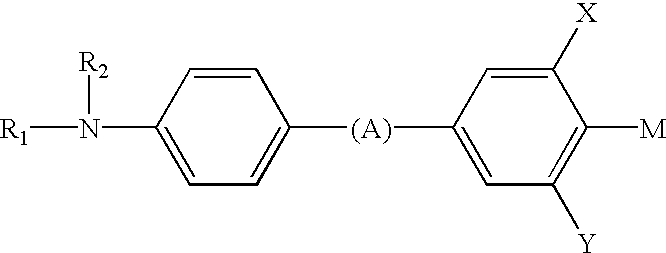
Figure 1 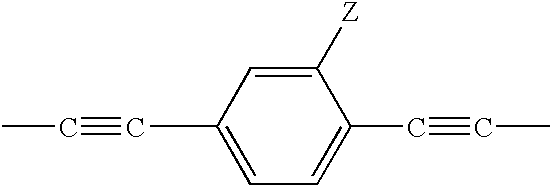
Figure 2 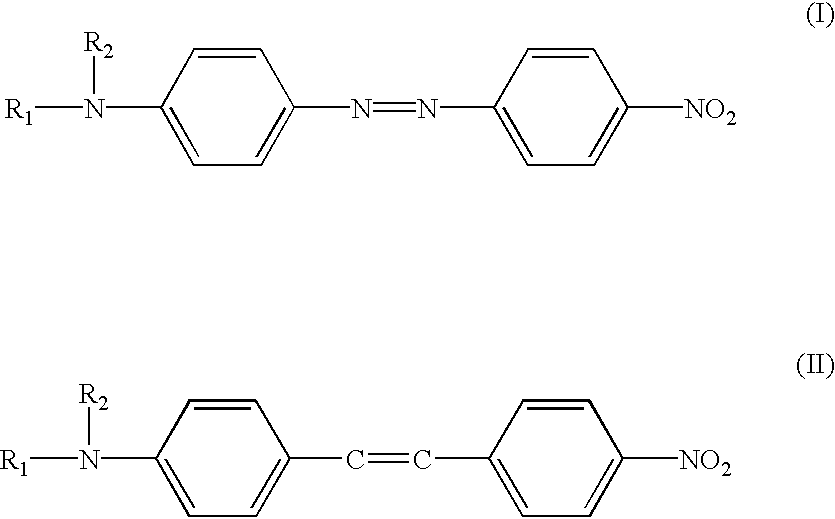
Figure 3
Abstract
Description
The present invention is directed generally to liquid crystals, and, more particularly, to improved low voltage operation of liquid crystal devices.Liquid crystal display elements utilize the optical anisotropy and the dielectric anisotropy of liquid crystal materials. Various display modes and various driving methods for driving the display modes are well-known.The properties of liquid crystal materials used for these liquid crystal display devices are various, but any liquid crystal materials have in common stability to moisture, air, heat, light, etc. Further, it is required for the devices that the liquid crystal phases have a temperature range as broad as possible, around room temperature, have a low viscosity, and, in the display device, have a quick response rate, a high contrast, and a comparatively low driving voltage. In addition, it is necessary that the liquid crystal materials have an adequate dielectric anisotropy (.DELTA..di-elect cons.). However, a single liquid crys...
Examples
Embodiment Construction
Reference is now made in detail to a specific embodiment of the present invention, which illustrates the best mode presently contemplated by the inventor for practicing the invention. Alternative embodiments are also briefly described as applicable.
Low voltage operation of a liquid crystal (LC) device is highly desirable because it enables a low cost electronic driver to be used. Low threshold LC mixtures will find useful application in optical phased arrays for agile beam steering and flat panel display devices.
In the agile beam steering employing a liquid crystal phase modulator, a homogeneous alignment is a preferred approach. Based on the Freedericksz transition, the threshold voltage, V.sub.th, of a homogeneously aligned liquid crystal cell is governed by the splay elastic constant (K.sub.11) and dielectric anisotropy (.DELTA..di-elect cons.) of the liquid crystal material as V.sub.th =.pi.(K.sub.11 / .DELTA..di-elect cons.).sup.1 / 2. A simple way to reduce V.sub.th is to use liq...