
Detection of cancer by elevated levels of BCL-2
a cancer marker and elevated level technology, applied in the field of detection of cancer by elevated levels of bcl2, can solve the problems of insufficient cancer markers, few markers have been shown to be helpful in this way, and the level of cancer markers is usually too high, so as to achieve the effect of reducing the urinary level of bcl-2
Patent Information
- Authority / Receiving Office
- US · United States
- Patent Type
- Patents(United States)
- Current Assignee / Owner
- Publication Date
- 2011-10-11
Smart Images
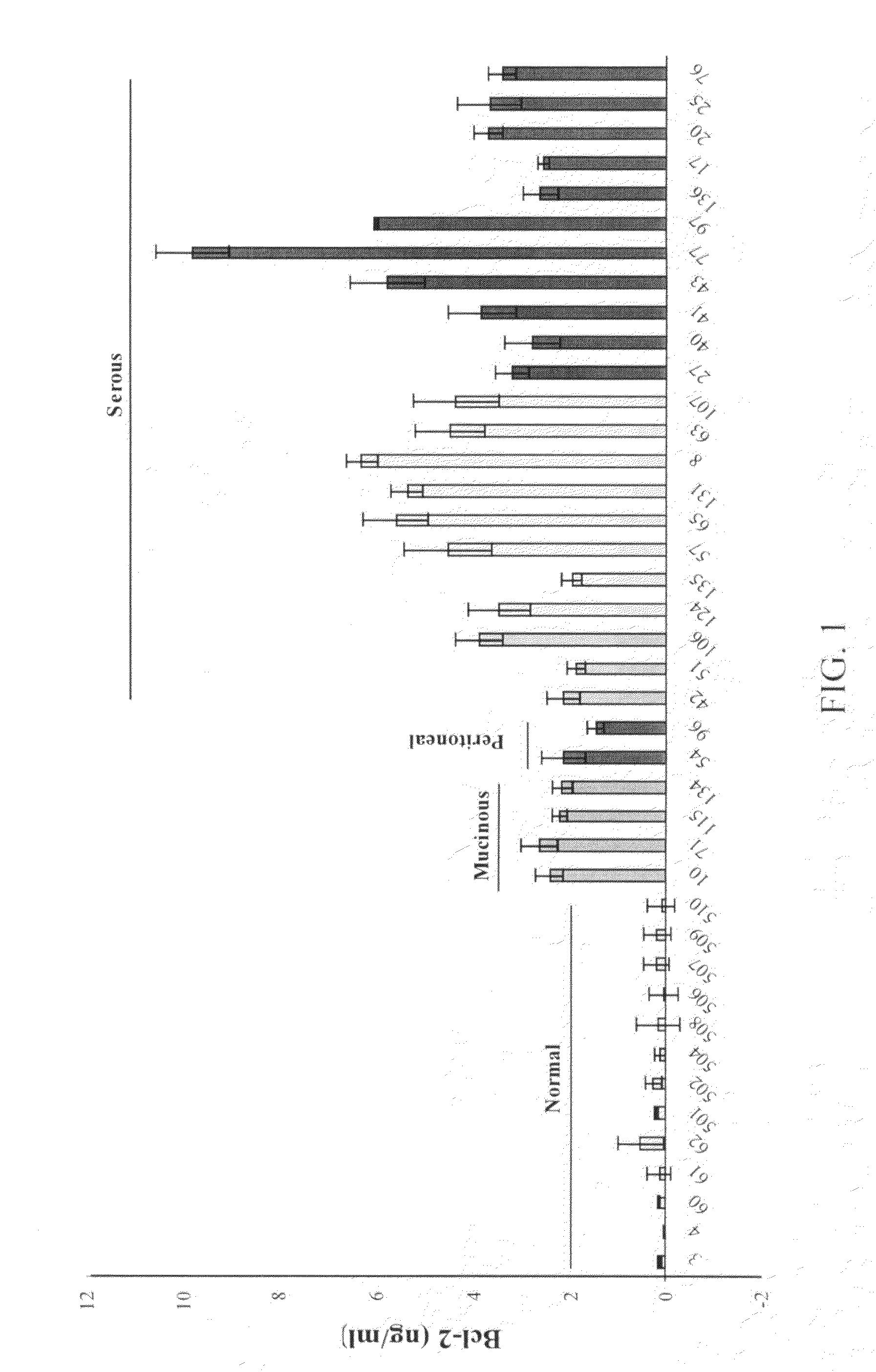
Figure 1 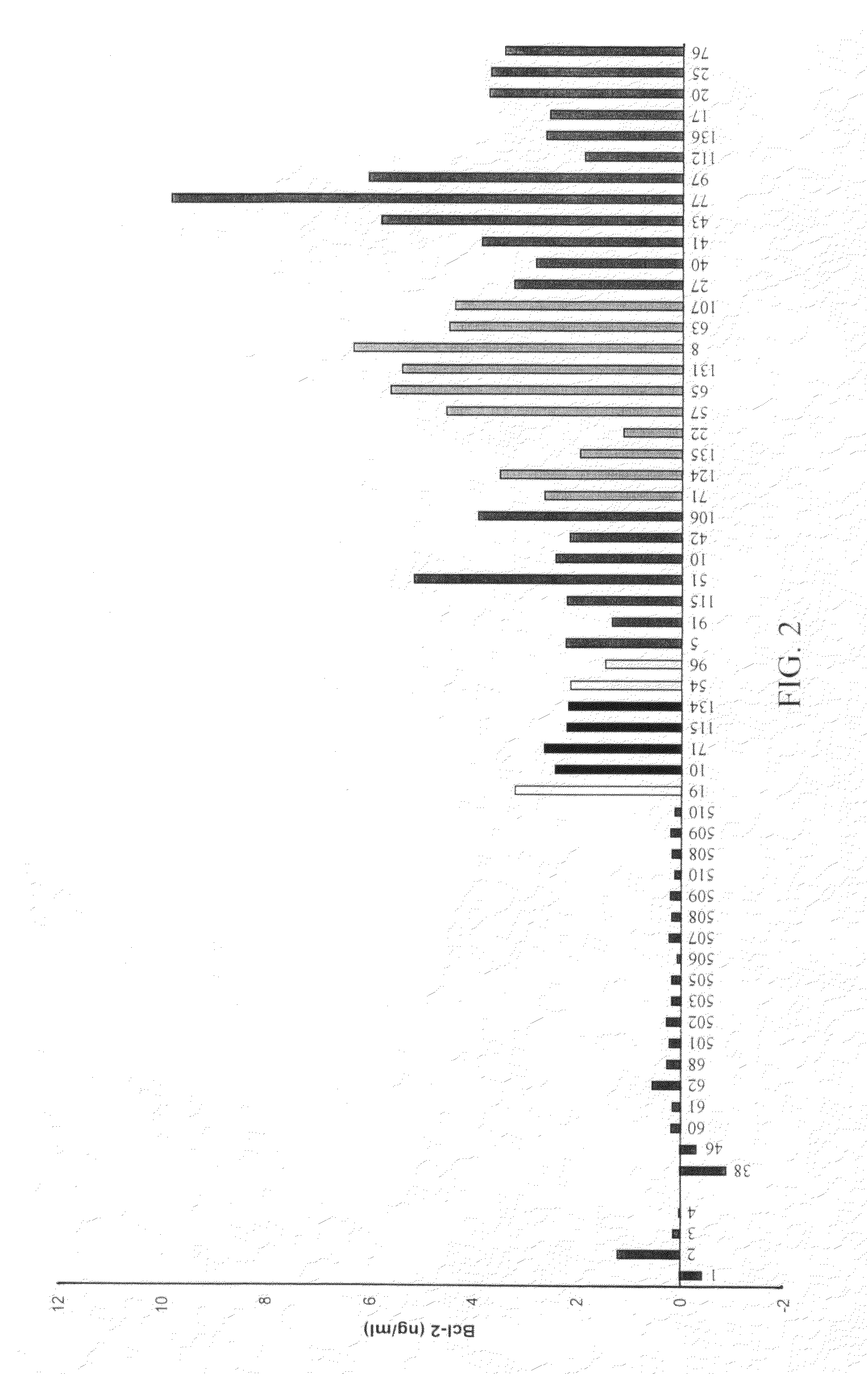
Figure 2 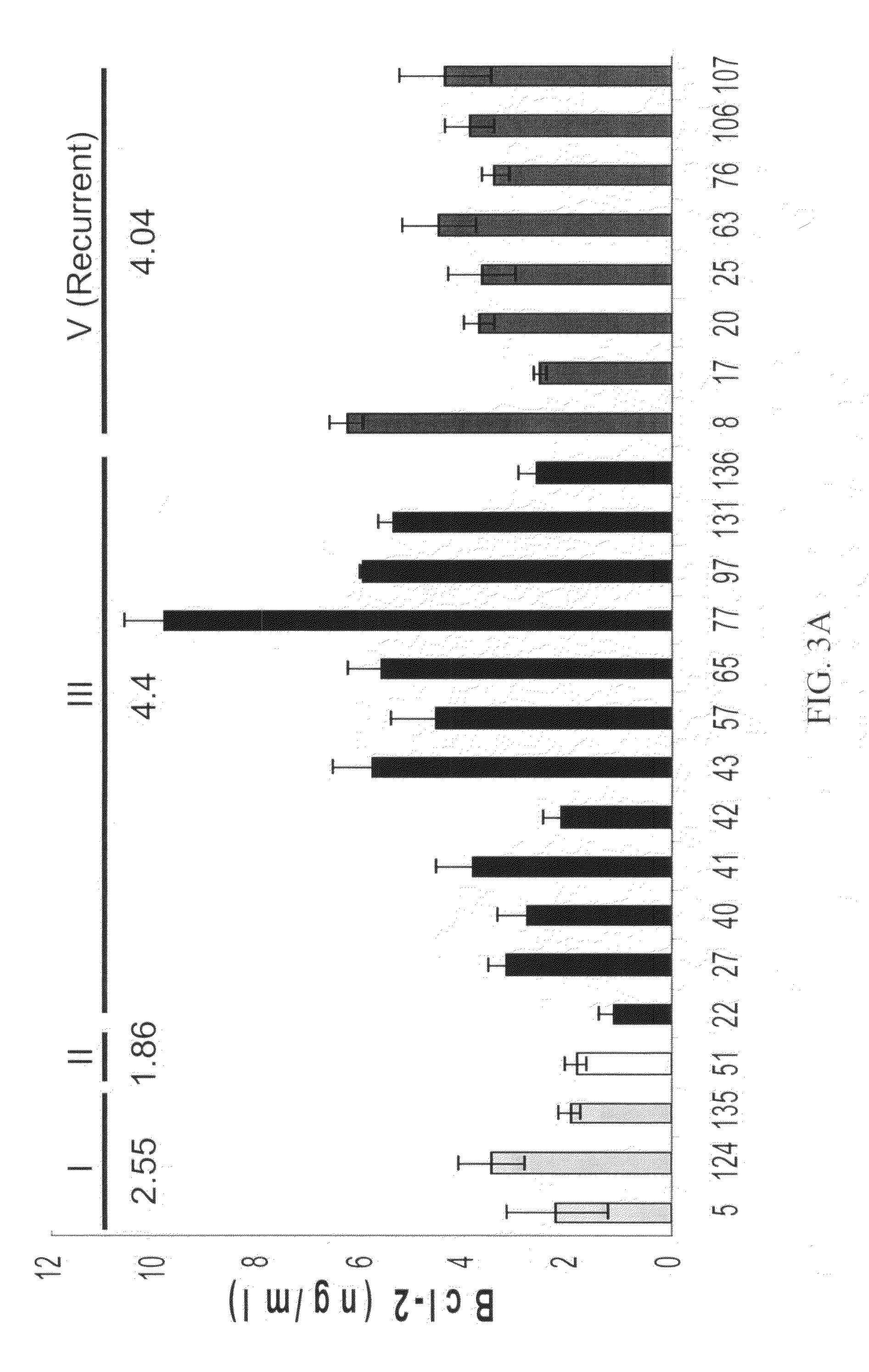
Figure 3
Abstract
Description
CROSS-REFERENCE TO RELATED APPLICATION
[0001] The present application claims the benefit of U.S. Provisional Application Ser. No. 60 / 771,677, filed Feb. 9, 2006, which is hereby incorporated by reference herein in its entirety, including any figures, tables, nucleic acid sequences, amino acid sequences, and drawings.
[0002] This invention was made with government support under US Army Department of Defense New Idea Award #W81XWH-07-1-0276(PAK). The government has certain rights in the invention.BACKGROUND OF THE INVENTION
[0003] Cancer markers are substances that can be found in the body (usually in the blood or urine) when cancer is present. They can be products of the cancer cells themselves, or of the body in response to cancer or other conditions. For several reasons, cancer markers themselves are usually not enough to diagnose (or rule out) a specific type of cancer. Most cancer markers can be produced by normal cells as well as by cancer cells, even if in smaller amounts. Sometimes,...
Examples
example 1
Urinary Bcl-2 Levels are Elevated in Ovarian Cancer Patients
[0175]Urine and blood were collected from 90 individuals with samples collected from normal controls (N=21), women with benign disease (N=35) and women with ovarian cancer (N=34). The latter category consisted of women diagnosed with endometriod (N=1), mucinous (N=7) as well as serous ovarian cancer (N=24) and primary peritoneal cancer, which is often related to ovarian cancer, (N=2). The samples collected from women with benign gynecologic disease consisted of women with benign cystic teratomas (N=2), simple cysts (N=10), leiomyomas (N=8), polycystic ovarian disease (N=1), ovarian adenofibromas (N=4), mucinous cystadenomas (N=2) and serous cystadenomas (N=8). Though this cohort comprises a small pilot study, it is representative of a typical clinical practice with regards to histology, grade and stage distribution.
[0176]To determine the potential suitability of urinary Bcl-2 levels as a new molecular marker for ovarian can...
example 2
Urinary Bcl-2 in Patients with Benign Gynecological Disease is not Elevated
[0180]ELISA measurement of urinary Bcl-2 from 35 women with benign gynecologic disease (urine collected just prior to patient's treatment) indicated Bcl-2 levels averaging 0.02 ng / ml with no samples>1.8 ng / ml Bcl-2, as shown in FIG. 8A. These benign diseases included benign teratomas, simple cists, leiomyomas, polystronic ovary, fibromas, and adenomas. These values were similar to normal controls, but significantly less than ovarian cancer samples suggesting that elevated urinary Bcl-2 levels greater than 1.8 ng / ml was associated with ovarian cancer.
[0181]The Kruskal-Wallis test was used to test the normal distribution of the data. Since the ‘normal’ group failed to meet normal distribution, likely due to small sampling number, the differences between groups were analyzed by the Mann-Whitney U-test. The results indicated no significant difference between normal and benign (p90%.
example 3
Urinary Bcl-2 does not Correlate with Patient Age or Tumor Size
[0182]Comparison of clinical parameters suggested that urinary Bcl-2 levels did not relate with patient age (see FIG. 5). Though the age range and average age of normal controls (29-81 yr, average 48.5±S.D. 12.7 yr) and women with benign gynecologic disease (28-84 yr, average 55.9±S.D. 13.9 yr) was somewhat lower that that of women with ovarian cancer (26-92 yr, average 62.2±S.D. 13.8 yr), the differences were not statistically significant in this study. Similarly, urinary Bcl-2 levels did not correlate with tumor size measured at debulking surgery (FIG. 6), ranging from microscopic to >10 cm and may reflect biologic variation between individuals or variation of tumor composition.