
X-ray radiator to generate quasi-monochromatic x-ray radiation, and radiography x-ray acquisition system employing same
a radiography x-ray acquisition system and quasi-monochromatic technology, applied in applications, instruments, nuclear engineering, etc., can solve the problems of significant efficiency loss due to polychromatic braking spectrum, insignificant monochromatic x-ray radiation, and increase efficiency, so as to achieve optimally large exposure area and high radiation intensity
Patent Information
- Authority / Receiving Office
- US · United States
- Patent Type
- Patents(United States)
- Current Assignee / Owner
- Publication Date
- 2013-09-17
Smart Images
Figure 1 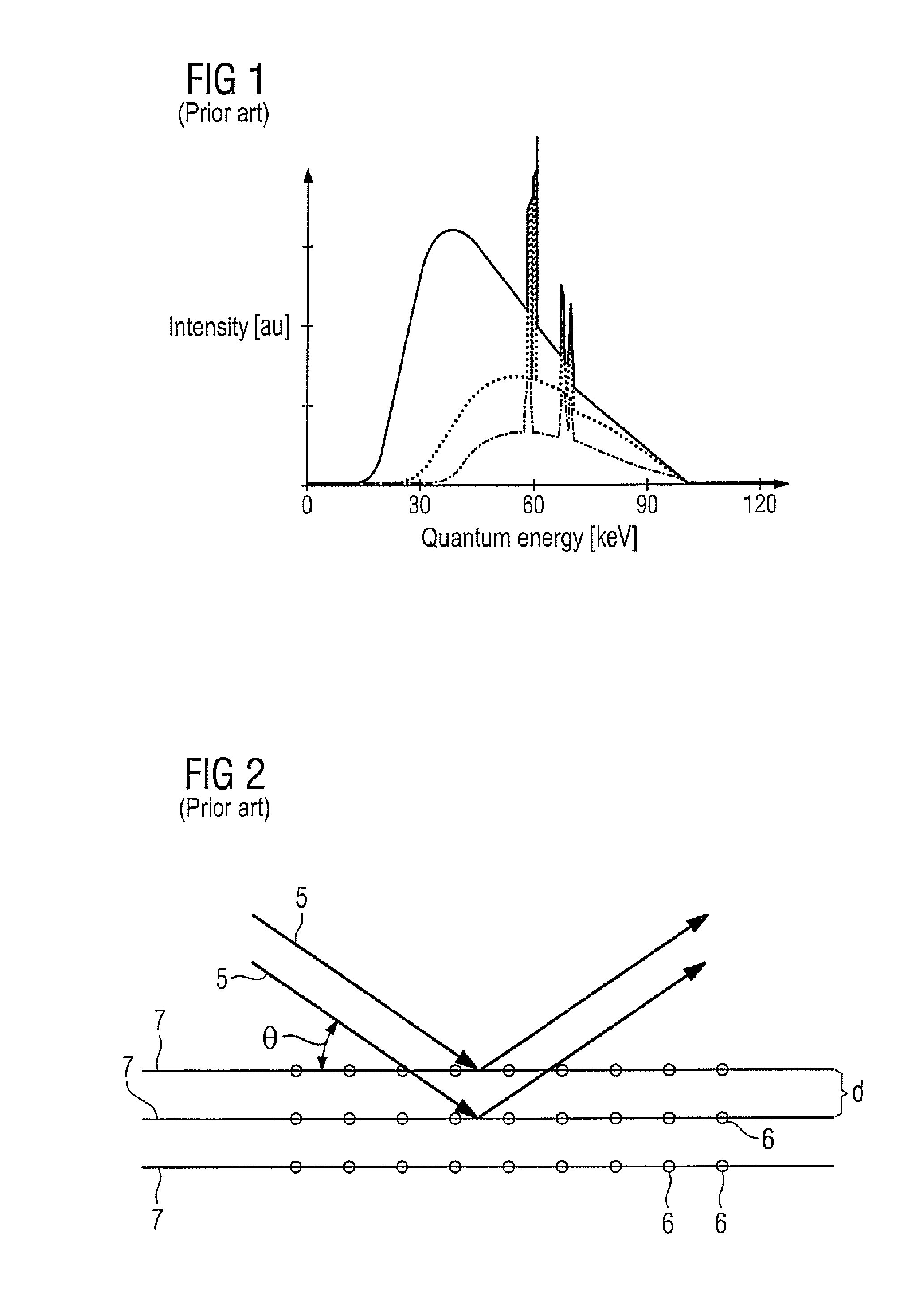
Figure 2 
Figure 3
Abstract
Description
BACKGROUND OF THE INVENTION
[0001] 1. Field of the Invention
[0002] The present invention concerns an x-ray radiator to generate quasi-monochromatic x-ray radiation, and a medical radiography x-ray acquisition system embodying such an x-ray
[0003] 2. Description of the Prior Art
[0004] X-ray systems for x-ray-based medical imaging are known with the following design. A point-shaped x-ray source (bremsstrahlung generated by an x-ray beam at an anode) in an x-ray radiator emits polychromatic x-ray radiation. The radiation can be brought into the shape of a delimited fan by a collimator. The x-ray radiation penetrates a subject to be exposed, in which the radiation is attenuated before it is received by an image receiver with spatial resolution. In the use of such x-ray systems, a significant efficiency loss occurs due to the polychromatic braking spectrum. It is known that for each task, i.e. the imaging of a specific subject within a defined background and a given geometry—there is precisely...
Examples
Embodiment Construction
[0032]FIG. 1 shows an x-ray braking spectrum of a conventional, polychromatic x-ray source according to the prior art, wherein the solid line shows an unfiltered x-ray spectrum and the dashed line and dash-dot line show an x-ray spectrum filtered with a copper filter. All x-ray spectra are generated with comparable tube voltage of the x-ray source of approximately 100 kV. The dash-dot x-ray spectrum was generated with a stronger filtering than the dashed curve. Low-energy portions of the x-ray spectrum are masked out via the use of a filter; however, the intensity is also severely reduced. Given the generation of a quasi-monochromatic x-ray radiation—thus an x-ray radiation whose quantum energy is limited to an energy band of essentially 15 keV or less—so little intensity remains that an imaging with full image acquisition is still possible only for very thin objects. The highest energy of the x-ray spectrum is determined by the tube voltage.
[0033]The Bragg reflection of x-ray radia...