
Curing agent for low temperature cure applications
a cure agent and low temperature technology, applied in the preparation of organic compounds, amino-hyroxy compounds, coatings, etc., can solve the problems of stress crack failure of coatings, affecting the productivity of shipyards, and increasing the difficulty of cure, so as to improve the “walk-on” dry time, improve the effect of hardness development and good gloss and surface appearan
Patent Information
- Authority / Receiving Office
- US · United States
- Patent Type
- Patents(United States)
- Current Assignee / Owner
- Publication Date
- 2014-05-27
Smart Images
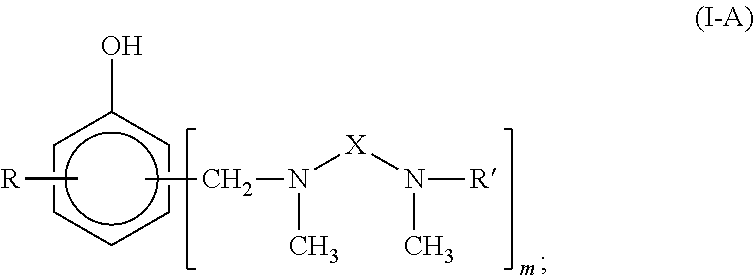
Figure 1 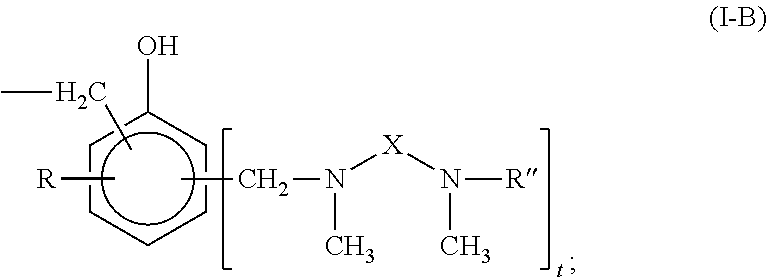
Figure 2 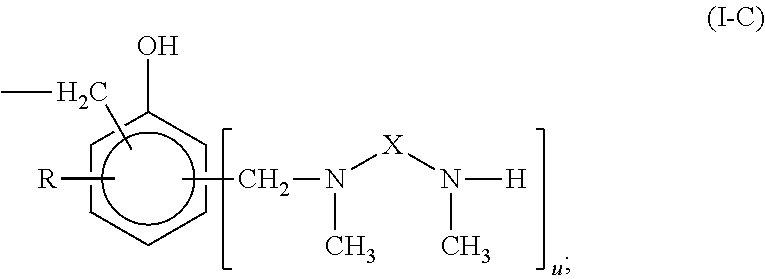
Figure 3
Abstract
Description
BACKGROUND OF THE INVENTION
[0001] The present invention relates generally to Mannich base derivatives of N,N′-dimethyl secondary diamine polymeric compounds, amine and amine-epoxy compositions employing these materials, and methods of making epoxy resin compositions.
[0002] Epoxy resins which are cured, hardened, or crosslinked with multifunctional amines, i.e., amine compounds having three or more active amine hydrogens, are well known in the industry. These materials are widely used in applications such as coatings, adhesives, composites, and civil engineering applications such as formulations for flooring. In coating applications, amine-cured epoxy formulations generally can be cured at room temperature to yield films with high mechanical strength, good water, chemical, and corrosion resistance, and excellent adhesion properties, particularly to metallic substrates. Thus, they are often employed as primers and topcoats for large structures such as ships, bridges, and industrial plan...
Examples
example 1
Synthesis of Methylamine-Terminated poly-(N-methylazacycloheptane)
[0200]135 g of adipodinitrile, 50 g of isopropanol, and 2.7 g of Pd / Al2O3 catalyst were placed in a 1-liter stainless-steel batch pressure reactor equipped with a stirrer and 1-liter hydrogen ballast tank. The Pd / Al2O3 catalyst is commercially available from the Johnson-Mathey Corporation. The reactor was sealed and subsequently purged with nitrogen and hydrogen to remove any air from the reactor. While stirring the reactor contents, 85 g of anhydrous methylamine were added to the reactor. The reactor was then pressurized with hydrogen to 1.72 MPa (250 psi), and heated to 120° C. These conditions were maintained until the rate of hydrogen uptake from the ballast tank fell below 0.0034 MPa / min (0.5 psi / min). When this occurred, the reactor pressure was raised to 5.86 MPa (850 psi). These conditions were maintained until the rate of hydrogen uptake from the ballast tank fell below 0.0034 MPa / min (0.5 psi / min). The react...
example 2
Synthesis of Methylamine-Terminated poly-(N-methylazetidine)
[0204]282 g of acrylonitrile and 8.5 g of water were placed in a 1-liter stainless-steel batch pressure reactor equipped with a stirrer. The reactor was sealed and subsequently purged with nitrogen to remove any air from the reactor. While stirring the reactor contents, 200 g of methylamine were added to the reactor over a time period of 5 hours. During the addition of the methylamine, the reactor temperature was maintained in range of 55-60° C. This temperature range was then maintained for 1.5 hours after the methylamine addition was complete. The reactor was cooled and the intermediate product removed.
[0205]120 g of isopropanol and 7.5 g of Pd / Al2O3 catalyst were placed in a 1-liter stainless-steel batch pressure reactor equipped with a stirrer and 1-liter hydrogen ballast tank. The Pd / Al2O3 catalyst is commercially available from the Johnson-Mathey Corporation. The reactor was sealed and subsequently purged with nitroge...
example 3
Synthesis of Methylamine-Terminated poly-(N-methylazetidine)
[0209]282 g of acrylonitrile and 8.5 g of water were placed in a 1-liter stainless-steel batch pressure reactor equipped with a stirrer. The reactor was sealed and subsequently purged with nitrogen to remove any air from the reactor. While stirring the reactor contents, 87 g of methylamine were added to the reactor over a time period of 5 hours. During the addition of the methylamine, the reactor temperature was maintained in range of 55-60° C. This temperature range was then maintained for 1.5 hours after the methylamine addition was complete. The reactor was cooled and the intermediate product removed.
[0210]120 g of isopropanol and 7 g of Pd / Al2O3 catalyst were placed in a 1-liter stainless-steel batch pressure reactor equipped with a stirrer and 1-liter hydrogen ballast tank. The Pd / Al2O3 catalyst is commercially available from the Johnson-Mathey Corporation. The reactor was sealed and subsequently purged with nitrogen a...