
Production of paraffin fuels using renewable materials by a continuous hydrotreatment comprising a pre-treatment step under hydrogen
a technology of paraffin fuel and hydrotreatment step, which is applied in the direction of waste based fuel, organic chemistry, chemistry apparatus and processes, etc., can solve the problems of difficulty in obtaining low nitrogen content levels of paraffinic fuel, limited total flow rate of reactor, and difficulty in carrying out hydrodenitrogenation reactions (hdn), etc., to promote hydrodeoxygenation reactions, improve thermal integration of process, and increase temperature profile
Patent Information
- Authority / Receiving Office
- US · United States
- Patent Type
- Patents(United States)
- Current Assignee / Owner
- Publication Date
- 2016-04-19
Smart Images
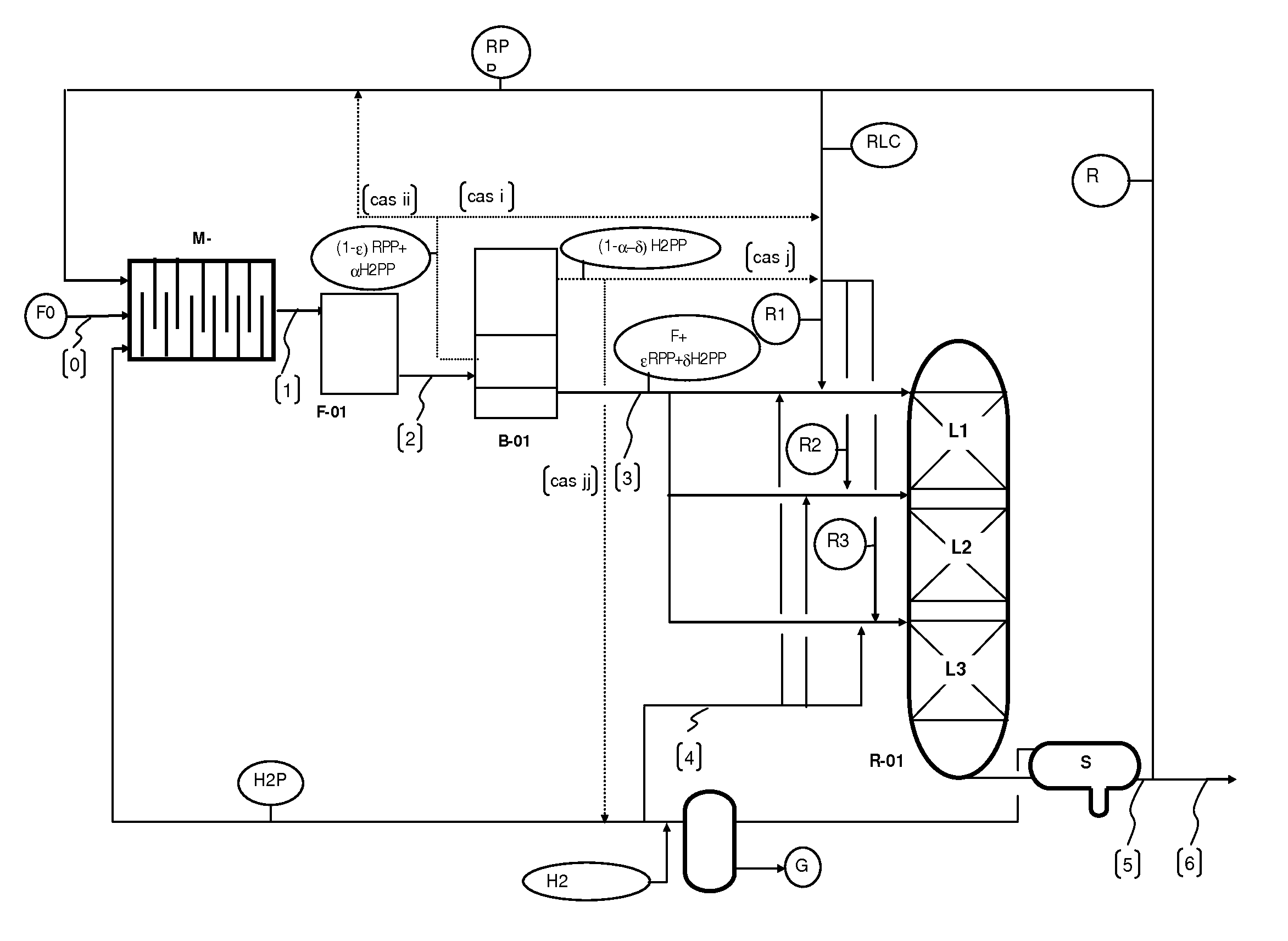
Figure 1 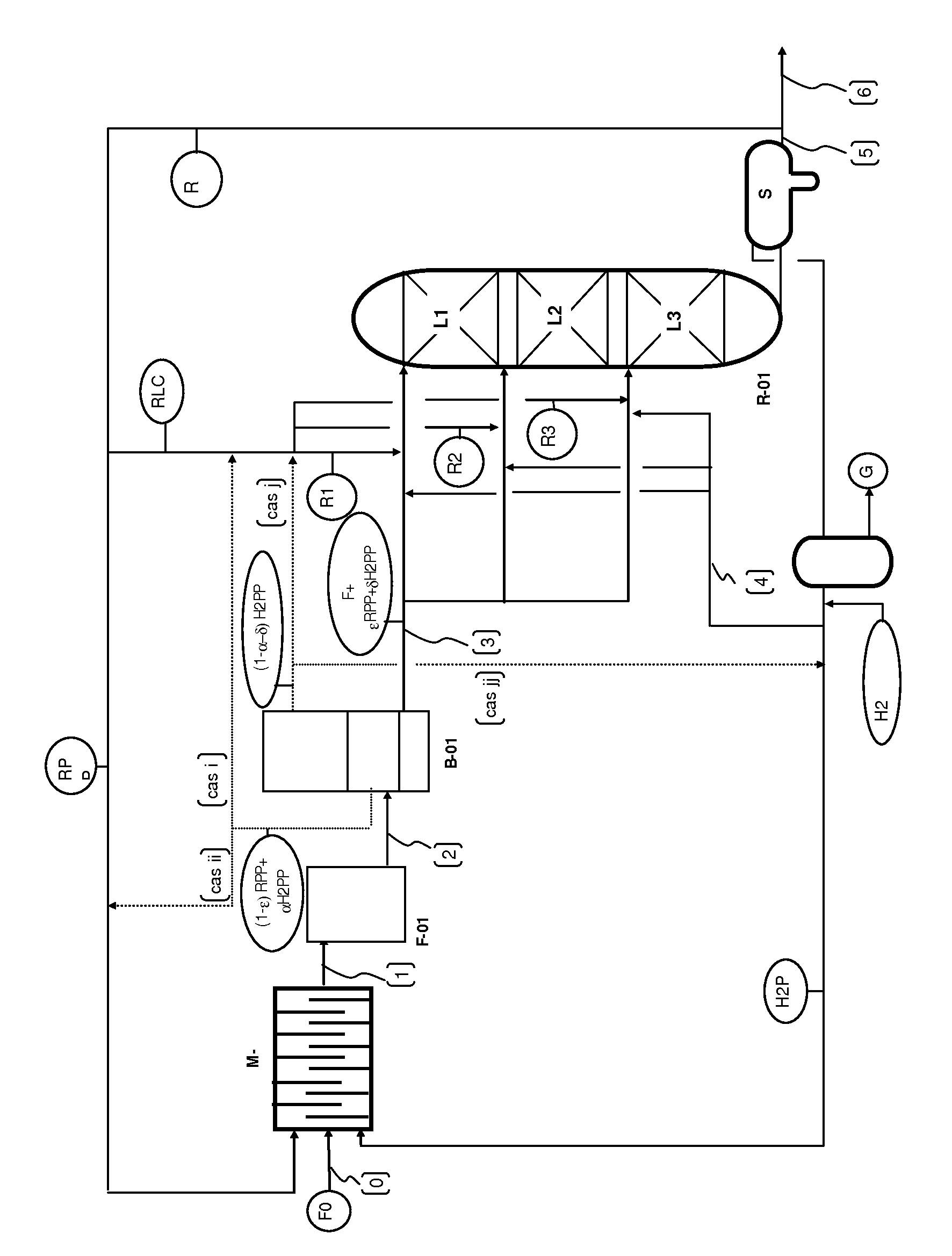
Figure 2
Abstract
Description
[0001] The invention relates to a process for the production of paraffinic hydrocarbons that can be used as fuels by hydrotreatment of feeds from renewable sources such as oils and fats of vegetable or animal origin. In particular, the invention relates to a process for the production of paraffinic hydrocarbons by hydrotreatment of feeds from renewable sources, in which a thorough pre-treatment step, allowing the elimination of the inorganic impurities contained in said feeds, is incorporated upstream of the fixed bed hydrotreatment catalytic zones.
[0002] The present international context is characterised primarily by the rapid growth in the need for fuels, in particular those with gas oil and kerosene bases, and also by the scale of the problems associated with global warming and emissions of greenhouse gases. The result is a desire to reduce energy dependence upon raw materials of fossil origin and a reduction in CO2 emissions. In this context, the search for new feeds from renewabl...
Examples
example 2
In Accordance with the Invention
[0204]The same feed of semi-refined jatropha oil as in the previous example was treated, with an identical feed flow: Fo=F=100 g / h. The catalyst and its preparation were identical to example 1.
[0205]The quantity of liquid recycle used, R, was 100 g / h. This recycle was divided into a flow RLC containing the paraffinic hydrocarbons from separation step d), which was sent in its entirety to the first catalytic zone Z1, and the flow rate of which was 80 g / h, and a flow RPP of 20 g / h, which was mixed with the feed flow of rapeseed oil F0. The ratio RPP / F0 was thus 0.2. The flow of hydrogen-rich gas, H2P, containing 90% by volume of hydrogen (4% vol of methane and 6% vol of propane) was such that the ratio H2P / F0 was 930 NL / L and was injected with the flow F0 of the oil feed and the flow RPP of paraffins.
[0206]The jatropha oil was mixed with the RPP flow and the H2P flow in a mixer, and the mixture was heated to a temperature of 165° C. This mixture was int...