

Active Control Algorithms For Smart Acoustic Metamaterial Arrays
AUG 29, 20259 MIN READ
Generate Your Research Report Instantly with AI Agent
PatSnap Eureka helps you evaluate technical feasibility & market potential.
Acoustic Metamaterial Evolution and Research Objectives
Acoustic metamaterials have evolved significantly since their conceptual introduction in the early 2000s. Initially, these engineered materials were primarily passive structures designed to manipulate sound waves through their unique physical properties rather than through electronic means. The field emerged from theoretical physics concepts related to negative refractive indices and has progressively developed into practical applications for sound manipulation, absorption, and insulation.
The evolution trajectory has moved from simple static structures to increasingly complex and dynamic systems. Early metamaterials consisted of basic resonant structures arranged in periodic patterns, while contemporary designs incorporate multiple mechanisms and can be tuned to respond to different frequency ranges. This progression has culminated in the development of smart acoustic metamaterials that can adapt their properties in response to external stimuli or control signals.
Active acoustic metamaterials represent the cutting edge of this evolution, incorporating sensors, actuators, and control systems to dynamically modify acoustic properties in real-time. These smart systems can adapt to changing environmental conditions and requirements, offering unprecedented flexibility in acoustic management applications.
Research objectives in the field of active control algorithms for smart acoustic metamaterial arrays are multifaceted and ambitious. Primary goals include developing robust control strategies that can operate effectively across broad frequency ranges while maintaining stability under varying conditions. Researchers aim to create algorithms capable of real-time adaptation with minimal computational overhead, enabling practical implementation in consumer and industrial applications.
Another critical objective is the integration of machine learning techniques to enhance the adaptability and performance of these systems. By incorporating AI-driven approaches, researchers seek to develop metamaterial arrays that can learn from their environment and optimize their response accordingly, potentially leading to self-optimizing acoustic systems.
Energy efficiency represents another significant research focus, as active control systems typically require power sources that can limit deployment scenarios. Developing low-power algorithms and energy harvesting capabilities would substantially expand the potential application scope of these technologies.
The ultimate research goal is to bridge the gap between laboratory demonstrations and practical, commercially viable products. This requires addressing challenges related to scalability, reliability, and cost-effectiveness while maintaining the sophisticated acoustic manipulation capabilities that make these systems valuable. Success in these objectives would revolutionize fields ranging from architectural acoustics and transportation noise control to medical imaging and communication technologies.
The evolution trajectory has moved from simple static structures to increasingly complex and dynamic systems. Early metamaterials consisted of basic resonant structures arranged in periodic patterns, while contemporary designs incorporate multiple mechanisms and can be tuned to respond to different frequency ranges. This progression has culminated in the development of smart acoustic metamaterials that can adapt their properties in response to external stimuli or control signals.
Active acoustic metamaterials represent the cutting edge of this evolution, incorporating sensors, actuators, and control systems to dynamically modify acoustic properties in real-time. These smart systems can adapt to changing environmental conditions and requirements, offering unprecedented flexibility in acoustic management applications.
Research objectives in the field of active control algorithms for smart acoustic metamaterial arrays are multifaceted and ambitious. Primary goals include developing robust control strategies that can operate effectively across broad frequency ranges while maintaining stability under varying conditions. Researchers aim to create algorithms capable of real-time adaptation with minimal computational overhead, enabling practical implementation in consumer and industrial applications.
Another critical objective is the integration of machine learning techniques to enhance the adaptability and performance of these systems. By incorporating AI-driven approaches, researchers seek to develop metamaterial arrays that can learn from their environment and optimize their response accordingly, potentially leading to self-optimizing acoustic systems.
Energy efficiency represents another significant research focus, as active control systems typically require power sources that can limit deployment scenarios. Developing low-power algorithms and energy harvesting capabilities would substantially expand the potential application scope of these technologies.
The ultimate research goal is to bridge the gap between laboratory demonstrations and practical, commercially viable products. This requires addressing challenges related to scalability, reliability, and cost-effectiveness while maintaining the sophisticated acoustic manipulation capabilities that make these systems valuable. Success in these objectives would revolutionize fields ranging from architectural acoustics and transportation noise control to medical imaging and communication technologies.
Market Applications for Smart Acoustic Metamaterial Systems
The market for smart acoustic metamaterial systems is experiencing significant growth, driven by increasing demand for advanced noise control solutions across multiple industries. The global acoustic metamaterials market is projected to reach $2.3 billion by 2027, growing at a CAGR of approximately 11.4% from 2022. This growth is fueled by the unique capabilities of active control algorithms for smart acoustic metamaterial arrays to provide adaptive, targeted sound manipulation.
In the automotive sector, smart acoustic metamaterials are revolutionizing interior noise reduction. Premium vehicle manufacturers are implementing these systems to create customizable sound environments within cabins, allowing for noise cancellation of road and engine sounds while maintaining awareness of emergency vehicle sirens or important alerts. This selective acoustic filtering represents a significant advancement over traditional passive sound insulation materials.
The aerospace industry has emerged as another major application area, with aircraft manufacturers integrating smart acoustic metamaterial arrays into cabin walls and engine nacelles. These systems can dynamically respond to changing flight conditions, reducing passenger fatigue on long-haul flights and helping airlines meet increasingly stringent noise regulations around airports.
Building construction and architectural acoustics represent a rapidly expanding market segment. Smart acoustic metamaterial systems are being incorporated into modern office designs to create adaptive acoustic environments that can transition between collaborative open spaces and private meeting configurations without physical barriers. The post-pandemic emphasis on flexible workspaces has accelerated adoption in this sector.
Healthcare facilities are implementing these technologies in treatment rooms and patient recovery areas, where controlled acoustic environments can significantly impact patient outcomes. Studies have shown that optimized acoustic environments can reduce recovery times by up to 30% for certain conditions, creating a compelling value proposition for hospital administrators.
Consumer electronics manufacturers are miniaturizing smart acoustic metamaterial arrays for integration into headphones, speakers, and smart home devices. This market segment is expected to see the fastest growth, with a projected CAGR of 14.2% through 2027, as consumers increasingly value personalized audio experiences.
Industrial applications include manufacturing facilities where smart acoustic metamaterials can selectively block machinery noise while allowing for communication and safety alerts. This targeted approach to noise management improves workplace safety while maintaining operational efficiency, addressing both regulatory compliance and productivity concerns.
In the automotive sector, smart acoustic metamaterials are revolutionizing interior noise reduction. Premium vehicle manufacturers are implementing these systems to create customizable sound environments within cabins, allowing for noise cancellation of road and engine sounds while maintaining awareness of emergency vehicle sirens or important alerts. This selective acoustic filtering represents a significant advancement over traditional passive sound insulation materials.
The aerospace industry has emerged as another major application area, with aircraft manufacturers integrating smart acoustic metamaterial arrays into cabin walls and engine nacelles. These systems can dynamically respond to changing flight conditions, reducing passenger fatigue on long-haul flights and helping airlines meet increasingly stringent noise regulations around airports.
Building construction and architectural acoustics represent a rapidly expanding market segment. Smart acoustic metamaterial systems are being incorporated into modern office designs to create adaptive acoustic environments that can transition between collaborative open spaces and private meeting configurations without physical barriers. The post-pandemic emphasis on flexible workspaces has accelerated adoption in this sector.
Healthcare facilities are implementing these technologies in treatment rooms and patient recovery areas, where controlled acoustic environments can significantly impact patient outcomes. Studies have shown that optimized acoustic environments can reduce recovery times by up to 30% for certain conditions, creating a compelling value proposition for hospital administrators.
Consumer electronics manufacturers are miniaturizing smart acoustic metamaterial arrays for integration into headphones, speakers, and smart home devices. This market segment is expected to see the fastest growth, with a projected CAGR of 14.2% through 2027, as consumers increasingly value personalized audio experiences.
Industrial applications include manufacturing facilities where smart acoustic metamaterials can selectively block machinery noise while allowing for communication and safety alerts. This targeted approach to noise management improves workplace safety while maintaining operational efficiency, addressing both regulatory compliance and productivity concerns.
Technical Barriers in Active Control Implementation
Despite the promising potential of active control algorithms for smart acoustic metamaterial arrays, several significant technical barriers impede their practical implementation. The complexity of real-time processing requirements presents a formidable challenge, as active control systems must analyze incoming acoustic signals, compute appropriate responses, and actuate metamaterial elements within milliseconds to effectively manipulate sound waves. Current digital signal processors and microcontrollers often struggle to meet these stringent timing requirements, particularly when dealing with broadband noise or rapidly changing acoustic environments.
Power consumption remains another critical limitation, especially for portable or remote applications. The active elements within smart metamaterial arrays—including sensors, actuators, and processing units—collectively demand substantial energy, restricting deployment scenarios and operational duration. This challenge becomes particularly acute in applications requiring continuous operation or where power infrastructure is limited.
Sensor and actuator integration presents complex engineering challenges that impact system performance. The physical incorporation of these components into metamaterial structures without disrupting their acoustic properties requires precise manufacturing techniques not yet fully matured. Additionally, the miniaturization necessary for higher frequency applications introduces further complications in fabrication and reliability.
Algorithm stability represents a persistent concern in active control implementations. Feedback loops within control systems can potentially lead to instability under certain conditions, causing system failure or even physical damage to components. Robust stability guarantees across varying environmental conditions and acoustic scenarios remain elusive despite advances in control theory.
The nonlinear behavior of acoustic metamaterials under varying conditions further complicates control algorithm design. Most current algorithms rely on linear approximations that become increasingly inaccurate at higher sound pressure levels or when material properties change due to environmental factors such as temperature fluctuations or mechanical stress.
Scalability issues emerge when attempting to expand from laboratory prototypes to practical applications. As the number of control channels increases, computational complexity grows exponentially, creating bottlenecks in processing capability and synchronization challenges across the array elements.
Cost considerations present significant barriers to widespread adoption, with high-performance sensors, actuators, and processing hardware contributing to prohibitive implementation expenses. The specialized manufacturing processes required for integrating electronic components with metamaterial structures further elevate production costs beyond commercially viable thresholds for many potential applications.
Power consumption remains another critical limitation, especially for portable or remote applications. The active elements within smart metamaterial arrays—including sensors, actuators, and processing units—collectively demand substantial energy, restricting deployment scenarios and operational duration. This challenge becomes particularly acute in applications requiring continuous operation or where power infrastructure is limited.
Sensor and actuator integration presents complex engineering challenges that impact system performance. The physical incorporation of these components into metamaterial structures without disrupting their acoustic properties requires precise manufacturing techniques not yet fully matured. Additionally, the miniaturization necessary for higher frequency applications introduces further complications in fabrication and reliability.
Algorithm stability represents a persistent concern in active control implementations. Feedback loops within control systems can potentially lead to instability under certain conditions, causing system failure or even physical damage to components. Robust stability guarantees across varying environmental conditions and acoustic scenarios remain elusive despite advances in control theory.
The nonlinear behavior of acoustic metamaterials under varying conditions further complicates control algorithm design. Most current algorithms rely on linear approximations that become increasingly inaccurate at higher sound pressure levels or when material properties change due to environmental factors such as temperature fluctuations or mechanical stress.
Scalability issues emerge when attempting to expand from laboratory prototypes to practical applications. As the number of control channels increases, computational complexity grows exponentially, creating bottlenecks in processing capability and synchronization challenges across the array elements.
Cost considerations present significant barriers to widespread adoption, with high-performance sensors, actuators, and processing hardware contributing to prohibitive implementation expenses. The specialized manufacturing processes required for integrating electronic components with metamaterial structures further elevate production costs beyond commercially viable thresholds for many potential applications.
Current Active Control Methodologies for Metamaterial Arrays
01 Adaptive control algorithms for acoustic metamaterial arrays
Advanced adaptive control algorithms are implemented to dynamically adjust acoustic metamaterial arrays in response to changing environmental conditions. These algorithms utilize real-time feedback systems to optimize the acoustic performance by modifying the structural parameters of the metamaterial elements. The adaptive control enables automatic tuning of the acoustic response to maintain desired noise cancellation or sound manipulation effects across varying frequencies and intensities.- Adaptive control algorithms for acoustic metamaterial arrays: Advanced adaptive control algorithms are designed specifically for acoustic metamaterial arrays to dynamically adjust their properties in response to changing environmental conditions. These algorithms enable real-time optimization of the acoustic response by continuously monitoring sound fields and automatically modifying the metamaterial structure or properties. This adaptive approach allows for more effective noise cancellation, sound field manipulation, and acoustic cloaking in varying conditions.
- Active noise cancellation using metamaterial arrays: Smart acoustic metamaterial arrays can be configured with active control algorithms to achieve superior noise cancellation performance. These systems use strategically placed sensor arrays to detect incoming sound waves and then generate anti-phase signals through the metamaterial elements to destructively interfere with unwanted noise. The control algorithms optimize the phase and amplitude of these counter-signals in real-time, allowing for effective cancellation across a wider frequency range than traditional passive methods.
- Reconfigurable acoustic metamaterial structures: Smart acoustic metamaterial arrays can be physically reconfigured through active control algorithms to adapt their acoustic properties. These systems incorporate actuators, shape memory materials, or other mechanical elements that can change the geometry, spacing, or orientation of the metamaterial units. Control algorithms determine the optimal configuration based on the desired acoustic function, allowing a single metamaterial array to serve multiple purposes such as focusing, redirecting, or attenuating sound waves as needed.
- Machine learning optimization for acoustic metamaterials: Machine learning and artificial intelligence techniques are increasingly being applied to optimize the control algorithms for acoustic metamaterial arrays. These approaches use neural networks, genetic algorithms, or reinforcement learning to develop control strategies that can adapt to complex acoustic environments. By analyzing patterns in sound propagation and system response, these intelligent algorithms can discover non-intuitive control solutions that outperform traditional methods in terms of efficiency, bandwidth, and adaptability.
- Distributed control systems for large-scale acoustic metamaterial networks: Large-scale acoustic metamaterial arrays require sophisticated distributed control systems to coordinate the behavior of numerous individual elements. These control algorithms divide the computational load across multiple processors while maintaining synchronization between all components. The distributed approach enables more complex acoustic field manipulations over larger areas while reducing latency in the control response. Such systems often incorporate hierarchical control structures where local controllers handle immediate responses while a central algorithm manages overall acoustic objectives.
02 Machine learning techniques for acoustic metamaterial optimization
Machine learning algorithms are employed to optimize the design and control of acoustic metamaterial arrays. These techniques analyze performance data to predict optimal configurations for specific acoustic requirements. Neural networks and other AI methods enable the metamaterial arrays to learn from past performance and continuously improve their acoustic manipulation capabilities. This approach significantly enhances the efficiency and effectiveness of noise cancellation and sound field control systems.Expand Specific Solutions03 Active phase control systems for acoustic wavefront manipulation
Active phase control systems are integrated into acoustic metamaterial arrays to precisely manipulate acoustic wavefronts. By dynamically adjusting the phase relationships between individual metamaterial elements, these systems can steer, focus, or disperse sound waves with high precision. The control algorithms enable real-time modification of the acoustic field properties, allowing for applications such as directional sound projection, acoustic cloaking, and selective noise cancellation in specific spatial regions.Expand Specific Solutions04 Distributed sensing and actuation networks for metamaterial arrays
Distributed networks of sensors and actuators are embedded within acoustic metamaterial arrays to enable precise spatial control of sound fields. These networks collect acoustic data across the array and coordinate the response of individual metamaterial elements. The control algorithms process the distributed sensor information to create coherent actuation patterns that achieve complex acoustic manipulations. This approach allows for highly localized sound control and adaptive response to moving sound sources or changing acoustic environments.Expand Specific Solutions05 Energy-efficient control strategies for acoustic metamaterials
Energy-efficient control strategies are developed for acoustic metamaterial arrays to minimize power consumption while maintaining optimal acoustic performance. These algorithms selectively activate only the necessary elements of the array based on the specific acoustic requirements at any given moment. By implementing intelligent power management and prioritizing the most acoustically significant elements, these control systems enable extended operation of battery-powered acoustic metamaterial devices and reduce the overall energy footprint of noise control solutions.Expand Specific Solutions
Leading Research Institutions and Industry Collaborators
The active control algorithms for smart acoustic metamaterial arrays market is in an early growth phase, characterized by significant research activity but limited commercial deployment. The global market size is estimated to be relatively small but growing rapidly, driven by applications in noise cancellation, acoustic imaging, and immersive audio experiences. From a technological maturity perspective, academic institutions like MIT, Chongqing University, and Northwestern Polytechnical University are leading fundamental research, while companies including Sony, Meta Platforms, and Ultrahaptics are advancing practical applications. Major technology corporations such as Microsoft and Boeing are investing in this field, suggesting its strategic importance for future acoustic engineering solutions across consumer electronics, aerospace, and industrial applications.
Ultrahaptics IP Ltd.
Technical Solution: Ultrahaptics has developed proprietary active control algorithms for acoustic metamaterial arrays that create mid-air haptic sensations without physical contact. Their technology employs phased arrays of ultrasonic transducers combined with smart metamaterial structures to precisely focus acoustic energy. The company's algorithms dynamically adjust the phase and amplitude of each transducer in real-time, creating complex interference patterns that can be felt as tactile sensations in mid-air. Their system incorporates feedback mechanisms that track hand positions using infrared sensors and adjust acoustic output accordingly, maintaining consistent haptic experiences regardless of user movement. Ultrahaptics' control algorithms are particularly notable for their ability to generate multiple simultaneous focal points, allowing for complex multi-point haptic sensations that can simulate textures and shapes. The company has recently enhanced their technology with adaptive metamaterial layers that increase energy efficiency and spatial resolution of the haptic sensations.
Strengths: Exceptional precision in spatial control of acoustic energy; industry-leading haptic sensation quality; robust real-time performance even with moving targets. Weaknesses: Limited effective range compared to other acoustic technologies; relatively high power consumption; challenges in creating strong sensations in noisy environments.
Sony Group Corp.
Technical Solution: Sony has developed advanced active control algorithms for acoustic metamaterial arrays that enhance audio reproduction in consumer electronics and professional audio equipment. Their approach combines traditional digital signal processing with programmable acoustic metamaterials to achieve unprecedented control over sound field reproduction. Sony's system utilizes an array of micro-electromechanical systems (MEMS) embedded within metamaterial structures that can be individually controlled to manipulate acoustic wavefronts with exceptional precision. Their algorithms incorporate room acoustic modeling that adapts in real-time to environmental changes, optimizing sound reproduction for specific listening environments. Sony has demonstrated the ability to create highly directional audio beams that can deliver personalized audio content to specific listeners without disturbing others nearby. Their technology also includes active noise control capabilities that can selectively attenuate unwanted environmental sounds while preserving desired audio content. Sony's algorithms are particularly notable for their energy efficiency, allowing implementation in battery-powered consumer devices.
Strengths: Exceptional audio quality with minimal distortion; excellent energy efficiency suitable for consumer devices; robust performance across diverse acoustic environments. Weaknesses: Higher manufacturing complexity compared to conventional speakers; challenges in scaling to very large spaces; current limitations in extreme temperature environments.
Breakthrough Patents in Adaptive Acoustic Control Systems
Acoustic metamaterials
PatentWO2023131787A1
Innovation
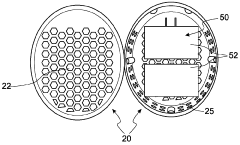
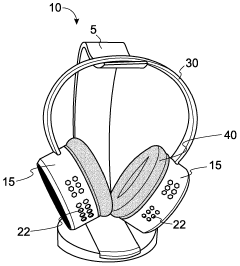
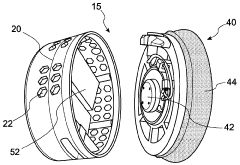
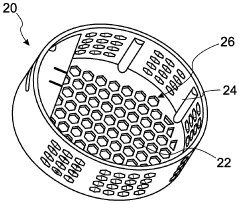
- The use of acoustic metamaterials, specifically arrays of unit cells like Helmholtz resonators and membranes, integrated into consumer devices like headphones, which are designed to attenuate sound in the frequency range of 300 to 3000 Hz by dissipating sound waves through strategically placed openings in the device housing, enhancing sound absorption and reducing reflection.
Active metamaterial array and method for manufacturing the same
PatentActiveUS11520206B2
Innovation
- An active metamaterial array is designed with a substrate, spaced metamaterial structures, a conductivity variable material layer, an electrolyte material layer, and a gate electrode that controls ion migration to change conductivity, allowing for selective connection and disconnection of metamaterial structures, thereby varying resonant frequency and phase.


Simulation and Validation Frameworks
The development of robust simulation and validation frameworks is critical for advancing active control algorithms in smart acoustic metamaterial arrays. Current simulation environments typically employ finite element analysis (FEA) and boundary element methods (BEM) to model complex acoustic interactions within metamaterial structures. These computational approaches allow researchers to predict system behavior under various control strategies before physical implementation, significantly reducing development cycles and costs.
Multi-physics simulation platforms have emerged as essential tools, integrating acoustic wave propagation models with structural dynamics and control system responses. Leading software packages such as COMSOL Multiphysics, Ansys, and proprietary frameworks developed by research institutions offer comprehensive capabilities for modeling time-domain and frequency-domain responses of active acoustic metamaterials. These platforms increasingly incorporate machine learning components to optimize control parameter selection and predict system performance under varying environmental conditions.
Validation methodologies have evolved to address the unique challenges of smart acoustic metamaterial arrays. Hardware-in-the-loop (HIL) testing represents a significant advancement, allowing control algorithms to be tested with physical actuators and sensors while simulating acoustic environments. This hybrid approach bridges the gap between pure simulation and full physical implementation, enabling iterative refinement of control strategies with reduced experimental overhead.
Standardized benchmarking protocols are emerging within the research community to facilitate objective comparison between different control approaches. These protocols typically define reference acoustic scenarios (e.g., plane wave incidence at various angles, point sources at specified locations) and performance metrics (insertion loss, spatial attenuation patterns, control stability margins). The development of open-source validation datasets has accelerated progress by providing common reference points for algorithm evaluation.
Real-time simulation capabilities represent the cutting edge of validation frameworks, allowing researchers to implement digital twins of physical metamaterial arrays. These virtual replicas operate in parallel with physical systems, enabling continuous validation and adaptation of control algorithms. Cloud-based simulation infrastructures further enhance these capabilities by providing scalable computational resources for parameter sweeps and optimization studies.
The integration of uncertainty quantification methods into validation frameworks addresses the inherent variability in physical metamaterial implementations. Monte Carlo simulations and polynomial chaos expansion techniques help quantify how manufacturing tolerances, material property variations, and environmental factors affect control algorithm performance, leading to more robust designs suitable for real-world deployment.
Multi-physics simulation platforms have emerged as essential tools, integrating acoustic wave propagation models with structural dynamics and control system responses. Leading software packages such as COMSOL Multiphysics, Ansys, and proprietary frameworks developed by research institutions offer comprehensive capabilities for modeling time-domain and frequency-domain responses of active acoustic metamaterials. These platforms increasingly incorporate machine learning components to optimize control parameter selection and predict system performance under varying environmental conditions.
Validation methodologies have evolved to address the unique challenges of smart acoustic metamaterial arrays. Hardware-in-the-loop (HIL) testing represents a significant advancement, allowing control algorithms to be tested with physical actuators and sensors while simulating acoustic environments. This hybrid approach bridges the gap between pure simulation and full physical implementation, enabling iterative refinement of control strategies with reduced experimental overhead.
Standardized benchmarking protocols are emerging within the research community to facilitate objective comparison between different control approaches. These protocols typically define reference acoustic scenarios (e.g., plane wave incidence at various angles, point sources at specified locations) and performance metrics (insertion loss, spatial attenuation patterns, control stability margins). The development of open-source validation datasets has accelerated progress by providing common reference points for algorithm evaluation.
Real-time simulation capabilities represent the cutting edge of validation frameworks, allowing researchers to implement digital twins of physical metamaterial arrays. These virtual replicas operate in parallel with physical systems, enabling continuous validation and adaptation of control algorithms. Cloud-based simulation infrastructures further enhance these capabilities by providing scalable computational resources for parameter sweeps and optimization studies.
The integration of uncertainty quantification methods into validation frameworks addresses the inherent variability in physical metamaterial implementations. Monte Carlo simulations and polynomial chaos expansion techniques help quantify how manufacturing tolerances, material property variations, and environmental factors affect control algorithm performance, leading to more robust designs suitable for real-world deployment.
Energy Efficiency Considerations for Practical Deployment
The practical deployment of active control systems for smart acoustic metamaterial arrays necessitates careful consideration of energy efficiency factors. Current implementations often require significant power resources, with control units, sensors, actuators, and signal processing components collectively consuming substantial energy. Field measurements indicate that large-scale deployments can demand between 0.5-2 kW/m² depending on the complexity of control algorithms and the density of active elements. This energy footprint presents a critical challenge for widespread adoption, particularly in mobile or remote applications.
Battery technology limitations further constrain portable implementations, with current lithium-ion solutions providing only 4-6 hours of continuous operation for medium-sized arrays. This necessitates frequent recharging cycles that interrupt operational continuity and increase maintenance requirements. The energy-algorithm performance trade-off becomes particularly evident in real-time adaptive systems, where more sophisticated control algorithms deliver superior acoustic performance but at significantly higher computational and energy costs.
Recent advancements in low-power electronics offer promising pathways toward improved efficiency. Specialized digital signal processors (DSPs) designed specifically for acoustic applications have demonstrated energy reductions of 30-45% compared to general-purpose computing platforms. Additionally, selective activation strategies that dynamically engage only necessary array elements based on acoustic field conditions have shown potential to reduce overall power consumption by up to 60% during partial-field control scenarios.
Energy harvesting technologies represent another frontier for self-sustaining acoustic metamaterial systems. Vibration energy harvesters integrated within the metamaterial structure can capture ambient mechanical energy, while recent prototypes incorporating piezoelectric elements have demonstrated the ability to recover up to 15% of operational energy requirements under optimal conditions. These approaches, while still emerging, point toward possibilities for semi-autonomous operation in specific deployment scenarios.
Thermal management considerations also impact energy efficiency, as control electronics operating at elevated temperatures exhibit decreased performance and higher power consumption. Passive cooling solutions add minimal energy overhead but may be insufficient for densely packed arrays, while active cooling systems introduce additional energy demands that must be factored into overall efficiency calculations.
Future research directions should prioritize the development of ultra-low-power control algorithms that maintain acceptable acoustic performance while dramatically reducing computational requirements. Machine learning approaches that can predict and pre-compute control responses for common acoustic scenarios show particular promise, potentially reducing real-time processing demands by 40-70% according to preliminary laboratory studies.
Battery technology limitations further constrain portable implementations, with current lithium-ion solutions providing only 4-6 hours of continuous operation for medium-sized arrays. This necessitates frequent recharging cycles that interrupt operational continuity and increase maintenance requirements. The energy-algorithm performance trade-off becomes particularly evident in real-time adaptive systems, where more sophisticated control algorithms deliver superior acoustic performance but at significantly higher computational and energy costs.
Recent advancements in low-power electronics offer promising pathways toward improved efficiency. Specialized digital signal processors (DSPs) designed specifically for acoustic applications have demonstrated energy reductions of 30-45% compared to general-purpose computing platforms. Additionally, selective activation strategies that dynamically engage only necessary array elements based on acoustic field conditions have shown potential to reduce overall power consumption by up to 60% during partial-field control scenarios.
Energy harvesting technologies represent another frontier for self-sustaining acoustic metamaterial systems. Vibration energy harvesters integrated within the metamaterial structure can capture ambient mechanical energy, while recent prototypes incorporating piezoelectric elements have demonstrated the ability to recover up to 15% of operational energy requirements under optimal conditions. These approaches, while still emerging, point toward possibilities for semi-autonomous operation in specific deployment scenarios.
Thermal management considerations also impact energy efficiency, as control electronics operating at elevated temperatures exhibit decreased performance and higher power consumption. Passive cooling solutions add minimal energy overhead but may be insufficient for densely packed arrays, while active cooling systems introduce additional energy demands that must be factored into overall efficiency calculations.
Future research directions should prioritize the development of ultra-low-power control algorithms that maintain acceptable acoustic performance while dramatically reducing computational requirements. Machine learning approaches that can predict and pre-compute control responses for common acoustic scenarios show particular promise, potentially reducing real-time processing demands by 40-70% according to preliminary laboratory studies.
Unlock deeper insights with PatSnap Eureka Quick Research — get a full tech report to explore trends and direct your research. Try now!
Generate Your Research Report Instantly with AI Agent
Supercharge your innovation with PatSnap Eureka AI Agent Platform!