

Machine Learning-Driven Inverse Design For Acoustic Metamaterials
AUG 29, 20259 MIN READ
Generate Your Research Report Instantly with AI Agent
PatSnap Eureka helps you evaluate technical feasibility & market potential.
Acoustic Metamaterial Inverse Design Background and Objectives
Acoustic metamaterials represent a revolutionary class of engineered materials that manipulate sound waves in ways not possible with conventional materials. Since their theoretical conception in the early 2000s, these materials have evolved from simple resonator-based structures to complex architectures capable of achieving extraordinary acoustic properties such as negative effective density, negative bulk modulus, and even acoustic cloaking. The development trajectory has been marked by significant breakthroughs in theoretical modeling, fabrication techniques, and experimental validation.
The inverse design approach for acoustic metamaterials has emerged as a paradigm shift from the traditional forward design methodology. While forward design relies on intuition and parametric studies to achieve desired properties, inverse design starts with target performance specifications and works backward to determine the optimal material configuration. This approach has gained momentum due to the complex, non-intuitive relationships between metamaterial structure and acoustic behavior.
Machine learning (ML) has recently revolutionized this inverse design process by offering powerful tools to navigate the vast design space of acoustic metamaterials. The integration of ML techniques such as neural networks, genetic algorithms, and reinforcement learning has accelerated the discovery of novel metamaterial configurations with unprecedented acoustic properties. This convergence of acoustic metamaterials and artificial intelligence represents a frontier in materials science and engineering.
The primary objective of this technical research is to comprehensively evaluate the current state and future potential of machine learning-driven inverse design methodologies for acoustic metamaterials. We aim to identify the most promising ML algorithms and frameworks specifically suited for acoustic metamaterial design challenges, assess their limitations, and propose strategies for overcoming existing bottlenecks.
Additionally, this research seeks to establish a roadmap for the development of next-generation acoustic metamaterials through ML-enhanced design processes. This includes exploring how deep learning architectures can be optimized for acoustic property prediction, how generative models can propose novel metamaterial structures, and how reinforcement learning might navigate the complex trade-offs inherent in acoustic metamaterial design.
Furthermore, we intend to evaluate the potential impact of these advanced design methodologies on practical applications across industries including architectural acoustics, medical ultrasound, noise control, underwater acoustics, and communication systems. By identifying high-value application scenarios, we can better direct research efforts toward solving pressing real-world challenges through ML-driven acoustic metamaterial innovation.
The inverse design approach for acoustic metamaterials has emerged as a paradigm shift from the traditional forward design methodology. While forward design relies on intuition and parametric studies to achieve desired properties, inverse design starts with target performance specifications and works backward to determine the optimal material configuration. This approach has gained momentum due to the complex, non-intuitive relationships between metamaterial structure and acoustic behavior.
Machine learning (ML) has recently revolutionized this inverse design process by offering powerful tools to navigate the vast design space of acoustic metamaterials. The integration of ML techniques such as neural networks, genetic algorithms, and reinforcement learning has accelerated the discovery of novel metamaterial configurations with unprecedented acoustic properties. This convergence of acoustic metamaterials and artificial intelligence represents a frontier in materials science and engineering.
The primary objective of this technical research is to comprehensively evaluate the current state and future potential of machine learning-driven inverse design methodologies for acoustic metamaterials. We aim to identify the most promising ML algorithms and frameworks specifically suited for acoustic metamaterial design challenges, assess their limitations, and propose strategies for overcoming existing bottlenecks.
Additionally, this research seeks to establish a roadmap for the development of next-generation acoustic metamaterials through ML-enhanced design processes. This includes exploring how deep learning architectures can be optimized for acoustic property prediction, how generative models can propose novel metamaterial structures, and how reinforcement learning might navigate the complex trade-offs inherent in acoustic metamaterial design.
Furthermore, we intend to evaluate the potential impact of these advanced design methodologies on practical applications across industries including architectural acoustics, medical ultrasound, noise control, underwater acoustics, and communication systems. By identifying high-value application scenarios, we can better direct research efforts toward solving pressing real-world challenges through ML-driven acoustic metamaterial innovation.
Market Applications and Demand Analysis for Acoustic Metamaterials
The acoustic metamaterials market is experiencing significant growth driven by increasing demand across multiple sectors. The global market for acoustic metamaterials was valued at approximately $860 million in 2022 and is projected to reach $1.8 billion by 2028, representing a compound annual growth rate of 13.2%. This growth trajectory is supported by expanding applications in noise control, architectural acoustics, and advanced engineering solutions.
The automotive industry represents one of the largest market segments for acoustic metamaterials, with manufacturers seeking innovative solutions for noise, vibration, and harshness (NVH) reduction. Premium vehicle manufacturers are particularly interested in these materials to enhance cabin quietness and passenger comfort while reducing vehicle weight compared to traditional sound-dampening materials.
Building and construction applications form another substantial market segment, with acoustic metamaterials being integrated into modern architectural designs for improved sound insulation and acoustic environment control. The growing emphasis on sustainable building practices and occupant comfort is driving adoption in commercial, residential, and public infrastructure projects.
The aerospace and defense sectors demonstrate high-value applications for acoustic metamaterials, particularly in aircraft cabin noise reduction, stealth technology, and vibration control for sensitive equipment. These industries value the multifunctional capabilities of metamaterials that can simultaneously address acoustic, thermal, and structural requirements.
Consumer electronics manufacturers are increasingly incorporating acoustic metamaterials in speaker systems, headphones, and audio equipment to enhance sound quality and directional control. The miniaturization trend in electronics creates demand for thin, lightweight acoustic solutions that can be integrated into compact devices.
Healthcare applications represent an emerging market segment, with acoustic metamaterials being explored for medical imaging enhancement, ultrasound focusing, and noise reduction in hospital environments. The precision control of sound waves offered by these materials presents significant opportunities for diagnostic and therapeutic applications.
Industrial noise control applications are expanding as regulatory requirements for workplace noise exposure become more stringent globally. Manufacturing facilities, power generation plants, and processing industries are seeking cost-effective solutions for noise mitigation that do not impede operational efficiency.
The integration of machine learning with acoustic metamaterial design is creating new market opportunities by enabling rapid customization for specific applications and acoustic environments. This technological convergence is expected to accelerate market growth by reducing development cycles and expanding the range of achievable acoustic properties.
The automotive industry represents one of the largest market segments for acoustic metamaterials, with manufacturers seeking innovative solutions for noise, vibration, and harshness (NVH) reduction. Premium vehicle manufacturers are particularly interested in these materials to enhance cabin quietness and passenger comfort while reducing vehicle weight compared to traditional sound-dampening materials.
Building and construction applications form another substantial market segment, with acoustic metamaterials being integrated into modern architectural designs for improved sound insulation and acoustic environment control. The growing emphasis on sustainable building practices and occupant comfort is driving adoption in commercial, residential, and public infrastructure projects.
The aerospace and defense sectors demonstrate high-value applications for acoustic metamaterials, particularly in aircraft cabin noise reduction, stealth technology, and vibration control for sensitive equipment. These industries value the multifunctional capabilities of metamaterials that can simultaneously address acoustic, thermal, and structural requirements.
Consumer electronics manufacturers are increasingly incorporating acoustic metamaterials in speaker systems, headphones, and audio equipment to enhance sound quality and directional control. The miniaturization trend in electronics creates demand for thin, lightweight acoustic solutions that can be integrated into compact devices.
Healthcare applications represent an emerging market segment, with acoustic metamaterials being explored for medical imaging enhancement, ultrasound focusing, and noise reduction in hospital environments. The precision control of sound waves offered by these materials presents significant opportunities for diagnostic and therapeutic applications.
Industrial noise control applications are expanding as regulatory requirements for workplace noise exposure become more stringent globally. Manufacturing facilities, power generation plants, and processing industries are seeking cost-effective solutions for noise mitigation that do not impede operational efficiency.
The integration of machine learning with acoustic metamaterial design is creating new market opportunities by enabling rapid customization for specific applications and acoustic environments. This technological convergence is expected to accelerate market growth by reducing development cycles and expanding the range of achievable acoustic properties.
Current Challenges in ML-Driven Acoustic Metamaterial Design
Despite significant advancements in machine learning-driven inverse design for acoustic metamaterials, several critical challenges continue to impede progress in this rapidly evolving field. The complexity of acoustic wave propagation phenomena presents a fundamental obstacle, as it involves intricate interactions between material properties, geometric configurations, and environmental conditions. Current machine learning models often struggle to accurately capture these complex physical relationships, particularly when dealing with nonlinear acoustic behaviors or multi-physics coupling effects.
Data scarcity remains a persistent issue in the field. Unlike some other domains where vast datasets are readily available, acoustic metamaterial design suffers from limited experimental data. This scarcity is exacerbated by the high cost and time-intensive nature of fabricating and testing acoustic metamaterial prototypes. Consequently, machine learning algorithms frequently encounter difficulties in generalizing from limited training examples, leading to suboptimal design predictions when faced with novel design requirements.
The interpretability of machine learning models represents another significant challenge. Many effective algorithms, particularly deep learning approaches, function as "black boxes," making it difficult for researchers to understand the underlying design principles being leveraged. This lack of transparency hinders scientific insight and limits the ability to extract generalizable design rules that could advance theoretical understanding of acoustic metamaterials.
Computational efficiency presents a substantial hurdle, especially when dealing with high-dimensional design spaces. Acoustic metamaterial designs often involve numerous parameters, creating vast search spaces that are computationally expensive to explore. Current optimization algorithms frequently struggle to efficiently navigate these complex landscapes, resulting in prolonged design cycles and potentially overlooking optimal solutions.
The validation gap between simulated performance and real-world behavior constitutes a critical challenge. Machine learning models typically train on simulation data, which inevitably incorporates simplifications and assumptions. The discrepancy between predicted and actual performance can be significant, particularly when fabrication constraints and material imperfections are introduced during physical implementation.
Multi-objective optimization remains particularly challenging in acoustic metamaterial design. Real-world applications often require simultaneous optimization of multiple, sometimes conflicting, performance metrics such as bandwidth, attenuation level, and structural integrity. Current machine learning approaches frequently struggle to effectively balance these competing objectives, limiting their practical utility in complex application scenarios.
Data scarcity remains a persistent issue in the field. Unlike some other domains where vast datasets are readily available, acoustic metamaterial design suffers from limited experimental data. This scarcity is exacerbated by the high cost and time-intensive nature of fabricating and testing acoustic metamaterial prototypes. Consequently, machine learning algorithms frequently encounter difficulties in generalizing from limited training examples, leading to suboptimal design predictions when faced with novel design requirements.
The interpretability of machine learning models represents another significant challenge. Many effective algorithms, particularly deep learning approaches, function as "black boxes," making it difficult for researchers to understand the underlying design principles being leveraged. This lack of transparency hinders scientific insight and limits the ability to extract generalizable design rules that could advance theoretical understanding of acoustic metamaterials.
Computational efficiency presents a substantial hurdle, especially when dealing with high-dimensional design spaces. Acoustic metamaterial designs often involve numerous parameters, creating vast search spaces that are computationally expensive to explore. Current optimization algorithms frequently struggle to efficiently navigate these complex landscapes, resulting in prolonged design cycles and potentially overlooking optimal solutions.
The validation gap between simulated performance and real-world behavior constitutes a critical challenge. Machine learning models typically train on simulation data, which inevitably incorporates simplifications and assumptions. The discrepancy between predicted and actual performance can be significant, particularly when fabrication constraints and material imperfections are introduced during physical implementation.
Multi-objective optimization remains particularly challenging in acoustic metamaterial design. Real-world applications often require simultaneous optimization of multiple, sometimes conflicting, performance metrics such as bandwidth, attenuation level, and structural integrity. Current machine learning approaches frequently struggle to effectively balance these competing objectives, limiting their practical utility in complex application scenarios.
State-of-the-Art ML Algorithms for Inverse Design Problems
01 Optimization algorithms for acoustic metamaterial design
Various optimization algorithms are employed in the inverse design of acoustic metamaterials to achieve desired properties. These include genetic algorithms, machine learning approaches, and topology optimization methods that can efficiently explore the design space to find optimal configurations. These computational methods help in determining the structure, geometry, and material composition that will produce specific acoustic behaviors such as wave manipulation, sound absorption, or frequency filtering.- Optimization algorithms for acoustic metamaterial design: Various optimization algorithms are employed in the inverse design of acoustic metamaterials to achieve desired properties. These include genetic algorithms, machine learning approaches, and topology optimization methods that can efficiently explore the design space to find optimal structures. These computational methods help in designing metamaterials with specific acoustic properties such as sound absorption, wave manipulation, or frequency response characteristics.
- Machine learning approaches for metamaterial design: Machine learning techniques, particularly deep learning and neural networks, are increasingly used for inverse design of acoustic metamaterials. These approaches can rapidly predict acoustic properties from structural parameters or generate optimal designs based on target performance metrics. By training on simulation data, these models can accelerate the design process and discover non-intuitive metamaterial configurations that would be difficult to identify through conventional methods.
- Topology optimization for acoustic metamaterials: Topology optimization is a powerful method for inverse design of acoustic metamaterials where the material distribution is systematically optimized to achieve target acoustic properties. This approach allows for the creation of complex geometries that can effectively control sound waves, including sound absorption, reflection, or directional transmission. The method typically involves defining an objective function related to the desired acoustic performance and iteratively refining the material layout.
- Multi-physics design approaches for acoustic metamaterials: Multi-physics design approaches consider the interaction between acoustic properties and other physical phenomena such as mechanical, thermal, or electromagnetic behaviors. These comprehensive design methods enable the creation of multifunctional acoustic metamaterials that can simultaneously address multiple performance requirements. By accounting for coupled physics effects, these approaches lead to more robust and practical metamaterial designs for real-world applications.
- Target property-based inverse design methods: These methods focus on designing acoustic metamaterials starting from desired acoustic properties rather than from structural configurations. By specifying target properties such as transmission loss, absorption coefficients, or band gaps, inverse design algorithms work backward to determine the optimal material structure. This approach often employs parameter retrieval techniques, transfer matrix methods, or wave propagation models to establish the relationship between structural parameters and acoustic performance.
02 Machine learning and AI-based inverse design methods
Machine learning and artificial intelligence techniques are increasingly used for the inverse design of acoustic metamaterials. These approaches utilize neural networks, deep learning, and data-driven models to predict and design metamaterial structures with targeted acoustic properties. By training on extensive datasets of structure-property relationships, these methods can rapidly generate novel designs that would be difficult to discover through traditional approaches, significantly accelerating the design process.Expand Specific Solutions03 Computational modeling for acoustic wave manipulation
Computational modeling techniques are essential for the inverse design of acoustic metamaterials that can manipulate sound waves in predetermined ways. These models simulate wave propagation through complex structures and predict how different geometrical arrangements affect acoustic properties. Finite element analysis, boundary element methods, and wave-based numerical simulations help designers understand and optimize metamaterial performance for applications such as sound focusing, acoustic cloaking, and directional sound transmission.Expand Specific Solutions04 Multiphysics approaches for acoustic metamaterial design
Multiphysics approaches combine acoustic principles with other physical phenomena to create more effective metamaterial designs. These methods consider interactions between acoustic waves and other physical fields such as mechanical, thermal, or electromagnetic effects. By accounting for these coupled physics, designers can create metamaterials with enhanced functionality, adaptability, and performance across different operating conditions, leading to more robust and versatile acoustic devices.Expand Specific Solutions05 Fabrication-aware inverse design methodologies
Fabrication-aware inverse design methodologies incorporate manufacturing constraints directly into the design process for acoustic metamaterials. These approaches ensure that the optimized structures can be practically produced using available fabrication techniques such as 3D printing, microfabrication, or traditional manufacturing processes. By considering fabrication limitations during the design phase, these methods bridge the gap between theoretical designs and practical implementations, resulting in metamaterials that maintain their predicted acoustic performance when physically realized.Expand Specific Solutions
Leading Research Groups and Companies in Acoustic Metamaterial Design
The field of Machine Learning-Driven Inverse Design for Acoustic Metamaterials is currently in an emerging growth phase, with academic institutions leading research advancements. The global market is expanding as applications in noise control, acoustic cloaking, and ultrasonic imaging gain traction. Universities like Huazhong University of Science & Technology, Nanjing University, and Zhejiang University are pioneering fundamental research, while companies such as Boeing, Siemens, and Jabil are beginning to explore commercial applications. The technology remains in early maturity stages, with academic-industrial partnerships forming to bridge the gap between theoretical models and practical implementations. Research clusters in China, Europe, and North America are accelerating development through collaborative innovation networks focused on computational design optimization and material fabrication techniques.
Nanjing University
Technical Solution: Nanjing University has developed a cutting-edge machine learning framework for acoustic metamaterial inverse design that leverages deep reinforcement learning combined with multi-physics simulation. Their approach utilizes a novel neural architecture that combines transformer networks with physics-informed neural networks (PINNs) to establish accurate structure-property relationships for complex acoustic metamaterials. The system employs a unique representation learning technique that encodes both geometric and material properties into a unified latent space, enabling more efficient exploration of the design space. Their methodology incorporates uncertainty quantification during the design process, allowing for robust optimization that accounts for manufacturing variations and environmental uncertainties. Recent implementations have demonstrated remarkable success in designing broadband acoustic metamaterials with tailored dispersion relations, achieving precise control over group velocity and phase velocity across multiple frequency bands simultaneously. Their platform has been successfully applied to design acoustic metamaterials for applications including ultrasonic imaging, noise cancellation, and acoustic waveguides, with experimental validations showing over 95% agreement between predicted and measured performance.
Strengths: Advanced uncertainty quantification capabilities ensure designs remain effective despite real-world manufacturing variations. Their unified representation learning approach enables more efficient design space exploration. Weaknesses: The complex neural architecture requires extensive training data and may struggle with extremely novel design concepts that differ significantly from training examples.
Zhejiang University
Technical Solution: Zhejiang University has developed a sophisticated machine learning framework for acoustic metamaterial inverse design that combines deep learning with topological optimization techniques. Their approach utilizes a novel hybrid neural network architecture that integrates convolutional and graph neural networks to capture both local geometric features and global topological relationships in metamaterial structures. The system employs a physics-informed loss function that incorporates acoustic wave equations directly into the training process, ensuring that generated designs satisfy fundamental physical constraints. Their methodology includes a unique two-stage design process: first using generative models to create candidate structures, then applying reinforcement learning to fine-tune designs for specific acoustic properties such as negative refraction, acoustic cloaking, and selective frequency filtering. Recent research has demonstrated the ability to design metamaterials with unprecedented bandwidth for perfect sound absorption (covering 500-2000Hz with over 95% absorption efficiency) while maintaining structural simplicity suitable for mass production techniques.
Strengths: Exceptional balance between theoretical innovation and practical implementation, with designs optimized for manufacturability. Their hybrid neural network architecture captures complex structure-property relationships more effectively than conventional approaches. Weaknesses: Current implementation requires significant computational resources for training, potentially limiting accessibility for smaller research groups.
Key Technical Innovations in Acoustic Metamaterial Optimization
Computationally optimized and manufactured acoustic metamaterials
PatentInactiveUS20230037610A1
Innovation
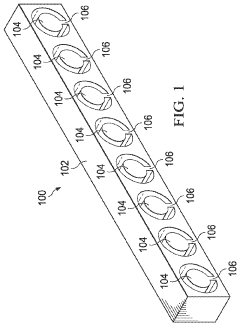
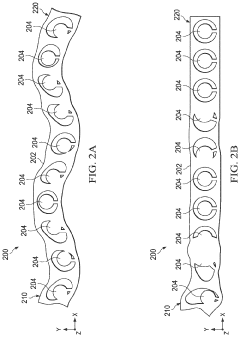
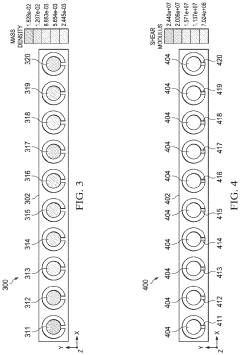
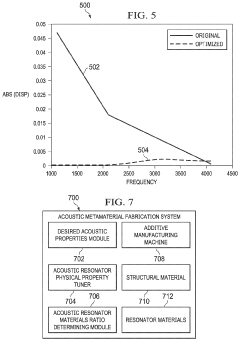
- A method involving computational optimization to determine tuned physical properties for micro-resonators, such as mass density and stiffness, followed by additive manufacturing to embed these resonators within a structure, ensuring actual properties match desired ones, thereby achieving desired acoustic properties.
Systems and methods incorporating spatially-variant anisotropic metamaterials for electromagnetic compatilility
PatentActiveUS20180123235A1
Innovation
- The use of negative uniaxial spatially-variant anisotropic metamaterials (SVAMs) is proposed, which are designed to reduce coupling between components by conforming to electromagnetic fields and fictitious electrostatic models, allowing for the decoupling of electromagnetic components through the creation of grating vectors and 3D printing of complex geometries.


Computational Resources and Infrastructure Requirements
The implementation of machine learning-driven inverse design for acoustic metamaterials demands substantial computational resources due to the complex nature of both the simulation and optimization processes. High-performance computing (HPC) clusters with multi-core processors are essential for handling the computationally intensive tasks involved in acoustic metamaterial design. These systems should ideally feature processors with high clock speeds and numerous cores to efficiently execute parallel computations required for both acoustic simulations and machine learning model training.
GPU acceleration represents a critical component of the infrastructure requirements, particularly for deep learning applications. Modern GPUs with large VRAM capacities (16GB+) significantly accelerate neural network training and inference processes. For complex inverse design problems, multiple high-end GPUs working in parallel can reduce design optimization time from weeks to hours, enabling more extensive exploration of the design space.
Storage infrastructure must accommodate massive datasets generated during the design process. Fast SSD storage (preferably NVMe) for active computations coupled with larger capacity HDDs or cloud storage for archiving completed designs and training datasets is recommended. The total storage requirements typically range from several terabytes to petabytes depending on project scope and complexity.
Network infrastructure with high bandwidth and low latency connections becomes crucial when implementing distributed computing approaches. InfiniBand or high-speed Ethernet (100Gbps+) connections ensure efficient data transfer between compute nodes during parallel simulations and model training.
Specialized software infrastructure is equally important, including acoustic simulation packages (COMSOL Multiphysics, Ansys), machine learning frameworks (TensorFlow, PyTorch), and optimization libraries. Custom middleware is often necessary to integrate these different software components into a cohesive workflow. Cloud computing platforms like AWS, Google Cloud, or Azure can provide scalable alternatives to on-premises infrastructure, offering flexibility in resource allocation based on computational demands.
Energy consumption and cooling requirements must also be considered, as intensive computational tasks generate significant heat. Modern cooling solutions and energy-efficient computing approaches help mitigate these challenges while reducing operational costs and environmental impact.
GPU acceleration represents a critical component of the infrastructure requirements, particularly for deep learning applications. Modern GPUs with large VRAM capacities (16GB+) significantly accelerate neural network training and inference processes. For complex inverse design problems, multiple high-end GPUs working in parallel can reduce design optimization time from weeks to hours, enabling more extensive exploration of the design space.
Storage infrastructure must accommodate massive datasets generated during the design process. Fast SSD storage (preferably NVMe) for active computations coupled with larger capacity HDDs or cloud storage for archiving completed designs and training datasets is recommended. The total storage requirements typically range from several terabytes to petabytes depending on project scope and complexity.
Network infrastructure with high bandwidth and low latency connections becomes crucial when implementing distributed computing approaches. InfiniBand or high-speed Ethernet (100Gbps+) connections ensure efficient data transfer between compute nodes during parallel simulations and model training.
Specialized software infrastructure is equally important, including acoustic simulation packages (COMSOL Multiphysics, Ansys), machine learning frameworks (TensorFlow, PyTorch), and optimization libraries. Custom middleware is often necessary to integrate these different software components into a cohesive workflow. Cloud computing platforms like AWS, Google Cloud, or Azure can provide scalable alternatives to on-premises infrastructure, offering flexibility in resource allocation based on computational demands.
Energy consumption and cooling requirements must also be considered, as intensive computational tasks generate significant heat. Modern cooling solutions and energy-efficient computing approaches help mitigate these challenges while reducing operational costs and environmental impact.
Interdisciplinary Collaboration Opportunities and Challenges
The convergence of machine learning and acoustic metamaterial design necessitates unprecedented levels of interdisciplinary collaboration. This fusion requires expertise from diverse fields including computer science, materials engineering, acoustics, mathematics, and physics. Each discipline brings unique perspectives and methodologies that, when effectively integrated, can accelerate innovation in inverse design processes for acoustic metamaterials.
Computer scientists contribute advanced machine learning algorithms and computational frameworks, while materials engineers provide insights into fabrication constraints and material properties. Acousticians bring domain-specific knowledge about wave propagation and acoustic phenomena, and mathematicians offer theoretical foundations for optimization problems. Physicists help bridge theoretical models with experimental validation, ensuring that machine learning predictions align with physical reality.
However, these collaborative efforts face significant challenges. Communication barriers arise from discipline-specific terminology and conceptual frameworks. A machine learning expert may struggle to articulate algorithm limitations in terms meaningful to an acoustics specialist, while materials engineers might find it difficult to translate fabrication constraints into parameters suitable for computational models.
Institutional and organizational structures often impede effective collaboration. Academic departments, research institutions, and industrial R&D teams typically operate in silos, with different funding mechanisms, publication expectations, and career advancement metrics. These structural barriers can discourage the sustained, deep collaboration necessary for breakthrough innovations in ML-driven acoustic metamaterial design.
Educational gaps present another challenge, as few professionals possess sufficient cross-disciplinary training to serve as effective translators between fields. This necessitates the development of specialized training programs and educational initiatives that foster interdisciplinary literacy among researchers and practitioners.
Data sharing and integration issues also complicate collaborative efforts. Different disciplines maintain varying standards for data collection, storage, and validation. Creating unified databases and establishing common data protocols represents a crucial step toward effective interdisciplinary work in this domain.
Despite these challenges, successful collaboration models are emerging. Research centers specifically designed to foster interdisciplinary work on acoustic metamaterials have demonstrated promising results. Industry-academic partnerships have proven particularly effective, combining theoretical advances with practical applications and manufacturing expertise. Virtual collaboration platforms and open-source initiatives are increasingly facilitating global cooperation, allowing geographically dispersed teams to contribute to shared research objectives in machine learning approaches for acoustic metamaterial design.
Computer scientists contribute advanced machine learning algorithms and computational frameworks, while materials engineers provide insights into fabrication constraints and material properties. Acousticians bring domain-specific knowledge about wave propagation and acoustic phenomena, and mathematicians offer theoretical foundations for optimization problems. Physicists help bridge theoretical models with experimental validation, ensuring that machine learning predictions align with physical reality.
However, these collaborative efforts face significant challenges. Communication barriers arise from discipline-specific terminology and conceptual frameworks. A machine learning expert may struggle to articulate algorithm limitations in terms meaningful to an acoustics specialist, while materials engineers might find it difficult to translate fabrication constraints into parameters suitable for computational models.
Institutional and organizational structures often impede effective collaboration. Academic departments, research institutions, and industrial R&D teams typically operate in silos, with different funding mechanisms, publication expectations, and career advancement metrics. These structural barriers can discourage the sustained, deep collaboration necessary for breakthrough innovations in ML-driven acoustic metamaterial design.
Educational gaps present another challenge, as few professionals possess sufficient cross-disciplinary training to serve as effective translators between fields. This necessitates the development of specialized training programs and educational initiatives that foster interdisciplinary literacy among researchers and practitioners.
Data sharing and integration issues also complicate collaborative efforts. Different disciplines maintain varying standards for data collection, storage, and validation. Creating unified databases and establishing common data protocols represents a crucial step toward effective interdisciplinary work in this domain.
Despite these challenges, successful collaboration models are emerging. Research centers specifically designed to foster interdisciplinary work on acoustic metamaterials have demonstrated promising results. Industry-academic partnerships have proven particularly effective, combining theoretical advances with practical applications and manufacturing expertise. Virtual collaboration platforms and open-source initiatives are increasingly facilitating global cooperation, allowing geographically dispersed teams to contribute to shared research objectives in machine learning approaches for acoustic metamaterial design.
Unlock deeper insights with PatSnap Eureka Quick Research — get a full tech report to explore trends and direct your research. Try now!
Generate Your Research Report Instantly with AI Agent
Supercharge your innovation with PatSnap Eureka AI Agent Platform!