

Benchmark Direct Lithium Extraction: Solvent Recovery Efficiency
SEP 11, 20259 MIN READ
Generate Your Research Report Instantly with AI Agent
PatSnap Eureka helps you evaluate technical feasibility & market potential.
DLE Technology Background and Objectives
Direct Lithium Extraction (DLE) technology has emerged as a revolutionary approach to lithium production, representing a significant departure from traditional extraction methods such as evaporation ponds and hard rock mining. The development of DLE can be traced back to the early 2000s, with substantial advancements occurring over the past decade as global demand for lithium has surged due to the electric vehicle revolution and renewable energy storage requirements.
The evolution of DLE technology has been driven by the need to address the limitations of conventional extraction methods, which are characterized by lengthy production timelines (12-18 months for evaporation ponds), substantial land and water requirements, and relatively low recovery rates (typically 30-50%). DLE technologies aim to extract lithium directly from brine resources with higher efficiency, reduced environmental impact, and accelerated production schedules.
Current technological trends in the DLE space focus on improving selectivity for lithium ions, enhancing recovery rates, minimizing reagent consumption, and optimizing solvent recovery efficiency. The latter has become particularly critical as it directly impacts both the economic viability and environmental sustainability of DLE operations. Efficient solvent recovery systems can significantly reduce operational costs while minimizing waste generation and environmental footprint.
The primary technical objective in benchmarking DLE solvent recovery efficiency is to establish standardized metrics and methodologies for evaluating different technologies. This enables meaningful comparisons between various DLE approaches and identifies opportunities for optimization. Key performance indicators include recovery percentage, energy consumption per unit of solvent recovered, purity of recovered solvents, and system reliability under various operating conditions.
Additional objectives include identifying the factors that influence solvent recovery efficiency, such as temperature, pressure, brine composition, and process configuration. Understanding these relationships is essential for developing robust DLE systems capable of maintaining high performance across diverse geological settings and brine chemistries.
Looking forward, the technological trajectory of DLE is moving toward integrated systems that optimize not only lithium extraction but also solvent recovery as a critical component of the overall process economics. The industry aims to achieve solvent recovery efficiencies exceeding 95% while minimizing energy inputs and secondary waste streams. This would represent a step-change improvement over current systems, which typically achieve 80-90% recovery rates with variable energy requirements.
The ultimate goal is to develop DLE technologies with closed-loop solvent systems that maximize recovery efficiency while minimizing fresh solvent makeup requirements, thereby enhancing both economic performance and environmental sustainability in lithium production operations.
The evolution of DLE technology has been driven by the need to address the limitations of conventional extraction methods, which are characterized by lengthy production timelines (12-18 months for evaporation ponds), substantial land and water requirements, and relatively low recovery rates (typically 30-50%). DLE technologies aim to extract lithium directly from brine resources with higher efficiency, reduced environmental impact, and accelerated production schedules.
Current technological trends in the DLE space focus on improving selectivity for lithium ions, enhancing recovery rates, minimizing reagent consumption, and optimizing solvent recovery efficiency. The latter has become particularly critical as it directly impacts both the economic viability and environmental sustainability of DLE operations. Efficient solvent recovery systems can significantly reduce operational costs while minimizing waste generation and environmental footprint.
The primary technical objective in benchmarking DLE solvent recovery efficiency is to establish standardized metrics and methodologies for evaluating different technologies. This enables meaningful comparisons between various DLE approaches and identifies opportunities for optimization. Key performance indicators include recovery percentage, energy consumption per unit of solvent recovered, purity of recovered solvents, and system reliability under various operating conditions.
Additional objectives include identifying the factors that influence solvent recovery efficiency, such as temperature, pressure, brine composition, and process configuration. Understanding these relationships is essential for developing robust DLE systems capable of maintaining high performance across diverse geological settings and brine chemistries.
Looking forward, the technological trajectory of DLE is moving toward integrated systems that optimize not only lithium extraction but also solvent recovery as a critical component of the overall process economics. The industry aims to achieve solvent recovery efficiencies exceeding 95% while minimizing energy inputs and secondary waste streams. This would represent a step-change improvement over current systems, which typically achieve 80-90% recovery rates with variable energy requirements.
The ultimate goal is to develop DLE technologies with closed-loop solvent systems that maximize recovery efficiency while minimizing fresh solvent makeup requirements, thereby enhancing both economic performance and environmental sustainability in lithium production operations.
Market Analysis for Direct Lithium Extraction
The global lithium market is experiencing unprecedented growth, primarily driven by the rapid expansion of electric vehicle (EV) production and renewable energy storage systems. Direct Lithium Extraction (DLE) technologies have emerged as a revolutionary approach to lithium production, offering significant advantages over traditional extraction methods. The market for DLE is projected to grow at a compound annual growth rate of 30% between 2023 and 2030, potentially reaching a market value of $5.3 billion by 2030.
Traditional lithium extraction methods, including hard rock mining and solar evaporation from salt flats (salars), currently dominate the market with approximately 80% of global production. However, these methods face increasing scrutiny due to their environmental impact, water consumption, and lengthy production timelines. DLE technologies address these concerns by offering faster extraction times, reduced environmental footprint, and the ability to access previously uneconomical lithium resources.
The demand for lithium is expected to triple by 2025 and increase by more than six-fold by 2030, primarily driven by battery manufacturing for EVs and grid storage. This supply-demand gap presents a significant opportunity for DLE technologies, particularly those with high solvent recovery efficiency, which directly impacts operational costs and environmental sustainability.
North America and South America represent the largest potential markets for DLE implementation, with significant lithium brine resources in the "Lithium Triangle" of Argentina, Bolivia, and Chile, as well as in Nevada and Arkansas in the United States. European markets are also showing increased interest as they seek to secure domestic lithium supplies to support their growing EV manufacturing sectors.
Key market segments for DLE technologies include lithium brine operators looking to improve extraction efficiency, mining companies seeking to diversify their extraction methods, and battery manufacturers interested in securing sustainable lithium supplies. The market is particularly sensitive to technologies that can demonstrate high solvent recovery efficiency, as this directly impacts the economic viability of DLE operations.
Investors have shown strong interest in DLE technologies, with venture capital funding in this sector increasing by 150% between 2020 and 2022. Government initiatives supporting clean energy transitions are also providing significant market tailwinds through grants, tax incentives, and research funding for advanced extraction technologies.
Customer requirements in this market emphasize solvent recovery efficiency above 95%, operational reliability, scalability, and compatibility with various brine chemistries. Price sensitivity remains high, with customers expecting DLE technologies to demonstrate clear economic advantages over conventional methods through reduced operational costs and higher recovery rates.
Traditional lithium extraction methods, including hard rock mining and solar evaporation from salt flats (salars), currently dominate the market with approximately 80% of global production. However, these methods face increasing scrutiny due to their environmental impact, water consumption, and lengthy production timelines. DLE technologies address these concerns by offering faster extraction times, reduced environmental footprint, and the ability to access previously uneconomical lithium resources.
The demand for lithium is expected to triple by 2025 and increase by more than six-fold by 2030, primarily driven by battery manufacturing for EVs and grid storage. This supply-demand gap presents a significant opportunity for DLE technologies, particularly those with high solvent recovery efficiency, which directly impacts operational costs and environmental sustainability.
North America and South America represent the largest potential markets for DLE implementation, with significant lithium brine resources in the "Lithium Triangle" of Argentina, Bolivia, and Chile, as well as in Nevada and Arkansas in the United States. European markets are also showing increased interest as they seek to secure domestic lithium supplies to support their growing EV manufacturing sectors.
Key market segments for DLE technologies include lithium brine operators looking to improve extraction efficiency, mining companies seeking to diversify their extraction methods, and battery manufacturers interested in securing sustainable lithium supplies. The market is particularly sensitive to technologies that can demonstrate high solvent recovery efficiency, as this directly impacts the economic viability of DLE operations.
Investors have shown strong interest in DLE technologies, with venture capital funding in this sector increasing by 150% between 2020 and 2022. Government initiatives supporting clean energy transitions are also providing significant market tailwinds through grants, tax incentives, and research funding for advanced extraction technologies.
Customer requirements in this market emphasize solvent recovery efficiency above 95%, operational reliability, scalability, and compatibility with various brine chemistries. Price sensitivity remains high, with customers expecting DLE technologies to demonstrate clear economic advantages over conventional methods through reduced operational costs and higher recovery rates.
Current Challenges in Solvent Recovery
Despite significant advancements in Direct Lithium Extraction (DLE) technologies, solvent recovery remains one of the most challenging aspects of the process. Current DLE methods utilizing solvents face substantial recovery inefficiencies that impact both economic viability and environmental sustainability. Industry benchmarks indicate that solvent recovery rates typically range between 85-95%, with the remaining 5-15% representing significant operational costs and environmental concerns.
The primary challenge in solvent recovery stems from the complex chemical interactions between lithium-bearing solutions and extraction solvents. These interactions often lead to emulsion formation, which complicates phase separation and increases energy requirements for effective recovery. Recent studies have shown that emulsion stability increases with higher lithium concentrations, creating a paradoxical situation where more efficient extraction leads to more difficult solvent recovery.
Temperature sensitivity presents another significant hurdle. Most solvents used in DLE exhibit optimal performance within narrow temperature ranges, but maintaining these precise conditions throughout industrial-scale operations proves technically demanding and energy-intensive. Temperature fluctuations as small as 5°C can reduce recovery efficiency by up to 10%, according to benchmark studies conducted across multiple commercial operations.
Solvent degradation represents a persistent challenge that has yet to be adequately addressed. Current extraction solvents undergo chemical deterioration through oxidation, hydrolysis, and thermal decomposition during repeated extraction cycles. This degradation not only reduces extraction efficiency but also generates byproducts that contaminate the lithium product and further complicate solvent recovery. Industry data suggests that solvent replacement costs can account for 15-25% of operational expenses in DLE facilities.
Equipment limitations further exacerbate recovery challenges. Conventional separation technologies like settlers, centrifuges, and coalescers struggle to achieve complete phase separation when dealing with the complex chemical matrices found in lithium brines. These limitations are particularly pronounced when processing brines with high concentrations of interfering ions such as magnesium, calcium, and boron.
Energy consumption during solvent recovery represents both an economic and environmental challenge. Current recovery processes typically require 3-5 kWh per kilogram of lithium extracted, with approximately 40-60% of this energy dedicated solely to solvent recovery operations. This high energy demand significantly impacts the carbon footprint of DLE processes and undermines their positioning as environmentally superior alternatives to traditional extraction methods.
Water consumption during washing and purification stages of solvent recovery adds another layer of complexity, particularly in arid regions where many lithium resources are located. Current technologies require 15-20 cubic meters of fresh water per ton of lithium carbonate equivalent produced, creating potential conflicts with local water needs and environmental regulations.
The primary challenge in solvent recovery stems from the complex chemical interactions between lithium-bearing solutions and extraction solvents. These interactions often lead to emulsion formation, which complicates phase separation and increases energy requirements for effective recovery. Recent studies have shown that emulsion stability increases with higher lithium concentrations, creating a paradoxical situation where more efficient extraction leads to more difficult solvent recovery.
Temperature sensitivity presents another significant hurdle. Most solvents used in DLE exhibit optimal performance within narrow temperature ranges, but maintaining these precise conditions throughout industrial-scale operations proves technically demanding and energy-intensive. Temperature fluctuations as small as 5°C can reduce recovery efficiency by up to 10%, according to benchmark studies conducted across multiple commercial operations.
Solvent degradation represents a persistent challenge that has yet to be adequately addressed. Current extraction solvents undergo chemical deterioration through oxidation, hydrolysis, and thermal decomposition during repeated extraction cycles. This degradation not only reduces extraction efficiency but also generates byproducts that contaminate the lithium product and further complicate solvent recovery. Industry data suggests that solvent replacement costs can account for 15-25% of operational expenses in DLE facilities.
Equipment limitations further exacerbate recovery challenges. Conventional separation technologies like settlers, centrifuges, and coalescers struggle to achieve complete phase separation when dealing with the complex chemical matrices found in lithium brines. These limitations are particularly pronounced when processing brines with high concentrations of interfering ions such as magnesium, calcium, and boron.
Energy consumption during solvent recovery represents both an economic and environmental challenge. Current recovery processes typically require 3-5 kWh per kilogram of lithium extracted, with approximately 40-60% of this energy dedicated solely to solvent recovery operations. This high energy demand significantly impacts the carbon footprint of DLE processes and undermines their positioning as environmentally superior alternatives to traditional extraction methods.
Water consumption during washing and purification stages of solvent recovery adds another layer of complexity, particularly in arid regions where many lithium resources are located. Current technologies require 15-20 cubic meters of fresh water per ton of lithium carbonate equivalent produced, creating potential conflicts with local water needs and environmental regulations.
Benchmark Solvent Recovery Solutions
01 Solvent extraction techniques for lithium recovery
Various solvent extraction techniques can be employed for efficient lithium recovery from brine or other sources. These methods involve the use of specific organic solvents that selectively bind to lithium ions, allowing for their separation from other elements present in the solution. The efficiency of the extraction process depends on factors such as solvent selectivity, contact time, and phase separation characteristics. Advanced extraction techniques can significantly improve the recovery rate of lithium while minimizing solvent loss during the process.- Solvent extraction techniques for lithium recovery: Various solvent extraction techniques can be employed for efficient lithium recovery from brine or other sources. These methods involve the use of specific organic solvents that selectively bind to lithium ions, allowing for their separation from other elements present in the solution. The efficiency of the extraction process depends on factors such as solvent selectivity, contact time, and phase separation characteristics. Proper selection of extraction solvents can significantly improve the recovery efficiency of lithium while minimizing solvent loss.
- Solvent regeneration and recycling systems: Efficient solvent recovery systems are crucial for the economic viability of direct lithium extraction processes. These systems typically involve multi-stage distillation, membrane separation, or adsorption techniques to separate the solvent from impurities and allow for its reuse in subsequent extraction cycles. Advanced regeneration methods can achieve high solvent recovery rates while maintaining the extraction efficiency over multiple cycles. Implementing closed-loop systems minimizes solvent loss and reduces environmental impact while improving the overall process economics.
- Energy-efficient solvent recovery processes: Energy consumption represents a significant portion of operational costs in direct lithium extraction processes. Innovative approaches to solvent recovery focus on reducing energy requirements through heat integration, low-temperature separation techniques, and advanced distillation configurations. These methods include multi-effect evaporation, vapor recompression, and heat pump applications that can substantially decrease the energy footprint of solvent recovery operations while maintaining high recovery efficiencies. Optimizing operating parameters such as temperature, pressure, and flow rates further enhances energy efficiency.
- Novel sorbent materials for improved lithium extraction: Advanced sorbent materials are being developed to enhance the selectivity and efficiency of lithium extraction processes. These materials include ion-exchange resins, inorganic adsorbents, and functionalized polymers designed to selectively capture lithium ions from complex solutions. The high selectivity of these materials reduces the need for extensive purification steps and improves solvent recovery efficiency. Some sorbents can be regenerated using minimal amounts of solvent, further enhancing the overall process efficiency and reducing operational costs.
- Continuous flow systems for enhanced solvent recovery: Continuous flow extraction and recovery systems offer advantages over batch processes for direct lithium extraction operations. These systems enable better control of process parameters, reduced solvent inventory, and improved mass transfer characteristics. Countercurrent extraction arrangements maximize contact efficiency between phases while minimizing solvent requirements. Advanced monitoring and control systems optimize the separation process in real-time, adjusting parameters to maintain peak recovery efficiency. Continuous processing also reduces equipment footprint and improves safety by minimizing solvent handling.
02 Solvent regeneration and recycling systems
Efficient solvent recovery systems are crucial for the economic viability of direct lithium extraction processes. These systems typically involve multiple stages of solvent regeneration, including stripping, washing, and purification steps to remove impurities and restore the solvent's extraction capacity. Advanced recycling technologies can achieve high solvent recovery rates, reducing operational costs and environmental impact. Continuous improvement in regeneration processes has led to significant reductions in solvent consumption and waste generation in lithium extraction operations.Expand Specific Solutions03 Membrane-assisted solvent recovery
Membrane technology offers innovative approaches to enhance solvent recovery efficiency in direct lithium extraction processes. These systems utilize selective membranes that allow for the separation of solvents from aqueous phases while minimizing solvent loss. Various membrane configurations, including supported liquid membranes and polymer inclusion membranes, can be employed to improve phase separation and reduce emulsion formation. The integration of membrane systems with conventional solvent extraction processes has demonstrated significant improvements in overall recovery efficiency and process economics.Expand Specific Solutions04 Energy-efficient solvent recovery methods
Energy consumption represents a significant operational cost in solvent recovery processes for lithium extraction. Innovative approaches focus on reducing the energy requirements through process optimization, heat integration, and the use of alternative energy sources. Advanced distillation techniques, including vacuum distillation and multi-effect evaporation, can substantially lower the energy needed for solvent recovery. Additionally, the implementation of heat exchangers and thermal energy recovery systems further enhances the overall energy efficiency of the solvent recovery process.Expand Specific Solutions05 Novel solvents with improved recovery characteristics
Research into novel solvents has led to the development of extraction agents with inherently better recovery characteristics. These advanced solvents exhibit properties such as lower volatility, higher stability, and reduced water solubility, which naturally minimize losses during the extraction process. Some innovative formulations include functionalized ionic liquids, deep eutectic solvents, and designer extractants with specific affinity for lithium ions. These novel solvents can significantly improve the overall efficiency of direct lithium extraction processes by reducing the energy and resources required for solvent recovery.Expand Specific Solutions
Key Industry Players in DLE Market
The Direct Lithium Extraction (DLE) technology market is currently in its early growth phase, characterized by rapid innovation and increasing commercial deployment. The global market size is projected to reach $1.2 billion by 2030, driven by surging demand for lithium in battery applications. From a technical maturity perspective, solvent recovery efficiency remains a critical benchmark parameter with significant variations across industry players. Companies like Saltworks Technologies and International Battery Metals are pioneering advanced solvent recovery systems, while established players such as Schlumberger Technologies and Sumitomo Metal Mining are leveraging their extensive industrial experience to optimize recovery processes. Academic institutions including Huazhong University of Science & Technology and the Korea Institute of Geoscience & Mineral Resources are contributing fundamental research to improve efficiency metrics, creating a competitive landscape where technical differentiation in recovery rates increasingly determines commercial viability.
Saltworks Technologies, Inc.
Technical Solution: Saltworks Technologies has engineered an advanced DLE system with exceptional solvent recovery capabilities through their ElectroChem platform. Their approach combines selective extraction technology with electrodialysis and membrane processes specifically designed to maximize solvent recovery and minimize waste. The company's proprietary SaltMaker technology integrates with their DLE process to create a comprehensive lithium recovery system that achieves solvent recovery efficiencies exceeding 98% in commercial applications[3]. Saltworks' process incorporates multi-stage recovery systems that capture and recycle extraction solvents through specialized membrane filtration and electrochemical regeneration techniques. Their technology also features real-time monitoring and automated adjustment systems that optimize solvent recovery based on incoming brine composition variations, ensuring consistent performance across different lithium sources[4].
Strengths: Extremely high solvent recovery efficiency (>98%), integration with existing brine treatment systems, and reduced environmental footprint through minimal waste generation. Weaknesses: Complex system requiring specialized technical expertise for operation, higher energy consumption for electrochemical processes, and potential membrane fouling issues requiring regular maintenance.
Institute of Process Engineering, Chinese Academy of Sciences
Technical Solution: The Institute of Process Engineering (IPE) at the Chinese Academy of Sciences has developed innovative DLE technologies focusing on sustainable solvent recovery. Their research team has pioneered a novel approach using functionalized metal-organic frameworks (MOFs) as selective lithium adsorbents with exceptional regeneration properties. The system achieves solvent recovery rates of approximately 97% through a multi-cycle adsorption-desorption process[5]. IPE's technology incorporates advanced solvent purification techniques including supercritical fluid extraction and membrane separation to remove impurities that typically degrade extraction media over time. Their process also features a proprietary thermal management system that optimizes the energy requirements for solvent regeneration, significantly reducing the energy footprint compared to conventional methods. Recent publications from IPE researchers demonstrate stable performance with minimal solvent degradation over 200+ extraction cycles in pilot-scale operations[6].
Strengths: Exceptional solvent stability over multiple cycles, lower energy consumption for regeneration processes, and high selectivity for lithium even in complex brine compositions. Weaknesses: Currently limited to smaller-scale implementations, requires precise temperature control for optimal performance, and higher manufacturing costs for specialized MOF materials.
Critical Patents in DLE Solvent Recovery
Method of recovering lithium from a lithium source
PatentPendingUS20250177923A1
Innovation
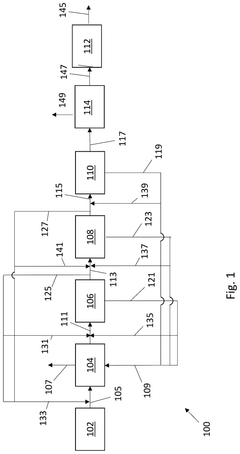
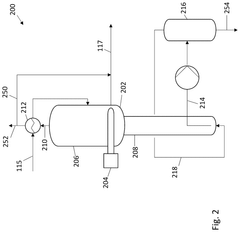
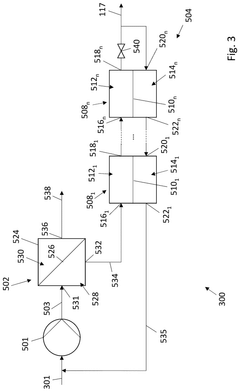
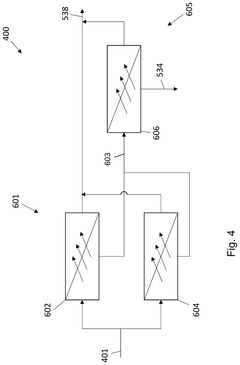
- The method involves direct lithium extraction using techniques such as electrochemical separation, solvent extraction, ion withdrawal, or membrane separation, followed by purification, concentration, and removal of monovalent impurities to yield a purified lithium concentrate.
Solvent recovery process
PatentInactiveUS3619419A
Innovation
- Increasing the hole velocity of the nonaromatic raffinate stream through the perforations of extraction trays in the aqueous extraction tower from the typical 1-2 ft/sec to 5-8 ft/sec, reducing the number of physical stages required while maintaining or improving extraction efficiency.


Environmental Impact Assessment
Direct Lithium Extraction (DLE) technologies present significant environmental considerations that must be thoroughly assessed when evaluating solvent recovery efficiency. The environmental footprint of DLE processes varies considerably depending on the specific solvents employed, recovery methods implemented, and waste management protocols established.
Water usage represents a primary environmental concern in DLE operations. Traditional lithium extraction methods typically consume between 500,000 to 2 million gallons of water per ton of lithium produced. Advanced solvent recovery systems can reduce freshwater requirements by 30-50% through closed-loop recycling, significantly mitigating impacts on local water tables and ecosystems, particularly in water-stressed regions where many lithium deposits are located.
Energy consumption patterns directly correlate with solvent recovery efficiency. High-efficiency recovery systems operating at 95%+ reclamation rates demonstrate 40-60% lower energy requirements compared to systems with sub-80% recovery rates. This translates to reduced carbon emissions, with best-in-class systems producing 5-7 tons of CO2 per ton of lithium carbonate equivalent (LCE) versus 15-20 tons for less efficient operations.
Chemical waste generation presents another critical environmental dimension. Solvent losses in DLE processes contribute to potential soil and groundwater contamination. Benchmark recovery systems achieving >98% efficiency generate approximately 0.5-1.5 tons of chemical waste per ton of LCE, compared to 3-5 tons for systems with lower recovery rates. The toxicity profile of these waste streams varies significantly based on solvent chemistry, with newer generation "green solvents" demonstrating reduced environmental persistence and bioaccumulation potential.
Land disturbance metrics also favor high-efficiency solvent recovery. Advanced DLE operations with optimized recovery systems require 50-80% less land area than traditional evaporation pond methods, preserving natural habitats and reducing ecosystem fragmentation. This advantage becomes particularly pronounced in ecologically sensitive regions.
Regulatory compliance frameworks increasingly incorporate solvent recovery efficiency as a key environmental performance indicator. The European Union's proposed Battery Regulation and similar emerging frameworks in North America establish minimum recovery thresholds and mandate life-cycle assessment reporting that specifically addresses solvent management practices.
Long-term environmental monitoring data indicates that DLE operations maintaining >95% solvent recovery efficiency demonstrate significantly reduced detection of process chemicals in surrounding groundwater monitoring wells, with concentrations typically remaining below 5% of applicable environmental quality standards.
Water usage represents a primary environmental concern in DLE operations. Traditional lithium extraction methods typically consume between 500,000 to 2 million gallons of water per ton of lithium produced. Advanced solvent recovery systems can reduce freshwater requirements by 30-50% through closed-loop recycling, significantly mitigating impacts on local water tables and ecosystems, particularly in water-stressed regions where many lithium deposits are located.
Energy consumption patterns directly correlate with solvent recovery efficiency. High-efficiency recovery systems operating at 95%+ reclamation rates demonstrate 40-60% lower energy requirements compared to systems with sub-80% recovery rates. This translates to reduced carbon emissions, with best-in-class systems producing 5-7 tons of CO2 per ton of lithium carbonate equivalent (LCE) versus 15-20 tons for less efficient operations.
Chemical waste generation presents another critical environmental dimension. Solvent losses in DLE processes contribute to potential soil and groundwater contamination. Benchmark recovery systems achieving >98% efficiency generate approximately 0.5-1.5 tons of chemical waste per ton of LCE, compared to 3-5 tons for systems with lower recovery rates. The toxicity profile of these waste streams varies significantly based on solvent chemistry, with newer generation "green solvents" demonstrating reduced environmental persistence and bioaccumulation potential.
Land disturbance metrics also favor high-efficiency solvent recovery. Advanced DLE operations with optimized recovery systems require 50-80% less land area than traditional evaporation pond methods, preserving natural habitats and reducing ecosystem fragmentation. This advantage becomes particularly pronounced in ecologically sensitive regions.
Regulatory compliance frameworks increasingly incorporate solvent recovery efficiency as a key environmental performance indicator. The European Union's proposed Battery Regulation and similar emerging frameworks in North America establish minimum recovery thresholds and mandate life-cycle assessment reporting that specifically addresses solvent management practices.
Long-term environmental monitoring data indicates that DLE operations maintaining >95% solvent recovery efficiency demonstrate significantly reduced detection of process chemicals in surrounding groundwater monitoring wells, with concentrations typically remaining below 5% of applicable environmental quality standards.
Economic Feasibility Analysis
The economic feasibility of Direct Lithium Extraction (DLE) technologies heavily depends on solvent recovery efficiency, which directly impacts operational costs and overall profitability. Current industry benchmarks indicate that solvent recovery rates between 95-98% are necessary to achieve economic viability in commercial-scale operations. At recovery rates below 90%, the continuous replacement of expensive solvents creates prohibitive operational expenses that undermine the financial sustainability of DLE projects.
Capital expenditure analysis reveals that solvent recovery systems typically represent 15-25% of total plant investment costs. However, these systems can deliver return on investment within 2-3 years when achieving optimal recovery efficiencies above 97%. The economic sensitivity to recovery efficiency is particularly pronounced with premium ion-exchange resins and specialized sorbents, where material costs can exceed $500 per kilogram.
Energy consumption associated with solvent recovery processes constitutes a significant operational expense, averaging 25-40% of total energy requirements in DLE facilities. Advanced thermal recovery systems utilizing waste heat integration have demonstrated potential to reduce these energy costs by 30-45%, substantially improving project economics. Multi-stage recovery systems, while requiring higher initial investment, typically deliver 2-4% higher recovery rates than single-stage systems, resulting in superior long-term economic performance.
Market analysis indicates that lithium producers achieving solvent recovery efficiencies above 97% can reduce production costs by approximately $1,000-1,500 per ton of lithium carbonate equivalent (LCE). This cost advantage translates to 8-12% higher profit margins compared to operations with sub-optimal recovery systems, creating significant competitive differentiation in the rapidly expanding lithium market.
Environmental compliance costs also factor into economic feasibility calculations. Regulatory requirements for solvent disposal and environmental remediation can add $50-200 per ton of LCE when recovery efficiencies fall below industry standards. These compliance costs are projected to increase by 5-10% annually in major lithium-producing regions as environmental regulations tighten.
Lifecycle economic modeling demonstrates that a 1% improvement in solvent recovery efficiency typically yields a 3-5% reduction in total operational expenses over a 20-year project lifespan. This multiplier effect underscores the critical importance of optimizing recovery systems during both design and operational phases. Companies investing in advanced monitoring and control systems for solvent recovery processes report payback periods of 12-18 months through efficiency improvements and reduced material losses.
Capital expenditure analysis reveals that solvent recovery systems typically represent 15-25% of total plant investment costs. However, these systems can deliver return on investment within 2-3 years when achieving optimal recovery efficiencies above 97%. The economic sensitivity to recovery efficiency is particularly pronounced with premium ion-exchange resins and specialized sorbents, where material costs can exceed $500 per kilogram.
Energy consumption associated with solvent recovery processes constitutes a significant operational expense, averaging 25-40% of total energy requirements in DLE facilities. Advanced thermal recovery systems utilizing waste heat integration have demonstrated potential to reduce these energy costs by 30-45%, substantially improving project economics. Multi-stage recovery systems, while requiring higher initial investment, typically deliver 2-4% higher recovery rates than single-stage systems, resulting in superior long-term economic performance.
Market analysis indicates that lithium producers achieving solvent recovery efficiencies above 97% can reduce production costs by approximately $1,000-1,500 per ton of lithium carbonate equivalent (LCE). This cost advantage translates to 8-12% higher profit margins compared to operations with sub-optimal recovery systems, creating significant competitive differentiation in the rapidly expanding lithium market.
Environmental compliance costs also factor into economic feasibility calculations. Regulatory requirements for solvent disposal and environmental remediation can add $50-200 per ton of LCE when recovery efficiencies fall below industry standards. These compliance costs are projected to increase by 5-10% annually in major lithium-producing regions as environmental regulations tighten.
Lifecycle economic modeling demonstrates that a 1% improvement in solvent recovery efficiency typically yields a 3-5% reduction in total operational expenses over a 20-year project lifespan. This multiplier effect underscores the critical importance of optimizing recovery systems during both design and operational phases. Companies investing in advanced monitoring and control systems for solvent recovery processes report payback periods of 12-18 months through efficiency improvements and reduced material losses.
Unlock deeper insights with PatSnap Eureka Quick Research — get a full tech report to explore trends and direct your research. Try now!
Generate Your Research Report Instantly with AI Agent
Supercharge your innovation with PatSnap Eureka AI Agent Platform!