

Direct Lithium Extraction: Techniques for Minimizing Solvent Use
SEP 11, 20259 MIN READ
Generate Your Research Report Instantly with AI Agent
Patsnap Eureka helps you evaluate technical feasibility & market potential.
DLE Technology Background and Objectives
Direct Lithium Extraction (DLE) has emerged as a revolutionary approach to lithium production, evolving significantly since its conceptual development in the 1970s. Traditional lithium extraction methods primarily relied on solar evaporation of brine deposits or hard-rock mining, both presenting considerable environmental challenges and resource inefficiencies. The technological evolution of DLE represents a paradigm shift in how this critical element is sourced for global markets.
The historical trajectory of DLE technology began with rudimentary ion exchange and adsorption techniques, gradually advancing through membrane-based separation methods to today's sophisticated selective extraction systems. This evolution has been driven by the exponential growth in lithium demand, primarily fueled by the electric vehicle revolution and renewable energy storage requirements, creating an urgent need for more sustainable and efficient extraction methodologies.
Current DLE technologies encompass several approaches including ion exchange, adsorption, solvent extraction, and membrane processes. Each technique offers distinct advantages in terms of selectivity, recovery rates, and operational parameters. However, a persistent challenge across all DLE methods has been the substantial use of solvents, which introduces both economic and environmental concerns to the extraction process.
The primary technical objective in modern DLE development focuses on minimizing solvent usage while maintaining or improving extraction efficiency. This goal addresses multiple imperatives: reducing operational costs, minimizing environmental footprint, enhancing process sustainability, and improving the overall economics of lithium production. Achieving solvent reduction without compromising extraction performance represents a critical balance in technology optimization.
Recent technological trends indicate a movement toward hybrid systems that combine multiple extraction principles to maximize efficiency while reducing chemical inputs. These integrated approaches often leverage selective adsorption materials coupled with optimized regeneration cycles to minimize solvent requirements. Additionally, developments in materials science have yielded novel adsorbents with enhanced selectivity for lithium ions, potentially reducing the need for chemical separating agents.
The global transition toward carbon neutrality has further accelerated DLE technology development, with projections suggesting lithium demand could increase by 400-800% by 2030. This market pressure intensifies the need for breakthrough technologies that can extract lithium with minimal environmental impact and resource consumption, particularly regarding water and solvent usage.
As the technology continues to mature, the ultimate objective remains developing commercially viable DLE processes that can operate at industrial scale with minimal solvent requirements, high recovery rates, and reduced environmental footprint compared to conventional extraction methods. This technological evolution represents not just an improvement in resource extraction but a fundamental reimagining of how critical battery materials are sourced in a sustainable economy.
The historical trajectory of DLE technology began with rudimentary ion exchange and adsorption techniques, gradually advancing through membrane-based separation methods to today's sophisticated selective extraction systems. This evolution has been driven by the exponential growth in lithium demand, primarily fueled by the electric vehicle revolution and renewable energy storage requirements, creating an urgent need for more sustainable and efficient extraction methodologies.
Current DLE technologies encompass several approaches including ion exchange, adsorption, solvent extraction, and membrane processes. Each technique offers distinct advantages in terms of selectivity, recovery rates, and operational parameters. However, a persistent challenge across all DLE methods has been the substantial use of solvents, which introduces both economic and environmental concerns to the extraction process.
The primary technical objective in modern DLE development focuses on minimizing solvent usage while maintaining or improving extraction efficiency. This goal addresses multiple imperatives: reducing operational costs, minimizing environmental footprint, enhancing process sustainability, and improving the overall economics of lithium production. Achieving solvent reduction without compromising extraction performance represents a critical balance in technology optimization.
Recent technological trends indicate a movement toward hybrid systems that combine multiple extraction principles to maximize efficiency while reducing chemical inputs. These integrated approaches often leverage selective adsorption materials coupled with optimized regeneration cycles to minimize solvent requirements. Additionally, developments in materials science have yielded novel adsorbents with enhanced selectivity for lithium ions, potentially reducing the need for chemical separating agents.
The global transition toward carbon neutrality has further accelerated DLE technology development, with projections suggesting lithium demand could increase by 400-800% by 2030. This market pressure intensifies the need for breakthrough technologies that can extract lithium with minimal environmental impact and resource consumption, particularly regarding water and solvent usage.
As the technology continues to mature, the ultimate objective remains developing commercially viable DLE processes that can operate at industrial scale with minimal solvent requirements, high recovery rates, and reduced environmental footprint compared to conventional extraction methods. This technological evolution represents not just an improvement in resource extraction but a fundamental reimagining of how critical battery materials are sourced in a sustainable economy.
Market Analysis for Sustainable Lithium Extraction
The global lithium market is experiencing unprecedented growth driven by the rapid expansion of electric vehicle (EV) production and renewable energy storage systems. Current projections indicate the lithium market will reach $8.2 billion by 2027, with a compound annual growth rate (CAGR) of approximately 14.8% from 2022. This growth trajectory is primarily fueled by government initiatives promoting clean energy adoption, stringent emission regulations, and increasing consumer preference for sustainable transportation options.
Traditional lithium extraction methods, particularly evaporative brine processing and hard rock mining, face significant sustainability challenges. These conventional approaches consume vast quantities of water—up to 500,000 gallons per ton of lithium—and have substantial environmental footprints. This reality has created a distinct market opportunity for Direct Lithium Extraction (DLE) technologies that minimize solvent usage.
The sustainable lithium extraction segment is projected to grow at a CAGR of 20.3% through 2030, outpacing the broader lithium market. This accelerated growth reflects increasing pressure from both regulatory bodies and end-users for environmentally responsible supply chains. Major automotive manufacturers, including Tesla, Volkswagen, and BMW, have publicly committed to sourcing materials through sustainable practices, creating premium market segments for low-impact lithium.
Regional analysis reveals that North America and Europe are leading adoption of sustainable extraction technologies, driven by stringent environmental regulations and consumer awareness. The Asia-Pacific region, while currently dominated by traditional extraction methods, is showing increasing interest in sustainable alternatives as environmental policies tighten across China, Japan, and South Korea.
Investment patterns further validate market potential, with venture capital funding for DLE startups exceeding $450 million in 2022 alone—a 215% increase from 2020. Strategic investments from established mining companies and battery manufacturers highlight industry recognition of the shifting landscape toward sustainable extraction methodologies.
End-user segmentation shows that premium EV manufacturers are willing to pay 8-12% price premiums for sustainably sourced lithium, creating economic incentives for adoption of solvent-minimizing technologies. Energy storage system manufacturers similarly prioritize sustainable sourcing to align with their broader environmental positioning.
Market barriers include high initial capital requirements for new extraction facilities and technological uncertainties around scaled implementation. However, these are increasingly offset by favorable policy environments, including tax incentives for sustainable mining practices in key markets and potential carbon pricing mechanisms that would further advantage low-impact extraction methods.
Traditional lithium extraction methods, particularly evaporative brine processing and hard rock mining, face significant sustainability challenges. These conventional approaches consume vast quantities of water—up to 500,000 gallons per ton of lithium—and have substantial environmental footprints. This reality has created a distinct market opportunity for Direct Lithium Extraction (DLE) technologies that minimize solvent usage.
The sustainable lithium extraction segment is projected to grow at a CAGR of 20.3% through 2030, outpacing the broader lithium market. This accelerated growth reflects increasing pressure from both regulatory bodies and end-users for environmentally responsible supply chains. Major automotive manufacturers, including Tesla, Volkswagen, and BMW, have publicly committed to sourcing materials through sustainable practices, creating premium market segments for low-impact lithium.
Regional analysis reveals that North America and Europe are leading adoption of sustainable extraction technologies, driven by stringent environmental regulations and consumer awareness. The Asia-Pacific region, while currently dominated by traditional extraction methods, is showing increasing interest in sustainable alternatives as environmental policies tighten across China, Japan, and South Korea.
Investment patterns further validate market potential, with venture capital funding for DLE startups exceeding $450 million in 2022 alone—a 215% increase from 2020. Strategic investments from established mining companies and battery manufacturers highlight industry recognition of the shifting landscape toward sustainable extraction methodologies.
End-user segmentation shows that premium EV manufacturers are willing to pay 8-12% price premiums for sustainably sourced lithium, creating economic incentives for adoption of solvent-minimizing technologies. Energy storage system manufacturers similarly prioritize sustainable sourcing to align with their broader environmental positioning.
Market barriers include high initial capital requirements for new extraction facilities and technological uncertainties around scaled implementation. However, these are increasingly offset by favorable policy environments, including tax incentives for sustainable mining practices in key markets and potential carbon pricing mechanisms that would further advantage low-impact extraction methods.
Current Challenges in Solvent-Based DLE Methods
Solvent-based Direct Lithium Extraction (DLE) methods have emerged as promising alternatives to traditional evaporation ponds for lithium recovery. However, these techniques face significant challenges that limit their widespread commercial adoption. The primary concern is the high solvent consumption rates, which substantially increase operational costs and reduce economic viability. Current industrial implementations require large volumes of organic solvents that can range from 10-50 times the volume of brine processed, creating significant logistical and financial burdens.
Environmental impact represents another critical challenge, as many solvents used in DLE processes are petroleum-derived compounds with considerable carbon footprints. Solvent losses through volatilization, entrainment, and degradation not only increase costs but also pose environmental risks through potential groundwater contamination and air pollution. Regulatory frameworks in many regions are becoming increasingly stringent regarding chemical releases, further complicating deployment.
Selectivity issues persist in current solvent systems, with most extractants showing insufficient discrimination between lithium and competing ions such as sodium, potassium, magnesium, and calcium. This poor selectivity necessitates additional purification steps, increasing process complexity and solvent requirements. The problem is particularly acute in brines with high magnesium-to-lithium ratios, where co-extraction significantly reduces efficiency.
Solvent stability under operational conditions presents another significant hurdle. Many extraction solvents degrade when exposed to the harsh chemical environments typical of geothermal brines or oil field produced waters. High temperatures, extreme pH conditions, and the presence of oxidizing agents can cause solvent breakdown, reducing extraction efficiency and increasing replacement costs. Current industrial systems typically experience solvent losses of 1-5% per cycle, representing a substantial ongoing expense.
Scale-up challenges further complicate commercial implementation. Laboratory-scale successes often fail to translate to industrial settings due to issues with mass transfer limitations, mixing inefficiencies, and phase separation difficulties. The equipment required for large-scale solvent handling, including mixer-settlers, centrifugal extractors, and solvent recovery systems, demands significant capital investment and specialized expertise for operation and maintenance.
Recovery and recycling inefficiencies compound these challenges. Current technologies for solvent recovery typically achieve only 95-99% recovery rates, meaning that continuous makeup of fresh solvent is required. The energy requirements for solvent regeneration and recycling further impact the overall process economics and environmental footprint, with thermal regeneration methods often consuming 30-40% of the total process energy.
Environmental impact represents another critical challenge, as many solvents used in DLE processes are petroleum-derived compounds with considerable carbon footprints. Solvent losses through volatilization, entrainment, and degradation not only increase costs but also pose environmental risks through potential groundwater contamination and air pollution. Regulatory frameworks in many regions are becoming increasingly stringent regarding chemical releases, further complicating deployment.
Selectivity issues persist in current solvent systems, with most extractants showing insufficient discrimination between lithium and competing ions such as sodium, potassium, magnesium, and calcium. This poor selectivity necessitates additional purification steps, increasing process complexity and solvent requirements. The problem is particularly acute in brines with high magnesium-to-lithium ratios, where co-extraction significantly reduces efficiency.
Solvent stability under operational conditions presents another significant hurdle. Many extraction solvents degrade when exposed to the harsh chemical environments typical of geothermal brines or oil field produced waters. High temperatures, extreme pH conditions, and the presence of oxidizing agents can cause solvent breakdown, reducing extraction efficiency and increasing replacement costs. Current industrial systems typically experience solvent losses of 1-5% per cycle, representing a substantial ongoing expense.
Scale-up challenges further complicate commercial implementation. Laboratory-scale successes often fail to translate to industrial settings due to issues with mass transfer limitations, mixing inefficiencies, and phase separation difficulties. The equipment required for large-scale solvent handling, including mixer-settlers, centrifugal extractors, and solvent recovery systems, demands significant capital investment and specialized expertise for operation and maintenance.
Recovery and recycling inefficiencies compound these challenges. Current technologies for solvent recovery typically achieve only 95-99% recovery rates, meaning that continuous makeup of fresh solvent is required. The energy requirements for solvent regeneration and recycling further impact the overall process economics and environmental footprint, with thermal regeneration methods often consuming 30-40% of the total process energy.
Current Solvent Minimization Approaches in DLE
01 Organic solvent-based extraction methods
Organic solvents are used in direct lithium extraction processes due to their selectivity for lithium ions. These methods typically involve contacting lithium-containing brines with specific organic solvents that can selectively bind to lithium ions. The lithium-loaded organic phase is then separated and the lithium is recovered through stripping processes. This approach offers advantages in terms of extraction efficiency and can be optimized for different brine compositions.- Organic solvent-based extraction systems: Organic solvents are used in direct lithium extraction processes due to their selectivity for lithium ions. These systems typically employ solvents such as alcohols, ethers, or ketones that can form complexes with lithium ions, allowing for selective separation from other elements present in brine solutions. The organic solvent-based extraction methods offer advantages in terms of efficiency and can be optimized for different brine compositions.
- Ionic liquid extraction technologies: Ionic liquids serve as specialized solvents for direct lithium extraction due to their unique properties including negligible vapor pressure, high thermal stability, and tunable selectivity. These designer solvents can be tailored to selectively bind with lithium ions while rejecting other competing ions such as sodium, potassium, and magnesium. The extraction process using ionic liquids typically involves multiple stages of contact between the ionic liquid and the lithium-containing solution, followed by a stripping process to recover the lithium.
- Polymer-based extraction methods: Polymer-based extraction methods utilize specialized polymeric materials that can selectively capture lithium ions from brine solutions. These polymers often contain functional groups that have high affinity for lithium ions. The extraction process typically involves contacting the lithium-containing solution with the polymer, allowing the polymer to selectively bind with lithium ions, followed by a regeneration step to recover the lithium and regenerate the polymer for reuse. This approach offers advantages in terms of environmental impact and operational simplicity.
- Solvent impregnated resins for lithium extraction: Solvent impregnated resins combine the advantages of liquid extraction and solid adsorbents by incorporating selective extractants into porous polymer matrices. These hybrid materials can be used for direct lithium extraction from brines and other sources. The extraction process involves passing the lithium-containing solution through a column packed with the solvent impregnated resin, where lithium ions are selectively captured. The lithium can then be recovered by elution with an appropriate solution, and the resin can be regenerated for repeated use.
- Green solvents and sustainable extraction approaches: Environmentally friendly solvents and sustainable approaches are being developed for direct lithium extraction to minimize environmental impact. These methods focus on using biodegradable solvents, reducing water consumption, and developing closed-loop processes that minimize waste generation. The extraction processes often incorporate renewable energy sources and aim to reduce the carbon footprint associated with lithium production. These sustainable approaches are particularly important for lithium extraction operations in environmentally sensitive areas.
02 Ionic liquid extraction systems
Ionic liquids serve as effective solvents for direct lithium extraction due to their unique properties including low volatility, high thermal stability, and tunable selectivity. These designer solvents can be specifically formulated to have high affinity for lithium ions while rejecting other competing ions commonly found in brines. The extraction process typically involves contacting the lithium-containing solution with the ionic liquid, followed by a stripping step to recover concentrated lithium.Expand Specific Solutions03 Solvent-impregnated adsorbent systems
This approach combines the advantages of liquid extraction and solid adsorption by impregnating porous support materials with selective extraction solvents. The solvent-impregnated adsorbents can be packed into columns or used in batch processes to extract lithium from brines. These systems offer improved handling compared to pure liquid extraction while maintaining good selectivity for lithium. The lithium can be recovered by elution with suitable stripping solutions, and the adsorbents can be regenerated for repeated use.Expand Specific Solutions04 Environmentally-friendly green solvents
Sustainable and environmentally-friendly solvents are being developed for direct lithium extraction to reduce environmental impact. These green solvents include bio-based extractants, water-soluble polymers, and environmentally benign designer solvents. The extraction processes using these solvents are designed to minimize waste generation, reduce energy consumption, and eliminate the use of toxic chemicals while maintaining high lithium recovery rates and selectivity.Expand Specific Solutions05 Solvent modification and enhancement techniques
Various techniques are employed to enhance the performance of extraction solvents in direct lithium extraction processes. These include adding modifiers to improve selectivity, using synergistic mixtures of extractants, incorporating phase transfer catalysts, and developing novel solvent formulations with improved properties. These enhancements aim to increase lithium recovery rates, improve selectivity over competing ions, reduce solvent loss, and optimize the overall extraction process economics.Expand Specific Solutions
Key Industry Players in DLE Innovation
Direct Lithium Extraction (DLE) technology is currently in an early growth phase, with the global market expected to reach $1.5 billion by 2030. The competitive landscape features established players like Schlumberger, Koch Technology Solutions, and Sinopec alongside innovative startups such as Lilac Solutions and EnergyX. Technical maturity varies significantly across companies, with research institutions (Institute of Process Engineering, Chinese Academy of Sciences, University of Manchester) focusing on fundamental solvent reduction techniques, while commercial entities like International Battery Metals and Sunresin New Materials have developed pilot-scale implementations. BYD and POSCO Holdings are vertically integrating DLE into their battery supply chains, while Lilac Solutions and EnergyX lead in ion-exchange and membrane-based approaches that minimize solvent usage.
Institute of Process Engineering, Chinese Academy of Sciences
Technical Solution: The Institute of Process Engineering at the Chinese Academy of Sciences has developed an innovative electrochemical Direct Lithium Extraction (DLE) technology that significantly reduces solvent requirements. Their approach utilizes specially designed electrochemical cells with lithium-selective electrodes that can capture lithium ions from brine solutions through controlled potential application. During the extraction phase, lithium ions are selectively adsorbed onto the electrodes when a specific voltage is applied, while other ions remain in solution. The lithium is then released during a desorption phase by reversing the potential, creating a concentrated lithium solution. This electrochemical cycling eliminates the need for large volumes of chemical solvents typically used in conventional extraction methods. The institute's research demonstrates lithium recovery rates exceeding 85% while reducing water consumption by approximately 90% compared to traditional evaporation methods. Their system operates at ambient temperatures and can process brines with varying lithium concentrations (from 50 to 2000 ppm), making it adaptable to different lithium resources worldwide. The technology incorporates advanced electrode materials with enhanced stability that can withstand thousands of adsorption-desorption cycles without significant degradation.
Strengths: Minimal chemical solvent requirements; operates at ambient temperature reducing energy consumption; highly selective for lithium with limited cross-contamination; adaptable to various brine compositions; rapid extraction timeframe compared to evaporation methods. Weaknesses: Electrode materials may degrade over extended operation requiring periodic replacement; energy consumption for electrochemical process; technology still scaling to commercial implementation; higher initial capital investment than traditional methods.
POSCO Holdings, Inc.
Technical Solution: POSCO Holdings has developed a proprietary Direct Lithium Extraction technology called "PosLX" that significantly minimizes solvent usage through an advanced adsorption-based process. Their system employs specially engineered adsorbent materials with high lithium selectivity that can effectively extract lithium from various brine sources, including low-concentration resources that would be uneconomical with traditional methods. The PosLX process operates in a continuous cycle where brine passes through columns containing the adsorbent material, which selectively captures lithium ions while allowing other elements to pass through. Once the adsorbent reaches capacity, a minimal amount of dilute hydrochloric acid is used to release the lithium, creating a concentrated lithium chloride solution. This solution undergoes further processing to produce battery-grade lithium compounds. POSCO's technology achieves lithium recovery rates of approximately 80-90% while reducing water consumption by up to 70% compared to conventional evaporation methods. The entire extraction process takes hours rather than months, dramatically improving production efficiency. POSCO has successfully demonstrated this technology at commercial scale, processing various brine types including those from salt lakes and geothermal sources.
Strengths: Significantly reduced chemical solvent requirements; applicable to low-concentration lithium sources; high lithium selectivity minimizing impurities; compact physical footprint; rapid processing time compared to evaporation methods. Weaknesses: Still requires some acid consumption for desorption; adsorbent materials need periodic replacement; higher energy requirements than passive evaporation; performance may vary with different brine chemistries.
Critical Patents and Research in Low-Solvent DLE
Systems and methods for direct lithium extraction
PatentPendingUS20250011957A1
Innovation
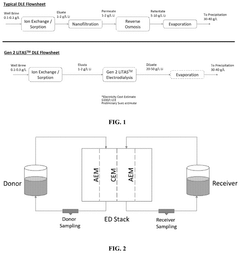
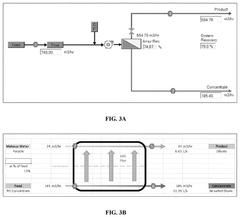
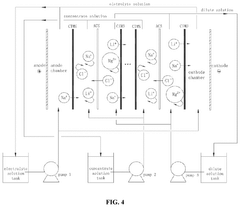
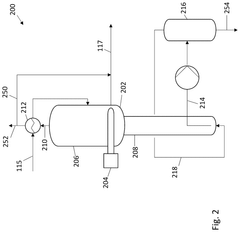
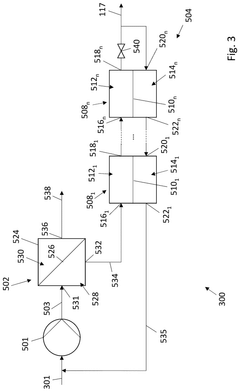
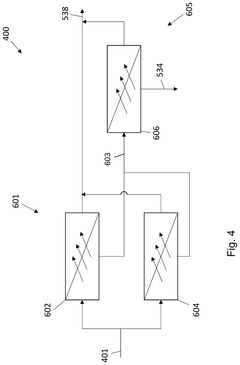
- The integration of selective membrane electrodialysis as a single step to simultaneously concentrate and purify lithium brines, reducing the number of required processing steps, capital and operating costs, and carbon footprint, while eliminating the need for large equipment at remote mining locations.
Method of recovering lithium from a lithium source
PatentPendingUS20250177923A1
Innovation
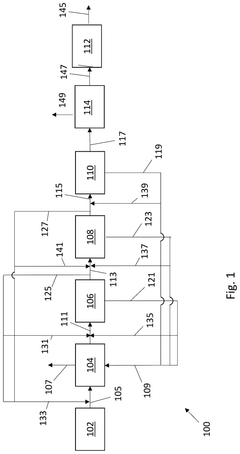
- The method involves direct lithium extraction using techniques such as electrochemical separation, solvent extraction, ion withdrawal, or membrane separation, followed by purification, concentration, and removal of monovalent impurities to yield a purified lithium concentrate.
Environmental Impact Assessment of DLE Methods
The environmental impact assessment of Direct Lithium Extraction (DLE) methods reveals significant advantages over traditional extraction techniques, particularly regarding solvent usage minimization. DLE technologies demonstrate substantially reduced water consumption compared to conventional evaporation ponds, with some advanced systems achieving up to 90% water reduction. This represents a critical advancement for lithium production in water-scarce regions where traditional methods consume approximately 500,000 gallons of water per ton of lithium produced.
Solvent-based DLE methods have evolved to incorporate closed-loop systems that recycle extraction media, dramatically reducing chemical waste generation. Recent field implementations show that optimized ion-exchange and adsorption-based DLE processes can operate with minimal solvent replacement, extending media lifespan to 3-5 years before requiring regeneration or replacement.
Land disturbance metrics indicate DLE facilities require approximately 50-90% less surface area than traditional evaporation ponds, significantly reducing habitat disruption and biodiversity impacts. The compact nature of these systems allows for more responsible land stewardship in ecologically sensitive areas, particularly in the lithium triangle of South America where traditional operations have faced criticism for extensive land use.
Carbon footprint analyses of modern DLE operations demonstrate varied results depending on energy sources utilized. While the process intensification requires higher energy inputs than passive evaporation methods, the overall lifecycle assessment reveals that DLE can achieve lower greenhouse gas emissions when powered by renewable energy sources. Studies indicate potential carbon reductions of 30-60% compared to conventional methods when utilizing solar or geothermal energy.
Waste stream characterization from pilot DLE projects shows promising results in terms of reduced brine alteration. The selective extraction mechanisms leave most non-target elements in the brine, potentially allowing for more responsible reinjection practices that maintain hydrogeological balance. This represents a significant improvement over evaporation methods that permanently remove large volumes of brine from aquifer systems.
Regulatory compliance assessments indicate that DLE methods generally align better with strengthening environmental protection standards worldwide. The controlled processing environment facilitates more effective monitoring and management of potential contaminants, supporting companies in meeting increasingly stringent environmental regulations in major markets including the EU, North America, and parts of Asia.
Solvent-based DLE methods have evolved to incorporate closed-loop systems that recycle extraction media, dramatically reducing chemical waste generation. Recent field implementations show that optimized ion-exchange and adsorption-based DLE processes can operate with minimal solvent replacement, extending media lifespan to 3-5 years before requiring regeneration or replacement.
Land disturbance metrics indicate DLE facilities require approximately 50-90% less surface area than traditional evaporation ponds, significantly reducing habitat disruption and biodiversity impacts. The compact nature of these systems allows for more responsible land stewardship in ecologically sensitive areas, particularly in the lithium triangle of South America where traditional operations have faced criticism for extensive land use.
Carbon footprint analyses of modern DLE operations demonstrate varied results depending on energy sources utilized. While the process intensification requires higher energy inputs than passive evaporation methods, the overall lifecycle assessment reveals that DLE can achieve lower greenhouse gas emissions when powered by renewable energy sources. Studies indicate potential carbon reductions of 30-60% compared to conventional methods when utilizing solar or geothermal energy.
Waste stream characterization from pilot DLE projects shows promising results in terms of reduced brine alteration. The selective extraction mechanisms leave most non-target elements in the brine, potentially allowing for more responsible reinjection practices that maintain hydrogeological balance. This represents a significant improvement over evaporation methods that permanently remove large volumes of brine from aquifer systems.
Regulatory compliance assessments indicate that DLE methods generally align better with strengthening environmental protection standards worldwide. The controlled processing environment facilitates more effective monitoring and management of potential contaminants, supporting companies in meeting increasingly stringent environmental regulations in major markets including the EU, North America, and parts of Asia.
Economic Viability of Advanced DLE Technologies
The economic viability of advanced Direct Lithium Extraction (DLE) technologies hinges on several interconnected factors that determine their commercial feasibility in the competitive lithium market. Cost-benefit analyses indicate that while traditional extraction methods have lower initial capital expenditure, advanced DLE technologies with minimized solvent usage demonstrate superior long-term economic returns through reduced operational expenses and environmental compliance costs.
Investment requirements for implementing cutting-edge DLE technologies typically range from $20-50 million for medium-scale operations, with larger commercial installations potentially exceeding $100 million. However, these technologies offer operational cost reductions of 30-45% compared to conventional evaporation pond methods, primarily through decreased solvent consumption, energy efficiency, and accelerated extraction timeframes.
The economic equation is further balanced by significantly higher lithium recovery rates of 80-90% for advanced DLE systems versus 40-50% for traditional methods. This efficiency translates directly to increased revenue potential per extraction site, improving the return on investment timeline from 7-10 years to 3-5 years in optimal scenarios.
Market sensitivity analysis reveals that advanced DLE technologies with minimal solvent requirements maintain profitability even when lithium carbonate prices drop to $8,000 per ton, whereas conventional methods become economically unviable below $12,000 per ton. This resilience to market fluctuations represents a critical economic advantage in the volatile commodity landscape.
Economies of scale play a decisive role in DLE economics, with unit costs decreasing approximately 25-30% when production capacity doubles. This scaling effect is particularly pronounced in technologies that minimize solvent usage through innovative materials and process designs, as the relative savings on chemical inputs compound at larger operational scales.
The economic proposition is further strengthened by reduced environmental liabilities and regulatory compliance costs. Advanced DLE technologies with minimal solvent footprints typically incur 60-70% lower environmental remediation expenses and face fewer regulatory hurdles, accelerating time-to-market and reducing legal exposure risks that could otherwise undermine project economics.
Financing models are evolving to accommodate these technologies, with several specialized investment funds now offering preferential terms for environmentally optimized extraction projects. This access to green financing can reduce capital costs by 1-2 percentage points, further enhancing the economic case for advanced DLE implementation with minimized chemical inputs.
Investment requirements for implementing cutting-edge DLE technologies typically range from $20-50 million for medium-scale operations, with larger commercial installations potentially exceeding $100 million. However, these technologies offer operational cost reductions of 30-45% compared to conventional evaporation pond methods, primarily through decreased solvent consumption, energy efficiency, and accelerated extraction timeframes.
The economic equation is further balanced by significantly higher lithium recovery rates of 80-90% for advanced DLE systems versus 40-50% for traditional methods. This efficiency translates directly to increased revenue potential per extraction site, improving the return on investment timeline from 7-10 years to 3-5 years in optimal scenarios.
Market sensitivity analysis reveals that advanced DLE technologies with minimal solvent requirements maintain profitability even when lithium carbonate prices drop to $8,000 per ton, whereas conventional methods become economically unviable below $12,000 per ton. This resilience to market fluctuations represents a critical economic advantage in the volatile commodity landscape.
Economies of scale play a decisive role in DLE economics, with unit costs decreasing approximately 25-30% when production capacity doubles. This scaling effect is particularly pronounced in technologies that minimize solvent usage through innovative materials and process designs, as the relative savings on chemical inputs compound at larger operational scales.
The economic proposition is further strengthened by reduced environmental liabilities and regulatory compliance costs. Advanced DLE technologies with minimal solvent footprints typically incur 60-70% lower environmental remediation expenses and face fewer regulatory hurdles, accelerating time-to-market and reducing legal exposure risks that could otherwise undermine project economics.
Financing models are evolving to accommodate these technologies, with several specialized investment funds now offering preferential terms for environmentally optimized extraction projects. This access to green financing can reduce capital costs by 1-2 percentage points, further enhancing the economic case for advanced DLE implementation with minimized chemical inputs.
Unlock deeper insights with Patsnap Eureka Quick Research — get a full tech report to explore trends and direct your research. Try now!
Generate Your Research Report Instantly with AI Agent
Supercharge your innovation with Patsnap Eureka AI Agent Platform!