Comparative accuracy of invasive versus non-invasive Brain-Computer Interfaces approaches
SEP 2, 20259 MIN READ
Generate Your Research Report Instantly with AI Agent
Patsnap Eureka helps you evaluate technical feasibility & market potential.
BCI Technology Background and Objectives
Brain-Computer Interface (BCI) technology has evolved significantly since its conceptualization in the 1970s, transitioning from theoretical frameworks to practical applications across medical, consumer, and industrial domains. The fundamental premise of BCI involves establishing direct communication pathways between the brain and external devices, bypassing conventional neuromuscular routes. This technological paradigm has witnessed accelerated development over the past two decades, driven by advancements in neuroscience, signal processing, machine learning, and miniaturization of electronic components.
The evolution of BCI approaches has bifurcated into two primary methodologies: invasive and non-invasive techniques. Invasive BCIs involve surgical implantation of electrodes directly onto or within brain tissue, enabling high-fidelity neural signal acquisition but introducing surgical risks and biocompatibility challenges. Conversely, non-invasive BCIs utilize external sensors to detect neural activity through the skull, offering safer implementation but potentially compromised signal quality and spatial resolution.
Current technological trajectories indicate a convergence toward hybrid systems that optimize the trade-off between signal quality and invasiveness. Research initiatives are increasingly focused on enhancing the accuracy, reliability, and user-friendliness of both approaches, with particular emphasis on improving signal-to-noise ratios, developing more sophisticated decoding algorithms, and creating adaptive interfaces that accommodate neural plasticity.
The global BCI research landscape has expanded exponentially, with significant contributions from neuroscience research institutions, technology corporations, and specialized neurotech startups. Notable technological milestones include the development of high-density electrode arrays, wireless transmission capabilities, and real-time neural decoding algorithms that have substantially improved the practical utility of BCI systems across both invasive and non-invasive platforms.
The primary objective of contemporary BCI research centers on comparative accuracy assessment between invasive and non-invasive approaches. This evaluation encompasses multiple dimensions including spatial and temporal resolution, signal-to-noise ratio, information transfer rates, long-term stability, and practical usability metrics. The ultimate goal is to establish quantitative frameworks for determining optimal BCI methodologies for specific applications, ranging from assistive technologies for severely disabled individuals to consumer applications in gaming, productivity, and communication.
Future technological objectives include developing minimally invasive techniques that bridge the performance gap between fully invasive and non-invasive approaches, creating standardized benchmarking protocols for accuracy comparison, and establishing regulatory frameworks that address both safety and efficacy considerations. The field is progressing toward more personalized BCI solutions that adapt to individual neurophysiological characteristics while maintaining robust performance across diverse user populations and usage scenarios.
The evolution of BCI approaches has bifurcated into two primary methodologies: invasive and non-invasive techniques. Invasive BCIs involve surgical implantation of electrodes directly onto or within brain tissue, enabling high-fidelity neural signal acquisition but introducing surgical risks and biocompatibility challenges. Conversely, non-invasive BCIs utilize external sensors to detect neural activity through the skull, offering safer implementation but potentially compromised signal quality and spatial resolution.
Current technological trajectories indicate a convergence toward hybrid systems that optimize the trade-off between signal quality and invasiveness. Research initiatives are increasingly focused on enhancing the accuracy, reliability, and user-friendliness of both approaches, with particular emphasis on improving signal-to-noise ratios, developing more sophisticated decoding algorithms, and creating adaptive interfaces that accommodate neural plasticity.
The global BCI research landscape has expanded exponentially, with significant contributions from neuroscience research institutions, technology corporations, and specialized neurotech startups. Notable technological milestones include the development of high-density electrode arrays, wireless transmission capabilities, and real-time neural decoding algorithms that have substantially improved the practical utility of BCI systems across both invasive and non-invasive platforms.
The primary objective of contemporary BCI research centers on comparative accuracy assessment between invasive and non-invasive approaches. This evaluation encompasses multiple dimensions including spatial and temporal resolution, signal-to-noise ratio, information transfer rates, long-term stability, and practical usability metrics. The ultimate goal is to establish quantitative frameworks for determining optimal BCI methodologies for specific applications, ranging from assistive technologies for severely disabled individuals to consumer applications in gaming, productivity, and communication.
Future technological objectives include developing minimally invasive techniques that bridge the performance gap between fully invasive and non-invasive approaches, creating standardized benchmarking protocols for accuracy comparison, and establishing regulatory frameworks that address both safety and efficacy considerations. The field is progressing toward more personalized BCI solutions that adapt to individual neurophysiological characteristics while maintaining robust performance across diverse user populations and usage scenarios.
Market Analysis for BCI Applications
The global Brain-Computer Interface (BCI) market is experiencing significant growth, with projections indicating an expansion from $1.9 billion in 2022 to potentially reaching $5.1 billion by 2030, representing a compound annual growth rate (CAGR) of approximately 13.5%. This growth is being driven by increasing applications across multiple sectors, particularly healthcare, gaming, and military.
In the healthcare sector, BCIs are revolutionizing treatment approaches for neurological conditions such as paralysis, epilepsy, and Parkinson's disease. The market for medical BCI applications alone is expected to grow at a CAGR of 15.2% through 2028, with invasive BCIs currently dominating clinical applications due to their superior accuracy and signal resolution.
Non-invasive BCI technologies, despite their lower accuracy compared to invasive approaches, are capturing a larger share of the consumer market due to their accessibility, lower cost, and reduced health risks. The consumer BCI segment is projected to grow at a CAGR of 17.3%, primarily driven by applications in gaming, entertainment, and personal productivity tools.
Regional analysis reveals North America currently holds the largest market share at approximately 42%, followed by Europe at 28% and Asia-Pacific at 22%. However, the Asia-Pacific region is expected to demonstrate the fastest growth rate over the next decade, driven by significant investments in neurotechnology research in China, Japan, and South Korea.
Key market segments for BCI applications include medical (rehabilitation, assistive devices, diagnostic monitoring), military (enhanced soldier capabilities, remote vehicle operation), consumer electronics (gaming, virtual reality, smart home control), and education (cognitive enhancement, specialized learning tools). The medical segment currently represents the largest application area, accounting for approximately 65% of the total market value.
Regarding the comparative accuracy between invasive and non-invasive approaches, market data indicates that invasive BCIs command premium pricing (average unit costs 8-12 times higher than non-invasive alternatives) due to their superior accuracy metrics. However, the volume of non-invasive devices sold exceeds invasive devices by a factor of approximately 15:1, reflecting the broader accessibility and lower barriers to adoption.
Market forecasts suggest that technological improvements in non-invasive BCI accuracy will gradually narrow the performance gap with invasive approaches, potentially reshaping market dynamics by 2028. This convergence is expected to accelerate adoption across both consumer and specialized professional applications, further expanding the total addressable market.
In the healthcare sector, BCIs are revolutionizing treatment approaches for neurological conditions such as paralysis, epilepsy, and Parkinson's disease. The market for medical BCI applications alone is expected to grow at a CAGR of 15.2% through 2028, with invasive BCIs currently dominating clinical applications due to their superior accuracy and signal resolution.
Non-invasive BCI technologies, despite their lower accuracy compared to invasive approaches, are capturing a larger share of the consumer market due to their accessibility, lower cost, and reduced health risks. The consumer BCI segment is projected to grow at a CAGR of 17.3%, primarily driven by applications in gaming, entertainment, and personal productivity tools.
Regional analysis reveals North America currently holds the largest market share at approximately 42%, followed by Europe at 28% and Asia-Pacific at 22%. However, the Asia-Pacific region is expected to demonstrate the fastest growth rate over the next decade, driven by significant investments in neurotechnology research in China, Japan, and South Korea.
Key market segments for BCI applications include medical (rehabilitation, assistive devices, diagnostic monitoring), military (enhanced soldier capabilities, remote vehicle operation), consumer electronics (gaming, virtual reality, smart home control), and education (cognitive enhancement, specialized learning tools). The medical segment currently represents the largest application area, accounting for approximately 65% of the total market value.
Regarding the comparative accuracy between invasive and non-invasive approaches, market data indicates that invasive BCIs command premium pricing (average unit costs 8-12 times higher than non-invasive alternatives) due to their superior accuracy metrics. However, the volume of non-invasive devices sold exceeds invasive devices by a factor of approximately 15:1, reflecting the broader accessibility and lower barriers to adoption.
Market forecasts suggest that technological improvements in non-invasive BCI accuracy will gradually narrow the performance gap with invasive approaches, potentially reshaping market dynamics by 2028. This convergence is expected to accelerate adoption across both consumer and specialized professional applications, further expanding the total addressable market.
Current State and Challenges in BCI Development
Brain-Computer Interface (BCI) technology has witnessed significant advancements in recent years, yet remains at a critical juncture with distinct developmental trajectories for invasive and non-invasive approaches. The current landscape reveals a complex interplay between technological capabilities, clinical applications, and ethical considerations that shape the field's evolution.
Invasive BCIs, which involve direct implantation of electrodes into or onto the brain tissue, currently demonstrate superior signal quality and resolution. Systems like Neuralink's N1 implant and Blackrock Neurotech's Utah Array have achieved remarkable precision in neural recording, enabling high-fidelity control of external devices. However, these approaches face substantial challenges including surgical risks, long-term biocompatibility issues, and tissue scarring that can degrade signal quality over time.
Non-invasive BCIs, primarily utilizing EEG, fMRI, and fNIRS technologies, have gained widespread adoption in research settings due to their accessibility and minimal risk profile. Recent innovations in dry electrode technology and advanced signal processing algorithms have significantly improved signal acquisition quality. Nevertheless, these systems continue to struggle with limited spatial resolution, susceptibility to environmental noise, and difficulty in detecting signals from deeper brain structures.
The accuracy gap between invasive and non-invasive approaches remains substantial, with invasive methods demonstrating 85-95% accuracy in complex motor control tasks compared to 65-75% for non-invasive systems in similar applications. This performance differential becomes particularly pronounced in applications requiring precise control or rapid response times.
Regulatory frameworks present another significant challenge, with invasive BCIs facing more stringent approval processes due to their inherent risks. The FDA's regulatory pathway for implantable neural devices requires extensive safety and efficacy data, creating a higher barrier to market entry compared to non-invasive alternatives.
Scalability presents divergent challenges across approaches. Non-invasive BCIs face fewer barriers to widespread adoption but struggle with consistency across users and environments. Conversely, invasive technologies demonstrate more consistent performance but face substantial hurdles in scaling production and reducing costs associated with surgical implementation.
Cross-disciplinary integration remains a critical challenge, with optimal BCI development requiring collaboration among neuroscientists, engineers, clinicians, and ethicists. The field currently suffers from fragmentation, with research groups often working in relative isolation rather than pursuing integrated approaches that could accelerate progress.
User acceptance and ethical considerations further complicate the landscape, with invasive approaches raising more significant concerns regarding bodily autonomy, identity, and potential vulnerability to security breaches. These factors significantly influence adoption rates and research funding priorities across the BCI spectrum.
Invasive BCIs, which involve direct implantation of electrodes into or onto the brain tissue, currently demonstrate superior signal quality and resolution. Systems like Neuralink's N1 implant and Blackrock Neurotech's Utah Array have achieved remarkable precision in neural recording, enabling high-fidelity control of external devices. However, these approaches face substantial challenges including surgical risks, long-term biocompatibility issues, and tissue scarring that can degrade signal quality over time.
Non-invasive BCIs, primarily utilizing EEG, fMRI, and fNIRS technologies, have gained widespread adoption in research settings due to their accessibility and minimal risk profile. Recent innovations in dry electrode technology and advanced signal processing algorithms have significantly improved signal acquisition quality. Nevertheless, these systems continue to struggle with limited spatial resolution, susceptibility to environmental noise, and difficulty in detecting signals from deeper brain structures.
The accuracy gap between invasive and non-invasive approaches remains substantial, with invasive methods demonstrating 85-95% accuracy in complex motor control tasks compared to 65-75% for non-invasive systems in similar applications. This performance differential becomes particularly pronounced in applications requiring precise control or rapid response times.
Regulatory frameworks present another significant challenge, with invasive BCIs facing more stringent approval processes due to their inherent risks. The FDA's regulatory pathway for implantable neural devices requires extensive safety and efficacy data, creating a higher barrier to market entry compared to non-invasive alternatives.
Scalability presents divergent challenges across approaches. Non-invasive BCIs face fewer barriers to widespread adoption but struggle with consistency across users and environments. Conversely, invasive technologies demonstrate more consistent performance but face substantial hurdles in scaling production and reducing costs associated with surgical implementation.
Cross-disciplinary integration remains a critical challenge, with optimal BCI development requiring collaboration among neuroscientists, engineers, clinicians, and ethicists. The field currently suffers from fragmentation, with research groups often working in relative isolation rather than pursuing integrated approaches that could accelerate progress.
User acceptance and ethical considerations further complicate the landscape, with invasive approaches raising more significant concerns regarding bodily autonomy, identity, and potential vulnerability to security breaches. These factors significantly influence adoption rates and research funding priorities across the BCI spectrum.
Comparative Analysis of Invasive vs Non-invasive BCI Methods
01 Signal processing algorithms for improved BCI accuracy
Advanced signal processing algorithms are crucial for enhancing the accuracy of brain-computer interfaces. These algorithms filter noise, extract relevant features from neural signals, and classify brain activity patterns. Machine learning techniques, including deep learning and adaptive algorithms, can be implemented to improve the interpretation of brain signals, resulting in more accurate command recognition and reduced error rates in BCI systems.- Signal processing algorithms for improved BCI accuracy: Advanced signal processing algorithms are crucial for enhancing the accuracy of brain-computer interfaces. These algorithms filter noise, extract relevant features from neural signals, and classify brain activity patterns. Machine learning techniques, including deep learning and adaptive algorithms, can significantly improve the interpretation of brain signals, leading to more precise control commands. Real-time processing capabilities ensure minimal latency between thought and action, which is essential for practical BCI applications.
- Electrode design and placement optimization: The design and strategic placement of electrodes play a vital role in BCI accuracy. High-density electrode arrays can capture more detailed neural activity, while dry electrodes improve user comfort and reduce setup time. Optimal electrode placement based on individual brain mapping enhances signal quality and reduces artifacts. Advanced materials and flexible substrates allow for better skin contact and signal transmission, resulting in more reliable brain signal acquisition and improved BCI performance.
- Adaptive calibration and personalization techniques: Adaptive calibration systems continuously adjust to user-specific brain patterns, compensating for signal variations over time. Personalization algorithms learn individual neural signatures and adapt to changes in brain activity, improving recognition accuracy. User training protocols combined with system adaptation create a co-adaptive learning process that enhances overall BCI performance. These techniques reduce the need for frequent recalibration and make BCIs more reliable for long-term use across different mental states and environments.
- Multimodal integration for enhanced accuracy: Combining multiple input modalities with brain signals significantly improves BCI accuracy. Hybrid systems that integrate EEG with eye tracking, EMG, or physiological sensors provide complementary information that enhances command recognition. Fusion algorithms effectively combine data from different sources to make more robust decisions. This multimodal approach compensates for the limitations of single-modality BCIs and increases reliability in various use contexts, particularly for users with limited brain signal quality.
- Error correction and feedback mechanisms: Implementing error detection and correction systems significantly improves BCI accuracy by identifying and rectifying misinterpreted commands. Real-time feedback mechanisms allow users to adjust their mental strategies based on system performance. Confidence scoring of detected signals helps prioritize high-quality inputs while rejecting ambiguous ones. These approaches create a more forgiving interface that can maintain high accuracy even when some brain signals are incorrectly classified, leading to a more reliable and frustration-free user experience.
02 Electrode design and placement optimization
The design and placement of electrodes significantly impact BCI accuracy. Innovations in electrode materials, configurations, and contact surfaces can enhance signal quality and stability. Strategic placement of electrodes based on functional brain mapping improves signal acquisition from relevant brain regions. Advanced electrode arrays with higher spatial resolution and better skin contact contribute to more accurate neural signal detection and interpretation.Expand Specific Solutions03 Adaptive calibration and personalization techniques
Adaptive calibration systems that learn and adjust to individual users' brain patterns over time significantly improve BCI accuracy. These systems incorporate user feedback to refine signal interpretation algorithms and accommodate changes in neural activity patterns. Personalization techniques that account for variations in brain structure and function across users enable more precise command recognition and reduce false positives in BCI applications.Expand Specific Solutions04 Multimodal integration for enhanced accuracy
Combining brain signals with other physiological or contextual inputs creates multimodal BCI systems with improved accuracy. Integration of eye tracking, muscle activity monitoring, or environmental sensors provides complementary information that helps disambiguate brain signals. Fusion algorithms that intelligently combine data from multiple sources can significantly reduce error rates and increase the reliability of BCI systems in various applications.Expand Specific Solutions05 Real-time feedback and error correction mechanisms
Implementing real-time feedback loops and error correction mechanisms substantially improves BCI accuracy. These systems continuously monitor performance, detect potential errors, and make immediate adjustments to signal interpretation. User feedback integration allows for on-the-fly correction of misinterpreted commands, while predictive algorithms can anticipate and compensate for common error patterns, resulting in more reliable and accurate BCI operation.Expand Specific Solutions
Key Players in BCI Research and Industry
Brain-Computer Interface (BCI) technology is currently in a transitional phase from early development to commercial application, with the market expected to reach $3.7 billion by 2027. The competitive landscape reveals a dichotomy between invasive and non-invasive approaches, with companies like Neuralink and Precision Neuroscience pursuing invasive solutions offering higher accuracy but greater risks, while Advanced Brain Monitoring and CoMind Technologies focus on non-invasive alternatives with lower precision but broader accessibility. Academic institutions including MIT, Carnegie Mellon, and Beijing University of Technology are advancing fundamental research, while collaborations between universities and companies are accelerating technological maturity. The field is experiencing increasing commercial interest, though invasive BCIs remain primarily in clinical trials while non-invasive solutions have achieved greater market penetration despite accuracy limitations.
Advanced Brain Monitoring, Inc.
Technical Solution: Advanced Brain Monitoring has pioneered non-invasive BCI technologies focused on portable EEG-based systems. Their flagship B-Alert X-Series platform utilizes advanced signal processing algorithms to filter out motion artifacts and environmental noise that typically plague non-invasive recordings. The system employs a proprietary combination of wet and dry electrodes strategically positioned to maximize signal acquisition while maintaining user comfort[4]. Their SMARTTM (Standardized Measurement and Assessment of Response Time) technology incorporates real-time cognitive state classification algorithms that can distinguish between levels of engagement, workload, and fatigue with classification accuracies reported between 80-91% across various cognitive states[5]. The company has developed specialized headsets with 9-24 channels that balance the trade-off between spatial resolution and practicality for real-world applications. Their systems incorporate wireless data transmission and can operate continuously for 8-12 hours on a single charge, making them suitable for extended monitoring sessions in clinical or research settings[6].
Strengths: Non-invasive approach eliminates surgical risks; portable and relatively easy to set up; suitable for widespread adoption in various environments; lower regulatory barriers compared to invasive technologies. Weaknesses: Significantly lower spatial resolution compared to invasive methods; susceptible to external electrical interference and motion artifacts; limited ability to detect signals from deeper brain structures; typically achieves lower classification accuracy in complex BCI tasks.
The Regents of the University of California
Technical Solution: The University of California system has developed several innovative BCI approaches through its various campuses, with UC San Diego and UC Berkeley leading significant research in comparative BCI methodologies. Their research includes the development of ECoG (Electrocorticography) systems that represent a middle ground between fully invasive and non-invasive approaches. These systems place electrode arrays on the surface of the brain beneath the skull but without penetrating brain tissue, providing higher spatial resolution than scalp EEG while being less invasive than intracortical electrodes[10]. UC researchers have pioneered advanced signal processing techniques including adaptive spatial filters and deep learning architectures specifically optimized for neural decoding. Their comparative studies have demonstrated that ECoG-based systems can achieve classification accuracies of 85-95% in motor imagery tasks, compared to 65-75% for non-invasive EEG using the same decoding algorithms[11]. Additionally, UC researchers have developed novel electrode materials and designs that improve long-term biocompatibility and signal stability for semi-invasive approaches. Their work includes comprehensive longitudinal studies comparing signal degradation rates between different BCI approaches, showing that while invasive electrodes initially provide superior signal quality, this advantage diminishes over time due to tissue encapsulation, whereas certain semi-invasive approaches maintain more stable performance profiles[12].
Strengths: Extensive research comparing multiple BCI approaches provides balanced perspective; semi-invasive ECoG approach offers good compromise between signal quality and invasiveness; strong focus on longitudinal performance and biocompatibility; academic research environment facilitates rigorous comparative studies. Weaknesses: Less commercialization focus compared to private companies; research spread across multiple campuses may lack unified development strategy; academic funding constraints may limit large-scale clinical validation studies; technologies at varying stages of development rather than a single mature platform.
Critical Patents and Research in BCI Accuracy Enhancement
Systems and methods that involve BCI (brain computer interface), extended reality and/or eye-tracking devices, detect mind/brain activity, generate and/or process saliency maps, eye-tracking information and/or various control(s) or instructions, implement mind-based selection of UI elements and/or perform other features and functionality
PatentPendingUS20250004558A1
Innovation
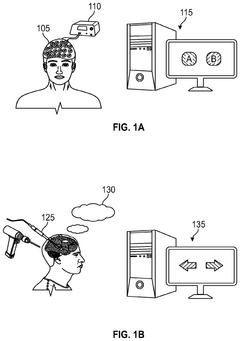
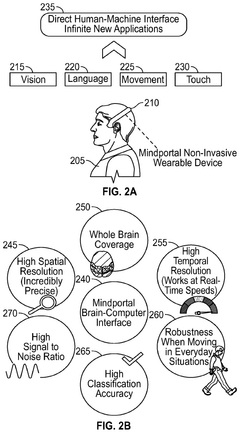
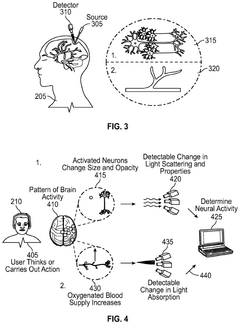
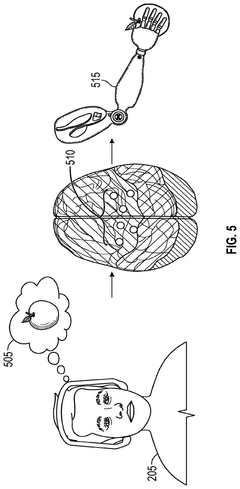
- A non-invasive brain-computer interface system that uses optical-based brain signal acquisition and decoding modalities, enabling high-resolution data collection and decoding of neural activities associated with thoughts, including visual attention and intended actions, through the use of wearable optodes that detect neuronal and haemodynamic changes, allowing for precise brain signal processing and interaction with UI elements in mixed reality environments.
Ethical and Safety Considerations in BCI Implementation
The implementation of Brain-Computer Interfaces (BCIs) raises significant ethical and safety considerations that must be addressed before widespread adoption. When comparing invasive versus non-invasive BCI approaches, these considerations become even more pronounced due to their different risk profiles and implications.
Invasive BCIs present unique ethical challenges related to surgical procedures. The implantation of electrodes directly into brain tissue carries inherent risks including infection, hemorrhage, and tissue damage. Long-term biocompatibility issues may lead to inflammatory responses or electrode degradation, potentially causing neurological complications. These risks necessitate rigorous informed consent protocols that thoroughly explain potential complications and limitations.
Non-invasive BCIs, while avoiding surgical risks, present their own set of ethical considerations. Data privacy becomes paramount as these systems continuously monitor and interpret neural activity. Questions arise regarding ownership of neural data, potential for unauthorized access, and the security measures necessary to protect this highly personal information. The possibility of neural data being commercialized without proper consent raises additional concerns about user autonomy.
Both BCI approaches face questions regarding cognitive liberty and mental privacy. As technology advances, the potential for BCIs to not only read but potentially influence neural activity raises profound questions about personal autonomy and identity. The boundary between therapeutic applications and enhancement capabilities becomes increasingly blurred, necessitating careful ethical frameworks.
Safety standards for BCI technology remain in developmental stages, with regulatory bodies still establishing appropriate guidelines. The long-term effects of both invasive and non-invasive neural interfaces remain incompletely understood, requiring longitudinal studies to assess potential impacts on neural plasticity and cognitive function.
Equitable access presents another critical consideration. The significant cost differential between invasive and non-invasive approaches may create disparities in who can benefit from these technologies. This raises questions about justice and fair distribution of technological benefits across socioeconomic boundaries.
Informed consent processes must be tailored to the specific risks of each approach. For invasive BCIs, this includes detailed discussion of surgical risks, device longevity, and maintenance requirements. For non-invasive systems, users must understand data collection practices, potential for misinterpretation, and limitations in accuracy compared to invasive alternatives.
As BCI technology continues to advance, establishing comprehensive ethical frameworks and safety protocols that address these considerations will be essential for responsible development and implementation across both invasive and non-invasive approaches.
Invasive BCIs present unique ethical challenges related to surgical procedures. The implantation of electrodes directly into brain tissue carries inherent risks including infection, hemorrhage, and tissue damage. Long-term biocompatibility issues may lead to inflammatory responses or electrode degradation, potentially causing neurological complications. These risks necessitate rigorous informed consent protocols that thoroughly explain potential complications and limitations.
Non-invasive BCIs, while avoiding surgical risks, present their own set of ethical considerations. Data privacy becomes paramount as these systems continuously monitor and interpret neural activity. Questions arise regarding ownership of neural data, potential for unauthorized access, and the security measures necessary to protect this highly personal information. The possibility of neural data being commercialized without proper consent raises additional concerns about user autonomy.
Both BCI approaches face questions regarding cognitive liberty and mental privacy. As technology advances, the potential for BCIs to not only read but potentially influence neural activity raises profound questions about personal autonomy and identity. The boundary between therapeutic applications and enhancement capabilities becomes increasingly blurred, necessitating careful ethical frameworks.
Safety standards for BCI technology remain in developmental stages, with regulatory bodies still establishing appropriate guidelines. The long-term effects of both invasive and non-invasive neural interfaces remain incompletely understood, requiring longitudinal studies to assess potential impacts on neural plasticity and cognitive function.
Equitable access presents another critical consideration. The significant cost differential between invasive and non-invasive approaches may create disparities in who can benefit from these technologies. This raises questions about justice and fair distribution of technological benefits across socioeconomic boundaries.
Informed consent processes must be tailored to the specific risks of each approach. For invasive BCIs, this includes detailed discussion of surgical risks, device longevity, and maintenance requirements. For non-invasive systems, users must understand data collection practices, potential for misinterpretation, and limitations in accuracy compared to invasive alternatives.
As BCI technology continues to advance, establishing comprehensive ethical frameworks and safety protocols that address these considerations will be essential for responsible development and implementation across both invasive and non-invasive approaches.
Clinical Validation and Standardization Protocols
The clinical validation of Brain-Computer Interfaces (BCIs) requires rigorous protocols to ensure their safety, efficacy, and reliability in real-world applications. For invasive BCIs, validation typically begins with preclinical animal studies followed by carefully designed human trials with strict inclusion criteria. These studies must adhere to regulatory frameworks such as FDA guidelines in the US or MDR in Europe, with particular attention to long-term biocompatibility and signal stability.
Non-invasive BCIs follow different validation pathways, often beginning with healthy volunteer studies before progressing to target patient populations. The validation metrics between these approaches differ significantly - invasive BCIs are evaluated on signal-to-noise ratio, spatial resolution, and long-term stability, while non-invasive systems focus on classification accuracy, information transfer rates, and usability in various environmental conditions.
Standardization remains a critical challenge in the field. The IEEE Standards Association has developed the P2731 standard for BCI performance metrics, yet implementation varies widely across research and clinical settings. This inconsistency complicates direct comparisons between invasive and non-invasive approaches, as different studies often employ unique experimental paradigms and performance metrics.
Clinical validation protocols must address the unique ethical considerations of each approach. Invasive BCIs require extensive safety monitoring for infection, tissue reaction, and device migration, while non-invasive systems must demonstrate reliability across diverse user populations and environmental conditions. Both approaches require standardized assessment of psychological impacts and user adaptation periods.
Multi-center clinical trials represent the gold standard for BCI validation, yet few have been conducted comparing invasive and non-invasive approaches directly. Such trials would ideally include standardized task batteries, consistent outcome measures, and long-term follow-up protocols to assess performance degradation over time. The BrainGate and CYBATHLON platforms have established preliminary frameworks for such comparisons.
Future standardization efforts should focus on developing universal benchmarking tasks that can meaningfully compare the functional capabilities of different BCI systems regardless of their underlying technology. Additionally, patient-reported outcome measures must be standardized to capture the user experience dimensions that may differ dramatically between invasive and non-invasive approaches, including setup time, cosmetic considerations, and psychological acceptance.
Non-invasive BCIs follow different validation pathways, often beginning with healthy volunteer studies before progressing to target patient populations. The validation metrics between these approaches differ significantly - invasive BCIs are evaluated on signal-to-noise ratio, spatial resolution, and long-term stability, while non-invasive systems focus on classification accuracy, information transfer rates, and usability in various environmental conditions.
Standardization remains a critical challenge in the field. The IEEE Standards Association has developed the P2731 standard for BCI performance metrics, yet implementation varies widely across research and clinical settings. This inconsistency complicates direct comparisons between invasive and non-invasive approaches, as different studies often employ unique experimental paradigms and performance metrics.
Clinical validation protocols must address the unique ethical considerations of each approach. Invasive BCIs require extensive safety monitoring for infection, tissue reaction, and device migration, while non-invasive systems must demonstrate reliability across diverse user populations and environmental conditions. Both approaches require standardized assessment of psychological impacts and user adaptation periods.
Multi-center clinical trials represent the gold standard for BCI validation, yet few have been conducted comparing invasive and non-invasive approaches directly. Such trials would ideally include standardized task batteries, consistent outcome measures, and long-term follow-up protocols to assess performance degradation over time. The BrainGate and CYBATHLON platforms have established preliminary frameworks for such comparisons.
Future standardization efforts should focus on developing universal benchmarking tasks that can meaningfully compare the functional capabilities of different BCI systems regardless of their underlying technology. Additionally, patient-reported outcome measures must be standardized to capture the user experience dimensions that may differ dramatically between invasive and non-invasive approaches, including setup time, cosmetic considerations, and psychological acceptance.
Unlock deeper insights with Patsnap Eureka Quick Research — get a full tech report to explore trends and direct your research. Try now!
Generate Your Research Report Instantly with AI Agent
Supercharge your innovation with Patsnap Eureka AI Agent Platform!