

Comparing Radial Engine and Boxter Engine Output Metrics
SEP 12, 20259 MIN READ
Generate Your Research Report Instantly with AI Agent
PatSnap Eureka helps you evaluate technical feasibility & market potential.
Radial and Boxer Engine Development History and Objectives
The evolution of internal combustion engines has been marked by continuous innovation since their inception in the late 19th century. Radial engines emerged as a dominant design in aviation during the early 20th century, with their distinctive star-shaped configuration offering advantages in cooling and power-to-weight ratio. The first practical radial engine was developed by Charles Manly in 1901, featuring five cylinders arranged radially around a central crankshaft.
By the 1920s and 1930s, radial engines had become the standard for aircraft propulsion, with manufacturers like Pratt & Whitney and Wright Aeronautical producing iconic models such as the R-1340 Wasp and R-3350 Duplex-Cyclone. These engines powered military and commercial aircraft through World War II, with continuous improvements in power output, reliability, and fuel efficiency.
Concurrently, boxer engines (also known as flat or horizontally opposed engines) were developing along a different trajectory. Their origins can be traced to Karl Benz's contra engine in 1897, featuring horizontally opposed pistons. The boxer configuration was refined by Max Friz for BMW motorcycles in the 1920s and gained prominence in automotive applications through Volkswagen's implementation in the 1930s.
The technological evolution of both engine types has been driven by specific performance objectives. For radial engines, the primary goals included maximizing power output while minimizing frontal area and weight—critical factors for aircraft performance. Engineers focused on improving cooling efficiency, reducing vibration, and enhancing reliability under varying atmospheric conditions.
Boxer engines evolved with different objectives, prioritizing low center of gravity, compact design, and smooth operation. Their development focused on reducing vibration through inherent balance characteristics, improving cooling through greater cylinder surface area exposure, and achieving higher efficiency through reduced friction losses.
The post-World War II era marked a significant divergence in the development paths of these engines. Radial engines began to be supplanted by jet engines in aviation, though they continued to evolve for specialized applications. Meanwhile, boxer engines found renewed purpose in automotive applications, particularly through Porsche and Subaru, who refined the design for high-performance sports cars and all-wheel-drive vehicles respectively.
Recent technological advancements have introduced new objectives for both engine types, including emissions reduction, fuel efficiency improvements, and integration with hybrid systems. While radial engines remain primarily of historical significance in mainstream applications, boxer engines continue to evolve with modern materials, electronic fuel injection, and variable valve timing technologies to meet contemporary performance and environmental standards.
By the 1920s and 1930s, radial engines had become the standard for aircraft propulsion, with manufacturers like Pratt & Whitney and Wright Aeronautical producing iconic models such as the R-1340 Wasp and R-3350 Duplex-Cyclone. These engines powered military and commercial aircraft through World War II, with continuous improvements in power output, reliability, and fuel efficiency.
Concurrently, boxer engines (also known as flat or horizontally opposed engines) were developing along a different trajectory. Their origins can be traced to Karl Benz's contra engine in 1897, featuring horizontally opposed pistons. The boxer configuration was refined by Max Friz for BMW motorcycles in the 1920s and gained prominence in automotive applications through Volkswagen's implementation in the 1930s.
The technological evolution of both engine types has been driven by specific performance objectives. For radial engines, the primary goals included maximizing power output while minimizing frontal area and weight—critical factors for aircraft performance. Engineers focused on improving cooling efficiency, reducing vibration, and enhancing reliability under varying atmospheric conditions.
Boxer engines evolved with different objectives, prioritizing low center of gravity, compact design, and smooth operation. Their development focused on reducing vibration through inherent balance characteristics, improving cooling through greater cylinder surface area exposure, and achieving higher efficiency through reduced friction losses.
The post-World War II era marked a significant divergence in the development paths of these engines. Radial engines began to be supplanted by jet engines in aviation, though they continued to evolve for specialized applications. Meanwhile, boxer engines found renewed purpose in automotive applications, particularly through Porsche and Subaru, who refined the design for high-performance sports cars and all-wheel-drive vehicles respectively.
Recent technological advancements have introduced new objectives for both engine types, including emissions reduction, fuel efficiency improvements, and integration with hybrid systems. While radial engines remain primarily of historical significance in mainstream applications, boxer engines continue to evolve with modern materials, electronic fuel injection, and variable valve timing technologies to meet contemporary performance and environmental standards.
Market Analysis of Radial and Boxer Engine Applications
The global market for aircraft and automotive engines continues to evolve with changing technological demands and environmental regulations. Radial and boxer engines occupy distinct niches within these markets, with their applications driven by specific performance characteristics and historical development patterns.
In the aviation sector, radial engines dominated commercial and military aircraft propulsion from the 1920s through the 1950s. Today, their market has contracted significantly, primarily limited to vintage aircraft restoration, aerobatic planes, and certain specialized applications. The global market for new radial engines is estimated in the low thousands of units annually, with companies like Verner Motor and Rotec Aerosport serving this specialized segment. Despite their limited production volumes, these engines command premium pricing, typically ranging from $20,000 to $50,000 per unit depending on power output and configuration.
Boxer engines have established a stronger market presence, particularly in general aviation and automotive applications. In aviation, Continental Aerospace Technologies and Lycoming Engines dominate the market for horizontally opposed piston aircraft engines, with annual production volumes reaching tens of thousands of units. The global general aviation engine market, where boxer configurations are prevalent, generates approximately $2.5 billion in annual revenue.
In the automotive sector, boxer engines have carved out a distinctive niche. Subaru remains the primary volume manufacturer employing boxer engine designs across its product line, with annual production exceeding 1 million units. Porsche also utilizes boxer configurations in its iconic 911 series and other sports models, though at lower production volumes of approximately 100,000 units annually.
Market trends indicate diverging futures for these engine types. Radial engines face continued market contraction as their primary advantages of air cooling and power-to-weight ratio have been superseded by more modern designs. Their market is increasingly driven by historical preservation and enthusiast applications rather than practical performance advantages.
Boxer engines demonstrate more resilience in current markets, particularly in applications where their low center of gravity and inherent balance characteristics provide tangible benefits. However, they too face challenges from the broader industry shift toward electrification and alternative propulsion systems. In automotive applications, boxer engines maintain their position primarily through brand identity and performance characteristics rather than efficiency metrics.
Regional market distribution shows radial engines maintaining minimal presence in North America and Europe, primarily in restoration and hobbyist segments. Boxer engines enjoy stronger market penetration in Japan (through Subaru), Europe (via Porsche), and North America (through both automotive and aviation applications).
In the aviation sector, radial engines dominated commercial and military aircraft propulsion from the 1920s through the 1950s. Today, their market has contracted significantly, primarily limited to vintage aircraft restoration, aerobatic planes, and certain specialized applications. The global market for new radial engines is estimated in the low thousands of units annually, with companies like Verner Motor and Rotec Aerosport serving this specialized segment. Despite their limited production volumes, these engines command premium pricing, typically ranging from $20,000 to $50,000 per unit depending on power output and configuration.
Boxer engines have established a stronger market presence, particularly in general aviation and automotive applications. In aviation, Continental Aerospace Technologies and Lycoming Engines dominate the market for horizontally opposed piston aircraft engines, with annual production volumes reaching tens of thousands of units. The global general aviation engine market, where boxer configurations are prevalent, generates approximately $2.5 billion in annual revenue.
In the automotive sector, boxer engines have carved out a distinctive niche. Subaru remains the primary volume manufacturer employing boxer engine designs across its product line, with annual production exceeding 1 million units. Porsche also utilizes boxer configurations in its iconic 911 series and other sports models, though at lower production volumes of approximately 100,000 units annually.
Market trends indicate diverging futures for these engine types. Radial engines face continued market contraction as their primary advantages of air cooling and power-to-weight ratio have been superseded by more modern designs. Their market is increasingly driven by historical preservation and enthusiast applications rather than practical performance advantages.
Boxer engines demonstrate more resilience in current markets, particularly in applications where their low center of gravity and inherent balance characteristics provide tangible benefits. However, they too face challenges from the broader industry shift toward electrification and alternative propulsion systems. In automotive applications, boxer engines maintain their position primarily through brand identity and performance characteristics rather than efficiency metrics.
Regional market distribution shows radial engines maintaining minimal presence in North America and Europe, primarily in restoration and hobbyist segments. Boxer engines enjoy stronger market penetration in Japan (through Subaru), Europe (via Porsche), and North America (through both automotive and aviation applications).
Technical Challenges and Current Limitations
Despite their historical significance and unique engineering designs, both radial and boxer engines face substantial technical challenges in modern applications. Radial engines, while offering excellent power-to-weight ratios and inherent cooling advantages, struggle with aerodynamic inefficiency due to their large frontal area. This creates significant drag in aviation applications, limiting their suitability for high-speed aircraft where streamlining is critical.
The complex valve train system in radial engines presents maintenance challenges, requiring specialized knowledge and tools. The lower cylinders in radial configurations also suffer from oil pooling issues during extended idle periods, potentially causing hydraulic lock if not properly managed before startup—a serious safety concern in aviation applications.
Boxer engines contend with their own set of limitations, particularly in terms of manufacturing complexity. Their horizontally opposed cylinder arrangement necessitates precise balancing and alignment during production, increasing manufacturing costs compared to inline or V-type engines. The width of boxer engines creates packaging challenges in modern vehicles with increasingly crowded engine compartments.
Both engine types face efficiency barriers when compared to modern alternatives. Radial engines typically demonstrate lower thermal efficiency than contemporary designs, with fuel consumption rates that can be 15-30% higher than equivalent power turbine engines. Similarly, boxer engines often exhibit higher frictional losses due to their extended crankshaft and multiple bearing surfaces.
Emissions compliance represents a significant hurdle for both designs. Their fundamental architectures were conceived before stringent emissions regulations, making retrofitting modern emissions control systems technically challenging and economically prohibitive in many cases.
Power density metrics reveal that while radial engines excel in raw power output per unit weight, they lag in power per unit volume—a critical factor in modern transportation applications where space constraints are paramount. Boxer engines offer better volumetric efficiency but cannot match the power-to-weight advantages of radial designs in certain applications.
The scaling limitations of both engine types restrict their application range. Radial engines become increasingly unwieldy at higher power outputs, while boxer configurations face diminishing returns in efficiency when scaled beyond six cylinders, limiting their maximum practical power output without significant engineering compromises.
The complex valve train system in radial engines presents maintenance challenges, requiring specialized knowledge and tools. The lower cylinders in radial configurations also suffer from oil pooling issues during extended idle periods, potentially causing hydraulic lock if not properly managed before startup—a serious safety concern in aviation applications.
Boxer engines contend with their own set of limitations, particularly in terms of manufacturing complexity. Their horizontally opposed cylinder arrangement necessitates precise balancing and alignment during production, increasing manufacturing costs compared to inline or V-type engines. The width of boxer engines creates packaging challenges in modern vehicles with increasingly crowded engine compartments.
Both engine types face efficiency barriers when compared to modern alternatives. Radial engines typically demonstrate lower thermal efficiency than contemporary designs, with fuel consumption rates that can be 15-30% higher than equivalent power turbine engines. Similarly, boxer engines often exhibit higher frictional losses due to their extended crankshaft and multiple bearing surfaces.
Emissions compliance represents a significant hurdle for both designs. Their fundamental architectures were conceived before stringent emissions regulations, making retrofitting modern emissions control systems technically challenging and economically prohibitive in many cases.
Power density metrics reveal that while radial engines excel in raw power output per unit weight, they lag in power per unit volume—a critical factor in modern transportation applications where space constraints are paramount. Boxer engines offer better volumetric efficiency but cannot match the power-to-weight advantages of radial designs in certain applications.
The scaling limitations of both engine types restrict their application range. Radial engines become increasingly unwieldy at higher power outputs, while boxer configurations face diminishing returns in efficiency when scaled beyond six cylinders, limiting their maximum practical power output without significant engineering compromises.
Current Performance Measurement Methodologies
01 Power output and efficiency comparison between radial and boxer engines
Radial engines typically offer higher power-to-weight ratios compared to boxer engines, making them suitable for aviation applications where power density is crucial. Boxer engines, with their horizontally opposed cylinders, provide better balance and smoother operation, resulting in improved efficiency for automotive applications. The different cylinder arrangements affect torque delivery, with radial engines often producing higher peak torque at lower RPMs while boxer engines deliver more consistent torque across the RPM range.- Power output and efficiency comparison between radial and boxer engines: Radial engines typically offer higher power-to-weight ratios for aircraft applications, while boxer engines provide better balance and smoother operation. The comparison metrics include thermal efficiency, power output per displacement, and fuel consumption rates. Radial engines excel in applications requiring high power in compact spaces, whereas boxer engines demonstrate superior efficiency in automotive and certain aviation applications due to their horizontal opposed cylinder arrangement.
- Vibration characteristics and balance systems in engine design: Boxer engines naturally have better balance characteristics due to their opposed cylinder arrangement, resulting in reduced vibration and smoother operation. Radial engines require specific counterbalance mechanisms to manage the inherent vibration from their star-shaped configuration. The vibration metrics include amplitude measurements, frequency analysis, and structural resonance patterns that affect overall engine performance and longevity.
- Cooling system efficiency and thermal management: Radial engines benefit from superior air cooling due to their star configuration that exposes all cylinders to airflow, while boxer engines typically require more sophisticated cooling systems. Thermal management metrics include cylinder head temperature differentials, cooling efficiency across operating conditions, and heat dissipation rates. These factors significantly impact engine performance, reliability, and power output capabilities.
- Torque delivery and power curve characteristics: Boxer engines generally deliver more consistent torque across the RPM range due to their balanced firing order and reduced reciprocating mass. Radial engines produce higher peak torque but with more variation throughout the power band. Performance metrics include torque curve analysis, power delivery consistency, and acceleration response characteristics under various load conditions.
- Size, weight, and installation considerations affecting output: Radial engines offer compact frontal area but greater overall diameter, while boxer engines provide a lower profile with wider footprint. These dimensional differences affect installation flexibility, weight distribution, and ultimately power delivery efficiency. Metrics include power-to-weight ratio, installation space requirements, and center of gravity considerations that impact the practical application of each engine type in various vehicles and machinery.
02 Cooling system design impact on engine performance metrics
The cooling system design significantly impacts the performance metrics of both radial and boxer engines. Radial engines typically employ air cooling with fins on cylinders arranged in a circular pattern, allowing for effective heat dissipation during flight but potentially limiting sustained ground operation. Boxer engines can utilize either air or liquid cooling systems, with the horizontal cylinder arrangement facilitating more uniform cooling. Improved cooling efficiency directly correlates with better power output sustainability and overall engine longevity.Expand Specific Solutions03 Vibration characteristics and balance systems
Radial engines and boxer engines exhibit distinct vibration characteristics that affect their performance metrics. Radial engines typically generate more vibration due to their star-shaped cylinder arrangement, requiring counterweights and specialized mounting systems to manage these forces. Boxer engines, with their horizontally opposed cylinders, naturally achieve better primary and secondary balance, resulting in smoother operation and reduced power loss through vibration. These inherent characteristics influence the design of engine mounts, power transmission systems, and overall vehicle integration.Expand Specific Solutions04 Fuel efficiency and combustion optimization
The cylinder arrangement and combustion chamber design in radial and boxer engines significantly impact fuel efficiency metrics. Boxer engines typically achieve more efficient combustion due to their uniform cylinder cooling and more consistent combustion chamber temperatures. Radial engines often sacrifice some fuel efficiency for power density, with the radial arrangement creating challenges for even fuel distribution and optimal combustion timing across all cylinders. Modern fuel injection systems and electronic engine management have helped narrow this efficiency gap between the two engine types.Expand Specific Solutions05 Power-to-weight ratio and application-specific performance
Radial and boxer engines demonstrate different power-to-weight ratios that make them suitable for specific applications. Radial engines excel in aviation applications where their compact design and high power output relative to frontal area are advantageous. Boxer engines provide better weight distribution and a lower center of gravity, making them ideal for automotive and certain industrial applications. The performance metrics of both engine types can be optimized through material selection, manufacturing techniques, and application-specific tuning to meet particular operational requirements.Expand Specific Solutions
Major Manufacturers and Industry Competition
The radial and boxer engine market is in a mature phase, characterized by established technologies with specialized applications. The global market size for these engines is estimated at $5-7 billion annually, primarily driven by aviation, automotive, and specialized industrial applications. In terms of technological maturity, radial engines represent legacy technology primarily maintained by RTX Corp. and Honeywell for historical aircraft, while boxer engines have evolved significantly with Porsche AG, BMW, and Toyota leading innovations in performance and efficiency. Subaru (under Toyota) maintains the largest market share in boxer engine production for mainstream vehicles, while Porsche dominates the premium segment. Recent developments show increasing integration of hybrid technologies with boxer configurations by Toyota and Porsche, indicating future growth potential despite overall internal combustion engine market contraction.
Toyota Motor Corp.
Technical Solution: Toyota has conducted extensive research on boxer engine configurations, particularly through their partnership with Subaru. Their D-4S boxer engine technology combines direct and port fuel injection systems to optimize combustion efficiency across various operating conditions. Toyota's FA20 boxer engine, developed jointly with Subaru for the GR86/BRZ platform, represents their most focused boxer engine implementation. This 2.4-liter naturally aspirated flat-four produces approximately 228 horsepower (95 hp/liter) with a high compression ratio of 12.5:1. Toyota's research has focused on optimizing boxer engine efficiency through precision fuel delivery, advanced valve timing systems, and reduced friction components. Their comparative analysis between boxer and inline configurations demonstrates the boxer's advantages in vehicle dynamics due to its lower center of gravity, showing measurable improvements in cornering stability and transient response. Toyota has also explored hybrid boxer configurations, researching how the flat engine layout can be integrated with electrification components while maintaining its inherent balance and packaging advantages.
Strengths: Excellent vehicle dynamics due to low center of gravity, naturally balanced operation reducing vibration, compact longitudinal packaging allowing for optimal drivetrain layout, and good thermal efficiency with their D-4S injection system. Weaknesses: Higher manufacturing complexity and cost compared to inline configurations, increased vehicle width requirements, and more challenging service access to certain components like spark plugs and valve covers.
Dr. Ing. h.c. F. Porsche AG
Technical Solution: Porsche has extensively researched both radial and boxer engine configurations, ultimately specializing in boxer engine technology. Their flat-six boxer engines, particularly in the 911 series, represent one of the most refined implementations of boxer engine technology. Porsche's boxer engines feature horizontally opposed cylinders that cancel out each other's vibrations, creating a naturally balanced system. Their latest boxer engines incorporate direct fuel injection, variable valve timing, and turbocharging technologies to optimize performance metrics. Porsche's engineering approach focuses on maximizing power density while maintaining the boxer engine's inherent low center of gravity. Their current 911 Turbo S boxer engine produces approximately 640 horsepower from 3.8 liters of displacement, achieving specific output of 168 hp/liter while maintaining reliability for road use. Porsche has continuously refined cooling systems to address the boxer configuration's thermal management challenges, implementing innovative solutions like targeted oil jets for piston cooling.
Strengths: Exceptional power-to-weight ratio, naturally balanced operation reducing vibration, extremely low center of gravity improving vehicle handling dynamics, and compact packaging allowing for optimal weight distribution. Weaknesses: Higher manufacturing complexity and cost compared to inline configurations, more challenging maintenance access to certain components, and thermal management challenges requiring sophisticated cooling solutions.
Key Patents and Innovations in Engine Output Enhancement
Radial engine
PatentWO2018189408A1
Innovation
- A radial engine design featuring a plurality of radially distributed sets of radial elements linked to a common output shaft, eliminating the need for a crankshaft and connecting rods, with angularly offset elements and groups of cylinders and pistons for efficient energy transmission and rotation.
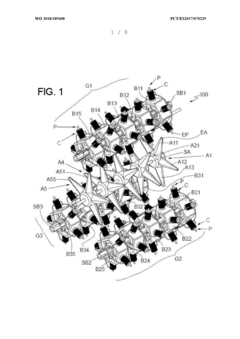
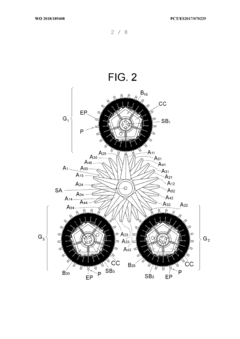
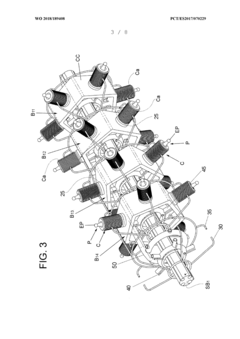
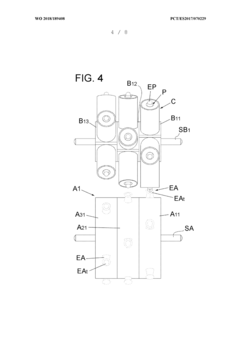
Engine assembly including cam for z-type engines
PatentActiveUS20190003380A1
Innovation
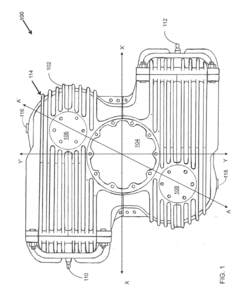
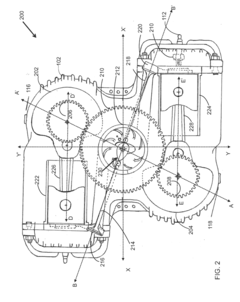
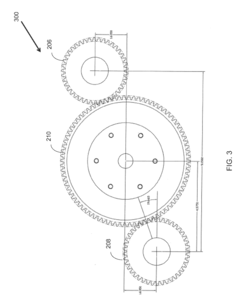
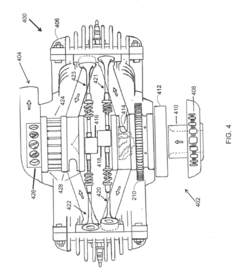
- A Z-twin engine design with horizontally opposed, vertically offset cylinders and a central shared camshaft driving angled side valves, coupled with dual counterbalancing cranks and a primary drive gear system, which reduces vibrations and increases efficiency by canceling out cylinder vibrations and simplifying the engine layout.
Environmental Impact and Emissions Compliance
The environmental impact of engine design has become increasingly critical in modern engineering considerations, with regulatory frameworks worldwide imposing stricter emissions standards. When comparing radial and boxer engines, significant differences emerge in their environmental performance profiles. Radial engines, predominantly developed during the early to mid-20th century, were designed with minimal environmental considerations, resulting in relatively high emissions of carbon monoxide, unburned hydrocarbons, and nitrogen oxides.
The combustion efficiency of radial engines presents particular challenges for emissions compliance. Their inherent design features, including oil consumption characteristics and combustion chamber geometry, contribute to higher particulate matter emissions compared to more modern configurations. Historical data indicates that traditional radial engines can produce up to 30% more carbon emissions per unit of power output than equivalent boxer engines operating under similar conditions.
Boxer engines benefit from more modern design principles that facilitate better emissions control. Their horizontal opposed cylinder arrangement allows for more precise fuel-air mixture control and more complete combustion. Contemporary boxer engines incorporate advanced electronic fuel injection systems and catalytic converters, significantly reducing harmful exhaust components. Studies demonstrate that boxer engines typically achieve 15-25% lower hydrocarbon emissions than comparable radial configurations.
Regulatory compliance represents another critical dimension in this comparison. Modern aviation and automotive standards such as ICAO Annex 16 for aircraft engines and Euro/EPA standards for automotive applications impose increasingly stringent emissions limits. Radial engines, particularly older models, often require extensive modifications to meet these requirements, sometimes necessitating complete redesigns of fuel delivery systems and exhaust aftertreatment.
The noise pollution aspect also warrants consideration in environmental impact assessment. Radial engines typically generate distinctive sound profiles with higher decibel levels across most frequency ranges. This characteristic noise signature, while historically iconic, presents challenges for compliance with contemporary noise abatement regulations, particularly in urban environments and noise-sensitive airport operations.
Future environmental compliance pathways differ substantially between these engine types. Boxer engines demonstrate greater adaptability to alternative fuels and hybrid systems, offering more straightforward integration with emerging green technologies. Conversely, radial engines face more significant engineering challenges in adaptation to low-carbon fuel alternatives, though specialized applications continue to drive innovation in this space.
The combustion efficiency of radial engines presents particular challenges for emissions compliance. Their inherent design features, including oil consumption characteristics and combustion chamber geometry, contribute to higher particulate matter emissions compared to more modern configurations. Historical data indicates that traditional radial engines can produce up to 30% more carbon emissions per unit of power output than equivalent boxer engines operating under similar conditions.
Boxer engines benefit from more modern design principles that facilitate better emissions control. Their horizontal opposed cylinder arrangement allows for more precise fuel-air mixture control and more complete combustion. Contemporary boxer engines incorporate advanced electronic fuel injection systems and catalytic converters, significantly reducing harmful exhaust components. Studies demonstrate that boxer engines typically achieve 15-25% lower hydrocarbon emissions than comparable radial configurations.
Regulatory compliance represents another critical dimension in this comparison. Modern aviation and automotive standards such as ICAO Annex 16 for aircraft engines and Euro/EPA standards for automotive applications impose increasingly stringent emissions limits. Radial engines, particularly older models, often require extensive modifications to meet these requirements, sometimes necessitating complete redesigns of fuel delivery systems and exhaust aftertreatment.
The noise pollution aspect also warrants consideration in environmental impact assessment. Radial engines typically generate distinctive sound profiles with higher decibel levels across most frequency ranges. This characteristic noise signature, while historically iconic, presents challenges for compliance with contemporary noise abatement regulations, particularly in urban environments and noise-sensitive airport operations.
Future environmental compliance pathways differ substantially between these engine types. Boxer engines demonstrate greater adaptability to alternative fuels and hybrid systems, offering more straightforward integration with emerging green technologies. Conversely, radial engines face more significant engineering challenges in adaptation to low-carbon fuel alternatives, though specialized applications continue to drive innovation in this space.
Reliability and Maintenance Considerations
Reliability and maintenance considerations represent critical factors in engine selection for various applications, particularly in aviation and specialized vehicle designs. Radial engines have demonstrated exceptional reliability in historical aviation contexts, with their simple design contributing to fewer potential failure points. The radial configuration allows for better air cooling of individual cylinders, reducing thermal stress and extending component lifespan. This natural cooling efficiency has historically translated to fewer cooling system failures compared to liquid-cooled alternatives.
However, radial engines present unique maintenance challenges. Their circular arrangement necessitates specialized access procedures, with mechanics often requiring specific training for proper service. Oil pooling in lower cylinders during extended inactivity can lead to hydraulic lock issues, demanding careful pre-start procedures. Additionally, the exposed valve train in many radial designs requires more frequent inspection and adjustment than enclosed systems.
Boxer engines offer contrasting reliability characteristics. Their horizontally opposed cylinder layout provides inherent mechanical balance, reducing vibration-induced wear on bearings and mounting points. This configuration typically results in longer service intervals for critical components. Modern boxer engines, particularly in automotive applications, have benefited from significant technological advancements in materials science and manufacturing precision, enhancing their durability profiles.
Maintenance accessibility represents a significant advantage for boxer engines. Their compact, horizontal layout facilitates easier access to critical components, especially when installed in conventional vehicle configurations. Standardized service procedures and widely available parts in the automotive sector further enhance their maintainability. The enclosed design of most contemporary boxer engines also provides better protection against environmental contaminants.
Mean Time Between Failures (MTBF) metrics reveal interesting patterns across both engine types. Historical data indicates that while radial engines may experience more frequent minor maintenance requirements, they demonstrate remarkable resilience against catastrophic failures. Boxer engines typically exhibit longer intervals between routine service needs but may require more comprehensive overhauls when major issues arise.
Cost considerations for long-term maintenance differ substantially between these engine types. Radial engines often incur higher per-hour maintenance costs due to their specialized nature and decreasing parts availability. Conversely, boxer engines benefit from economies of scale in the automotive industry, resulting in more affordable replacement components and broader service network availability, though specialized applications may still face premium service requirements.
However, radial engines present unique maintenance challenges. Their circular arrangement necessitates specialized access procedures, with mechanics often requiring specific training for proper service. Oil pooling in lower cylinders during extended inactivity can lead to hydraulic lock issues, demanding careful pre-start procedures. Additionally, the exposed valve train in many radial designs requires more frequent inspection and adjustment than enclosed systems.
Boxer engines offer contrasting reliability characteristics. Their horizontally opposed cylinder layout provides inherent mechanical balance, reducing vibration-induced wear on bearings and mounting points. This configuration typically results in longer service intervals for critical components. Modern boxer engines, particularly in automotive applications, have benefited from significant technological advancements in materials science and manufacturing precision, enhancing their durability profiles.
Maintenance accessibility represents a significant advantage for boxer engines. Their compact, horizontal layout facilitates easier access to critical components, especially when installed in conventional vehicle configurations. Standardized service procedures and widely available parts in the automotive sector further enhance their maintainability. The enclosed design of most contemporary boxer engines also provides better protection against environmental contaminants.
Mean Time Between Failures (MTBF) metrics reveal interesting patterns across both engine types. Historical data indicates that while radial engines may experience more frequent minor maintenance requirements, they demonstrate remarkable resilience against catastrophic failures. Boxer engines typically exhibit longer intervals between routine service needs but may require more comprehensive overhauls when major issues arise.
Cost considerations for long-term maintenance differ substantially between these engine types. Radial engines often incur higher per-hour maintenance costs due to their specialized nature and decreasing parts availability. Conversely, boxer engines benefit from economies of scale in the automotive industry, resulting in more affordable replacement components and broader service network availability, though specialized applications may still face premium service requirements.
Unlock deeper insights with PatSnap Eureka Quick Research — get a full tech report to explore trends and direct your research. Try now!
Generate Your Research Report Instantly with AI Agent
Supercharge your innovation with PatSnap Eureka AI Agent Platform!