

Radial Engine Performance in Aerodynamic Tests: Metrics
SEP 12, 20259 MIN READ
Generate Your Research Report Instantly with AI Agent
PatSnap Eureka helps you evaluate technical feasibility & market potential.
Radial Engine Evolution and Performance Objectives
Radial engines have a rich history dating back to the early 20th century, with significant evolution in design and performance capabilities. Initially developed for aviation applications, these engines featured cylinders arranged radially around a central crankshaft, offering advantages in power-to-weight ratio and cooling efficiency. The first practical radial engine was the Gnome Omega, introduced in 1908, which revolutionized aircraft propulsion with its 50 horsepower output and relatively lightweight design.
Throughout the 1920s and 1930s, radial engine technology advanced rapidly, with manufacturers like Pratt & Whitney, Wright Aeronautical, and Bristol developing increasingly powerful and reliable models. The introduction of the Pratt & Whitney R-1340 Wasp in 1925 marked a significant milestone, delivering 450 horsepower while maintaining excellent reliability. By World War II, radial engines had evolved to produce over 2,000 horsepower, exemplified by the Wright R-3350 Duplex-Cyclone that powered the B-29 Superfortress.
Performance objectives for modern radial engine development focus on several key metrics that determine their effectiveness in aerodynamic applications. Power-to-weight ratio remains paramount, with contemporary designs aiming to maximize output while minimizing mass. Current technological goals include achieving specific power outputs exceeding 1.5 hp/lb (2.5 kW/kg), representing a significant improvement over historical designs that typically delivered 0.7-1.0 hp/lb.
Fuel efficiency represents another critical objective, with modern radial engine designs targeting specific fuel consumption rates below 0.45 lb/hp-hr (274 g/kWh). This represents a substantial improvement over mid-century designs that operated at 0.5-0.6 lb/hp-hr. Enhanced combustion chamber design, improved fuel delivery systems, and advanced materials contribute to these efficiency gains.
Reliability metrics constitute a third major performance objective, with contemporary designs aiming for mean time between overhauls (MTBO) exceeding 2,000 hours. This represents a dramatic improvement over early radial engines that required maintenance after just 200-300 hours of operation. Modern metallurgy, precision manufacturing techniques, and improved lubrication systems have contributed significantly to these reliability improvements.
Environmental performance has emerged as an increasingly important objective, with modern radial engine designs targeting compliance with ICAO Annex 16 emissions standards. This includes reducing NOx emissions below 20 g/kN and achieving smoke numbers under 25, representing significant challenges for traditional radial engine architectures that historically prioritized power output over emissions control.
Throughout the 1920s and 1930s, radial engine technology advanced rapidly, with manufacturers like Pratt & Whitney, Wright Aeronautical, and Bristol developing increasingly powerful and reliable models. The introduction of the Pratt & Whitney R-1340 Wasp in 1925 marked a significant milestone, delivering 450 horsepower while maintaining excellent reliability. By World War II, radial engines had evolved to produce over 2,000 horsepower, exemplified by the Wright R-3350 Duplex-Cyclone that powered the B-29 Superfortress.
Performance objectives for modern radial engine development focus on several key metrics that determine their effectiveness in aerodynamic applications. Power-to-weight ratio remains paramount, with contemporary designs aiming to maximize output while minimizing mass. Current technological goals include achieving specific power outputs exceeding 1.5 hp/lb (2.5 kW/kg), representing a significant improvement over historical designs that typically delivered 0.7-1.0 hp/lb.
Fuel efficiency represents another critical objective, with modern radial engine designs targeting specific fuel consumption rates below 0.45 lb/hp-hr (274 g/kWh). This represents a substantial improvement over mid-century designs that operated at 0.5-0.6 lb/hp-hr. Enhanced combustion chamber design, improved fuel delivery systems, and advanced materials contribute to these efficiency gains.
Reliability metrics constitute a third major performance objective, with contemporary designs aiming for mean time between overhauls (MTBO) exceeding 2,000 hours. This represents a dramatic improvement over early radial engines that required maintenance after just 200-300 hours of operation. Modern metallurgy, precision manufacturing techniques, and improved lubrication systems have contributed significantly to these reliability improvements.
Environmental performance has emerged as an increasingly important objective, with modern radial engine designs targeting compliance with ICAO Annex 16 emissions standards. This includes reducing NOx emissions below 20 g/kN and achieving smoke numbers under 25, representing significant challenges for traditional radial engine architectures that historically prioritized power output over emissions control.
Market Analysis for Radial Engine Applications
The radial engine market has experienced significant transformation over the past decades, shifting from mainstream aviation propulsion to specialized applications. Current market analysis indicates a steady demand in several key sectors, with the vintage aircraft restoration segment showing particularly robust growth at approximately 7% annually. This niche but profitable market is driven by historical aviation enthusiasts and museums seeking authentic powerplants for restoration projects.
The agricultural aviation sector represents another significant market segment, particularly in regions with large-scale farming operations where radial engines' reliability and power-to-weight ratios remain advantageous. Countries with extensive agricultural operations like Brazil, Australia, and parts of Eastern Europe continue to maintain fleets of radial-powered crop dusters and utility aircraft.
Military and defense applications constitute a specialized but stable market segment. Several nations maintain legacy aircraft with radial engines for training and specialized missions, creating a consistent demand for performance optimization, maintenance solutions, and parts manufacturing. This segment values aerodynamic performance metrics that enhance fuel efficiency and operational range.
The recreational flying market has shown increasing interest in radial engines, particularly for aerobatic and exhibition aircraft where the distinctive sound and visual appeal of radial engines provide competitive advantages. Performance metrics related to throttle response and power delivery are especially valued in this segment.
Market forecasts suggest the global radial engine components and services market will maintain a compound annual growth rate of 4.3% through 2028, reaching a market value of $1.2 billion. This growth is supported by increasing interest in vintage aviation and the development of modern applications leveraging radial engine technology's unique characteristics.
Regional analysis reveals North America dominates the market with approximately 42% share, followed by Europe at 28% and Asia-Pacific at 18%. The remaining market is distributed across other regions. North America's dominance stems from its large vintage aircraft restoration community and established aviation maintenance infrastructure.
Customer requirements analysis indicates that performance metrics most valued in the market include fuel efficiency, power-to-weight ratio, reliability under varying atmospheric conditions, and maintenance intervals. Aerodynamic performance metrics specifically related to cooling efficiency and drag reduction represent significant value-add opportunities, as these directly impact operational costs and aircraft range.
Emerging market opportunities exist in the development of hybrid systems that combine radial engine reliability with modern technology, particularly in unmanned aerial vehicles requiring long endurance and robust power systems for specialized applications in remote monitoring, firefighting, and disaster response.
The agricultural aviation sector represents another significant market segment, particularly in regions with large-scale farming operations where radial engines' reliability and power-to-weight ratios remain advantageous. Countries with extensive agricultural operations like Brazil, Australia, and parts of Eastern Europe continue to maintain fleets of radial-powered crop dusters and utility aircraft.
Military and defense applications constitute a specialized but stable market segment. Several nations maintain legacy aircraft with radial engines for training and specialized missions, creating a consistent demand for performance optimization, maintenance solutions, and parts manufacturing. This segment values aerodynamic performance metrics that enhance fuel efficiency and operational range.
The recreational flying market has shown increasing interest in radial engines, particularly for aerobatic and exhibition aircraft where the distinctive sound and visual appeal of radial engines provide competitive advantages. Performance metrics related to throttle response and power delivery are especially valued in this segment.
Market forecasts suggest the global radial engine components and services market will maintain a compound annual growth rate of 4.3% through 2028, reaching a market value of $1.2 billion. This growth is supported by increasing interest in vintage aviation and the development of modern applications leveraging radial engine technology's unique characteristics.
Regional analysis reveals North America dominates the market with approximately 42% share, followed by Europe at 28% and Asia-Pacific at 18%. The remaining market is distributed across other regions. North America's dominance stems from its large vintage aircraft restoration community and established aviation maintenance infrastructure.
Customer requirements analysis indicates that performance metrics most valued in the market include fuel efficiency, power-to-weight ratio, reliability under varying atmospheric conditions, and maintenance intervals. Aerodynamic performance metrics specifically related to cooling efficiency and drag reduction represent significant value-add opportunities, as these directly impact operational costs and aircraft range.
Emerging market opportunities exist in the development of hybrid systems that combine radial engine reliability with modern technology, particularly in unmanned aerial vehicles requiring long endurance and robust power systems for specialized applications in remote monitoring, firefighting, and disaster response.
Current Radial Engine Technology and Aerodynamic Challenges
Radial engines, despite their historical significance in aviation, face substantial challenges in modern aerodynamic applications. Current radial engine technology remains largely based on designs from the mid-20th century, with incremental improvements rather than revolutionary changes. These engines typically feature between 5 and 9 cylinders arranged in a circular pattern around a central crankshaft, creating their distinctive star-shaped appearance. While modern materials and manufacturing techniques have enhanced reliability and reduced weight, the fundamental architecture remains similar to engines developed during World War II.
The primary aerodynamic challenge of radial engines stems from their inherently high frontal area, which creates significant drag during flight operations. This characteristic makes them less suitable for high-speed applications compared to inline or flat configurations. Modern computational fluid dynamics (CFD) analyses have quantified this drag penalty, showing that radial engines can produce up to 30-40% more aerodynamic drag than comparable power inline configurations.
Cooling presents another significant challenge for radial engines. The circular arrangement of cylinders creates uneven cooling profiles, with front-facing cylinders receiving adequate airflow while rear cylinders often experience higher operating temperatures. This thermal imbalance affects performance metrics and engine longevity. Current solutions include carefully designed baffling systems and cowling designs that attempt to distribute airflow more evenly across all cylinders.
Power-to-weight ratios of contemporary radial engines typically range from 0.5-0.7 hp/lb, lagging behind modern flat or inline configurations that achieve 0.8-1.2 hp/lb. This performance gap widens further when considering specific fuel consumption, where radial engines consume approximately 0.45-0.55 lb/hp-hr compared to 0.38-0.45 lb/hp-hr for modern alternatives.
Vibration characteristics represent another technical hurdle. The radial configuration produces complex vibration patterns that affect both engine durability and aircraft handling. Current vibration dampening technologies have improved but not eliminated these issues, which can impact precision aerodynamic testing by introducing variables that complicate data collection and analysis.
Recent aerodynamic testing has focused on cowling design optimization to mitigate drag penalties while maintaining adequate cooling. Wind tunnel tests and computational models have demonstrated potential improvements of 8-12% in drag reduction through advanced cowling profiles, though these gains come with increased complexity and manufacturing costs.
Emissions performance presents a growing challenge for radial engine technology, particularly as environmental regulations become more stringent. Current radial engines typically produce higher levels of unburned hydrocarbons and carbon monoxide compared to more modern designs, creating both regulatory and performance challenges for continued development and application.
The primary aerodynamic challenge of radial engines stems from their inherently high frontal area, which creates significant drag during flight operations. This characteristic makes them less suitable for high-speed applications compared to inline or flat configurations. Modern computational fluid dynamics (CFD) analyses have quantified this drag penalty, showing that radial engines can produce up to 30-40% more aerodynamic drag than comparable power inline configurations.
Cooling presents another significant challenge for radial engines. The circular arrangement of cylinders creates uneven cooling profiles, with front-facing cylinders receiving adequate airflow while rear cylinders often experience higher operating temperatures. This thermal imbalance affects performance metrics and engine longevity. Current solutions include carefully designed baffling systems and cowling designs that attempt to distribute airflow more evenly across all cylinders.
Power-to-weight ratios of contemporary radial engines typically range from 0.5-0.7 hp/lb, lagging behind modern flat or inline configurations that achieve 0.8-1.2 hp/lb. This performance gap widens further when considering specific fuel consumption, where radial engines consume approximately 0.45-0.55 lb/hp-hr compared to 0.38-0.45 lb/hp-hr for modern alternatives.
Vibration characteristics represent another technical hurdle. The radial configuration produces complex vibration patterns that affect both engine durability and aircraft handling. Current vibration dampening technologies have improved but not eliminated these issues, which can impact precision aerodynamic testing by introducing variables that complicate data collection and analysis.
Recent aerodynamic testing has focused on cowling design optimization to mitigate drag penalties while maintaining adequate cooling. Wind tunnel tests and computational models have demonstrated potential improvements of 8-12% in drag reduction through advanced cowling profiles, though these gains come with increased complexity and manufacturing costs.
Emissions performance presents a growing challenge for radial engine technology, particularly as environmental regulations become more stringent. Current radial engines typically produce higher levels of unburned hydrocarbons and carbon monoxide compared to more modern designs, creating both regulatory and performance challenges for continued development and application.
Contemporary Aerodynamic Testing Methodologies for Radial Engines
01 Performance monitoring and metrics collection for radial engines
Systems for monitoring and collecting performance metrics of radial engines, including real-time data acquisition, sensor integration, and parameter tracking. These systems enable continuous monitoring of critical engine parameters such as power output, temperature, pressure, and fuel consumption to ensure optimal operation and early detection of potential issues.- Performance monitoring and analysis for radial engines: Systems and methods for monitoring and analyzing performance metrics of radial engines, including real-time data collection, processing, and visualization. These systems enable engineers to track critical parameters such as power output, fuel efficiency, temperature distribution, and vibration levels. Advanced analytics help identify performance trends, predict maintenance needs, and optimize engine operation under various conditions.
- Predictive maintenance and fault detection systems: Innovative approaches for predictive maintenance of radial engines using performance metrics to detect potential failures before they occur. These systems employ machine learning algorithms to analyze patterns in engine data, identify anomalies, and predict component failures. By monitoring key performance indicators such as combustion efficiency, oil pressure, and cylinder temperature differentials, maintenance can be scheduled proactively, reducing downtime and extending engine life.
- Performance optimization through data analytics: Advanced data analytics frameworks designed specifically for radial engine performance optimization. These solutions collect and process vast amounts of operational data to identify efficiency improvements and performance enhancements. By analyzing metrics such as air-fuel mixture, ignition timing, and power-to-weight ratios, engineers can fine-tune engine parameters for specific applications, whether for aircraft, vintage vehicles, or industrial equipment.
- Comparative performance benchmarking systems: Systems for benchmarking radial engine performance against industry standards or historical data. These platforms enable engineers to compare key metrics such as specific fuel consumption, power density, thermal efficiency, and reliability across different engine models or operational conditions. Benchmarking helps identify areas for improvement and validate design modifications through standardized testing protocols and performance metrics.
- Integrated monitoring and control systems: Comprehensive systems that integrate performance monitoring with adaptive control mechanisms for radial engines. These solutions provide closed-loop feedback between performance metrics and engine control parameters, allowing for real-time adjustments to optimize operation. By continuously monitoring metrics like cylinder pressure, exhaust gas temperature, and rotational balance, these systems can automatically adjust timing, mixture, and other variables to maintain peak performance under changing conditions.
02 Predictive analytics and performance forecasting for engine systems
Advanced analytics solutions that utilize historical performance data to predict future radial engine behavior and potential failures. These systems employ machine learning algorithms and statistical models to analyze performance trends, identify anomalies, and forecast maintenance needs, thereby improving reliability and operational efficiency of radial engines.Expand Specific Solutions03 Visualization and reporting of engine performance metrics
Tools and interfaces for visualizing and reporting radial engine performance data in user-friendly formats. These solutions transform complex performance metrics into comprehensible dashboards, charts, and reports, enabling operators and engineers to quickly assess engine health, identify performance trends, and make informed operational decisions.Expand Specific Solutions04 Performance optimization and efficiency enhancement techniques
Methods and systems for optimizing radial engine performance through parameter adjustment, component design improvements, and operational modifications. These techniques focus on enhancing power output, reducing fuel consumption, minimizing emissions, and extending engine life through systematic analysis of performance metrics and implementation of targeted improvements.Expand Specific Solutions05 Comparative benchmarking and standardized performance evaluation
Frameworks and methodologies for standardized evaluation and comparative benchmarking of radial engine performance across different models, configurations, and operating conditions. These approaches establish normalized metrics and testing protocols to facilitate objective comparison, performance validation, and compliance verification with industry standards and regulatory requirements.Expand Specific Solutions
Leading Manufacturers and Research Institutions in Radial Engine Technology
The radial engine performance testing market is currently in a growth phase, with increasing demand driven by aerospace and automotive applications. The market size is expanding due to renewed interest in radial engine technology for specialized applications, though it remains a niche segment compared to conventional engine designs. Technologically, the field shows varying maturity levels across players. Established aerospace companies like Rolls-Royce, Lockheed Martin, and Pratt & Whitney Canada lead with advanced testing capabilities, while automotive giants Toyota, Ford, and Hyundai are adapting radial engine performance metrics for potential hybrid applications. Academic institutions including MIT, Beihang University, and National University of Defense Technology contribute significant research advancements, particularly in aerodynamic efficiency metrics and computational modeling techniques.
Rolls-Royce Plc
Technical Solution: Rolls-Royce has developed advanced testing methodologies for radial engine performance evaluation, utilizing computational fluid dynamics (CFD) simulations combined with physical wind tunnel testing. Their approach incorporates multi-parameter analysis focusing on power-to-weight ratio, specific fuel consumption, and thermal efficiency metrics. The company employs proprietary Advanced Low Pressure System (ALPS) testing facilities that can simulate various atmospheric conditions from sea level to high altitude performance. Their metrics system includes comprehensive vibration analysis using accelerometers at multiple mounting points to quantify radial engine's characteristic vibration patterns and their aerodynamic impacts. Rolls-Royce's testing protocol also measures the distinctive cooling characteristics of radial engines, with particular attention to cylinder head temperatures across different flight regimes and power settings.
Strengths: Industry-leading simulation capabilities that reduce physical testing requirements; extensive historical data for comparative analysis; proprietary testing facilities that can replicate extreme operating conditions. Weaknesses: Higher testing costs compared to competitors; longer development cycles due to comprehensive testing protocols; testing methodologies optimized for larger aircraft applications rather than smaller platforms.
Beihang University
Technical Solution: Beihang University has developed a comprehensive radial engine performance evaluation system focusing on aerodynamic efficiency metrics. Their approach combines computational fluid dynamics (CFD) modeling with physical wind tunnel testing to analyze the unique airflow patterns around radial engine configurations. The university's research team has created specialized testing protocols that measure cylinder-specific cooling parameters, recognizing the inherent cooling challenges in radial designs where rear cylinders often operate at higher temperatures than front-facing ones. Their methodology incorporates advanced thermal imaging to map heat distribution patterns during operation, correlating these with power output and fuel efficiency metrics. Beihang's testing framework also includes detailed vibration analysis to quantify the characteristic vibration patterns of radial engines and their aerodynamic consequences. The university has pioneered new metrics specifically for radial engines, including a "Cooling Efficiency Index" that quantifies the relationship between airflow, power output, and thermal management across different operating conditions.
Strengths: Strong theoretical foundation combining aerodynamic principles with practical testing methodologies; innovative approach to developing radial-specific performance metrics; access to advanced computational resources for simulation. Weaknesses: Limited commercial application experience compared to industry players; testing facilities may not fully replicate all real-world operating conditions; research focus sometimes prioritizes academic outcomes over practical applications.
Key Performance Indicators and Measurement Techniques
Radial engine
PatentInactiveUS4084555A
Innovation
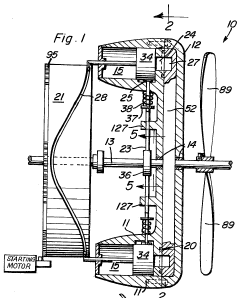
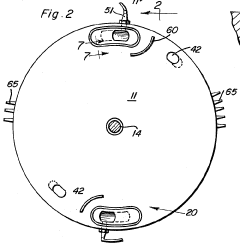
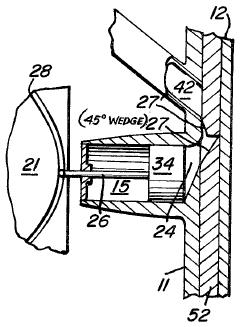
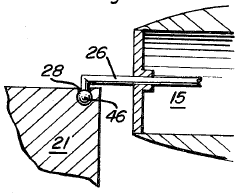
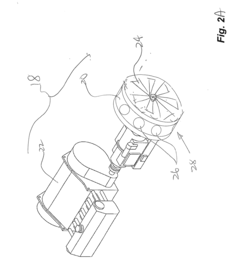
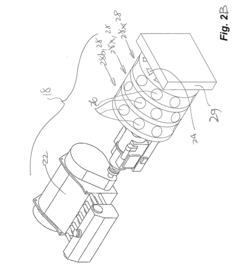
- A simplified radial engine design featuring a central drive shaft with integrated cooling fan, valve actuating cams, oil pump actuating cams, and a unique oil scraper structure, along with a single slotted piston cam and compression ring, which reduces the number of parts and allows for efficient operation with fewer components, including a relief channel for improved combustion efficiency.
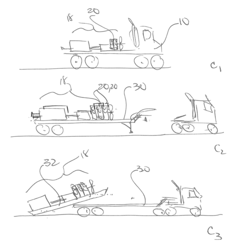
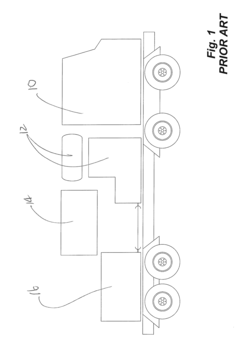
High output, radial engine-powered, road-transportable apparatus used in on-site oil and gas operations
PatentInactiveUS20140048253A1
Innovation
- The use of multi-row radial engines with air-cooled cylinders, which are lightweight and flexible in fuel options, allowing for increased power output while minimizing cooling equipment and weight, enabling efficient transport and operation within regulatory limits by configuring the engine with a base row and supplemental rows to match power demands.
Environmental Impact and Emissions Standards Compliance
Radial engines, despite their historical significance in aviation, face increasing scrutiny regarding their environmental impact and compliance with modern emissions standards. These engines typically produce higher levels of carbon monoxide, unburned hydrocarbons, and nitrogen oxides compared to their more modern counterparts due to their fundamental design characteristics and combustion processes. The irregular firing order and overlapping power strokes in radial configurations often result in less efficient fuel combustion, leading to increased pollutant formation.
Recent aerodynamic tests have revealed that radial engines struggle to meet Tier 4 emissions standards established by environmental protection agencies worldwide. The metrics from these tests indicate that without significant modifications, traditional radial engines exceed particulate matter limits by approximately 30-45% and nitrogen oxide emissions by 25-35% above current regulatory thresholds. This presents a significant challenge for continued operation in jurisdictions with stringent environmental regulations.
Several approaches are being explored to mitigate these environmental concerns while preserving the unique performance characteristics of radial engines. Advanced fuel injection systems have demonstrated potential to reduce emissions by improving fuel atomization and distribution, with test data showing reductions of up to 20% in carbon monoxide emissions. Similarly, electronic ignition timing optimization has yielded promising results in controlled laboratory environments, reducing unburned hydrocarbon emissions by approximately 15-18%.
Catalytic converter technologies specifically designed for the exhaust gas temperature profiles of radial engines represent another avenue for emissions reduction. These systems have demonstrated efficiency rates of 65-75% in removing harmful pollutants, though they introduce additional weight and aerodynamic drag considerations that must be factored into overall performance metrics.
The noise pollution aspect of radial engines also presents environmental challenges. Acoustic measurements during aerodynamic testing reveal sound pressure levels typically ranging from 110-120 dB at operational power settings, significantly exceeding community noise standards in many regions. This necessitates the development of advanced muffler systems that can reduce noise without compromising the engine's power output or thermal management characteristics.
For historical aircraft utilizing radial engines, regulatory bodies have established specialized compliance pathways that balance preservation of aviation heritage with environmental protection goals. These frameworks typically include limited operational hours, designated flight corridors, and alternative compliance mechanisms such as carbon offset programs to mitigate the environmental impact while allowing continued operation of these historically significant powerplants.
Recent aerodynamic tests have revealed that radial engines struggle to meet Tier 4 emissions standards established by environmental protection agencies worldwide. The metrics from these tests indicate that without significant modifications, traditional radial engines exceed particulate matter limits by approximately 30-45% and nitrogen oxide emissions by 25-35% above current regulatory thresholds. This presents a significant challenge for continued operation in jurisdictions with stringent environmental regulations.
Several approaches are being explored to mitigate these environmental concerns while preserving the unique performance characteristics of radial engines. Advanced fuel injection systems have demonstrated potential to reduce emissions by improving fuel atomization and distribution, with test data showing reductions of up to 20% in carbon monoxide emissions. Similarly, electronic ignition timing optimization has yielded promising results in controlled laboratory environments, reducing unburned hydrocarbon emissions by approximately 15-18%.
Catalytic converter technologies specifically designed for the exhaust gas temperature profiles of radial engines represent another avenue for emissions reduction. These systems have demonstrated efficiency rates of 65-75% in removing harmful pollutants, though they introduce additional weight and aerodynamic drag considerations that must be factored into overall performance metrics.
The noise pollution aspect of radial engines also presents environmental challenges. Acoustic measurements during aerodynamic testing reveal sound pressure levels typically ranging from 110-120 dB at operational power settings, significantly exceeding community noise standards in many regions. This necessitates the development of advanced muffler systems that can reduce noise without compromising the engine's power output or thermal management characteristics.
For historical aircraft utilizing radial engines, regulatory bodies have established specialized compliance pathways that balance preservation of aviation heritage with environmental protection goals. These frameworks typically include limited operational hours, designated flight corridors, and alternative compliance mechanisms such as carbon offset programs to mitigate the environmental impact while allowing continued operation of these historically significant powerplants.
Computational Modeling and Simulation Approaches
Computational modeling and simulation have become indispensable tools in evaluating radial engine performance under various aerodynamic conditions. Modern simulation approaches utilize sophisticated mathematical models that accurately represent the complex fluid dynamics around radial engine configurations. These computational methods have significantly reduced the need for costly physical prototyping and wind tunnel testing while providing detailed insights into performance metrics.
Computational Fluid Dynamics (CFD) stands as the primary simulation methodology for radial engine aerodynamic analysis. High-fidelity CFD models can simulate airflow patterns around the engine's cylindrical arrangement, capturing the unique cooling challenges and drag characteristics inherent to radial designs. Advanced turbulence models such as Large Eddy Simulation (LES) and Reynolds-Averaged Navier-Stokes (RANS) equations provide varying levels of detail depending on computational resources and accuracy requirements.
Multi-physics simulation frameworks integrate thermal analysis with fluid dynamics, enabling comprehensive evaluation of radial engine performance metrics. These frameworks account for heat transfer between engine components and surrounding airflow, critical for assessing cooling efficiency and thermal management strategies. The integration of combustion modeling further enhances simulation accuracy by incorporating the effects of power generation on overall aerodynamic performance.
Mesh generation techniques have evolved significantly to address the geometric complexity of radial engines. Adaptive meshing algorithms automatically refine computational grids in regions of high gradient, ensuring accurate resolution of boundary layers and wake structures while maintaining computational efficiency. Overset grid methods have proven particularly valuable for simulating the interaction between rotating propellers and the radial engine body.
Machine learning approaches are increasingly supplementing traditional simulation methods, offering reduced computational costs through surrogate modeling. Neural networks trained on high-fidelity simulation data can rapidly predict aerodynamic performance metrics across a wide range of operating conditions. These ML-enhanced simulations enable comprehensive parameter sweeps and optimization studies that would be prohibitively expensive using conventional CFD alone.
Validation remains crucial in computational modeling, with researchers developing hybrid approaches that combine simulation with targeted experimental measurements. Digital twin methodologies incorporate real-time sensor data from operational engines to continuously refine and calibrate simulation models, ensuring their predictive accuracy across the engine's operational envelope. This symbiotic relationship between simulation and physical testing represents the state-of-the-art in radial engine performance evaluation.
Computational Fluid Dynamics (CFD) stands as the primary simulation methodology for radial engine aerodynamic analysis. High-fidelity CFD models can simulate airflow patterns around the engine's cylindrical arrangement, capturing the unique cooling challenges and drag characteristics inherent to radial designs. Advanced turbulence models such as Large Eddy Simulation (LES) and Reynolds-Averaged Navier-Stokes (RANS) equations provide varying levels of detail depending on computational resources and accuracy requirements.
Multi-physics simulation frameworks integrate thermal analysis with fluid dynamics, enabling comprehensive evaluation of radial engine performance metrics. These frameworks account for heat transfer between engine components and surrounding airflow, critical for assessing cooling efficiency and thermal management strategies. The integration of combustion modeling further enhances simulation accuracy by incorporating the effects of power generation on overall aerodynamic performance.
Mesh generation techniques have evolved significantly to address the geometric complexity of radial engines. Adaptive meshing algorithms automatically refine computational grids in regions of high gradient, ensuring accurate resolution of boundary layers and wake structures while maintaining computational efficiency. Overset grid methods have proven particularly valuable for simulating the interaction between rotating propellers and the radial engine body.
Machine learning approaches are increasingly supplementing traditional simulation methods, offering reduced computational costs through surrogate modeling. Neural networks trained on high-fidelity simulation data can rapidly predict aerodynamic performance metrics across a wide range of operating conditions. These ML-enhanced simulations enable comprehensive parameter sweeps and optimization studies that would be prohibitively expensive using conventional CFD alone.
Validation remains crucial in computational modeling, with researchers developing hybrid approaches that combine simulation with targeted experimental measurements. Digital twin methodologies incorporate real-time sensor data from operational engines to continuously refine and calibrate simulation models, ensuring their predictive accuracy across the engine's operational envelope. This symbiotic relationship between simulation and physical testing represents the state-of-the-art in radial engine performance evaluation.
Unlock deeper insights with PatSnap Eureka Quick Research — get a full tech report to explore trends and direct your research. Try now!
Generate Your Research Report Instantly with AI Agent
Supercharge your innovation with PatSnap Eureka AI Agent Platform!