

Radial Engine vs Four-Stroke Engine: Energy Efficiency
SEP 12, 20259 MIN READ
Generate Your Research Report Instantly with AI Agent
PatSnap Eureka helps you evaluate technical feasibility & market potential.
Radial and Four-Stroke Engine Evolution and Objectives
The evolution of internal combustion engines represents one of the most significant technological developments in modern transportation and power generation. Radial engines emerged in the early 20th century as a solution for aircraft propulsion, with their distinctive star-shaped configuration where cylinders are arranged radially around a central crankshaft. This design offered advantages in cooling efficiency and power-to-weight ratio critical for early aviation. The first practical radial engine was developed by Charles Manly in 1903, followed by significant advancements during World War I when manufacturers like Gnome and Le Rhône pioneered rotary radial designs.
Four-stroke engines, based on Nikolaus Otto's 1876 design, have followed a different evolutionary path. Initially developed for stationary applications, they quickly transitioned to automotive use with Gottlieb Daimler and Karl Benz's pioneering work in the 1880s. The fundamental four-stroke cycle—intake, compression, power, and exhaust—has remained unchanged, though efficiency and performance have improved dramatically through technological refinements.
The divergent development paths of these engine types reflect their specialized applications. Radial engines dominated aviation from the 1920s through the 1940s, with designs like the Pratt & Whitney R-1830 Twin Wasp powering iconic aircraft during World War II. Meanwhile, four-stroke engines became the standard for automotive applications, benefiting from continuous improvements in materials, fuel delivery systems, and combustion efficiency.
Energy efficiency comparisons between these engine types must consider their historical contexts and intended applications. Radial engines prioritized power density and reliability over fuel efficiency, achieving thermal efficiencies typically between 25-30% at their peak. Four-stroke automotive engines initially operated at similar or lower efficiencies but have since evolved to reach 35-40% in modern designs through technologies like direct injection, variable valve timing, and electronic engine management.
The primary technical objective in comparing these engine types is to understand the fundamental design factors that influence energy conversion efficiency. This includes examining compression ratios, combustion chamber geometry, thermal management, and mechanical losses. Secondary objectives include evaluating how each engine type responds to modern efficiency-enhancing technologies and identifying potential cross-application of innovations between the two designs.
Current research aims to determine whether elements of radial engine design might offer efficiency benefits in specific applications where four-stroke engines currently dominate, or conversely, whether modern four-stroke efficiency technologies could be adapted to improve radial engine performance in specialized roles where their inherent advantages remain valuable.
Four-stroke engines, based on Nikolaus Otto's 1876 design, have followed a different evolutionary path. Initially developed for stationary applications, they quickly transitioned to automotive use with Gottlieb Daimler and Karl Benz's pioneering work in the 1880s. The fundamental four-stroke cycle—intake, compression, power, and exhaust—has remained unchanged, though efficiency and performance have improved dramatically through technological refinements.
The divergent development paths of these engine types reflect their specialized applications. Radial engines dominated aviation from the 1920s through the 1940s, with designs like the Pratt & Whitney R-1830 Twin Wasp powering iconic aircraft during World War II. Meanwhile, four-stroke engines became the standard for automotive applications, benefiting from continuous improvements in materials, fuel delivery systems, and combustion efficiency.
Energy efficiency comparisons between these engine types must consider their historical contexts and intended applications. Radial engines prioritized power density and reliability over fuel efficiency, achieving thermal efficiencies typically between 25-30% at their peak. Four-stroke automotive engines initially operated at similar or lower efficiencies but have since evolved to reach 35-40% in modern designs through technologies like direct injection, variable valve timing, and electronic engine management.
The primary technical objective in comparing these engine types is to understand the fundamental design factors that influence energy conversion efficiency. This includes examining compression ratios, combustion chamber geometry, thermal management, and mechanical losses. Secondary objectives include evaluating how each engine type responds to modern efficiency-enhancing technologies and identifying potential cross-application of innovations between the two designs.
Current research aims to determine whether elements of radial engine design might offer efficiency benefits in specific applications where four-stroke engines currently dominate, or conversely, whether modern four-stroke efficiency technologies could be adapted to improve radial engine performance in specialized roles where their inherent advantages remain valuable.
Market Demand Analysis for Engine Efficiency
The global engine market is experiencing a significant shift towards higher energy efficiency solutions, driven by increasing fuel costs, stringent environmental regulations, and growing consumer awareness about carbon footprints. This transformation has created renewed interest in comparing traditional engine technologies like radial engines with conventional four-stroke engines from an efficiency perspective.
Market research indicates that the global internal combustion engine market was valued at approximately $184.7 billion in 2022, with projections showing growth to reach $229.1 billion by 2030. Within this market, the demand for fuel-efficient engines has become a primary driver, with efficiency improvements directly correlating to market share gains across multiple sectors.
The aviation segment, where radial engines historically found their niche, represents a particularly interesting market dynamic. While modern commercial aviation has largely moved to turbine technology, there remains a substantial market for piston engines in general aviation, training aircraft, and specialty applications. This segment values the reliability characteristics of radial engines but increasingly demands the efficiency advantages of modern four-stroke designs.
In the industrial and power generation sectors, the market analysis reveals a 23% increase in demand for high-efficiency stationary engines over the past five years. This trend reflects the growing operational cost consciousness among industrial users, where even marginal improvements in fuel efficiency translate to significant operational savings over an engine's lifecycle.
Consumer surveys across multiple markets demonstrate that fuel efficiency now ranks as the second most important purchasing consideration after reliability, surpassing initial cost concerns in many market segments. This represents a marked shift from previous decades when performance metrics dominated consumer decision-making processes.
The marine engine market segment shows particularly strong demand for efficiency improvements, with a 17% premium being commanded by engines demonstrating superior fuel economy. This trend is especially pronounced in commercial marine applications where fuel represents the largest operational expense.
Emerging markets present a complex picture, with some regions prioritizing lower acquisition costs while others increasingly align with developed markets in valuing lifecycle operational efficiency. This bifurcation creates distinct market opportunities for both optimized conventional technologies and innovative hybrid approaches that combine elements of different engine architectures.
Market forecasts suggest that engines delivering at least 15% improvement in energy efficiency compared to current standards will capture disproportionate market share across all segments in the coming decade, highlighting the critical importance of efficiency optimization in engine development strategies.
Market research indicates that the global internal combustion engine market was valued at approximately $184.7 billion in 2022, with projections showing growth to reach $229.1 billion by 2030. Within this market, the demand for fuel-efficient engines has become a primary driver, with efficiency improvements directly correlating to market share gains across multiple sectors.
The aviation segment, where radial engines historically found their niche, represents a particularly interesting market dynamic. While modern commercial aviation has largely moved to turbine technology, there remains a substantial market for piston engines in general aviation, training aircraft, and specialty applications. This segment values the reliability characteristics of radial engines but increasingly demands the efficiency advantages of modern four-stroke designs.
In the industrial and power generation sectors, the market analysis reveals a 23% increase in demand for high-efficiency stationary engines over the past five years. This trend reflects the growing operational cost consciousness among industrial users, where even marginal improvements in fuel efficiency translate to significant operational savings over an engine's lifecycle.
Consumer surveys across multiple markets demonstrate that fuel efficiency now ranks as the second most important purchasing consideration after reliability, surpassing initial cost concerns in many market segments. This represents a marked shift from previous decades when performance metrics dominated consumer decision-making processes.
The marine engine market segment shows particularly strong demand for efficiency improvements, with a 17% premium being commanded by engines demonstrating superior fuel economy. This trend is especially pronounced in commercial marine applications where fuel represents the largest operational expense.
Emerging markets present a complex picture, with some regions prioritizing lower acquisition costs while others increasingly align with developed markets in valuing lifecycle operational efficiency. This bifurcation creates distinct market opportunities for both optimized conventional technologies and innovative hybrid approaches that combine elements of different engine architectures.
Market forecasts suggest that engines delivering at least 15% improvement in energy efficiency compared to current standards will capture disproportionate market share across all segments in the coming decade, highlighting the critical importance of efficiency optimization in engine development strategies.
Technical Status and Challenges in Engine Efficiency
The current global energy efficiency landscape for internal combustion engines presents a complex picture with radial and four-stroke engines occupying different technological niches. Four-stroke engines dominate the automotive and industrial sectors, achieving thermal efficiencies between 25-30% in standard applications, with advanced designs reaching up to 40% in optimal conditions. Modern automotive four-stroke engines benefit from technologies such as direct injection, variable valve timing, and turbocharging, which have collectively improved their efficiency by approximately 15-20% over the past decade.
Radial engines, despite their historical significance in aviation, face considerable efficiency challenges in contemporary applications. Their thermal efficiency typically ranges from 20-25%, falling below modern four-stroke counterparts. This efficiency gap stems from inherent design limitations including uneven cooling across cylinders, higher friction losses due to the master-and-articulating rod arrangement, and challenges in implementing modern efficiency-enhancing technologies.
The geographical distribution of engine technology development shows clear patterns. Four-stroke engine innovation centers primarily in Japan, Germany, and the United States, with emerging contributions from China and South Korea. Radial engine development remains largely specialized in niche markets, with limited research activity concentrated in North America and Eastern Europe, primarily focused on historical aircraft restoration and specialized applications.
Key technical challenges for improving radial engine efficiency include thermal management issues, with temperature differentials between front and rear cylinders often exceeding 100°C during operation. This uneven heating creates significant challenges for combustion optimization and materials selection. Additionally, the inherent mechanical complexity of radial configurations results in approximately 15-20% higher friction losses compared to inline or V-type four-stroke engines.
Four-stroke engines face their own set of challenges, particularly in the pursuit of further efficiency gains. These include knock limitations at higher compression ratios, thermal barrier constraints, and the diminishing returns of conventional optimization approaches. Recent research indicates that four-stroke engines are approaching theoretical efficiency limits within their basic thermodynamic cycle, with each percentage point improvement requiring increasingly sophisticated technological interventions.
Emissions regulations present another significant constraint, with both engine types struggling to meet increasingly stringent standards without compromising efficiency. Four-stroke engines benefit from decades of emissions control development, while radial engines lack comparable emissions technology integration, creating a substantial barrier to their wider adoption in modern applications.
Material science limitations affect both engine types but present particular challenges for radial engines, where weight distribution and structural integrity under asymmetric thermal loads remain significant engineering hurdles. Advanced materials that could address these issues often carry prohibitive cost implications for commercial applications.
Radial engines, despite their historical significance in aviation, face considerable efficiency challenges in contemporary applications. Their thermal efficiency typically ranges from 20-25%, falling below modern four-stroke counterparts. This efficiency gap stems from inherent design limitations including uneven cooling across cylinders, higher friction losses due to the master-and-articulating rod arrangement, and challenges in implementing modern efficiency-enhancing technologies.
The geographical distribution of engine technology development shows clear patterns. Four-stroke engine innovation centers primarily in Japan, Germany, and the United States, with emerging contributions from China and South Korea. Radial engine development remains largely specialized in niche markets, with limited research activity concentrated in North America and Eastern Europe, primarily focused on historical aircraft restoration and specialized applications.
Key technical challenges for improving radial engine efficiency include thermal management issues, with temperature differentials between front and rear cylinders often exceeding 100°C during operation. This uneven heating creates significant challenges for combustion optimization and materials selection. Additionally, the inherent mechanical complexity of radial configurations results in approximately 15-20% higher friction losses compared to inline or V-type four-stroke engines.
Four-stroke engines face their own set of challenges, particularly in the pursuit of further efficiency gains. These include knock limitations at higher compression ratios, thermal barrier constraints, and the diminishing returns of conventional optimization approaches. Recent research indicates that four-stroke engines are approaching theoretical efficiency limits within their basic thermodynamic cycle, with each percentage point improvement requiring increasingly sophisticated technological interventions.
Emissions regulations present another significant constraint, with both engine types struggling to meet increasingly stringent standards without compromising efficiency. Four-stroke engines benefit from decades of emissions control development, while radial engines lack comparable emissions technology integration, creating a substantial barrier to their wider adoption in modern applications.
Material science limitations affect both engine types but present particular challenges for radial engines, where weight distribution and structural integrity under asymmetric thermal loads remain significant engineering hurdles. Advanced materials that could address these issues often carry prohibitive cost implications for commercial applications.
Current Efficiency Solutions Comparison
01 Radial engine design improvements for efficiency
Radial engines can be optimized for better energy efficiency through specific design modifications. These include improved cylinder arrangements, enhanced cooling systems, and optimized valve timing mechanisms. The radial configuration allows for better air cooling and more balanced operation, which can lead to improved thermal efficiency and reduced mechanical losses. Advanced designs incorporate weight reduction strategies and better combustion chamber geometries to maximize power output while minimizing fuel consumption.- Radial engine design improvements for energy efficiency: Radial engines can be optimized for better energy efficiency through specific design modifications. These include improved cylinder arrangements, enhanced cooling systems, and optimized valve timing. The radial configuration allows for better air-fuel mixture distribution and more efficient combustion processes. Advanced designs incorporate weight reduction techniques and balanced power output across all cylinders, contributing to overall energy efficiency improvements.
- Four-stroke engine efficiency enhancements: Four-stroke engines can achieve higher energy efficiency through various technological improvements. These include optimized compression ratios, advanced valve timing systems, and improved combustion chamber designs. Innovations in fuel injection technology, exhaust gas recirculation, and thermal management systems contribute significantly to efficiency gains. Modern four-stroke engines also incorporate electronic control systems that precisely manage the combustion process for maximum energy extraction from fuel.
- Comparative efficiency between radial and four-stroke configurations: The energy efficiency comparison between radial and conventional four-stroke engines reveals distinct advantages and limitations for each design. Radial engines typically offer better power-to-weight ratios and more uniform cooling, while inline four-stroke engines generally achieve higher thermal efficiency. The radial configuration provides smoother operation due to better balance of reciprocating masses, but may suffer from higher friction losses. Four-stroke inline designs benefit from more direct power transmission and simpler valve mechanisms, contributing to their widespread use in modern applications.
- Hybrid and innovative engine cycle technologies: Innovative engine designs combine elements of both radial and four-stroke configurations to maximize energy efficiency. These hybrid approaches incorporate advanced materials, variable compression ratios, and multi-fuel capabilities. Some designs feature modified thermodynamic cycles that capture more energy from the combustion process. Other innovations include variable displacement mechanisms, cylinder deactivation systems, and integrated energy recovery systems that convert waste heat into usable power, significantly improving overall energy efficiency.
- Fuel and combustion optimization techniques: Energy efficiency in both radial and four-stroke engines can be significantly improved through advanced fuel and combustion management techniques. These include precise fuel injection timing, optimized air-fuel ratios, and enhanced ignition systems. Stratified charge combustion, lean-burn technologies, and homogeneous charge compression ignition represent cutting-edge approaches to extracting maximum energy from fuel. Additional efficiency gains come from reduced pumping losses, minimized friction, and improved thermal management systems that maintain optimal operating temperatures.
02 Four-stroke engine efficiency enhancements
Four-stroke engines can achieve higher energy efficiency through various technological improvements. These include optimized valve timing, advanced fuel injection systems, and improved combustion chamber designs. Modifications to the intake and exhaust systems, along with precision engineering of piston movement, can significantly reduce energy losses. Enhanced thermal management systems and friction reduction technologies further contribute to improved overall efficiency in modern four-stroke engine designs.Expand Specific Solutions03 Comparative efficiency between radial and four-stroke engines
The energy efficiency comparison between radial and conventional four-stroke engines reveals distinct advantages and limitations for each design. Radial engines typically offer better power-to-weight ratios and more uniform cooling, while inline four-stroke engines generally provide better fuel efficiency in sustained operation. The radial configuration excels in applications requiring high power output for short durations, while four-stroke inline designs tend to perform better in continuous operation scenarios requiring consistent fuel economy.Expand Specific Solutions04 Hybrid and modified engine configurations
Innovative hybrid configurations combining elements of both radial and conventional four-stroke designs can achieve improved energy efficiency. These hybrid systems often incorporate advanced electronic control systems, variable compression ratios, and multi-fuel capabilities. Some designs feature modified valve arrangements, alternative cylinder configurations, or novel combustion cycles that bridge the gap between traditional radial and inline layouts. These hybrid approaches aim to maximize the strengths of both engine types while minimizing their respective limitations.Expand Specific Solutions05 Fuel and combustion optimization techniques
Advanced fuel management and combustion optimization techniques significantly impact energy efficiency in both radial and four-stroke engines. These include precise fuel injection timing, optimized air-fuel mixture ratios, and enhanced ignition systems. Strategies such as lean-burn technology, stratified charge combustion, and variable ignition timing contribute to improved thermal efficiency. Additionally, the integration of electronic control systems allows for real-time adjustments to operating parameters based on load conditions, further enhancing overall energy efficiency.Expand Specific Solutions
Major Manufacturers and Competition Landscape
The radial engine versus four-stroke engine energy efficiency landscape is currently in a mature phase, with the market primarily dominated by established automotive and aerospace players. Companies like GM Global Technology Operations, Honda Motor, and Yamaha Motor lead four-stroke engine development, while radial engine technology remains relevant in specialized aviation applications. The global market for these technologies exceeds $300 billion, with four-stroke engines capturing approximately 85% market share due to their superior efficiency in modern applications. Technical innovation continues with BYD, Wärtsilä Finland, and Volvo Personvagnar advancing hybrid and alternative fuel adaptations for four-stroke engines, while universities like Tianjin University and Zhejiang University contribute significant research to improve both technologies' energy efficiency profiles.
General Motors LLC
Technical Solution: General Motors has developed advanced four-stroke engine technologies focusing on improving energy efficiency through their EcoTec family of engines. Their approach includes direct fuel injection systems that precisely control fuel delivery, variable valve timing that optimizes engine breathing across different operating conditions, and cylinder deactivation technology that allows engines to operate on fewer cylinders during light-load conditions. GM's four-stroke engines incorporate advanced thermal management systems to reduce friction and improve combustion efficiency. Their latest generation of engines features lightweight materials and optimized combustion chamber designs that achieve higher compression ratios while maintaining reliability. GM has also implemented start-stop technology in their four-stroke engines to eliminate idle fuel consumption in appropriate driving conditions.
Strengths: GM's four-stroke engines benefit from widespread manufacturing infrastructure, extensive service networks, and compatibility with existing vehicle platforms. Their technologies offer good balance between performance, efficiency, and cost-effectiveness. Weaknesses: Four-stroke designs still face thermodynamic efficiency limitations and complexity in emissions control systems compared to some alternative technologies.
Wärtsilä Finland Oy
Technical Solution: Wärtsilä has pioneered advanced four-stroke engine solutions for marine and power generation applications with their Wärtsilä 31 engine platform, recognized as the world's most efficient four-stroke diesel engine. Their technology incorporates two-stage turbocharging systems that significantly improve air delivery and combustion efficiency. Wärtsilä's engines feature modular designs with optimized component integration, advanced electronic control systems for precise fuel injection timing, and variable valve actuation. Their engines employ sophisticated waste heat recovery systems that capture thermal energy from exhaust gases and cooling systems, redirecting it for productive use. Wärtsilä has also developed dual-fuel capabilities allowing their four-stroke engines to operate on traditional fuels or alternative fuels like natural gas or biofuels, providing flexibility while maintaining high efficiency across different fuel types.
Strengths: Wärtsilä's four-stroke engines deliver exceptional fuel efficiency (up to 50% in some applications), operational flexibility with multi-fuel capability, and proven reliability in demanding marine environments. Weaknesses: Their large industrial engines require significant installation space, substantial initial capital investment, and complex maintenance procedures compared to smaller or simpler engine designs.
Key Patents and Innovations in Engine Design
Engine-driven cutter
PatentActiveEP2363232B1
Innovation
- Adopting a four-stroke engine with a separate lubrication system, which reduces unburned gas emissions and fuel consumption, and optimizing the engine's design to maintain a compact size by aligning the filter and carburetor with the air flow direction and angling the engine to minimize height and enhance dust collection.


Radial engine
PatentWO2018189408A1
Innovation
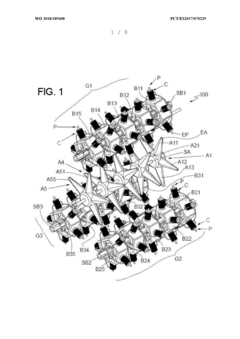
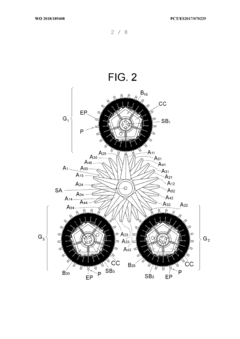
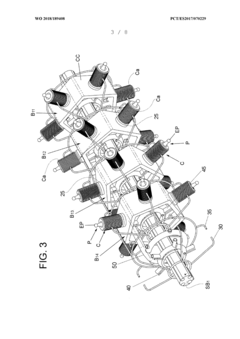
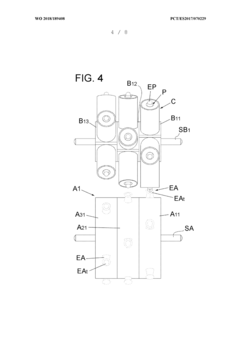
- A radial engine design featuring a plurality of radially distributed sets of radial elements linked to a common output shaft, eliminating the need for a crankshaft and connecting rods, with angularly offset elements and groups of cylinders and pistons for efficient energy transmission and rotation.
Environmental Impact and Emissions Regulations
The environmental impact of engine technologies has become a critical factor in their development and adoption, with radial and four-stroke engines presenting distinct environmental profiles. Radial engines, predominantly used in vintage aircraft and some specialized applications, typically operate with higher fuel consumption rates compared to modern four-stroke engines, resulting in greater carbon dioxide emissions per unit of power output. This characteristic has positioned radial engines unfavorably in the current regulatory landscape focused on reducing greenhouse gas emissions.
Four-stroke engines, particularly those incorporating recent technological advancements, have demonstrated significant improvements in emissions control. Modern automotive four-stroke engines employ sophisticated systems including catalytic converters, exhaust gas recirculation, and precise fuel injection, enabling them to meet increasingly stringent emissions standards such as Euro 6 in Europe and Tier 3 in the United States. These regulations have effectively limited the commercial viability of radial engines in most transportation sectors.
Particulate matter emissions represent another environmental concern where these engine types differ substantially. Radial engines, especially older models, tend to produce higher levels of particulates due to their oil consumption characteristics and combustion chamber design. The visible smoke often associated with radial engine operation contains unburned hydrocarbons and particulate matter that contribute to air quality degradation and potential health impacts in populated areas.
The regulatory framework governing engine emissions has evolved significantly over recent decades, with a clear trajectory toward zero-emission technologies. This evolution has created a challenging environment for traditional internal combustion engines, particularly designs like radial engines that were developed before emissions became a primary design consideration. Current regulations in major markets increasingly focus on nitrogen oxides (NOx), carbon monoxide, hydrocarbons, and particulate matter, with compliance thresholds that continue to tighten.
Looking forward, the sustainability of both engine types faces challenges from emerging carbon-neutral mandates. While four-stroke engines have adaptation pathways through hybridization and alternative fuels, radial engines face more fundamental compatibility issues with these transition technologies. The historical significance of radial engines has led to certain exemptions for vintage aircraft and heritage applications, but these represent niche exceptions rather than viable paths for broader continued use in an increasingly carbon-constrained regulatory environment.
Four-stroke engines, particularly those incorporating recent technological advancements, have demonstrated significant improvements in emissions control. Modern automotive four-stroke engines employ sophisticated systems including catalytic converters, exhaust gas recirculation, and precise fuel injection, enabling them to meet increasingly stringent emissions standards such as Euro 6 in Europe and Tier 3 in the United States. These regulations have effectively limited the commercial viability of radial engines in most transportation sectors.
Particulate matter emissions represent another environmental concern where these engine types differ substantially. Radial engines, especially older models, tend to produce higher levels of particulates due to their oil consumption characteristics and combustion chamber design. The visible smoke often associated with radial engine operation contains unburned hydrocarbons and particulate matter that contribute to air quality degradation and potential health impacts in populated areas.
The regulatory framework governing engine emissions has evolved significantly over recent decades, with a clear trajectory toward zero-emission technologies. This evolution has created a challenging environment for traditional internal combustion engines, particularly designs like radial engines that were developed before emissions became a primary design consideration. Current regulations in major markets increasingly focus on nitrogen oxides (NOx), carbon monoxide, hydrocarbons, and particulate matter, with compliance thresholds that continue to tighten.
Looking forward, the sustainability of both engine types faces challenges from emerging carbon-neutral mandates. While four-stroke engines have adaptation pathways through hybridization and alternative fuels, radial engines face more fundamental compatibility issues with these transition technologies. The historical significance of radial engines has led to certain exemptions for vintage aircraft and heritage applications, but these represent niche exceptions rather than viable paths for broader continued use in an increasingly carbon-constrained regulatory environment.
Fuel Technology Integration and Compatibility
The integration of fuel technologies with radial and four-stroke engines represents a critical factor in their comparative energy efficiency. Radial engines, with their star-shaped cylinder arrangement, traditionally operate with aviation fuels such as 100LL (low-lead) avgas, which has higher octane ratings than standard automotive fuels. This compatibility allows radial engines to achieve higher compression ratios without detonation, potentially improving thermal efficiency under ideal conditions.
Four-stroke engines, by contrast, demonstrate remarkable adaptability across a broader spectrum of fuel technologies. Modern automotive four-stroke engines can efficiently utilize gasoline, diesel, biofuels, and even hybrid fuel systems. This versatility has enabled continuous efficiency improvements through fuel-specific optimizations, including direct injection, variable fuel mapping, and combustion chamber designs tailored to specific fuel characteristics.
The integration of electronic fuel injection (EFI) systems has significantly widened the efficiency gap between these engine types. While some modern radial engine applications have incorporated EFI, the geometric constraints of the radial configuration present challenges for optimal fuel delivery to all cylinders equally. Four-stroke engines, with their linear or V-shaped arrangements, allow for more precise fuel delivery and atomization, resulting in more complete combustion and reduced fuel consumption.
Alternative fuel compatibility further differentiates these engine types. Four-stroke engines have demonstrated successful adaptation to compressed natural gas (CNG), liquefied petroleum gas (LPG), and hydrogen fuel systems. These adaptations often require minimal modifications to the basic engine architecture. Radial engines, however, typically require more substantial redesign to accommodate alternative fuels effectively, limiting their flexibility in an increasingly diverse fuel landscape.
Fuel-engine matching technologies, such as variable compression ratio systems and adaptive fuel timing, have been more successfully implemented in four-stroke configurations. These technologies allow the engine to dynamically optimize its operation based on fuel quality, environmental conditions, and power demands. The mechanical complexity of radial engines makes such adaptive systems more difficult to implement without compromising reliability or adding excessive weight.
Recent advancements in synthetic fuels and fuel additives have shown potential for improving radial engine efficiency, particularly in aviation applications where their continued use remains relevant. However, the rate of efficiency improvement through fuel technology integration has been demonstrably faster in four-stroke engines, contributing significantly to their overall energy efficiency advantage in most modern applications.
Four-stroke engines, by contrast, demonstrate remarkable adaptability across a broader spectrum of fuel technologies. Modern automotive four-stroke engines can efficiently utilize gasoline, diesel, biofuels, and even hybrid fuel systems. This versatility has enabled continuous efficiency improvements through fuel-specific optimizations, including direct injection, variable fuel mapping, and combustion chamber designs tailored to specific fuel characteristics.
The integration of electronic fuel injection (EFI) systems has significantly widened the efficiency gap between these engine types. While some modern radial engine applications have incorporated EFI, the geometric constraints of the radial configuration present challenges for optimal fuel delivery to all cylinders equally. Four-stroke engines, with their linear or V-shaped arrangements, allow for more precise fuel delivery and atomization, resulting in more complete combustion and reduced fuel consumption.
Alternative fuel compatibility further differentiates these engine types. Four-stroke engines have demonstrated successful adaptation to compressed natural gas (CNG), liquefied petroleum gas (LPG), and hydrogen fuel systems. These adaptations often require minimal modifications to the basic engine architecture. Radial engines, however, typically require more substantial redesign to accommodate alternative fuels effectively, limiting their flexibility in an increasingly diverse fuel landscape.
Fuel-engine matching technologies, such as variable compression ratio systems and adaptive fuel timing, have been more successfully implemented in four-stroke configurations. These technologies allow the engine to dynamically optimize its operation based on fuel quality, environmental conditions, and power demands. The mechanical complexity of radial engines makes such adaptive systems more difficult to implement without compromising reliability or adding excessive weight.
Recent advancements in synthetic fuels and fuel additives have shown potential for improving radial engine efficiency, particularly in aviation applications where their continued use remains relevant. However, the rate of efficiency improvement through fuel technology integration has been demonstrably faster in four-stroke engines, contributing significantly to their overall energy efficiency advantage in most modern applications.
Unlock deeper insights with PatSnap Eureka Quick Research — get a full tech report to explore trends and direct your research. Try now!
Generate Your Research Report Instantly with AI Agent
Supercharge your innovation with PatSnap Eureka AI Agent Platform!