Comparison of Neuromorphic and Semiconductor Computing Materials
OCT 27, 202510 MIN READ
Generate Your Research Report Instantly with AI Agent
PatSnap Eureka helps you evaluate technical feasibility & market potential.
Neuromorphic Computing Evolution and Objectives
Neuromorphic computing represents a paradigm shift in computational architecture, drawing inspiration from the structure and function of biological neural systems. The evolution of this field can be traced back to the 1980s when Carver Mead first introduced the concept of using electronic analog circuits to mimic neuro-biological architectures. Since then, neuromorphic computing has evolved significantly, transitioning from theoretical frameworks to practical implementations that challenge conventional semiconductor-based computing systems.
The trajectory of neuromorphic computing development has been characterized by several distinct phases. Initially, research focused on understanding and replicating basic neural functions through electronic circuits. This was followed by the development of specialized hardware architectures designed to implement neural network algorithms more efficiently than traditional von Neumann architectures. The most recent phase has seen the emergence of novel materials and devices specifically engineered for neuromorphic applications, moving beyond the limitations of traditional semiconductor materials.
Current technological trends indicate a growing convergence between neuromorphic computing and advanced material science. While conventional semiconductor computing relies primarily on silicon-based technologies, neuromorphic systems are increasingly exploring alternative materials such as phase-change memory, memristive devices, and organic electronics. These materials offer properties that more closely mimic biological neural systems, including analog behavior, plasticity, and low power consumption.
The primary objectives of neuromorphic computing research center around overcoming the fundamental limitations of traditional semiconductor computing. These include addressing the von Neumann bottleneck, where processing speed is limited by the separation between memory and processing units, and dramatically reducing energy consumption. Biological brains operate at remarkably low power levels compared to digital computers performing similar tasks, making energy efficiency a key goal for neuromorphic systems.
Another critical objective is achieving true parallel processing capabilities. Unlike conventional computers that process information sequentially, neuromorphic systems aim to process information in parallel, similar to biological neural networks. This approach offers potential advantages for specific applications such as pattern recognition, sensory processing, and decision-making under uncertainty.
Looking forward, the field is moving toward developing more sophisticated neuromorphic architectures that can integrate seamlessly with conventional computing systems. The ultimate goal is to create hybrid computing platforms that leverage the strengths of both paradigms: the precision and programmability of semiconductor computing alongside the efficiency and adaptability of neuromorphic systems. This evolution represents not merely an incremental improvement in computing technology but potentially a fundamental reimagining of how computational tasks are approached and implemented.
The trajectory of neuromorphic computing development has been characterized by several distinct phases. Initially, research focused on understanding and replicating basic neural functions through electronic circuits. This was followed by the development of specialized hardware architectures designed to implement neural network algorithms more efficiently than traditional von Neumann architectures. The most recent phase has seen the emergence of novel materials and devices specifically engineered for neuromorphic applications, moving beyond the limitations of traditional semiconductor materials.
Current technological trends indicate a growing convergence between neuromorphic computing and advanced material science. While conventional semiconductor computing relies primarily on silicon-based technologies, neuromorphic systems are increasingly exploring alternative materials such as phase-change memory, memristive devices, and organic electronics. These materials offer properties that more closely mimic biological neural systems, including analog behavior, plasticity, and low power consumption.
The primary objectives of neuromorphic computing research center around overcoming the fundamental limitations of traditional semiconductor computing. These include addressing the von Neumann bottleneck, where processing speed is limited by the separation between memory and processing units, and dramatically reducing energy consumption. Biological brains operate at remarkably low power levels compared to digital computers performing similar tasks, making energy efficiency a key goal for neuromorphic systems.
Another critical objective is achieving true parallel processing capabilities. Unlike conventional computers that process information sequentially, neuromorphic systems aim to process information in parallel, similar to biological neural networks. This approach offers potential advantages for specific applications such as pattern recognition, sensory processing, and decision-making under uncertainty.
Looking forward, the field is moving toward developing more sophisticated neuromorphic architectures that can integrate seamlessly with conventional computing systems. The ultimate goal is to create hybrid computing platforms that leverage the strengths of both paradigms: the precision and programmability of semiconductor computing alongside the efficiency and adaptability of neuromorphic systems. This evolution represents not merely an incremental improvement in computing technology but potentially a fundamental reimagining of how computational tasks are approached and implemented.
Market Analysis for Brain-Inspired Computing Solutions
The brain-inspired computing market is experiencing significant growth, driven by increasing demand for advanced AI applications and more efficient computing solutions. Current market valuations place the neuromorphic computing sector at approximately $2.5 billion, with projections indicating a compound annual growth rate of 20-25% over the next five years. This growth trajectory is supported by substantial investments from both private and public sectors, with government initiatives in the US, EU, and China allocating dedicated funding for neuromorphic research and development.
Market segmentation reveals diverse application areas for brain-inspired computing solutions. The healthcare sector represents the largest market share, with applications in medical imaging analysis, drug discovery, and personalized medicine. Autonomous vehicles and advanced robotics form the second-largest segment, where real-time processing capabilities and energy efficiency are critical requirements. Additional growth sectors include smart city infrastructure, industrial automation, and edge computing devices.
Customer demand analysis indicates shifting priorities among enterprise clients. Organizations are increasingly valuing energy efficiency and computational density over raw processing speed alone. This trend aligns perfectly with neuromorphic computing's value proposition, as these systems typically consume 100-1000 times less power than traditional semiconductor solutions for comparable AI workloads. The total addressable market for low-power AI computing solutions is estimated to reach $15 billion by 2028.
Regional market analysis shows North America leading in research and early commercial adoption, while Asia-Pacific demonstrates the fastest growth rate, particularly in China, Japan, and South Korea. European markets show strong interest in neuromorphic solutions for industrial applications and scientific research.
Market barriers include high initial development costs, lack of standardized programming frameworks, and integration challenges with existing computing infrastructure. The average cost of implementing neuromorphic solutions remains 30-40% higher than traditional computing alternatives, though this gap is narrowing as manufacturing processes mature.
Customer adoption patterns reveal a two-tiered market: large technology companies and research institutions pursuing custom neuromorphic hardware development, while mid-sized enterprises favor hybrid solutions that integrate neuromorphic components with conventional computing systems. This bifurcation creates distinct market opportunities for both specialized neuromorphic hardware manufacturers and integration service providers.
The competitive landscape features established semiconductor giants expanding into neuromorphic territory alongside specialized startups focused exclusively on brain-inspired architectures. This dynamic is creating a robust ecosystem of complementary technologies and approaches to neuromorphic computing implementation.
Market segmentation reveals diverse application areas for brain-inspired computing solutions. The healthcare sector represents the largest market share, with applications in medical imaging analysis, drug discovery, and personalized medicine. Autonomous vehicles and advanced robotics form the second-largest segment, where real-time processing capabilities and energy efficiency are critical requirements. Additional growth sectors include smart city infrastructure, industrial automation, and edge computing devices.
Customer demand analysis indicates shifting priorities among enterprise clients. Organizations are increasingly valuing energy efficiency and computational density over raw processing speed alone. This trend aligns perfectly with neuromorphic computing's value proposition, as these systems typically consume 100-1000 times less power than traditional semiconductor solutions for comparable AI workloads. The total addressable market for low-power AI computing solutions is estimated to reach $15 billion by 2028.
Regional market analysis shows North America leading in research and early commercial adoption, while Asia-Pacific demonstrates the fastest growth rate, particularly in China, Japan, and South Korea. European markets show strong interest in neuromorphic solutions for industrial applications and scientific research.
Market barriers include high initial development costs, lack of standardized programming frameworks, and integration challenges with existing computing infrastructure. The average cost of implementing neuromorphic solutions remains 30-40% higher than traditional computing alternatives, though this gap is narrowing as manufacturing processes mature.
Customer adoption patterns reveal a two-tiered market: large technology companies and research institutions pursuing custom neuromorphic hardware development, while mid-sized enterprises favor hybrid solutions that integrate neuromorphic components with conventional computing systems. This bifurcation creates distinct market opportunities for both specialized neuromorphic hardware manufacturers and integration service providers.
The competitive landscape features established semiconductor giants expanding into neuromorphic territory alongside specialized startups focused exclusively on brain-inspired architectures. This dynamic is creating a robust ecosystem of complementary technologies and approaches to neuromorphic computing implementation.
Current Landscape and Challenges in Computing Materials
The computing materials landscape is currently dominated by traditional semiconductor technologies, primarily silicon-based, which have successfully followed Moore's Law for decades. However, as we approach physical limits of miniaturization, the industry faces significant challenges in maintaining performance scaling. Silicon CMOS technology, while highly optimized, struggles with increasing power density and heat dissipation issues at advanced nodes below 5nm. These limitations have spurred research into alternative computing paradigms and materials.
Neuromorphic computing materials represent a promising alternative approach, drawing inspiration from biological neural systems. These materials include memristive devices based on phase-change materials, resistive RAM (RRAM), and spintronic components that can mimic synaptic behavior. Unlike traditional von Neumann architectures that separate memory and processing, neuromorphic systems integrate these functions, potentially offering orders of magnitude improvements in energy efficiency for specific workloads.
The current semiconductor industry faces several critical challenges. Quantum tunneling effects become prominent at extremely small scales, causing electron leakage and increasing power consumption. Thermal management issues limit clock speeds and operational density. Additionally, the economic challenges of developing new fabrication facilities, which now cost upwards of $20 billion, create significant barriers to entry and innovation.
Neuromorphic materials, while promising, face their own set of challenges. Device variability remains a significant issue, with memristive elements showing inconsistent behavior across manufacturing batches. Reliability and endurance of these novel materials often fall short of the standards set by silicon technology, with many neuromorphic components degrading after a relatively small number of operational cycles compared to traditional transistors.
The geographical distribution of computing materials technology shows interesting patterns. Traditional semiconductor manufacturing expertise is concentrated in East Asia (Taiwan, South Korea), the United States, and parts of Europe. Neuromorphic research centers are more distributed globally, with significant work occurring in North America, Europe, China, and Japan, often centered around academic institutions and research laboratories rather than established manufacturing hubs.
Bridging the gap between these technologies presents both challenges and opportunities. Hybrid systems that combine traditional semiconductor processing with neuromorphic components are emerging as a transitional approach. These systems leverage the maturity and reliability of semiconductor manufacturing while incorporating neuromorphic elements for specific functions like pattern recognition or sensory processing, potentially offering the best of both worlds while the field continues to mature.
Neuromorphic computing materials represent a promising alternative approach, drawing inspiration from biological neural systems. These materials include memristive devices based on phase-change materials, resistive RAM (RRAM), and spintronic components that can mimic synaptic behavior. Unlike traditional von Neumann architectures that separate memory and processing, neuromorphic systems integrate these functions, potentially offering orders of magnitude improvements in energy efficiency for specific workloads.
The current semiconductor industry faces several critical challenges. Quantum tunneling effects become prominent at extremely small scales, causing electron leakage and increasing power consumption. Thermal management issues limit clock speeds and operational density. Additionally, the economic challenges of developing new fabrication facilities, which now cost upwards of $20 billion, create significant barriers to entry and innovation.
Neuromorphic materials, while promising, face their own set of challenges. Device variability remains a significant issue, with memristive elements showing inconsistent behavior across manufacturing batches. Reliability and endurance of these novel materials often fall short of the standards set by silicon technology, with many neuromorphic components degrading after a relatively small number of operational cycles compared to traditional transistors.
The geographical distribution of computing materials technology shows interesting patterns. Traditional semiconductor manufacturing expertise is concentrated in East Asia (Taiwan, South Korea), the United States, and parts of Europe. Neuromorphic research centers are more distributed globally, with significant work occurring in North America, Europe, China, and Japan, often centered around academic institutions and research laboratories rather than established manufacturing hubs.
Bridging the gap between these technologies presents both challenges and opportunities. Hybrid systems that combine traditional semiconductor processing with neuromorphic components are emerging as a transitional approach. These systems leverage the maturity and reliability of semiconductor manufacturing while incorporating neuromorphic elements for specific functions like pattern recognition or sensory processing, potentially offering the best of both worlds while the field continues to mature.
Contemporary Material Solutions for Computing Architectures
01 Neuromorphic computing materials and architectures
Neuromorphic computing systems mimic the structure and function of the human brain, using specialized materials to create artificial neural networks. These systems incorporate materials that can simulate synaptic behavior, enabling efficient processing of complex information patterns. The architectures typically feature parallel processing capabilities and are designed to handle tasks like pattern recognition and machine learning with significantly lower power consumption compared to traditional computing systems.- Memristive materials for neuromorphic computing: Memristive materials are used in neuromorphic computing systems to mimic the behavior of biological synapses. These materials can change their resistance based on the history of applied voltage or current, enabling them to store and process information simultaneously. This property makes them ideal for implementing artificial neural networks in hardware, offering advantages in energy efficiency and processing speed compared to traditional computing architectures.
- Phase-change materials for memory and computing: Phase-change materials can rapidly switch between amorphous and crystalline states, exhibiting different electrical resistances in each state. This property enables them to function as non-volatile memory elements in neuromorphic computing systems. These materials offer advantages such as high switching speed, good scalability, and multi-level storage capabilities, making them suitable for implementing synaptic functions in brain-inspired computing architectures.
- 2D materials for semiconductor neuromorphic devices: Two-dimensional materials such as graphene, transition metal dichalcogenides, and hexagonal boron nitride offer unique electronic properties for neuromorphic computing applications. Their atomically thin nature allows for excellent electrostatic control, reduced power consumption, and novel device architectures. These materials can be used to create highly scalable and energy-efficient synaptic devices that mimic the functionality of biological neural systems.
- Oxide-based materials for neuromorphic computing: Metal oxides and complex oxide materials are widely used in neuromorphic computing devices due to their tunable electronic properties and compatibility with existing semiconductor manufacturing processes. These materials can exhibit resistive switching behavior, making them suitable for implementing artificial synapses and neurons. Oxide-based neuromorphic devices offer advantages in terms of scalability, endurance, and integration density.
- Quantum materials for advanced computing architectures: Quantum materials with unique electronic and magnetic properties are being explored for next-generation neuromorphic and semiconductor computing applications. These materials exhibit quantum effects that can be harnessed for information processing beyond classical computing paradigms. They offer potential advantages in terms of processing speed, energy efficiency, and novel functionalities that could enable more brain-like computing capabilities.
02 Phase-change materials for memory applications
Phase-change materials exhibit unique properties that allow them to switch between amorphous and crystalline states, making them ideal for memory applications in neuromorphic computing. These materials can store information based on their resistance states, enabling the creation of non-volatile memory elements that can function as artificial synapses. The ability to precisely control the phase transitions allows for multi-level storage capabilities, which is essential for implementing neural network weights in hardware.Expand Specific Solutions03 Memristive devices and resistive switching materials
Memristive devices utilize materials that can change their resistance based on the history of applied voltage or current, making them suitable for implementing synaptic functions in neuromorphic systems. These materials exhibit resistive switching behavior, allowing them to store and process information simultaneously. The non-volatile nature of these devices enables energy-efficient computing paradigms by eliminating the need for constant power to maintain stored information.Expand Specific Solutions04 2D materials and heterostructures for neuromorphic applications
Two-dimensional materials and their heterostructures offer unique electronic properties that make them promising candidates for neuromorphic computing applications. These atomically thin materials provide excellent scalability and can be engineered to exhibit tunable electronic characteristics. The ability to create complex heterostructures by stacking different 2D materials allows for the development of novel devices with synaptic functionalities, enabling more efficient neuromorphic computing systems.Expand Specific Solutions05 Integration of neuromorphic materials with conventional semiconductor technology
The integration of neuromorphic materials with conventional semiconductor technology enables the development of hybrid computing systems that leverage the strengths of both approaches. This integration involves developing compatible fabrication processes and interface technologies that allow neuromorphic elements to work alongside traditional CMOS circuits. The resulting hybrid systems can offer improved performance for specific applications while maintaining compatibility with existing semiconductor manufacturing infrastructure.Expand Specific Solutions
Leading Organizations in Neuromorphic and Semiconductor Research
The neuromorphic computing market is in its early growth phase, while semiconductor computing is mature and well-established. The global neuromorphic market is projected to reach approximately $8-10 billion by 2030, significantly smaller than the trillion-dollar semiconductor industry. Major semiconductor players like Samsung Electronics, IBM, and SK hynix are investing heavily in neuromorphic research to maintain competitive advantage. Specialized companies such as Syntiant are developing dedicated neuromorphic chips for edge AI applications. Academic institutions including Peking University, Fudan University, and Zhejiang University are collaborating with industry partners to advance novel computing materials. The technology landscape shows a convergence trend, with traditional semiconductor companies integrating neuromorphic elements into their product roadmaps while research institutions focus on developing next-generation materials that combine the advantages of both computing paradigms.
International Business Machines Corp.
Technical Solution: IBM has pioneered neuromorphic computing through its TrueNorth and subsequent Brain-inspired Computing architectures. Their approach utilizes a non-von Neumann architecture with specialized silicon-based neuromorphic chips that mimic neural networks. IBM's neuromorphic chips feature millions of programmable neurons and billions of synapses, implementing spiking neural networks (SNNs) that process information in an event-driven manner similar to biological brains. The company has developed advanced 3D stacking techniques for these neuromorphic chips, combining traditional CMOS technology with novel materials like phase-change memory (PCM) for synaptic functions. IBM's neuromorphic systems demonstrate remarkable energy efficiency, consuming only milliwatts of power while performing complex cognitive tasks that would require orders of magnitude more energy on conventional systems[1][2]. Their architecture allows for massively parallel processing with distributed memory, overcoming the von Neumann bottleneck that plagues traditional computing paradigms.
Strengths: Superior energy efficiency (100x-1000x better than conventional systems); excellent scalability through modular design; proven performance in pattern recognition tasks. Weaknesses: Programming complexity requires specialized knowledge; limited software ecosystem compared to traditional computing; challenges in implementing precise floating-point operations needed for some applications.
Syntiant Corp.
Technical Solution: Syntiant has developed a specialized neuromorphic processor called the Neural Decision Processor (NDP), specifically designed for edge AI applications with extreme power constraints. Their approach differs from traditional semiconductor computing by implementing a non-von Neumann architecture that processes neural networks in an analog fashion. Syntiant's chips utilize a combination of digital CMOS technology for control logic and analog computing elements for neural processing, allowing for ultra-low power consumption. The company's NDP architecture features dedicated hardware for convolutional neural networks and deep learning algorithms, with memory and processing co-located to minimize data movement. Their chips can operate at power levels below 1mW while performing continuous audio and vision processing tasks, representing orders of magnitude improvement over conventional semiconductor approaches[3]. Syntiant has optimized their architecture specifically for always-on applications in battery-powered devices, focusing on speech recognition, keyword spotting, and sensor fusion applications.
Strengths: Extremely low power consumption (sub-milliwatt operation); purpose-built for edge AI applications; small form factor suitable for integration into tiny devices. Weaknesses: Limited application scope compared to general-purpose computing; specialized programming model requires adaptation of existing algorithms; performance constraints when handling complex, non-pattern recognition tasks.
Critical Patents and Breakthroughs in Computing Materials
Semiconductor device including ferroelectric material, neuromorphic circuit including the semiconductor device, and neuromorphic computing apparatus including the neuromorphic circuit
PatentActiveUS11887989B2
Innovation
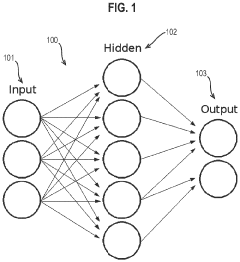
- The development of semiconductor devices and neuromorphic circuits incorporating ferroelectric materials, which enable efficient data processing by simulating synaptic functions, allowing for parallel processing and improved data storage and retrieval, thereby enhancing the accuracy and speed of data processing.
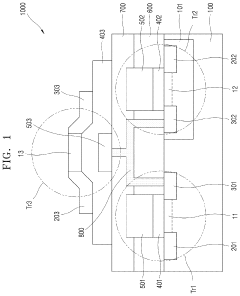
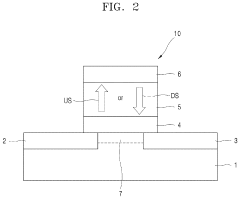
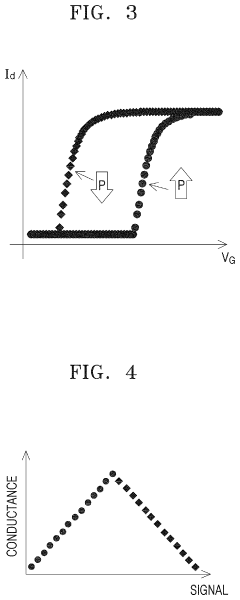
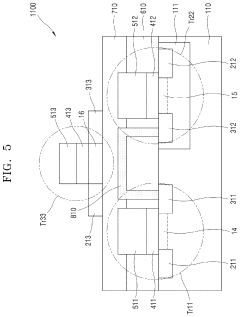
Neuromorphic computing
PatentPendingUS20240070446A1
Innovation
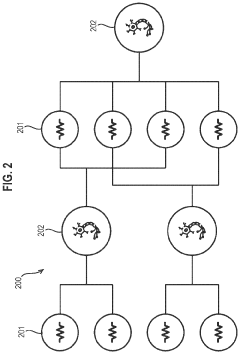
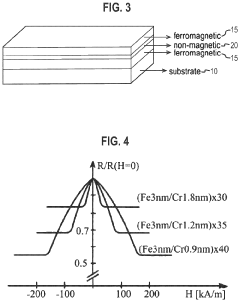
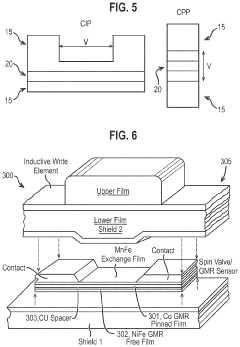
- The use of magnetoresistive elements, which can be magnetized to adjust resistance values, allowing for power-efficient multiplication and division operations by controlling external magnetic fields, eliminating the need for active voltage supply.
Energy Efficiency Comparison Between Computing Paradigms
The energy efficiency landscape between neuromorphic and traditional semiconductor computing represents a critical dimension in evaluating next-generation computing technologies. Traditional von Neumann architecture-based semiconductor computing has reached significant efficiency plateaus due to physical limitations, particularly as Moore's Law approaches its theoretical boundaries. Current high-performance computing systems typically operate at energy efficiencies of 1-10 picojoules per operation, with substantial energy losses attributed to data movement between memory and processing units.
In contrast, neuromorphic computing systems demonstrate remarkable theoretical energy advantages, with some implementations achieving efficiencies in the femtojoule range per synaptic operation. This represents a 100-1000x improvement over conventional semiconductor approaches. The efficiency gains stem from neuromorphic computing's fundamental architectural differences, particularly its co-location of memory and processing elements that significantly reduces energy-intensive data movement.
Material considerations play a crucial role in these efficiency differentials. Traditional CMOS-based semiconductors rely on silicon technologies optimized over decades but face increasing leakage current and heat dissipation challenges at smaller nodes. Neuromorphic materials, including memristive devices, phase-change materials, and spintronic components, offer inherently lower energy requirements for state changes that represent computational operations.
Recent benchmark studies comparing neuromorphic systems like IBM's TrueNorth and Intel's Loihi against conventional GPUs and TPUs have demonstrated energy efficiency improvements of 10-100x for specific pattern recognition and inference tasks. However, these advantages are not universal across all computational workloads, with conventional architectures maintaining efficiency advantages for precise numerical calculations and certain sequential processing tasks.
The energy efficiency equation must also consider the complete system context, including peripheral components, cooling requirements, and idle state power consumption. While neuromorphic cores may demonstrate superior operation-level efficiency, system-level implementations often incorporate traditional semiconductor components for interfaces and control logic, somewhat diluting the theoretical advantages.
Looking forward, hybrid systems that strategically deploy neuromorphic components alongside conventional semiconductor elements represent a promising approach to optimizing energy efficiency across diverse computational workloads. The development of specialized neuromorphic materials that can be integrated with standard semiconductor manufacturing processes will be crucial for realizing practical energy efficiency gains in commercial computing systems.
In contrast, neuromorphic computing systems demonstrate remarkable theoretical energy advantages, with some implementations achieving efficiencies in the femtojoule range per synaptic operation. This represents a 100-1000x improvement over conventional semiconductor approaches. The efficiency gains stem from neuromorphic computing's fundamental architectural differences, particularly its co-location of memory and processing elements that significantly reduces energy-intensive data movement.
Material considerations play a crucial role in these efficiency differentials. Traditional CMOS-based semiconductors rely on silicon technologies optimized over decades but face increasing leakage current and heat dissipation challenges at smaller nodes. Neuromorphic materials, including memristive devices, phase-change materials, and spintronic components, offer inherently lower energy requirements for state changes that represent computational operations.
Recent benchmark studies comparing neuromorphic systems like IBM's TrueNorth and Intel's Loihi against conventional GPUs and TPUs have demonstrated energy efficiency improvements of 10-100x for specific pattern recognition and inference tasks. However, these advantages are not universal across all computational workloads, with conventional architectures maintaining efficiency advantages for precise numerical calculations and certain sequential processing tasks.
The energy efficiency equation must also consider the complete system context, including peripheral components, cooling requirements, and idle state power consumption. While neuromorphic cores may demonstrate superior operation-level efficiency, system-level implementations often incorporate traditional semiconductor components for interfaces and control logic, somewhat diluting the theoretical advantages.
Looking forward, hybrid systems that strategically deploy neuromorphic components alongside conventional semiconductor elements represent a promising approach to optimizing energy efficiency across diverse computational workloads. The development of specialized neuromorphic materials that can be integrated with standard semiconductor manufacturing processes will be crucial for realizing practical energy efficiency gains in commercial computing systems.
Environmental Impact of Advanced Computing Materials
The environmental footprint of computing materials has become increasingly significant as technological advancement accelerates. Neuromorphic computing materials, designed to mimic biological neural systems, demonstrate fundamentally different environmental profiles compared to traditional semiconductor materials. Silicon-based semiconductors, while highly optimized through decades of manufacturing refinement, require energy-intensive fabrication processes including ultra-high purity material production and cleanroom environments that consume substantial resources.
Neuromorphic materials, particularly those utilizing memristive elements or phase-change materials, often incorporate rare earth elements and specialized compounds that present unique environmental challenges. The extraction of these materials frequently involves mining operations with significant ecological impacts, including habitat destruction, water pollution, and energy-intensive processing. However, the operational efficiency of neuromorphic systems potentially offers long-term environmental benefits through dramatically reduced power consumption during use.
Life cycle assessments reveal that semiconductor manufacturing generates substantial electronic waste containing hazardous substances like lead, mercury, and flame retardants. The semiconductor industry consumes approximately 235 billion liters of water annually, with a single fabrication facility using up to 15 million liters daily. In contrast, emerging neuromorphic technologies may require less water during operation but present new end-of-life recycling challenges due to their complex material compositions.
Carbon footprint comparisons indicate that while traditional semiconductor production releases significant greenhouse gases during manufacturing, neuromorphic systems may offset these impacts through operational efficiency. A typical semiconductor fabrication plant produces approximately 56,000 metric tons of CO2 equivalent annually, whereas neuromorphic computing architectures could potentially reduce operational emissions by 50-90% through their inherently lower power requirements.
Material scarcity represents another critical environmental consideration. Conventional semiconductors rely heavily on highly purified silicon, which remains relatively abundant. However, neuromorphic systems often incorporate materials like hafnium oxide, tantalum, and various rare earth elements that face supply constraints and geopolitical complications. These materials frequently originate from regions with limited environmental regulations, potentially exacerbating ecological damage through unregulated extraction practices.
Emerging recycling technologies show promise for both material types, with semiconductor recycling processes becoming increasingly sophisticated. Neuromorphic materials present both challenges and opportunities in this domain, as their diverse composition complicates separation but potentially increases the economic value of recovery operations. Recent research indicates that advanced hydrometallurgical processes could recover up to 95% of critical materials from next-generation computing components.
Neuromorphic materials, particularly those utilizing memristive elements or phase-change materials, often incorporate rare earth elements and specialized compounds that present unique environmental challenges. The extraction of these materials frequently involves mining operations with significant ecological impacts, including habitat destruction, water pollution, and energy-intensive processing. However, the operational efficiency of neuromorphic systems potentially offers long-term environmental benefits through dramatically reduced power consumption during use.
Life cycle assessments reveal that semiconductor manufacturing generates substantial electronic waste containing hazardous substances like lead, mercury, and flame retardants. The semiconductor industry consumes approximately 235 billion liters of water annually, with a single fabrication facility using up to 15 million liters daily. In contrast, emerging neuromorphic technologies may require less water during operation but present new end-of-life recycling challenges due to their complex material compositions.
Carbon footprint comparisons indicate that while traditional semiconductor production releases significant greenhouse gases during manufacturing, neuromorphic systems may offset these impacts through operational efficiency. A typical semiconductor fabrication plant produces approximately 56,000 metric tons of CO2 equivalent annually, whereas neuromorphic computing architectures could potentially reduce operational emissions by 50-90% through their inherently lower power requirements.
Material scarcity represents another critical environmental consideration. Conventional semiconductors rely heavily on highly purified silicon, which remains relatively abundant. However, neuromorphic systems often incorporate materials like hafnium oxide, tantalum, and various rare earth elements that face supply constraints and geopolitical complications. These materials frequently originate from regions with limited environmental regulations, potentially exacerbating ecological damage through unregulated extraction practices.
Emerging recycling technologies show promise for both material types, with semiconductor recycling processes becoming increasingly sophisticated. Neuromorphic materials present both challenges and opportunities in this domain, as their diverse composition complicates separation but potentially increases the economic value of recovery operations. Recent research indicates that advanced hydrometallurgical processes could recover up to 95% of critical materials from next-generation computing components.
Unlock deeper insights with PatSnap Eureka Quick Research — get a full tech report to explore trends and direct your research. Try now!
Generate Your Research Report Instantly with AI Agent
Supercharge your innovation with PatSnap Eureka AI Agent Platform!