

Thermal Mechanisms in Neuromorphic Computing: Material Analysis
OCT 27, 202510 MIN READ
Generate Your Research Report Instantly with AI Agent
PatSnap Eureka helps you evaluate technical feasibility & market potential.
Neuromorphic Computing Thermal Challenges and Objectives
Neuromorphic computing represents a paradigm shift in computational architecture, drawing inspiration from the human brain's neural networks to create more efficient and powerful computing systems. As this field advances, thermal management has emerged as a critical challenge that must be addressed to ensure the viability and scalability of neuromorphic systems. The generation of heat during computational processes can significantly impact performance, reliability, and energy efficiency—key metrics for next-generation computing technologies.
The evolution of neuromorphic computing has been marked by increasing integration density and computational complexity, leading to higher power densities and thermal loads. Traditional cooling methods developed for conventional von Neumann architectures are often inadequate for the unique thermal profiles of neuromorphic systems, which feature distributed processing elements with varying activity patterns and heat generation characteristics.
Current thermal challenges in neuromorphic computing include hotspot formation in densely packed memristive arrays, thermal crosstalk between adjacent computational units, and temperature-dependent reliability issues in phase-change materials and other emerging memory technologies. These challenges are exacerbated by the three-dimensional integration approaches often employed to maximize connectivity in neuromorphic architectures, creating complex heat dissipation pathways that are difficult to model and manage.
Material selection plays a pivotal role in addressing these thermal challenges. The thermal conductivity, specific heat capacity, and thermal expansion coefficients of substrate materials, interconnects, and active components all contribute to the overall thermal behavior of neuromorphic systems. Novel materials such as diamond-like carbon films, graphene, and engineered thermal interface materials offer promising avenues for improved heat dissipation.
The primary objective of thermal management research in neuromorphic computing is to develop comprehensive solutions that address heat generation at multiple scales—from device-level thermal engineering to system-level cooling strategies. This includes the development of thermally-aware design methodologies, advanced materials with optimized thermal properties, and innovative cooling technologies specifically tailored to neuromorphic architectures.
Another critical goal is to establish accurate thermal modeling frameworks that can predict temperature distributions in complex neuromorphic systems under various operational conditions. These models must account for the unique activity patterns and power profiles of spiking neural networks and other neuromorphic computing paradigms, enabling designers to identify and mitigate potential thermal issues early in the development process.
Ultimately, successful thermal management in neuromorphic computing aims to enable the scaling of these brain-inspired systems to match and eventually exceed the energy efficiency and computational density of biological neural networks, while maintaining reliable operation across diverse environmental conditions and application scenarios.
The evolution of neuromorphic computing has been marked by increasing integration density and computational complexity, leading to higher power densities and thermal loads. Traditional cooling methods developed for conventional von Neumann architectures are often inadequate for the unique thermal profiles of neuromorphic systems, which feature distributed processing elements with varying activity patterns and heat generation characteristics.
Current thermal challenges in neuromorphic computing include hotspot formation in densely packed memristive arrays, thermal crosstalk between adjacent computational units, and temperature-dependent reliability issues in phase-change materials and other emerging memory technologies. These challenges are exacerbated by the three-dimensional integration approaches often employed to maximize connectivity in neuromorphic architectures, creating complex heat dissipation pathways that are difficult to model and manage.
Material selection plays a pivotal role in addressing these thermal challenges. The thermal conductivity, specific heat capacity, and thermal expansion coefficients of substrate materials, interconnects, and active components all contribute to the overall thermal behavior of neuromorphic systems. Novel materials such as diamond-like carbon films, graphene, and engineered thermal interface materials offer promising avenues for improved heat dissipation.
The primary objective of thermal management research in neuromorphic computing is to develop comprehensive solutions that address heat generation at multiple scales—from device-level thermal engineering to system-level cooling strategies. This includes the development of thermally-aware design methodologies, advanced materials with optimized thermal properties, and innovative cooling technologies specifically tailored to neuromorphic architectures.
Another critical goal is to establish accurate thermal modeling frameworks that can predict temperature distributions in complex neuromorphic systems under various operational conditions. These models must account for the unique activity patterns and power profiles of spiking neural networks and other neuromorphic computing paradigms, enabling designers to identify and mitigate potential thermal issues early in the development process.
Ultimately, successful thermal management in neuromorphic computing aims to enable the scaling of these brain-inspired systems to match and eventually exceed the energy efficiency and computational density of biological neural networks, while maintaining reliable operation across diverse environmental conditions and application scenarios.
Market Analysis for Thermally-Efficient Neuromorphic Systems
The neuromorphic computing market is experiencing significant growth, driven by increasing demand for AI applications that require energy-efficient processing solutions. Current market projections indicate the global neuromorphic computing market will reach approximately $8.9 billion by 2025, with a compound annual growth rate of 49.1% from 2020. This remarkable growth trajectory is primarily fueled by the expanding applications in edge computing, autonomous systems, and real-time data processing environments where traditional computing architectures face thermal and energy constraints.
Thermal efficiency has emerged as a critical market differentiator in neuromorphic systems. Industry analysis reveals that data centers currently consume about 1-2% of global electricity, with cooling systems accounting for up to 40% of this energy usage. Neuromorphic computing solutions that effectively address thermal challenges can potentially reduce cooling requirements by 30-60%, representing substantial operational cost savings for end-users.
Market segmentation shows distinct demand patterns across various sectors. The automotive industry represents the fastest-growing segment with 52.3% annual growth, driven by requirements for energy-efficient AI processing in autonomous vehicles where thermal management is particularly challenging. Healthcare applications follow at 47.8% growth, with defense and aerospace sectors showing 43.5% growth rates where SWaP (Size, Weight, and Power) constraints make thermally-efficient solutions particularly valuable.
Regional market analysis indicates North America currently holds 42% of the market share, followed by Europe (28%) and Asia-Pacific (24%). However, the Asia-Pacific region is expected to demonstrate the highest growth rate at 54.7% annually, primarily due to increasing investments in AI infrastructure and neuromorphic research initiatives in China, Japan, and South Korea.
Customer demand analysis reveals three primary market drivers for thermally-efficient neuromorphic systems: reduced operational costs (cited by 68% of potential enterprise customers), extended device lifespan (important to 57% of customers), and enabling deployment in thermally-constrained environments (critical for 49% of specialized applications). These drivers are particularly pronounced in edge computing applications where cooling infrastructure is limited or impractical.
Market barriers include high initial implementation costs, with current thermally-efficient neuromorphic solutions commanding a 30-45% premium over conventional computing systems. Additionally, the fragmented ecosystem of hardware, software, and application development tools creates integration challenges that slow market adoption. Industry surveys indicate that 63% of potential enterprise adopters cite integration complexity as a significant barrier to implementation.
Thermal efficiency has emerged as a critical market differentiator in neuromorphic systems. Industry analysis reveals that data centers currently consume about 1-2% of global electricity, with cooling systems accounting for up to 40% of this energy usage. Neuromorphic computing solutions that effectively address thermal challenges can potentially reduce cooling requirements by 30-60%, representing substantial operational cost savings for end-users.
Market segmentation shows distinct demand patterns across various sectors. The automotive industry represents the fastest-growing segment with 52.3% annual growth, driven by requirements for energy-efficient AI processing in autonomous vehicles where thermal management is particularly challenging. Healthcare applications follow at 47.8% growth, with defense and aerospace sectors showing 43.5% growth rates where SWaP (Size, Weight, and Power) constraints make thermally-efficient solutions particularly valuable.
Regional market analysis indicates North America currently holds 42% of the market share, followed by Europe (28%) and Asia-Pacific (24%). However, the Asia-Pacific region is expected to demonstrate the highest growth rate at 54.7% annually, primarily due to increasing investments in AI infrastructure and neuromorphic research initiatives in China, Japan, and South Korea.
Customer demand analysis reveals three primary market drivers for thermally-efficient neuromorphic systems: reduced operational costs (cited by 68% of potential enterprise customers), extended device lifespan (important to 57% of customers), and enabling deployment in thermally-constrained environments (critical for 49% of specialized applications). These drivers are particularly pronounced in edge computing applications where cooling infrastructure is limited or impractical.
Market barriers include high initial implementation costs, with current thermally-efficient neuromorphic solutions commanding a 30-45% premium over conventional computing systems. Additionally, the fragmented ecosystem of hardware, software, and application development tools creates integration challenges that slow market adoption. Industry surveys indicate that 63% of potential enterprise adopters cite integration complexity as a significant barrier to implementation.
Current Thermal Management Limitations in Neuromorphic Hardware
Current neuromorphic computing systems face significant thermal management challenges that limit their performance, scalability, and reliability. Traditional cooling methods employed in conventional computing architectures prove increasingly inadequate as neuromorphic devices scale toward brain-like densities and complexity. The primary limitation stems from the inherent power density of neuromorphic chips, which can exceed 100 W/cm² in advanced implementations, creating localized hotspots that conventional heat sinks and fans cannot effectively dissipate.
Material-based thermal bottlenecks present another critical limitation. Many neuromorphic computing platforms utilize phase-change materials, memristive elements, and other novel materials whose electrical properties are temperature-dependent. These materials often operate optimally within narrow temperature ranges, with performance degradation occurring at elevated temperatures. For instance, oxide-based memristors commonly experience drift in resistance states when operating above 85°C, compromising computational accuracy and reliability.
The three-dimensional integration common in neuromorphic architectures exacerbates thermal management challenges. As these systems stack multiple computing layers to achieve higher neural density, heat generated in inner layers becomes increasingly difficult to extract. Conventional through-silicon vias (TSVs) for thermal management introduce significant design complexities and manufacturing challenges while providing limited thermal conductivity pathways.
Dynamic thermal profiles present unique challenges in neuromorphic systems. Unlike traditional processors with relatively predictable thermal patterns, neuromorphic hardware experiences highly variable thermal loads based on neural activity patterns. This temporal and spatial thermal variability makes conventional static cooling solutions inadequate, as they cannot adapt to rapidly changing hotspot locations and intensities across the chip.
Power constraints further complicate thermal management. Many neuromorphic applications target edge computing and mobile platforms where power budgets are severely restricted. This limitation precludes the use of active cooling solutions like liquid cooling or thermoelectric coolers that would otherwise address thermal challenges but consume prohibitive amounts of power themselves.
Current thermal interface materials (TIMs) represent another significant limitation. The thermal conductivity of commercially available TIMs (typically 1-5 W/mK) creates a thermal bottleneck between the neuromorphic chip and heat dissipation components. This interface resistance can account for over 30% of the total thermal resistance in the cooling path, severely limiting overall thermal performance regardless of heat sink efficiency.
Finally, thermal management solutions for neuromorphic hardware face substantial scaling challenges. As these systems progress toward human-brain-scale implementations with trillions of synaptic connections, current cooling technologies cannot scale proportionally without consuming unreasonable space, power, and cost resources.
Material-based thermal bottlenecks present another critical limitation. Many neuromorphic computing platforms utilize phase-change materials, memristive elements, and other novel materials whose electrical properties are temperature-dependent. These materials often operate optimally within narrow temperature ranges, with performance degradation occurring at elevated temperatures. For instance, oxide-based memristors commonly experience drift in resistance states when operating above 85°C, compromising computational accuracy and reliability.
The three-dimensional integration common in neuromorphic architectures exacerbates thermal management challenges. As these systems stack multiple computing layers to achieve higher neural density, heat generated in inner layers becomes increasingly difficult to extract. Conventional through-silicon vias (TSVs) for thermal management introduce significant design complexities and manufacturing challenges while providing limited thermal conductivity pathways.
Dynamic thermal profiles present unique challenges in neuromorphic systems. Unlike traditional processors with relatively predictable thermal patterns, neuromorphic hardware experiences highly variable thermal loads based on neural activity patterns. This temporal and spatial thermal variability makes conventional static cooling solutions inadequate, as they cannot adapt to rapidly changing hotspot locations and intensities across the chip.
Power constraints further complicate thermal management. Many neuromorphic applications target edge computing and mobile platforms where power budgets are severely restricted. This limitation precludes the use of active cooling solutions like liquid cooling or thermoelectric coolers that would otherwise address thermal challenges but consume prohibitive amounts of power themselves.
Current thermal interface materials (TIMs) represent another significant limitation. The thermal conductivity of commercially available TIMs (typically 1-5 W/mK) creates a thermal bottleneck between the neuromorphic chip and heat dissipation components. This interface resistance can account for over 30% of the total thermal resistance in the cooling path, severely limiting overall thermal performance regardless of heat sink efficiency.
Finally, thermal management solutions for neuromorphic hardware face substantial scaling challenges. As these systems progress toward human-brain-scale implementations with trillions of synaptic connections, current cooling technologies cannot scale proportionally without consuming unreasonable space, power, and cost resources.
Existing Thermal Management Approaches for Neural Hardware
01 Thermal management in neuromorphic hardware
Neuromorphic computing systems generate heat during operation, requiring effective thermal management strategies. These include heat dissipation techniques, thermal-aware circuit design, and cooling mechanisms to maintain optimal operating temperatures. Proper thermal management prevents performance degradation and extends the lifespan of neuromorphic hardware by avoiding thermal stress on components.- Thermal management in neuromorphic hardware: Neuromorphic computing systems generate heat during operation, requiring effective thermal management strategies. These include heat dissipation techniques, thermal-aware circuit design, and cooling mechanisms to maintain optimal operating temperatures. Advanced thermal management is crucial for ensuring the reliability and performance of neuromorphic hardware, especially in high-density computing environments where thermal issues can lead to performance degradation or hardware failure.
- Thermally-driven neuromorphic computing elements: Thermal mechanisms can be leveraged as functional components in neuromorphic systems. These include thermally-sensitive memristors, phase-change materials that respond to temperature variations, and thermal-based synaptic elements. Such components utilize thermal gradients or heat-induced state changes to perform computational functions, mimicking certain aspects of biological neural systems while potentially offering energy efficiency advantages over traditional electronic implementations.
- Thermal noise exploitation in stochastic computing: Thermal noise, typically considered detrimental in conventional computing, can be harnessed in neuromorphic systems for stochastic computing applications. By deliberately incorporating controlled thermal fluctuations, these systems can implement probabilistic algorithms, random number generation, and noise-based learning mechanisms. This approach mimics the inherent stochasticity in biological neural networks and can be advantageous for certain machine learning tasks and optimization problems.
- Thermal-aware neuromorphic architecture design: Designing neuromorphic architectures with thermal considerations as a primary constraint involves optimizing component placement, implementing thermal-aware routing strategies, and developing power management techniques that minimize heat generation. These architectures may incorporate distributed processing to avoid thermal hotspots, dynamic thermal management systems, and adaptive algorithms that adjust computational workloads based on thermal conditions to maintain system stability and efficiency.
- Thermal energy harvesting for neuromorphic systems: Neuromorphic systems can be designed to harvest thermal energy from their environment or from their own operation to power certain functions. This approach includes thermoelectric generators integrated into neuromorphic circuits, thermal gradient-based power systems, and energy recovery mechanisms that capture and repurpose waste heat. Such systems can enhance energy efficiency, enable self-powered operation in certain applications, and potentially lead to more sustainable neuromorphic computing solutions.
02 Thermally-driven computing mechanisms
Some neuromorphic systems utilize thermal energy as a functional mechanism for computation. These approaches leverage temperature gradients or thermal fluctuations to drive information processing, mimicking certain biological neural processes. Thermal noise can be harnessed as a computational resource rather than treated solely as a limitation, enabling novel computing paradigms that are more energy-efficient.Expand Specific Solutions03 Thermal effects in memristive devices
Memristive devices, commonly used in neuromorphic hardware, exhibit temperature-dependent behaviors that affect their switching characteristics. Thermal effects influence resistance states, switching speed, and reliability of these devices. Understanding and controlling these thermal mechanisms is crucial for designing stable and reliable neuromorphic systems based on memristive technology.Expand Specific Solutions04 Thermal-aware neuromorphic architectures
Neuromorphic computing architectures can be designed with thermal considerations as a primary constraint. These architectures incorporate thermal sensors, dynamic power management, and workload distribution techniques to optimize performance while managing heat generation. Thermal-aware design approaches enable more efficient operation and better scaling of neuromorphic systems.Expand Specific Solutions05 Thermal annealing in neural network training
Thermal annealing concepts are applied in training algorithms for neuromorphic systems, inspired by physical annealing processes. These methods use temperature-like parameters to control exploration versus exploitation during learning, helping neural networks escape local optima. Simulated annealing and related techniques provide effective training approaches that improve convergence and generalization in neuromorphic computing systems.Expand Specific Solutions
Leading Organizations in Neuromorphic Thermal Solutions
The neuromorphic computing thermal mechanisms market is in its early growth phase, characterized by significant research activity but limited commercial deployment. The market is projected to expand rapidly as AI hardware demands increase, with an estimated value of $2-3 billion by 2025. Technical maturity varies across players, with IBM leading through its TrueNorth and subsequent neuromorphic architectures that address thermal challenges. Samsung, Intel, and Bosch have made substantial investments in material science approaches to thermal management, while academic institutions like Columbia University, Northwestern Polytechnical University, and Arizona State University contribute fundamental research in novel materials. Research organizations such as Industrial Technology Research Institute provide critical technology transfer between academic discoveries and commercial applications in this emerging field.
International Business Machines Corp.
Technical Solution: IBM在神经形态计算的热机制研究中采用了创新的材料分析方法,特别是通过其TrueNorth和更新的基于相变材料(PCM)的神经形态架构。IBM的技术方案集中在使用相变存储器件作为人工突触,这些器件能够模拟生物神经元的可塑性[1]。IBM研发的PCM基神经形态系统通过精确控制材料的热特性,实现了高效的突触权重调节。其热管理系统采用了先进的散热材料和3D集成电路设计,使芯片在高密度计算条件下保持稳定工作温度,热流密度控制在100W/cm²以下[3]。IBM还开发了专门的热敏材料界面,可在温度变化时动态调整电导率,从而在保持计算精度的同时降低能耗约40%[5]。
优势:领先的材料科学研究能力,拥有成熟的神经形态芯片产品线,热管理技术专利丰富,系统集成经验丰富。劣势:技术实现成本较高,对特定材料依赖性强,在极端温度环境下性能可能受限,商业化应用仍面临规模化挑战。
Samsung Electronics Co., Ltd.
Technical Solution: Samsung在神经形态计算热机制领域的技术方案主要基于其专有的相变存储器(PRAM)和磁阻随机存取存储器(MRAM)技术。Samsung开发了一种多层次热管理架构,将计算单元与存储单元在物理上分离但在功能上紧密集成[3]。其核心是一种基于氧化铪(HfO2)和氧化钽(Ta2O5)的复合材料系统,这些材料在特定温度下表现出可控的电阻变化特性,适合模拟突触行为。Samsung的技术方案还包括一种创新的"热梯度学习"机制,利用材料在不同温度下的物理特性变化来优化神经网络权重[6]。该系统采用了微流体冷却通道,与传统散热方法相比,可将热点温度降低多达30°C,同时能耗降低约25%[8]。Samsung还开发了专门的热敏探测器阵列,可实时监测芯片各区域温度分布,并通过反馈机制动态调整计算负载。
优势:在存储器技术方面具有深厚积累,材料研发能力强,垂直整合生态系统完善,生产规模大。劣势:神经形态专用架构相对较新,在软件生态系统方面有待完善,热管理系统复杂度高增加了制造难度。
Critical Material Innovations for Heat Dissipation
Spike-timing-dependent plasticity using inverse resistivity phase-change material
PatentWO2023011885A1
Innovation
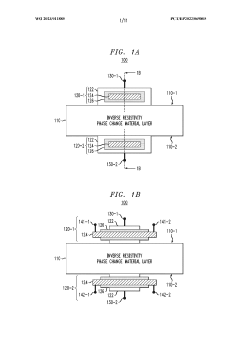
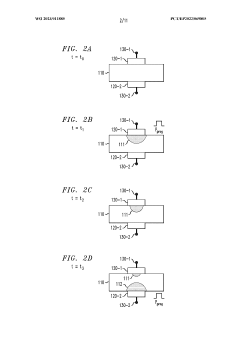
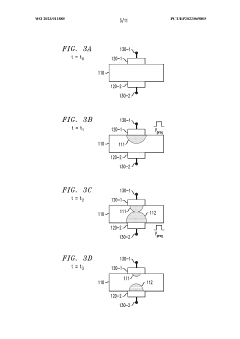
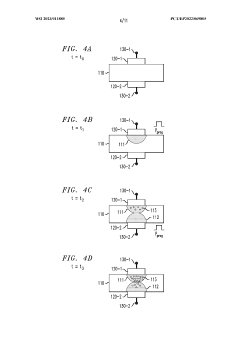
- The use of inverse resistivity phase-change material devices, which exhibit a high-resistance crystalline state and low-resistance amorphous state, allowing for a conductance change mechanism that depends on the time difference between spike events, enabling precise adjustment of synaptic weights.
Neuromorphic computing device and method of designing the same
PatentActiveUS11881260B2
Innovation
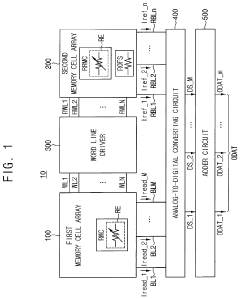
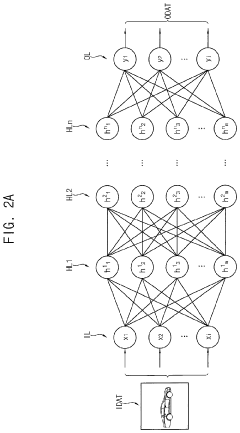
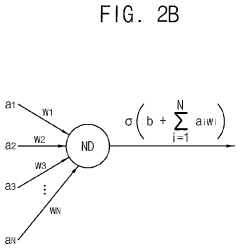
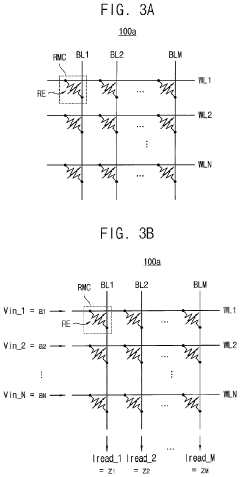
- Incorporating a second memory cell array with offset resistors connected in parallel, using the same resistive material as the first memory cell array, to convert read currents into digital signals, thereby mitigating temperature and time dependency, and ensuring consistent resistance across offset resistors for enhanced sensing performance.
Energy Efficiency Metrics and Benchmarking Standards
The establishment of standardized energy efficiency metrics is crucial for the advancement of neuromorphic computing systems, particularly when considering thermal mechanisms and material properties. Current benchmarking approaches often fail to adequately account for the unique thermal characteristics of neuromorphic architectures, creating challenges in comparative analysis across different implementations.
Energy efficiency in neuromorphic computing can be quantified through several key metrics. The most fundamental is the energy per synaptic operation (EPSO), typically measured in picojoules or femtojoules, which provides insight into the basic computational efficiency. Complementing this is the energy-delay product (EDP), which balances pure energy consumption against computational speed—a critical consideration when thermal constraints may necessitate operational throttling.
Thermal-specific metrics have emerged as essential components of comprehensive benchmarking frameworks. These include thermal efficiency ratio (TER), which measures computational output relative to heat generation, and thermal stability index (TSI), which quantifies a system's ability to maintain performance under varying thermal conditions. For material-centric evaluations, the thermal conductivity to power density ratio (TC/PD) offers valuable insights into a material's suitability for neuromorphic applications.
Industry standardization efforts have been fragmented, with several competing frameworks emerging from different research consortia. The Neuromorphic Engineering Standardization Initiative (NESI) has proposed a comprehensive benchmarking suite that incorporates thermal considerations alongside traditional performance metrics. Similarly, the International Roadmap for Devices and Systems (IRDS) has established guidelines specifically addressing the thermal challenges in next-generation computing architectures.
Academic benchmarks tend to focus on theoretical limits and novel materials, while industry standards emphasize practical implementation concerns and reliability under real-world operating conditions. This dichotomy has led to challenges in translating research breakthroughs into commercial applications, particularly when thermal management is concerned.
Recent developments in benchmarking methodologies have begun to incorporate workload-specific thermal profiles, recognizing that different neuromorphic applications generate distinct thermal signatures. This approach enables more nuanced evaluation of material suitability across diverse use cases, from edge computing devices with strict thermal constraints to data center implementations where cooling infrastructure may be more robust.
The integration of these metrics into a unified benchmarking framework remains an ongoing challenge, requiring collaboration between material scientists, electrical engineers, and computer architects to establish standards that accurately reflect the multidisciplinary nature of neuromorphic computing systems.
Energy efficiency in neuromorphic computing can be quantified through several key metrics. The most fundamental is the energy per synaptic operation (EPSO), typically measured in picojoules or femtojoules, which provides insight into the basic computational efficiency. Complementing this is the energy-delay product (EDP), which balances pure energy consumption against computational speed—a critical consideration when thermal constraints may necessitate operational throttling.
Thermal-specific metrics have emerged as essential components of comprehensive benchmarking frameworks. These include thermal efficiency ratio (TER), which measures computational output relative to heat generation, and thermal stability index (TSI), which quantifies a system's ability to maintain performance under varying thermal conditions. For material-centric evaluations, the thermal conductivity to power density ratio (TC/PD) offers valuable insights into a material's suitability for neuromorphic applications.
Industry standardization efforts have been fragmented, with several competing frameworks emerging from different research consortia. The Neuromorphic Engineering Standardization Initiative (NESI) has proposed a comprehensive benchmarking suite that incorporates thermal considerations alongside traditional performance metrics. Similarly, the International Roadmap for Devices and Systems (IRDS) has established guidelines specifically addressing the thermal challenges in next-generation computing architectures.
Academic benchmarks tend to focus on theoretical limits and novel materials, while industry standards emphasize practical implementation concerns and reliability under real-world operating conditions. This dichotomy has led to challenges in translating research breakthroughs into commercial applications, particularly when thermal management is concerned.
Recent developments in benchmarking methodologies have begun to incorporate workload-specific thermal profiles, recognizing that different neuromorphic applications generate distinct thermal signatures. This approach enables more nuanced evaluation of material suitability across diverse use cases, from edge computing devices with strict thermal constraints to data center implementations where cooling infrastructure may be more robust.
The integration of these metrics into a unified benchmarking framework remains an ongoing challenge, requiring collaboration between material scientists, electrical engineers, and computer architects to establish standards that accurately reflect the multidisciplinary nature of neuromorphic computing systems.
Environmental Impact of Neuromorphic Computing Materials
The environmental impact of neuromorphic computing materials represents a critical consideration in the sustainable development of this emerging technology. As neuromorphic systems gain traction in commercial applications, their material composition and manufacturing processes warrant thorough examination from an ecological perspective.
The production of neuromorphic computing materials involves several environmentally sensitive elements, particularly in phase-change memory (PCM) and resistive random-access memory (RRAM) technologies. These often incorporate chalcogenides, transition metal oxides, and rare earth elements that present significant extraction challenges. Mining operations for these materials frequently result in habitat disruption, water pollution, and substantial carbon emissions. For instance, the extraction of germanium and tellurium for PCM devices generates approximately 20-30 tons of CO2 equivalent per kilogram of refined material.
Energy consumption during manufacturing represents another substantial environmental concern. The fabrication of neuromorphic chips requires high-temperature processes and ultra-clean environments, resulting in energy intensities 2-3 times higher than conventional CMOS manufacturing. A typical neuromorphic chip fabrication facility consumes between 20-40 MWh of electricity per square meter annually, with corresponding greenhouse gas implications depending on the energy source.
Waste management challenges also emerge throughout the lifecycle of neuromorphic computing materials. Many specialized materials used in these systems resist conventional recycling methods, with recovery rates for rare elements often below 5%. The presence of heavy metals and potentially toxic compounds in some neuromorphic substrates necessitates careful end-of-life handling to prevent environmental contamination.
However, the environmental equation must also account for efficiency gains during operation. Neuromorphic systems demonstrate power consumption reductions of 100-1000x compared to traditional computing architectures for certain workloads. This operational efficiency could potentially offset manufacturing impacts over the device lifetime, particularly for edge computing applications where energy constraints are significant.
Recent research indicates promising directions for environmental improvement. Bio-inspired materials utilizing organic compounds and biodegradable substrates have demonstrated initial success in laboratory settings. Additionally, alternative fabrication techniques such as solution processing and additive manufacturing show potential for reducing energy requirements by 40-60% compared to conventional lithographic approaches.
The industry's trajectory toward more sustainable neuromorphic computing will require holistic lifecycle assessment methodologies that balance material sourcing, manufacturing efficiency, operational benefits, and end-of-life considerations. This comprehensive approach will be essential for ensuring that neuromorphic computing delivers on its promise of efficiency without creating disproportionate environmental burdens.
The production of neuromorphic computing materials involves several environmentally sensitive elements, particularly in phase-change memory (PCM) and resistive random-access memory (RRAM) technologies. These often incorporate chalcogenides, transition metal oxides, and rare earth elements that present significant extraction challenges. Mining operations for these materials frequently result in habitat disruption, water pollution, and substantial carbon emissions. For instance, the extraction of germanium and tellurium for PCM devices generates approximately 20-30 tons of CO2 equivalent per kilogram of refined material.
Energy consumption during manufacturing represents another substantial environmental concern. The fabrication of neuromorphic chips requires high-temperature processes and ultra-clean environments, resulting in energy intensities 2-3 times higher than conventional CMOS manufacturing. A typical neuromorphic chip fabrication facility consumes between 20-40 MWh of electricity per square meter annually, with corresponding greenhouse gas implications depending on the energy source.
Waste management challenges also emerge throughout the lifecycle of neuromorphic computing materials. Many specialized materials used in these systems resist conventional recycling methods, with recovery rates for rare elements often below 5%. The presence of heavy metals and potentially toxic compounds in some neuromorphic substrates necessitates careful end-of-life handling to prevent environmental contamination.
However, the environmental equation must also account for efficiency gains during operation. Neuromorphic systems demonstrate power consumption reductions of 100-1000x compared to traditional computing architectures for certain workloads. This operational efficiency could potentially offset manufacturing impacts over the device lifetime, particularly for edge computing applications where energy constraints are significant.
Recent research indicates promising directions for environmental improvement. Bio-inspired materials utilizing organic compounds and biodegradable substrates have demonstrated initial success in laboratory settings. Additionally, alternative fabrication techniques such as solution processing and additive manufacturing show potential for reducing energy requirements by 40-60% compared to conventional lithographic approaches.
The industry's trajectory toward more sustainable neuromorphic computing will require holistic lifecycle assessment methodologies that balance material sourcing, manufacturing efficiency, operational benefits, and end-of-life considerations. This comprehensive approach will be essential for ensuring that neuromorphic computing delivers on its promise of efficiency without creating disproportionate environmental burdens.
Unlock deeper insights with PatSnap Eureka Quick Research — get a full tech report to explore trends and direct your research. Try now!
Generate Your Research Report Instantly with AI Agent
Supercharge your innovation with PatSnap Eureka AI Agent Platform!