

Materials in Neuromorphic Computing: Technical Analysis
OCT 27, 202510 MIN READ
Generate Your Research Report Instantly with AI Agent
PatSnap Eureka helps you evaluate technical feasibility & market potential.
Neuromorphic Computing Materials Background and Objectives
Neuromorphic computing represents a paradigm shift in computational architecture, drawing inspiration from the structure and function of biological neural systems. This field has evolved significantly since its conceptual inception in the late 1980s by Carver Mead, who first proposed using analog circuits to mimic neurobiological architectures. The trajectory of neuromorphic computing has been characterized by a progressive refinement of materials and architectures that more closely emulate the efficiency, adaptability, and parallel processing capabilities of biological neural networks.
The evolution of materials in neuromorphic computing has transitioned through several distinct phases. Initially, complementary metal-oxide-semiconductor (CMOS) technology dominated implementations, offering a familiar platform for early neuromorphic designs. However, the inherent limitations of traditional CMOS in terms of energy efficiency and scalability prompted exploration of alternative materials and approaches.
Recent years have witnessed a significant shift toward emerging non-volatile memory technologies, including resistive random-access memory (RRAM), phase-change memory (PCM), and magnetic random-access memory (MRAM). These materials offer promising characteristics for implementing synaptic functions, particularly in terms of their ability to maintain states without continuous power consumption and to exhibit analog-like behavior essential for neuromorphic operations.
The development of two-dimensional materials, such as graphene and transition metal dichalcogenides, represents another frontier in neuromorphic materials research. These materials offer exceptional electrical properties, flexibility, and potential for integration with existing semiconductor technologies, making them candidates for next-generation neuromorphic systems.
Biological and organic materials have also emerged as an intriguing direction, with researchers exploring biomolecules, organic semiconductors, and hybrid bio-electronic interfaces that could potentially bridge the gap between artificial and biological neural systems more effectively than traditional inorganic materials.
The primary technical objectives in neuromorphic materials research center around several key parameters: energy efficiency that approaches biological levels (typically in the femtojoule range per synaptic operation), high integration density to support complex neural networks, reliable and reproducible behavior across multiple operational cycles, and compatibility with existing fabrication technologies to facilitate commercial adoption.
Additionally, researchers aim to develop materials that can support essential neuromorphic functions such as spike-timing-dependent plasticity (STDP), long-term potentiation and depression (LTP/LTD), and homeostatic plasticity—mechanisms that underlie learning and adaptation in biological systems.
The ultimate goal of neuromorphic materials research is to enable computing systems that can process information with the efficiency, adaptability, and robustness of biological neural networks while overcoming the von Neumann bottleneck that limits conventional computing architectures. This would potentially revolutionize applications in artificial intelligence, edge computing, autonomous systems, and brain-machine interfaces.
The evolution of materials in neuromorphic computing has transitioned through several distinct phases. Initially, complementary metal-oxide-semiconductor (CMOS) technology dominated implementations, offering a familiar platform for early neuromorphic designs. However, the inherent limitations of traditional CMOS in terms of energy efficiency and scalability prompted exploration of alternative materials and approaches.
Recent years have witnessed a significant shift toward emerging non-volatile memory technologies, including resistive random-access memory (RRAM), phase-change memory (PCM), and magnetic random-access memory (MRAM). These materials offer promising characteristics for implementing synaptic functions, particularly in terms of their ability to maintain states without continuous power consumption and to exhibit analog-like behavior essential for neuromorphic operations.
The development of two-dimensional materials, such as graphene and transition metal dichalcogenides, represents another frontier in neuromorphic materials research. These materials offer exceptional electrical properties, flexibility, and potential for integration with existing semiconductor technologies, making them candidates for next-generation neuromorphic systems.
Biological and organic materials have also emerged as an intriguing direction, with researchers exploring biomolecules, organic semiconductors, and hybrid bio-electronic interfaces that could potentially bridge the gap between artificial and biological neural systems more effectively than traditional inorganic materials.
The primary technical objectives in neuromorphic materials research center around several key parameters: energy efficiency that approaches biological levels (typically in the femtojoule range per synaptic operation), high integration density to support complex neural networks, reliable and reproducible behavior across multiple operational cycles, and compatibility with existing fabrication technologies to facilitate commercial adoption.
Additionally, researchers aim to develop materials that can support essential neuromorphic functions such as spike-timing-dependent plasticity (STDP), long-term potentiation and depression (LTP/LTD), and homeostatic plasticity—mechanisms that underlie learning and adaptation in biological systems.
The ultimate goal of neuromorphic materials research is to enable computing systems that can process information with the efficiency, adaptability, and robustness of biological neural networks while overcoming the von Neumann bottleneck that limits conventional computing architectures. This would potentially revolutionize applications in artificial intelligence, edge computing, autonomous systems, and brain-machine interfaces.
Market Analysis for Brain-Inspired Computing Solutions
The neuromorphic computing market is experiencing significant growth, driven by increasing demand for AI applications that require efficient processing of complex neural networks. Current market estimates value the global neuromorphic computing sector at approximately 3.2 billion USD in 2023, with projections indicating a compound annual growth rate of 23.7% through 2030. This growth trajectory is supported by substantial investments from both private and public sectors, with government initiatives in the US, EU, and China allocating dedicated funding for neuromorphic research and development.
The demand for brain-inspired computing solutions stems primarily from applications requiring real-time processing of unstructured data, energy efficiency, and adaptive learning capabilities. Key market segments include autonomous vehicles, robotics, healthcare monitoring systems, and edge computing devices. The automotive sector represents the fastest-growing application area, with manufacturers seeking neuromorphic solutions for advanced driver assistance systems and autonomous navigation that can process sensory data with minimal power consumption.
Healthcare applications constitute another significant market segment, with neuromorphic systems being developed for medical imaging analysis, patient monitoring, and early disease detection. These applications benefit from the pattern recognition capabilities inherent in brain-inspired architectures, allowing for more accurate diagnostics with reduced computational overhead.
From a geographical perspective, North America currently leads the market with approximately 42% share, followed by Europe and Asia-Pacific regions. However, the Asia-Pacific region is expected to witness the highest growth rate over the next five years, driven by substantial investments in AI infrastructure in China, Japan, and South Korea.
The customer base for neuromorphic computing solutions is evolving from primarily research institutions to include commercial enterprises across multiple industries. This shift indicates increasing market maturity and recognition of the practical benefits offered by brain-inspired computing architectures. Enterprise adoption is particularly strong in sectors dealing with large volumes of sensor data that require real-time processing and analysis.
Market challenges include the relatively high initial development costs, limited standardization across platforms, and competition from alternative computing paradigms such as quantum computing. Additionally, the specialized expertise required for implementing neuromorphic solutions presents a barrier to widespread adoption in some industry sectors.
Despite these challenges, market indicators suggest that neuromorphic computing is approaching an inflection point, with material innovations in memristive devices and phase-change materials potentially accelerating commercial viability and market penetration over the next three to five years.
The demand for brain-inspired computing solutions stems primarily from applications requiring real-time processing of unstructured data, energy efficiency, and adaptive learning capabilities. Key market segments include autonomous vehicles, robotics, healthcare monitoring systems, and edge computing devices. The automotive sector represents the fastest-growing application area, with manufacturers seeking neuromorphic solutions for advanced driver assistance systems and autonomous navigation that can process sensory data with minimal power consumption.
Healthcare applications constitute another significant market segment, with neuromorphic systems being developed for medical imaging analysis, patient monitoring, and early disease detection. These applications benefit from the pattern recognition capabilities inherent in brain-inspired architectures, allowing for more accurate diagnostics with reduced computational overhead.
From a geographical perspective, North America currently leads the market with approximately 42% share, followed by Europe and Asia-Pacific regions. However, the Asia-Pacific region is expected to witness the highest growth rate over the next five years, driven by substantial investments in AI infrastructure in China, Japan, and South Korea.
The customer base for neuromorphic computing solutions is evolving from primarily research institutions to include commercial enterprises across multiple industries. This shift indicates increasing market maturity and recognition of the practical benefits offered by brain-inspired computing architectures. Enterprise adoption is particularly strong in sectors dealing with large volumes of sensor data that require real-time processing and analysis.
Market challenges include the relatively high initial development costs, limited standardization across platforms, and competition from alternative computing paradigms such as quantum computing. Additionally, the specialized expertise required for implementing neuromorphic solutions presents a barrier to widespread adoption in some industry sectors.
Despite these challenges, market indicators suggest that neuromorphic computing is approaching an inflection point, with material innovations in memristive devices and phase-change materials potentially accelerating commercial viability and market penetration over the next three to five years.
Current Materials Challenges in Neuromorphic Systems
The development of neuromorphic computing systems faces significant materials-related challenges that currently limit their widespread adoption and performance optimization. Traditional silicon-based CMOS technology, while well-established for conventional computing, presents inherent limitations for brain-inspired architectures due to its fundamentally different operational principles compared to biological neural systems.
A primary challenge lies in developing materials that can effectively emulate synaptic plasticity with high energy efficiency. Current memristive devices based on oxide materials such as HfO2, TaOx, and TiO2 demonstrate promising resistance switching properties but suffer from reliability issues, including cycle-to-cycle variability and limited endurance. These inconsistencies significantly impact the learning capabilities and long-term stability of neuromorphic systems.
Phase-change materials (PCMs) like Ge2Sb2Te5, while offering multi-level resistance states crucial for synaptic weight representation, face challenges related to high programming currents and thermal management issues. The energy required for state transitions remains substantially higher than biological synapses, creating a significant barrier to achieving brain-like energy efficiency.
Emerging two-dimensional materials such as graphene and transition metal dichalcogenides (TMDs) show potential for ultra-thin, flexible neuromorphic devices but face manufacturing challenges at scale. The integration of these novel materials with conventional CMOS processes presents complex compatibility issues that have yet to be fully resolved.
The development of materials for efficient spike generation mechanisms represents another critical challenge. Current implementations often rely on CMOS-based oscillator circuits that consume orders of magnitude more energy than biological neurons. Materials that can intrinsically generate spike-like signals through physical phenomena such as magnetic domain wall motion or spin-torque oscillations are under investigation but remain in early research stages.
Interconnect materials present a significant bottleneck in neuromorphic architectures. The dense connectivity required to mimic neural networks demands novel approaches beyond traditional metal interconnects. Photonic interconnects offer promising bandwidth and energy characteristics but require integration of compatible materials that can efficiently convert between electronic and optical domains.
Packaging materials must also address unique challenges in neuromorphic systems, particularly for applications requiring 3D integration to achieve brain-like connectivity density. Advanced materials for through-silicon vias (TSVs) and interposers that can maintain signal integrity while managing thermal issues are essential for next-generation neuromorphic hardware.
A primary challenge lies in developing materials that can effectively emulate synaptic plasticity with high energy efficiency. Current memristive devices based on oxide materials such as HfO2, TaOx, and TiO2 demonstrate promising resistance switching properties but suffer from reliability issues, including cycle-to-cycle variability and limited endurance. These inconsistencies significantly impact the learning capabilities and long-term stability of neuromorphic systems.
Phase-change materials (PCMs) like Ge2Sb2Te5, while offering multi-level resistance states crucial for synaptic weight representation, face challenges related to high programming currents and thermal management issues. The energy required for state transitions remains substantially higher than biological synapses, creating a significant barrier to achieving brain-like energy efficiency.
Emerging two-dimensional materials such as graphene and transition metal dichalcogenides (TMDs) show potential for ultra-thin, flexible neuromorphic devices but face manufacturing challenges at scale. The integration of these novel materials with conventional CMOS processes presents complex compatibility issues that have yet to be fully resolved.
The development of materials for efficient spike generation mechanisms represents another critical challenge. Current implementations often rely on CMOS-based oscillator circuits that consume orders of magnitude more energy than biological neurons. Materials that can intrinsically generate spike-like signals through physical phenomena such as magnetic domain wall motion or spin-torque oscillations are under investigation but remain in early research stages.
Interconnect materials present a significant bottleneck in neuromorphic architectures. The dense connectivity required to mimic neural networks demands novel approaches beyond traditional metal interconnects. Photonic interconnects offer promising bandwidth and energy characteristics but require integration of compatible materials that can efficiently convert between electronic and optical domains.
Packaging materials must also address unique challenges in neuromorphic systems, particularly for applications requiring 3D integration to achieve brain-like connectivity density. Advanced materials for through-silicon vias (TSVs) and interposers that can maintain signal integrity while managing thermal issues are essential for next-generation neuromorphic hardware.
State-of-the-Art Neuromorphic Material Solutions
01 Phase-change materials for neuromorphic devices
Phase-change materials exhibit properties that make them suitable for neuromorphic computing applications. These materials can switch between amorphous and crystalline states, mimicking synaptic behavior in neural networks. The resistance changes in these materials can be used to store and process information, enabling the development of energy-efficient neuromorphic devices that can perform both memory and computational functions.- Phase-change materials for neuromorphic devices: Phase-change materials exhibit properties that make them suitable for neuromorphic computing applications. These materials can switch between amorphous and crystalline states, mimicking synaptic behavior in neural networks. The resistance changes in these materials can be used to store and process information, enabling the development of energy-efficient neuromorphic computing systems that can perform both memory and computational functions.
- Memristive materials and structures: Memristive materials and structures are fundamental components in neuromorphic computing systems. These materials can change their resistance based on the history of applied voltage or current, enabling them to mimic the behavior of biological synapses. Various metal oxides, chalcogenides, and organic materials are being explored for memristive applications, offering different performance characteristics in terms of switching speed, endurance, and power consumption.
- Magnetic materials for spintronic neuromorphic computing: Magnetic materials are being utilized in spintronic-based neuromorphic computing systems. These materials leverage electron spin properties to store and process information, offering advantages such as non-volatility, high endurance, and low power consumption. Magnetic tunnel junctions and domain wall devices made from ferromagnetic materials can implement synaptic and neuronal functions, enabling efficient neuromorphic architectures.
- 2D materials and heterostructures: Two-dimensional materials and their heterostructures are emerging as promising candidates for neuromorphic computing applications. Materials such as graphene, transition metal dichalcogenides, and hexagonal boron nitride offer unique electronic properties that can be exploited for synaptic functions. These atomically thin materials enable highly scalable and energy-efficient neuromorphic devices with tunable characteristics and integration capabilities with conventional electronics.
- Organic and biomimetic materials: Organic and biomimetic materials are being explored for bio-inspired neuromorphic computing systems. These materials can mimic biological neural processes more closely than traditional semiconductor materials. Organic semiconductors, polymers, and protein-based materials offer advantages such as flexibility, biocompatibility, and self-assembly properties. These materials enable the development of neuromorphic systems that more closely resemble biological neural networks in both structure and function.
02 Memristive materials and structures
Memristive materials are fundamental to neuromorphic computing as they can maintain a state of internal resistance based on the history of applied voltage and current. These materials exhibit properties similar to biological synapses, allowing for the implementation of learning algorithms directly in hardware. Various metal oxides, chalcogenides, and organic compounds are being explored as memristive materials to create efficient neuromorphic architectures.Expand Specific Solutions03 Magnetic materials for spintronic neuromorphic systems
Magnetic materials are being utilized in spintronic-based neuromorphic computing systems. These materials leverage electron spin properties to store and process information, offering advantages in terms of non-volatility, speed, and energy efficiency. Magnetic tunnel junctions and domain wall devices made from ferromagnetic materials can implement synaptic and neuronal functions, enabling brain-inspired computing architectures.Expand Specific Solutions04 2D materials and heterostructures
Two-dimensional materials and their heterostructures are emerging as promising candidates for neuromorphic computing applications. Materials such as graphene, transition metal dichalcogenides, and hexagonal boron nitride offer unique electronic properties that can be exploited for creating artificial synapses and neurons. These atomically thin materials enable highly scalable and energy-efficient neuromorphic devices with tunable functionalities.Expand Specific Solutions05 Organic and biomimetic materials
Organic and biomimetic materials are being explored for bio-inspired neuromorphic computing systems. These materials can mimic biological neural processes while offering advantages such as flexibility, biocompatibility, and low power consumption. Organic semiconductors, conducting polymers, and protein-based materials can be used to create artificial synapses and neurons that closely resemble their biological counterparts, potentially enabling more brain-like computing capabilities.Expand Specific Solutions
Leading Organizations in Neuromorphic Materials Research
Neuromorphic computing is currently in an early growth phase, with the market expected to expand significantly as brain-inspired computing architectures gain traction. The global market size is projected to reach several billion dollars by 2030, driven by applications in AI, edge computing, and low-power devices. Technologically, the field shows varying maturity levels across players. IBM leads with its TrueNorth and subsequent neuromorphic architectures, while Intel's Loihi chip represents another significant advancement. Samsung and Thales are investing heavily in neuromorphic materials research, with academic institutions like EPFL and CNRS providing fundamental breakthroughs. Emerging players like Syntiant and Beijing Lingxi are developing specialized neuromorphic solutions for edge applications, indicating a diversifying competitive landscape as the technology approaches broader commercial viability.
International Business Machines Corp.
Technical Solution: IBM has pioneered neuromorphic computing materials through its TrueNorth architecture, which implements a million programmable neurons and 256 million configurable synapses. Their approach uses phase-change memory (PCM) materials as artificial synapses, enabling analog computation with significantly reduced power consumption compared to traditional computing architectures. IBM's neuromorphic chips utilize a combination of CMOS technology for neurons and specialized resistive memory materials for synaptic connections, creating an efficient brain-inspired computing platform. Recent developments include their analog AI hardware that leverages non-volatile memory materials to perform computations directly in memory, addressing the von Neumann bottleneck[1]. IBM has also developed specialized magnetic materials that can mimic biological synaptic plasticity, demonstrating spike-timing-dependent plasticity (STDP) essential for learning in neuromorphic systems[3].
Strengths: Industry-leading integration of novel materials with established CMOS fabrication processes; extensive intellectual property portfolio in neuromorphic computing materials; demonstrated scalability to million-neuron systems. Weaknesses: Challenges in thermal stability of phase-change materials; reliability issues in long-term operation of resistive memory elements; higher manufacturing costs compared to conventional computing architectures.
Samsung Electronics Co., Ltd.
Technical Solution: Samsung has developed advanced neuromorphic computing materials focusing on resistive random-access memory (RRAM) and magnetoresistive random-access memory (MRAM) technologies. Their approach integrates these memory technologies directly with processing elements to create brain-inspired computing architectures. Samsung's neuromorphic materials research centers on hafnium oxide-based RRAM cells that can emulate synaptic behavior with multiple resistance states, enabling efficient implementation of neural network algorithms[2]. The company has demonstrated neuromorphic chips that combine their memory expertise with specialized analog computing elements, achieving energy efficiency improvements of up to 100x compared to conventional digital implementations[4]. Samsung has also pioneered 3D stacking techniques for neuromorphic hardware, using through-silicon vias (TSVs) to create dense, interconnected neural networks that more closely mimic biological neural structures.
Strengths: Vertical integration capabilities from materials research to mass production; extensive experience in memory technologies directly applicable to neuromorphic computing; strong manufacturing infrastructure for commercialization. Weaknesses: Relatively new entrant to neuromorphic-specific architectures compared to research-focused organizations; challenges in scaling analog computing elements while maintaining precision; material interface stability issues in multi-layer structures.
Critical Patents and Breakthroughs in Neural Materials
Neuromorphic computing device and method of designing the same
PatentActiveUS11881260B2
Innovation
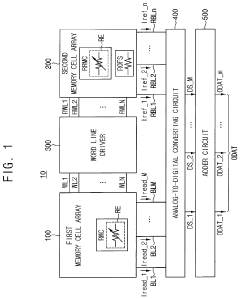
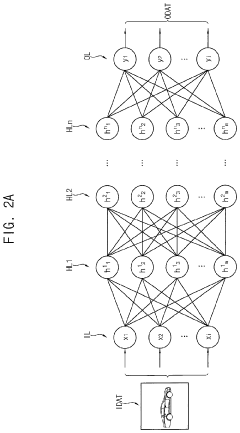
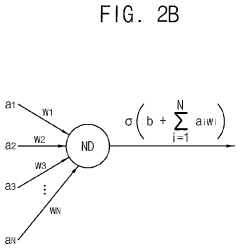
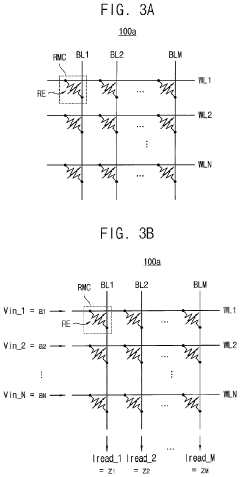
- Incorporating a second memory cell array with offset resistors connected in parallel, using the same resistive material as the first memory cell array, to convert read currents into digital signals, thereby mitigating temperature and time dependency, and ensuring consistent resistance across offset resistors for enhanced sensing performance.
Energy Efficiency Considerations in Neuromorphic Design
Energy efficiency represents a critical factor in the advancement of neuromorphic computing systems, particularly as these brain-inspired architectures aim to deliver cognitive capabilities while maintaining minimal power consumption. Traditional von Neumann computing architectures face fundamental energy limitations due to the physical separation between memory and processing units, creating a bottleneck that neuromorphic designs specifically address through their integrated approach.
Material selection plays a pivotal role in determining the energy profile of neuromorphic systems. Emerging materials such as phase-change memory (PCM), resistive random-access memory (RRAM), and magnetic RAM (MRAM) demonstrate significantly lower energy requirements compared to conventional CMOS technologies. For instance, PCM-based synaptic elements can operate at picojoule energy levels per synaptic event, representing orders of magnitude improvement over traditional implementations.
The energy advantages of neuromorphic systems stem from their event-driven processing paradigm, which fundamentally differs from the clock-driven approach of conventional computing. By processing information only when necessary (spike-based computing), these systems can achieve dramatic reductions in power consumption. Materials that support efficient spike generation and transmission, such as certain chalcogenides and oxide-based memristors, enable this paradigm while maintaining the required computational fidelity.
Thermal management considerations also influence material selection in neuromorphic designs. Materials with lower switching energies not only consume less power directly but also generate less waste heat, reducing cooling requirements and further enhancing overall system efficiency. This becomes particularly important in edge computing applications where passive cooling may be the only option available.
Recent advancements in two-dimensional materials, including graphene and transition metal dichalcogenides, show promise for ultra-low power neuromorphic implementations. These materials exhibit exceptional electronic properties at atomic thicknesses, potentially enabling synaptic functions with energy requirements approaching the theoretical biological limits of 1-10 femtojoules per synaptic event.
The scaling properties of neuromorphic materials also impact long-term energy efficiency. Materials that maintain their switching characteristics at reduced dimensions allow for higher integration densities without proportional increases in power consumption. This non-linear scaling advantage represents a significant departure from traditional computing paradigms and highlights the importance of material innovation in advancing neuromorphic computing toward practical applications.
Material selection plays a pivotal role in determining the energy profile of neuromorphic systems. Emerging materials such as phase-change memory (PCM), resistive random-access memory (RRAM), and magnetic RAM (MRAM) demonstrate significantly lower energy requirements compared to conventional CMOS technologies. For instance, PCM-based synaptic elements can operate at picojoule energy levels per synaptic event, representing orders of magnitude improvement over traditional implementations.
The energy advantages of neuromorphic systems stem from their event-driven processing paradigm, which fundamentally differs from the clock-driven approach of conventional computing. By processing information only when necessary (spike-based computing), these systems can achieve dramatic reductions in power consumption. Materials that support efficient spike generation and transmission, such as certain chalcogenides and oxide-based memristors, enable this paradigm while maintaining the required computational fidelity.
Thermal management considerations also influence material selection in neuromorphic designs. Materials with lower switching energies not only consume less power directly but also generate less waste heat, reducing cooling requirements and further enhancing overall system efficiency. This becomes particularly important in edge computing applications where passive cooling may be the only option available.
Recent advancements in two-dimensional materials, including graphene and transition metal dichalcogenides, show promise for ultra-low power neuromorphic implementations. These materials exhibit exceptional electronic properties at atomic thicknesses, potentially enabling synaptic functions with energy requirements approaching the theoretical biological limits of 1-10 femtojoules per synaptic event.
The scaling properties of neuromorphic materials also impact long-term energy efficiency. Materials that maintain their switching characteristics at reduced dimensions allow for higher integration densities without proportional increases in power consumption. This non-linear scaling advantage represents a significant departure from traditional computing paradigms and highlights the importance of material innovation in advancing neuromorphic computing toward practical applications.
Fabrication Techniques for Neural Computing Materials
The fabrication of materials for neuromorphic computing represents a critical frontier in advancing brain-inspired computing architectures. Traditional CMOS-based approaches have been complemented by emerging techniques specifically designed to create materials that can emulate neuronal and synaptic functions at the physical level.
Photolithography remains a cornerstone technique, though its application in neuromorphic computing has evolved to accommodate novel materials. Advanced electron beam lithography enables precise patterning at nanometer scales, critical for creating dense networks of artificial neurons and synapses. These techniques have been refined to work with unconventional materials beyond silicon, including phase-change materials and memristive oxides.
Atomic Layer Deposition (ALD) has emerged as a vital technique for creating the ultrathin films required in many neuromorphic devices. ALD allows for precise control over film thickness at the atomic scale, enabling the fabrication of devices with consistent electrical properties. This precision is particularly important for memristive devices where slight variations in oxide layer thickness can dramatically alter switching behavior.
Physical Vapor Deposition (PVD) and Chemical Vapor Deposition (CVD) techniques have been adapted for neuromorphic material fabrication, with specialized protocols developed for materials like hafnium oxide, titanium oxide, and various chalcogenides. These techniques enable the creation of high-quality films with controlled stoichiometry and crystallinity, critical factors in determining the electrical characteristics of neuromorphic devices.
Solution-based processing methods have gained traction for certain classes of neuromorphic materials, particularly organic electronic materials and some metal oxides. These approaches offer potential cost advantages and compatibility with flexible substrates, opening pathways to neuromorphic systems that can be integrated into non-traditional form factors.
Integration challenges remain significant, particularly when combining novel neuromorphic materials with conventional CMOS circuitry. Advanced packaging techniques and 3D integration approaches are being developed to address these challenges, enabling hybrid systems that leverage the strengths of both conventional and neuromorphic computing paradigms.
Quality control in neuromorphic material fabrication presents unique challenges due to the sensitivity of these materials to processing conditions. Advanced characterization techniques including in-situ monitoring during fabrication have become essential to ensure device reliability and performance consistency. Techniques such as conductive atomic force microscopy and transmission electron microscopy are increasingly employed to characterize neuromorphic materials at the nanoscale.
Scalability of fabrication processes represents perhaps the most significant hurdle in transitioning neuromorphic computing from laboratory demonstrations to commercial applications. Research efforts are increasingly focused on developing fabrication techniques that maintain material quality and device performance while scaling to wafer-level production.
Photolithography remains a cornerstone technique, though its application in neuromorphic computing has evolved to accommodate novel materials. Advanced electron beam lithography enables precise patterning at nanometer scales, critical for creating dense networks of artificial neurons and synapses. These techniques have been refined to work with unconventional materials beyond silicon, including phase-change materials and memristive oxides.
Atomic Layer Deposition (ALD) has emerged as a vital technique for creating the ultrathin films required in many neuromorphic devices. ALD allows for precise control over film thickness at the atomic scale, enabling the fabrication of devices with consistent electrical properties. This precision is particularly important for memristive devices where slight variations in oxide layer thickness can dramatically alter switching behavior.
Physical Vapor Deposition (PVD) and Chemical Vapor Deposition (CVD) techniques have been adapted for neuromorphic material fabrication, with specialized protocols developed for materials like hafnium oxide, titanium oxide, and various chalcogenides. These techniques enable the creation of high-quality films with controlled stoichiometry and crystallinity, critical factors in determining the electrical characteristics of neuromorphic devices.
Solution-based processing methods have gained traction for certain classes of neuromorphic materials, particularly organic electronic materials and some metal oxides. These approaches offer potential cost advantages and compatibility with flexible substrates, opening pathways to neuromorphic systems that can be integrated into non-traditional form factors.
Integration challenges remain significant, particularly when combining novel neuromorphic materials with conventional CMOS circuitry. Advanced packaging techniques and 3D integration approaches are being developed to address these challenges, enabling hybrid systems that leverage the strengths of both conventional and neuromorphic computing paradigms.
Quality control in neuromorphic material fabrication presents unique challenges due to the sensitivity of these materials to processing conditions. Advanced characterization techniques including in-situ monitoring during fabrication have become essential to ensure device reliability and performance consistency. Techniques such as conductive atomic force microscopy and transmission electron microscopy are increasingly employed to characterize neuromorphic materials at the nanoscale.
Scalability of fabrication processes represents perhaps the most significant hurdle in transitioning neuromorphic computing from laboratory demonstrations to commercial applications. Research efforts are increasingly focused on developing fabrication techniques that maintain material quality and device performance while scaling to wafer-level production.
Unlock deeper insights with PatSnap Eureka Quick Research — get a full tech report to explore trends and direct your research. Try now!
Generate Your Research Report Instantly with AI Agent
Supercharge your innovation with PatSnap Eureka AI Agent Platform!