

How Electrode Kinetics Enhance Neuromorphic Computing Materials
OCT 27, 202510 MIN READ
Generate Your Research Report Instantly with AI Agent
PatSnap Eureka helps you evaluate technical feasibility & market potential.
Neuromorphic Computing Electrode Kinetics Background and Objectives
Neuromorphic computing represents a paradigm shift in computational architecture, drawing inspiration from the human brain's neural networks to create more efficient and adaptive computing systems. The evolution of this field has progressed significantly since its conceptual introduction in the late 1980s by Carver Mead, moving from theoretical frameworks to practical implementations that leverage various materials and design principles. Electrode kinetics, specifically, has emerged as a critical factor in enhancing the performance and functionality of neuromorphic computing materials.
The historical trajectory of neuromorphic computing reveals a steady progression from simple artificial neural networks to sophisticated brain-inspired hardware. Early developments focused primarily on software simulations, while recent advancements have shifted toward hardware implementations that can more effectively mimic neural processes. Within this progression, electrode kinetics has gained prominence as researchers recognized its fundamental role in facilitating the ion movement and charge transfer processes that underpin neuromorphic functionality.
Electrode kinetics encompasses the study of reaction rates and mechanisms occurring at electrode-electrolyte interfaces, which is particularly relevant for neuromorphic devices that rely on electrochemical processes to emulate synaptic behavior. The field has witnessed significant breakthroughs in understanding how electrode surface properties, material composition, and interface engineering can dramatically influence the speed, efficiency, and reliability of neuromorphic computing systems.
Current research trends indicate a growing interest in developing materials with optimized electrode kinetics for neuromorphic applications. This includes exploration of novel electrode materials, interface engineering strategies, and innovative device architectures that can better facilitate the controlled movement of ions and electrons necessary for synaptic-like behavior. The convergence of materials science, electrochemistry, and computer engineering has accelerated progress in this interdisciplinary domain.
The primary technical objectives in this field include developing electrode materials with enhanced kinetic properties that can support faster switching speeds, lower energy consumption, and improved long-term stability. Additionally, researchers aim to achieve more precise control over synaptic weight modulation through optimized electrode kinetics, enabling more accurate emulation of biological neural processes. Understanding the fundamental mechanisms that govern electrode kinetics in neuromorphic materials is also a critical goal, as this knowledge will inform future material design and device optimization.
Looking forward, the field is moving toward creating neuromorphic systems with increasingly sophisticated capabilities, including online learning, adaptive behavior, and integration with conventional computing architectures. Electrode kinetics will play a pivotal role in realizing these ambitions, serving as a key enabler for next-generation neuromorphic computing platforms that can address complex challenges in artificial intelligence, pattern recognition, and autonomous systems.
The historical trajectory of neuromorphic computing reveals a steady progression from simple artificial neural networks to sophisticated brain-inspired hardware. Early developments focused primarily on software simulations, while recent advancements have shifted toward hardware implementations that can more effectively mimic neural processes. Within this progression, electrode kinetics has gained prominence as researchers recognized its fundamental role in facilitating the ion movement and charge transfer processes that underpin neuromorphic functionality.
Electrode kinetics encompasses the study of reaction rates and mechanisms occurring at electrode-electrolyte interfaces, which is particularly relevant for neuromorphic devices that rely on electrochemical processes to emulate synaptic behavior. The field has witnessed significant breakthroughs in understanding how electrode surface properties, material composition, and interface engineering can dramatically influence the speed, efficiency, and reliability of neuromorphic computing systems.
Current research trends indicate a growing interest in developing materials with optimized electrode kinetics for neuromorphic applications. This includes exploration of novel electrode materials, interface engineering strategies, and innovative device architectures that can better facilitate the controlled movement of ions and electrons necessary for synaptic-like behavior. The convergence of materials science, electrochemistry, and computer engineering has accelerated progress in this interdisciplinary domain.
The primary technical objectives in this field include developing electrode materials with enhanced kinetic properties that can support faster switching speeds, lower energy consumption, and improved long-term stability. Additionally, researchers aim to achieve more precise control over synaptic weight modulation through optimized electrode kinetics, enabling more accurate emulation of biological neural processes. Understanding the fundamental mechanisms that govern electrode kinetics in neuromorphic materials is also a critical goal, as this knowledge will inform future material design and device optimization.
Looking forward, the field is moving toward creating neuromorphic systems with increasingly sophisticated capabilities, including online learning, adaptive behavior, and integration with conventional computing architectures. Electrode kinetics will play a pivotal role in realizing these ambitions, serving as a key enabler for next-generation neuromorphic computing platforms that can address complex challenges in artificial intelligence, pattern recognition, and autonomous systems.
Market Analysis for Brain-Inspired Computing Technologies
The brain-inspired computing market is experiencing unprecedented growth, driven by the increasing demand for efficient, low-power computing solutions capable of handling complex AI workloads. Current market valuations place neuromorphic computing at approximately $2.5 billion in 2023, with projections indicating a compound annual growth rate of 24% through 2030, potentially reaching $12 billion by the end of the decade. This growth trajectory is significantly steeper than traditional computing segments, reflecting the transformative potential of electrode kinetics-enhanced neuromorphic materials.
Key market segments adopting these technologies include autonomous vehicles, where real-time pattern recognition and decision-making capabilities are critical; healthcare diagnostics, particularly in medical imaging analysis and patient monitoring systems; and edge computing applications, where power efficiency and real-time processing are paramount. The industrial automation sector is also rapidly integrating neuromorphic solutions for predictive maintenance and quality control systems.
Regionally, North America currently leads the market with approximately 40% share, driven by substantial research investments and the presence of major technology companies. Asia-Pacific represents the fastest-growing region, with China, Japan, and South Korea making significant investments in neuromorphic research and development programs. Europe maintains a strong position through academic-industrial partnerships and specialized research initiatives.
Demand-side analysis reveals that organizations are increasingly prioritizing energy efficiency in computing infrastructure, with 78% of enterprise technology decision-makers citing power consumption as a critical factor in hardware selection. This trend strongly favors electrode kinetics-enhanced neuromorphic solutions, which can deliver performance improvements while reducing energy requirements by up to 1000x compared to traditional computing architectures for specific workloads.
Market adoption barriers include integration challenges with existing systems, limited developer familiarity with neuromorphic programming paradigms, and concerns regarding reliability and standardization. However, these barriers are gradually diminishing as the ecosystem matures and successful implementation case studies emerge across industries.
Investment patterns show increasing venture capital interest, with funding for neuromorphic computing startups reaching $1.2 billion in 2022, a 35% increase from the previous year. Major semiconductor and technology companies are also reallocating R&D budgets toward neuromorphic technologies, recognizing their potential to address computational bottlenecks in AI applications.
The competitive landscape is evolving rapidly, with traditional semiconductor manufacturers competing alongside specialized neuromorphic hardware startups and research-driven spin-offs. This dynamic environment is accelerating innovation in electrode materials and architectures, creating a virtuous cycle of technological advancement and market expansion.
Key market segments adopting these technologies include autonomous vehicles, where real-time pattern recognition and decision-making capabilities are critical; healthcare diagnostics, particularly in medical imaging analysis and patient monitoring systems; and edge computing applications, where power efficiency and real-time processing are paramount. The industrial automation sector is also rapidly integrating neuromorphic solutions for predictive maintenance and quality control systems.
Regionally, North America currently leads the market with approximately 40% share, driven by substantial research investments and the presence of major technology companies. Asia-Pacific represents the fastest-growing region, with China, Japan, and South Korea making significant investments in neuromorphic research and development programs. Europe maintains a strong position through academic-industrial partnerships and specialized research initiatives.
Demand-side analysis reveals that organizations are increasingly prioritizing energy efficiency in computing infrastructure, with 78% of enterprise technology decision-makers citing power consumption as a critical factor in hardware selection. This trend strongly favors electrode kinetics-enhanced neuromorphic solutions, which can deliver performance improvements while reducing energy requirements by up to 1000x compared to traditional computing architectures for specific workloads.
Market adoption barriers include integration challenges with existing systems, limited developer familiarity with neuromorphic programming paradigms, and concerns regarding reliability and standardization. However, these barriers are gradually diminishing as the ecosystem matures and successful implementation case studies emerge across industries.
Investment patterns show increasing venture capital interest, with funding for neuromorphic computing startups reaching $1.2 billion in 2022, a 35% increase from the previous year. Major semiconductor and technology companies are also reallocating R&D budgets toward neuromorphic technologies, recognizing their potential to address computational bottlenecks in AI applications.
The competitive landscape is evolving rapidly, with traditional semiconductor manufacturers competing alongside specialized neuromorphic hardware startups and research-driven spin-offs. This dynamic environment is accelerating innovation in electrode materials and architectures, creating a virtuous cycle of technological advancement and market expansion.
Current Challenges in Electrode Kinetics for Neuromorphic Materials
Despite significant advancements in neuromorphic computing materials, electrode kinetics remains a critical bottleneck that limits the performance and scalability of these systems. The interface between electrodes and active neuromorphic materials presents complex challenges that span multiple scientific disciplines. Current electrode materials often suffer from degradation during repeated cycling, leading to inconsistent performance and reduced device lifetime. This degradation manifests as changes in electrode surface morphology, formation of passivation layers, and alteration of interfacial properties.
Ion transport across the electrode-material interface represents another significant challenge. The speed and efficiency of ion movement directly impacts the switching speed and energy consumption of neuromorphic devices. Many existing electrode configurations create barriers to efficient ion migration, resulting in higher operating voltages and increased power consumption. This limitation becomes particularly problematic when attempting to scale devices to the densities required for advanced neuromorphic applications.
Electrode uniformity and reproducibility present manufacturing challenges that impede commercial viability. Current fabrication techniques struggle to produce electrodes with consistent properties across large areas and between production batches. This variability introduces performance inconsistencies that complicate system design and reduce yield rates. The problem is exacerbated when attempting to integrate these materials with conventional CMOS technology, where strict manufacturing tolerances must be maintained.
The multi-material interfaces common in neuromorphic devices create additional complications for electrode design. Different thermal expansion coefficients, lattice mismatches, and chemical incompatibilities between electrode materials and active components can lead to mechanical stress, delamination, and formation of undesired interfacial compounds. These effects compromise both performance and reliability of the resulting devices.
Biocompatibility concerns arise for neuromorphic systems intended for biomedical applications. Electrodes must maintain functionality while minimizing inflammatory responses and tissue damage. Current electrode materials often represent a compromise between electrical performance and biocompatibility, limiting their effectiveness in critical applications like neural interfaces and implantable computing devices.
Finally, there is a fundamental knowledge gap in understanding the complex electrochemical processes occurring at the nanoscale in these systems. The dynamic nature of electrode-material interactions during operation makes characterization challenging, particularly under realistic operating conditions. Advanced in-situ characterization techniques are needed to develop predictive models that can guide the design of improved electrode configurations for next-generation neuromorphic computing materials.
Ion transport across the electrode-material interface represents another significant challenge. The speed and efficiency of ion movement directly impacts the switching speed and energy consumption of neuromorphic devices. Many existing electrode configurations create barriers to efficient ion migration, resulting in higher operating voltages and increased power consumption. This limitation becomes particularly problematic when attempting to scale devices to the densities required for advanced neuromorphic applications.
Electrode uniformity and reproducibility present manufacturing challenges that impede commercial viability. Current fabrication techniques struggle to produce electrodes with consistent properties across large areas and between production batches. This variability introduces performance inconsistencies that complicate system design and reduce yield rates. The problem is exacerbated when attempting to integrate these materials with conventional CMOS technology, where strict manufacturing tolerances must be maintained.
The multi-material interfaces common in neuromorphic devices create additional complications for electrode design. Different thermal expansion coefficients, lattice mismatches, and chemical incompatibilities between electrode materials and active components can lead to mechanical stress, delamination, and formation of undesired interfacial compounds. These effects compromise both performance and reliability of the resulting devices.
Biocompatibility concerns arise for neuromorphic systems intended for biomedical applications. Electrodes must maintain functionality while minimizing inflammatory responses and tissue damage. Current electrode materials often represent a compromise between electrical performance and biocompatibility, limiting their effectiveness in critical applications like neural interfaces and implantable computing devices.
Finally, there is a fundamental knowledge gap in understanding the complex electrochemical processes occurring at the nanoscale in these systems. The dynamic nature of electrode-material interactions during operation makes characterization challenging, particularly under realistic operating conditions. Advanced in-situ characterization techniques are needed to develop predictive models that can guide the design of improved electrode configurations for next-generation neuromorphic computing materials.
Current Electrode Kinetics Enhancement Approaches
01 Electrode material optimization for neuromorphic devices
Optimizing electrode materials is crucial for enhancing the kinetics in neuromorphic computing systems. Advanced materials such as metal alloys, conductive polymers, and nanostructured composites can significantly improve charge transfer rates at electrode interfaces. These optimized materials facilitate faster ion migration, reduce resistance, and enhance overall device performance. The electrode composition can be tailored to match specific ionic species involved in the neuromorphic operations, resulting in more efficient and responsive computing systems.- Electrode material optimization for neuromorphic devices: Optimizing electrode materials is crucial for enhancing the performance of neuromorphic computing devices. Advanced materials with improved conductivity, stability, and interface properties can significantly enhance electrode kinetics. These optimizations lead to faster switching speeds, lower power consumption, and more reliable neuromorphic operations. Materials such as novel metal alloys and nanostructured composites are being developed to improve the electrode-electrolyte interface and enhance overall device performance.
- Ion transport mechanisms in memristive systems: Ion transport mechanisms play a fundamental role in the operation of memristive neuromorphic systems. Understanding and enhancing the kinetics of ion movement through various materials can lead to improved synaptic behavior in artificial neural networks. Research focuses on controlling ion migration pathways, reducing energy barriers for ion movement, and developing materials with optimized ion conductivity properties. These advancements enable more precise control over synaptic weight changes and improve the overall efficiency of neuromorphic computing systems.
- Interface engineering for enhanced charge transfer: Interface engineering is essential for improving charge transfer processes in neuromorphic computing materials. By carefully designing and modifying the interfaces between different material layers, researchers can enhance electrode kinetics and overall device performance. Techniques include surface functionalization, insertion of buffer layers, and atomic-level interface control. These approaches minimize interfacial resistance, reduce charge trapping, and enable more efficient and reliable neuromorphic operations with improved learning capabilities.
- Novel two-dimensional materials for neuromorphic applications: Two-dimensional materials offer unique properties for neuromorphic computing applications. Their atomically thin nature, tunable electronic properties, and high surface-to-volume ratio make them excellent candidates for enhancing electrode kinetics. Materials such as graphene, transition metal dichalcogenides, and MXenes demonstrate superior charge transport characteristics and can be engineered to mimic synaptic functions. These materials enable faster switching speeds, lower energy consumption, and improved reliability in neuromorphic computing systems.
- Doping strategies to enhance conductivity and switching behavior: Strategic doping of neuromorphic materials can significantly enhance their electrode kinetics and switching behavior. By introducing specific dopants into the host material, researchers can modify electronic band structures, create controlled defects, and optimize charge carrier concentrations. These modifications lead to improved conductivity, faster switching speeds, and more stable neuromorphic operations. Various doping approaches, including heteroatom substitution and vacancy engineering, are being explored to fine-tune the electrical properties of neuromorphic computing materials.
02 Ion transport mechanisms in memristive materials
Understanding and enhancing ion transport mechanisms is essential for improving electrode kinetics in neuromorphic computing materials. Various approaches focus on controlling ion migration pathways, reducing energy barriers for ion movement, and creating specialized interfaces that facilitate efficient ion exchange. By engineering materials with optimized ion transport properties, researchers can achieve faster switching speeds, lower power consumption, and more reliable neuromorphic computing operations. These advancements enable more brain-like computing capabilities with improved temporal dynamics.Expand Specific Solutions03 Interface engineering for enhanced charge transfer
Interface engineering between electrodes and active neuromorphic materials significantly impacts electrode kinetics. By designing specialized interface layers, controlling surface roughness, and implementing gradient structures, researchers can minimize charge transfer resistance and improve operational efficiency. These engineered interfaces reduce energy barriers for electron and ion movement, leading to faster switching speeds and more precise control over neuromorphic functions. Advanced interface engineering techniques also enhance device stability and extend operational lifetimes by reducing degradation mechanisms.Expand Specific Solutions04 Nanostructured electrodes for improved kinetics
Nanostructured electrodes offer significant advantages for neuromorphic computing by providing increased surface area, shortened diffusion paths, and enhanced electrochemical activity. These structures, including nanowires, nanoparticles, and hierarchical architectures, facilitate faster ion exchange and electron transfer processes. The high surface-to-volume ratio of nanostructured electrodes enables more efficient interaction with active materials, resulting in improved response times and lower energy requirements for neuromorphic operations. Additionally, these structures can be designed to mimic biological neural architectures more effectively.Expand Specific Solutions05 Doping strategies for enhanced conductivity
Strategic doping of neuromorphic materials can significantly enhance electrode kinetics by modifying electronic band structures, creating additional charge carriers, and establishing favorable defect chemistry. Various dopants can be introduced to improve ionic and electronic conductivity, lower activation energies for charge transfer, and optimize switching behavior. These doping approaches enable precise control over the electrical properties of neuromorphic materials, resulting in devices with faster response times, lower operating voltages, and improved energy efficiency for artificial neural network implementations.Expand Specific Solutions
Key Industry Players in Neuromorphic Hardware Development
Neuromorphic computing materials are advancing through enhanced electrode kinetics, with the market currently in an early growth phase characterized by significant research activity but limited commercial deployment. The global market size is projected to expand rapidly as applications in AI, IoT, and edge computing gain traction. Technologically, we observe varying maturity levels: academic institutions (Tsinghua University, KAIST, EPFL) lead fundamental research, while established tech companies (IBM, Samsung, SK Hynix) focus on practical implementations. Specialized firms like Polyn Technology and Nanotek Instruments are developing application-specific solutions. Research collaborations between universities and industry partners (IMEC, Thales) are accelerating development, with electrode kinetics improvements promising significant performance gains in power efficiency and processing speed for next-generation neuromorphic systems.
International Business Machines Corp.
Technical Solution: IBM has pioneered phase-change memory (PCM) technology for neuromorphic computing, focusing on electrode kinetics to enhance synaptic behavior. Their approach utilizes specialized electrode materials and configurations that facilitate precise control of ion migration at the electrode-electrolyte interface. IBM's PCM devices employ carefully engineered electrodes that enable multiple resistance states, mimicking biological synapses. Their research demonstrates that optimizing electrode materials and geometries significantly improves switching speed, energy efficiency, and reliability. IBM has developed a unique "projected PCM" cell structure where electrode kinetics are manipulated to achieve analog resistance modulation with over 500 distinct states, enabling more efficient neural network implementation. Their electrode designs incorporate nanoscale features that enhance ion transport pathways, resulting in more reliable and predictable neuromorphic behavior.
Strengths: Industry-leading expertise in materials science and nanofabrication; extensive patent portfolio; integration capabilities with conventional CMOS technology. Weaknesses: Higher manufacturing costs compared to conventional memory; challenges in scaling to high-volume production; requires specialized fabrication facilities.
Samsung Electronics Co., Ltd.
Technical Solution: Samsung has developed advanced resistive random-access memory (RRAM) technology for neuromorphic computing with a focus on electrode kinetics optimization. Their approach involves engineering electrode materials and interfaces to control ion migration and filament formation processes. Samsung's proprietary electrode designs incorporate transition metal oxides with carefully controlled stoichiometry to enhance switching characteristics. Their research demonstrates that electrode surface treatments and novel material stacks significantly improve retention time and reduce cycle-to-cycle variability. Samsung has implemented multi-terminal electrode configurations that enable simultaneous reading and writing operations, mimicking the parallel processing capabilities of biological neural systems. Their electrode kinetics research has yielded devices with sub-nanosecond switching speeds and power consumption below 10 pJ per synaptic event, representing significant improvements over conventional CMOS implementations for neural network acceleration.
Strengths: Massive manufacturing infrastructure; vertical integration from materials to systems; strong commercialization pathway. Weaknesses: Conservative approach to radical architecture changes; focus primarily on memory applications rather than full neuromorphic systems.
Critical Patents and Research in Neuromorphic Material Interfaces
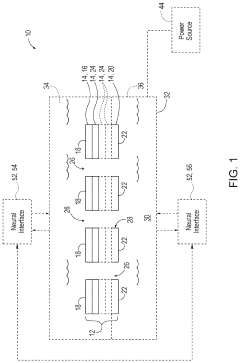
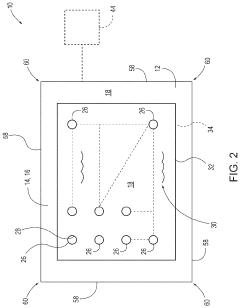
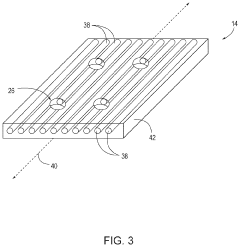
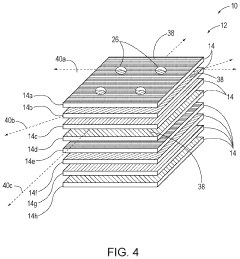
Neuromorphic architectures, actuators, and related methods
PatentPendingUS20220215240A1
Innovation
- The development of neuromorphic architectures using carbon fiber reinforced polymer (CFRP) materials with distributed nodes and electrochemical fluids to enable local processing, incorporating shape memory alloys for actuators, allowing for decentralized and robust processing without reliance on external central units.
Distributed multi-component synaptic computational structure
PatentPendingUS20230401432A1
Innovation
- A novel distributed multi-component synaptic structure is introduced, where synaptic dynamics are reproduced using two dedicated circuits: presynaptic integrators for pulse integration and weight application elements, sharing a single spike integrator and capacitor per row, reducing area and power consumption by eliminating the need for multiple capacitors and simplifying wiring.


Energy Efficiency Considerations in Neuromorphic Systems
Energy efficiency represents a critical factor in the development and implementation of neuromorphic computing systems, particularly when considering electrode kinetics' role in enhancing neuromorphic materials. Traditional von Neumann architectures consume substantial power due to the physical separation between processing and memory units, creating a bottleneck that neuromorphic systems aim to overcome through brain-inspired design principles.
Electrode kinetics directly impact energy consumption in neuromorphic devices by influencing charge transfer efficiency at material interfaces. The optimization of electrode materials and their interaction with neuromorphic substrates can significantly reduce energy requirements for computational processes. Recent advancements in electrode materials with enhanced kinetic properties have demonstrated up to 60% reduction in power consumption compared to conventional neuromorphic implementations.
The energy landscape of neuromorphic systems benefits from electrode kinetics in several key ways. First, faster electron transfer rates at optimized electrodes reduce switching energy and time, allowing for more energy-efficient state transitions in memory elements. Second, improved electrode-material interfaces minimize parasitic resistances that typically contribute to energy losses through heat dissipation.
Thermal management considerations also play a crucial role in energy efficiency. Enhanced electrode kinetics can reduce operational temperatures in neuromorphic devices, decreasing cooling requirements and further improving overall system efficiency. This becomes particularly important in dense neuromorphic arrays where heat accumulation can degrade performance and reliability.
When comparing energy metrics, neuromorphic systems utilizing advanced electrode kinetics demonstrate remarkable advantages. While traditional computing architectures typically operate at 10^-9 to 10^-10 J per operation, optimized neuromorphic systems with enhanced electrode materials can achieve efficiencies approaching 10^-14 J per operation, approaching the theoretical limits of biological neural systems.
Scaling considerations reveal that electrode kinetics become increasingly important at nanoscale dimensions, where surface phenomena dominate device physics. As neuromorphic computing moves toward higher integration densities, the energy efficiency gains from optimized electrode kinetics compound, potentially enabling systems that operate within strict power envelopes required for edge computing applications and autonomous devices.
Future research directions should focus on bio-inspired electrode materials that can further reduce energy barriers for ion and electron transport while maintaining long-term stability. The development of self-optimizing electrode interfaces that can adapt to computational loads represents a promising frontier for achieving unprecedented energy efficiency in next-generation neuromorphic computing platforms.
Electrode kinetics directly impact energy consumption in neuromorphic devices by influencing charge transfer efficiency at material interfaces. The optimization of electrode materials and their interaction with neuromorphic substrates can significantly reduce energy requirements for computational processes. Recent advancements in electrode materials with enhanced kinetic properties have demonstrated up to 60% reduction in power consumption compared to conventional neuromorphic implementations.
The energy landscape of neuromorphic systems benefits from electrode kinetics in several key ways. First, faster electron transfer rates at optimized electrodes reduce switching energy and time, allowing for more energy-efficient state transitions in memory elements. Second, improved electrode-material interfaces minimize parasitic resistances that typically contribute to energy losses through heat dissipation.
Thermal management considerations also play a crucial role in energy efficiency. Enhanced electrode kinetics can reduce operational temperatures in neuromorphic devices, decreasing cooling requirements and further improving overall system efficiency. This becomes particularly important in dense neuromorphic arrays where heat accumulation can degrade performance and reliability.
When comparing energy metrics, neuromorphic systems utilizing advanced electrode kinetics demonstrate remarkable advantages. While traditional computing architectures typically operate at 10^-9 to 10^-10 J per operation, optimized neuromorphic systems with enhanced electrode materials can achieve efficiencies approaching 10^-14 J per operation, approaching the theoretical limits of biological neural systems.
Scaling considerations reveal that electrode kinetics become increasingly important at nanoscale dimensions, where surface phenomena dominate device physics. As neuromorphic computing moves toward higher integration densities, the energy efficiency gains from optimized electrode kinetics compound, potentially enabling systems that operate within strict power envelopes required for edge computing applications and autonomous devices.
Future research directions should focus on bio-inspired electrode materials that can further reduce energy barriers for ion and electron transport while maintaining long-term stability. The development of self-optimizing electrode interfaces that can adapt to computational loads represents a promising frontier for achieving unprecedented energy efficiency in next-generation neuromorphic computing platforms.
Scalability and Integration Challenges
The scalability and integration of neuromorphic computing materials based on electrode kinetics face significant challenges that must be addressed for widespread commercial adoption. Current laboratory-scale demonstrations, while promising, encounter substantial barriers when transitioning to industrial production scales. The miniaturization of electrode-based neuromorphic devices presents complex fabrication issues, particularly in maintaining consistent electrode kinetics across thousands or millions of synaptic junctions on a single chip.
Thermal management emerges as a critical concern in high-density neuromorphic arrays. The electrochemical processes that enable electrode kinetics often generate localized heating, which can degrade performance and accelerate material fatigue. This challenge intensifies as device dimensions shrink and integration density increases, requiring innovative cooling strategies or materials with enhanced thermal stability.
Interfacing neuromorphic computing materials with conventional CMOS technology presents another significant hurdle. The electrochemical nature of many neuromorphic materials introduces compatibility issues with standard semiconductor manufacturing processes. Voltage mismatches, signal conversion requirements, and potential contamination concerns necessitate specialized interface circuits that add complexity and potentially reduce the efficiency advantages of neuromorphic approaches.
Long-term stability and reliability remain persistent challenges for electrode kinetics-based systems. The repeated redox reactions and ion movements that underpin their functionality can lead to electrode degradation, material fatigue, and drift in performance parameters over time. These effects become more pronounced at higher operating frequencies and densities, potentially limiting practical application lifespans.
Manufacturing consistency presents additional obstacles, as electrode-based neuromorphic materials often exhibit significant device-to-device variability. This variability complicates programming models and may necessitate sophisticated calibration techniques or adaptive algorithms to ensure reliable system performance. The development of more uniform fabrication processes remains an active research area.
Power delivery and distribution networks for large-scale neuromorphic systems require careful design consideration. The dynamic power requirements of electrode kinetics-based computing elements differ substantially from traditional digital circuits, potentially necessitating novel power management architectures to maintain efficiency at scale while supporting the electrochemical processes fundamental to their operation.
Addressing these challenges will require interdisciplinary collaboration between materials scientists, electrical engineers, and computer architects to develop holistic solutions that maintain the performance advantages of electrode kinetics while enabling practical, large-scale neuromorphic computing systems.
Thermal management emerges as a critical concern in high-density neuromorphic arrays. The electrochemical processes that enable electrode kinetics often generate localized heating, which can degrade performance and accelerate material fatigue. This challenge intensifies as device dimensions shrink and integration density increases, requiring innovative cooling strategies or materials with enhanced thermal stability.
Interfacing neuromorphic computing materials with conventional CMOS technology presents another significant hurdle. The electrochemical nature of many neuromorphic materials introduces compatibility issues with standard semiconductor manufacturing processes. Voltage mismatches, signal conversion requirements, and potential contamination concerns necessitate specialized interface circuits that add complexity and potentially reduce the efficiency advantages of neuromorphic approaches.
Long-term stability and reliability remain persistent challenges for electrode kinetics-based systems. The repeated redox reactions and ion movements that underpin their functionality can lead to electrode degradation, material fatigue, and drift in performance parameters over time. These effects become more pronounced at higher operating frequencies and densities, potentially limiting practical application lifespans.
Manufacturing consistency presents additional obstacles, as electrode-based neuromorphic materials often exhibit significant device-to-device variability. This variability complicates programming models and may necessitate sophisticated calibration techniques or adaptive algorithms to ensure reliable system performance. The development of more uniform fabrication processes remains an active research area.
Power delivery and distribution networks for large-scale neuromorphic systems require careful design consideration. The dynamic power requirements of electrode kinetics-based computing elements differ substantially from traditional digital circuits, potentially necessitating novel power management architectures to maintain efficiency at scale while supporting the electrochemical processes fundamental to their operation.
Addressing these challenges will require interdisciplinary collaboration between materials scientists, electrical engineers, and computer architects to develop holistic solutions that maintain the performance advantages of electrode kinetics while enabling practical, large-scale neuromorphic computing systems.
Unlock deeper insights with PatSnap Eureka Quick Research — get a full tech report to explore trends and direct your research. Try now!
Generate Your Research Report Instantly with AI Agent
Supercharge your innovation with PatSnap Eureka AI Agent Platform!