
How to Optimize Zirconia for Specialized Engineering Needs?
Zirconia Engineering Background and Objectives
Zirconia, a remarkable ceramic material, has been at the forefront of engineering innovation for decades. Its journey began in the early 20th century when researchers first recognized its potential for high-temperature applications. Since then, zirconia has evolved into a versatile material with a wide range of engineering uses, from thermal barrier coatings to biomedical implants.
The technological evolution of zirconia has been driven by the continuous demand for materials that can withstand extreme conditions while maintaining structural integrity. As industries push the boundaries of what's possible in aerospace, energy, and medical fields, zirconia has emerged as a critical component in addressing these challenges. Its unique combination of properties, including high strength, toughness, and thermal insulation, has made it an ideal candidate for specialized engineering needs.
In recent years, the focus has shifted towards optimizing zirconia for specific applications. This trend is fueled by the growing understanding of zirconia's complex phase transformations and the ability to tailor its microstructure. The advent of advanced manufacturing techniques, such as 3D printing and precision sintering, has opened new avenues for customizing zirconia components to meet precise engineering requirements.
The primary objective in optimizing zirconia for specialized engineering needs is to enhance its performance in targeted applications while overcoming its inherent limitations. This involves a multifaceted approach, including refining the material's composition, controlling its grain size and distribution, and developing novel processing methods. By fine-tuning these parameters, engineers aim to create zirconia-based materials with improved mechanical properties, enhanced thermal stability, and increased resistance to harsh environments.
Another crucial aspect of zirconia optimization is the development of composite materials that leverage zirconia's strengths while mitigating its weaknesses. This includes creating zirconia-toughened ceramics and zirconia-reinforced metal matrix composites, which offer superior performance in applications requiring a balance of strength, toughness, and wear resistance.
As we look to the future, the optimization of zirconia for specialized engineering needs is expected to play a pivotal role in enabling technological advancements across various sectors. From more efficient and durable jet engines to longer-lasting and biocompatible medical implants, the potential applications of optimized zirconia are vast and promising. The ongoing research in this field is not only pushing the boundaries of material science but also paving the way for innovative solutions to some of the most pressing engineering challenges of our time.
Market Analysis for Specialized Zirconia Applications
The specialized zirconia market is experiencing significant growth, driven by increasing demand across various engineering sectors. The global market for specialized zirconia applications is projected to reach several billion dollars by 2025, with a compound annual growth rate exceeding 5%. This growth is primarily fueled by the material's unique properties, including high strength, excellent thermal stability, and superior wear resistance.
Key industries driving the demand for specialized zirconia include aerospace, automotive, medical devices, and electronics. In the aerospace sector, zirconia is increasingly used in thermal barrier coatings for jet engine components, enhancing fuel efficiency and engine performance. The automotive industry is adopting zirconia for applications such as oxygen sensors and fuel injection systems, contributing to improved engine efficiency and reduced emissions.
The medical device industry represents a particularly promising market for specialized zirconia applications. Zirconia's biocompatibility and aesthetic properties make it an ideal material for dental implants and prosthetics. The growing aging population and increasing focus on cosmetic dentistry are expected to drive substantial growth in this segment.
In the electronics industry, zirconia finds applications in solid oxide fuel cells and as a substrate material for advanced semiconductors. The push for cleaner energy solutions and the development of next-generation electronic devices are likely to boost demand in this sector.
Geographically, Asia-Pacific is emerging as the fastest-growing market for specialized zirconia applications, driven by rapid industrialization and increasing investments in advanced manufacturing technologies. North America and Europe continue to be significant markets, particularly in high-tech and medical applications.
However, the market faces challenges such as high production costs and competition from alternative materials. Manufacturers are focusing on developing cost-effective production methods and enhancing material properties to address these challenges and expand market opportunities.
The demand for customized zirconia solutions tailored to specific engineering needs is a notable trend. This presents opportunities for companies to differentiate their offerings and capture higher-value market segments. Additionally, the integration of zirconia in additive manufacturing processes is opening new avenues for complex, high-performance components in various industries.
Current Zirconia Technology Challenges
Despite the widespread use of zirconia in various engineering applications, several challenges persist in optimizing this material for specialized needs. One of the primary issues is the inherent brittleness of zirconia, which limits its use in high-stress environments. While zirconia exhibits excellent strength and hardness, its low fracture toughness can lead to sudden and catastrophic failure under certain conditions. This characteristic poses significant challenges in applications requiring both high strength and impact resistance.
Another critical challenge lies in the phase transformation of zirconia. The material's unique property of transforming from tetragonal to monoclinic phase under stress, known as transformation toughening, is both a blessing and a curse. While this transformation can enhance the material's toughness, it can also lead to volume expansion and microcracking, potentially compromising the structural integrity of the component over time. Controlling this phase transformation precisely for specific applications remains a significant technological hurdle.
The sintering process of zirconia presents another set of challenges. Achieving full densification while maintaining a fine-grained microstructure is crucial for optimizing mechanical properties. However, the high sintering temperatures required can lead to grain growth, which can negatively impact the material's strength and toughness. Balancing these factors to achieve optimal microstructure and properties is an ongoing challenge in zirconia processing.
Thermal management is another area of concern, particularly in high-temperature applications. While zirconia has excellent thermal insulation properties, its relatively low thermal conductivity can lead to thermal shock issues and limit its use in certain thermal cycling environments. Improving the thermal shock resistance of zirconia without compromising its other beneficial properties remains a significant challenge.
The development of zirconia composites and the incorporation of dopants to enhance specific properties also present challenges. While these approaches offer promising avenues for tailoring zirconia's properties, achieving uniform dispersion of secondary phases or dopants and understanding their long-term effects on material stability and performance are ongoing areas of research and development.
Lastly, the cost-effective production of high-quality zirconia components, especially for complex geometries, remains a challenge. Advanced manufacturing techniques such as additive manufacturing offer potential solutions but come with their own set of challenges, including controlling porosity, achieving desired microstructures, and ensuring consistent properties throughout the component.
Addressing these challenges requires a multidisciplinary approach, combining materials science, engineering, and advanced manufacturing techniques. Overcoming these hurdles is crucial for expanding the application of zirconia in specialized engineering fields and fully leveraging its unique properties.
Current Zirconia Optimization Techniques
01 Zirconia synthesis and processing methods
Various techniques for synthesizing and processing zirconia materials, including sol-gel methods, hydrothermal synthesis, and sintering processes. These methods aim to control the crystalline structure, particle size, and properties of zirconia for different applications.- Zirconia synthesis and processing: Various methods for synthesizing and processing zirconia materials, including techniques for controlling particle size, crystalline structure, and purity. This encompasses sol-gel methods, hydrothermal synthesis, and other advanced processing techniques to produce zirconia with specific properties for different applications.
- Zirconia-based ceramics and composites: Development of zirconia-based ceramic materials and composites with enhanced mechanical, thermal, and chemical properties. This includes the incorporation of zirconia into other ceramic matrices or the addition of dopants to improve specific characteristics such as strength, toughness, and wear resistance.
- Dental and biomedical applications of zirconia: Utilization of zirconia in dental and biomedical applications, including dental implants, crowns, and orthopedic implants. This focuses on the biocompatibility, aesthetics, and mechanical properties of zirconia materials tailored for medical use.
- Zirconia in catalysis and fuel cells: Applications of zirconia in catalysis and fuel cell technology, including its use as a catalyst support, oxygen sensor, and solid electrolyte. This covers the development of zirconia-based materials with specific surface properties and ionic conductivity for these applications.
- Zirconia coatings and thin films: Methods for depositing zirconia coatings and thin films on various substrates for applications in optics, electronics, and protective coatings. This includes techniques such as physical vapor deposition, chemical vapor deposition, and sol-gel coating processes to create zirconia layers with specific optical, electrical, or mechanical properties.
02 Zirconia-based dental materials
Development of zirconia-based materials for dental applications, such as crowns, bridges, and implants. These materials offer high strength, biocompatibility, and aesthetic properties suitable for dental restorations.Expand Specific Solutions03 Zirconia in catalysis and fuel cells
Applications of zirconia in catalysis and solid oxide fuel cells, leveraging its unique properties such as high thermal stability and oxygen ion conductivity. This includes the development of zirconia-based catalysts and electrolytes for energy-related applications.Expand Specific Solutions04 Zirconia coatings and thin films
Methods for depositing zirconia coatings and thin films on various substrates, including physical vapor deposition, chemical vapor deposition, and sol-gel techniques. These coatings provide enhanced wear resistance, thermal insulation, and corrosion protection.Expand Specific Solutions05 Zirconia composites and nanocomposites
Development of zirconia-based composites and nanocomposites, combining zirconia with other materials to enhance mechanical, thermal, and electrical properties. These composites find applications in aerospace, automotive, and biomedical industries.Expand Specific Solutions
Key Players in Zirconia Engineering
The optimization of zirconia for specialized engineering needs is in a mature yet evolving phase, with a growing market driven by diverse industrial applications. The global zirconia market is expanding, fueled by increasing demand in sectors like ceramics, electronics, and medical devices. Technologically, the field is well-established but continues to advance, with companies like Tosoh Corp., Saint-Gobain, and 3M Innovative Properties Co. leading innovation. These firms, along with others like Sumitomo Chemical Co., Ltd. and CoorsTek, Inc., are pushing the boundaries of zirconia's properties and applications. The competitive landscape is characterized by a mix of large multinational corporations and specialized materials companies, each focusing on developing tailored zirconia solutions for specific engineering challenges.
Mitsui Mining & Smelting Co., Ltd.
Tosoh Corp.
Innovative Zirconia Properties Enhancement
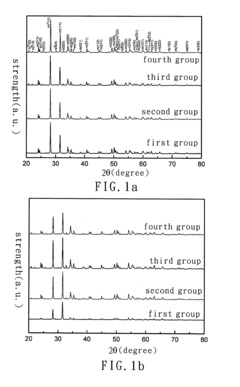
- Simultaneously adding yttria, ceria, and chromia to partially stabilized zirconia in specific proportions to create a microstructure with high tetragonal phase content, resulting in a ceramic with bending strength over 1150 MPa and fracture toughness over 15 MPa.m1/2, achieved through a process involving mixing, compacting, and sintering with controlled temperature and time.
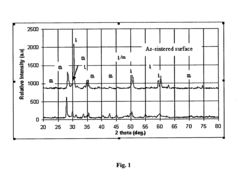
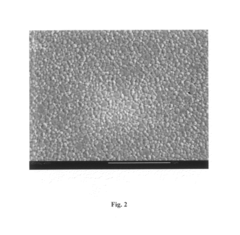
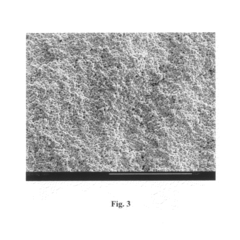
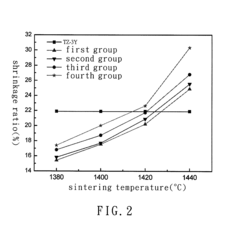
- A method involving wet mixing of silicon-containing zirconia powder with sodium carbonate and tetraethoxysilane, followed by calcination at reduced temperatures (900-1200°C) and subsequent sintering at 1415-1450°C to produce a silicon-containing zirconia calcined and sintered body with increased compactness and structural strength.
Environmental Impact of Zirconia Production
The production of zirconia for specialized engineering applications has significant environmental implications that must be carefully considered. The extraction and processing of zirconium minerals, primarily zircon sand, involve energy-intensive operations that contribute to greenhouse gas emissions. Mining activities can lead to habitat disruption and soil erosion, while the subsequent beneficiation processes may result in water pollution if not properly managed.
The conversion of zircon to zirconia through chemical processes requires substantial energy inputs and generates chemical waste streams. The most common method, the alkali fusion process, involves high-temperature reactions with sodium hydroxide, followed by acid leaching and precipitation. This process consumes considerable amounts of energy and chemicals, potentially leading to air and water pollution if emissions and effluents are not adequately controlled.
Advanced production techniques, such as hydrothermal synthesis or sol-gel methods, offer potential improvements in environmental performance. These approaches often operate at lower temperatures and may reduce energy consumption and waste generation. However, they may introduce new challenges, such as the use of organic solvents or specialized precursors that require careful handling and disposal.
The sintering of zirconia powders into final products is another energy-intensive step that contributes to the overall environmental footprint. While necessary for achieving desired material properties, optimizing sintering processes through techniques like spark plasma sintering or microwave sintering can reduce energy consumption and processing times.
Recycling and waste management in zirconia production present both challenges and opportunities. The recovery of zirconia from industrial waste streams and end-of-life products can reduce the demand for raw materials and minimize waste. However, the complex nature of many zirconia-containing products can make recycling technically challenging and economically unfeasible in some cases.
Water usage in zirconia production is another critical environmental consideration. From mining operations to chemical processing and final product manufacturing, significant volumes of water are required. Implementing closed-loop water systems and water-efficient technologies can help mitigate the impact on local water resources.
As the demand for specialized zirconia products grows, addressing these environmental challenges becomes increasingly important. Innovations in production technologies, coupled with stringent environmental management practices, are essential for minimizing the ecological footprint of zirconia production while meeting the evolving needs of advanced engineering applications.
Zirconia Standards and Certifications
Zirconia standards and certifications play a crucial role in ensuring the quality, reliability, and performance of zirconia materials used in specialized engineering applications. These standards provide a framework for manufacturers, engineers, and end-users to assess and validate the properties of zirconia products, ensuring they meet specific requirements for various industrial and technological applications.
The International Organization for Standardization (ISO) has developed several standards relevant to zirconia materials. ISO 13356 is a key standard that specifies requirements for yttria-stabilized tetragonal zirconia (Y-TZP) for surgical implant applications. This standard outlines the chemical composition, mechanical properties, and testing methods for Y-TZP materials used in medical devices.
ASTM International also provides important standards for zirconia materials. ASTM C1159 covers the standard test method for monotonic equibiaxial flexural strength of advanced ceramics at ambient temperature, which is applicable to zirconia materials. Additionally, ASTM F2393 specifies the standard specification for high-purity dense yttria tetragonal zirconium dioxide for surgical implant applications.
In the aerospace and defense industries, zirconia materials must often meet stringent military specifications (MIL-SPEC) or aerospace material specifications (AMS). These standards ensure that zirconia components can withstand extreme conditions and maintain their performance in critical applications.
For thermal barrier coatings using zirconia, standards such as those developed by the National Aeronautics and Space Administration (NASA) and the European Space Agency (ESA) are essential. These standards define the requirements for thermal and mechanical properties, as well as coating adhesion and durability under high-temperature conditions.
Certification processes for zirconia materials typically involve third-party testing and validation. Organizations like Underwriters Laboratories (UL) and TÜV SÜD provide certification services that assess zirconia products against relevant standards and industry-specific requirements. These certifications offer assurance to customers and regulatory bodies that the zirconia materials meet specified quality and performance criteria.
In the field of dental applications, zirconia materials must comply with standards set by dental associations and regulatory bodies. For instance, the American Dental Association (ADA) and the European Union's Medical Device Regulation (MDR) have established guidelines for zirconia-based dental prosthetics, ensuring biocompatibility and mechanical stability.
As zirconia finds increasing use in advanced engineering applications, new standards and certifications continue to emerge. For example, standards related to additive manufacturing of zirconia components are being developed to address the unique challenges and opportunities presented by 3D printing technologies. These evolving standards will be crucial in optimizing zirconia for specialized engineering needs across various industries.