

How to Reduce Diesel Particulate Filter Clogging Issues
SEP 18, 20259 MIN READ
Generate Your Research Report Instantly with AI Agent
Patsnap Eureka helps you evaluate technical feasibility & market potential.
DPF Technology Background and Objectives
Diesel Particulate Filters (DPFs) emerged in the early 1980s as a response to increasingly stringent emission regulations worldwide. Initially developed for heavy-duty diesel engines, these filtration systems have evolved significantly over the past four decades. The fundamental purpose of DPFs is to capture and remove particulate matter (PM) from diesel exhaust gases, primarily soot particles that pose serious environmental and health concerns. Early DPF systems faced considerable challenges related to filter durability, regeneration efficiency, and overall system integration.
The technological evolution of DPFs has been marked by several key milestones, including the introduction of passive regeneration systems in the 1990s, active regeneration technologies in the early 2000s, and more recently, advanced substrate materials and coating technologies. Modern DPF systems typically achieve filtration efficiencies exceeding 95%, representing a remarkable improvement from early designs that struggled to maintain consistent performance over extended operational periods.
Despite these advancements, DPF clogging remains a persistent challenge across various diesel applications. The accumulation of ash (non-combustible materials from engine oil additives and engine wear), unburned hydrocarbons, and incomplete regeneration cycles contribute to progressive filter blockage. This clogging phenomenon leads to increased backpressure in the exhaust system, reduced engine efficiency, higher fuel consumption, and potentially catastrophic filter failure if left unaddressed.
The primary objective of current DPF technology research is to develop more robust solutions that minimize clogging while maintaining or improving filtration efficiency. This includes exploring novel filter substrate geometries that maximize surface area while minimizing flow restriction, developing advanced catalyst formulations that promote more complete regeneration at lower temperatures, and implementing intelligent control systems that optimize regeneration timing based on real-time operating conditions.
Additionally, research aims to address the specific challenges faced in different operational environments. For instance, urban delivery vehicles operating in stop-and-go traffic patterns experience different DPF loading profiles compared to long-haul trucks or off-road equipment. Understanding these application-specific challenges is crucial for developing targeted solutions that effectively reduce clogging issues across diverse operational scenarios.
Looking forward, the industry is moving toward integrated emission control systems that consider DPF performance as part of a holistic approach to exhaust aftertreatment. This includes exploring synergies between DPFs and other emission control technologies such as Selective Catalytic Reduction (SCR) systems and Diesel Oxidation Catalysts (DOCs) to achieve optimal overall performance while minimizing maintenance requirements and operational disruptions caused by filter clogging.
The technological evolution of DPFs has been marked by several key milestones, including the introduction of passive regeneration systems in the 1990s, active regeneration technologies in the early 2000s, and more recently, advanced substrate materials and coating technologies. Modern DPF systems typically achieve filtration efficiencies exceeding 95%, representing a remarkable improvement from early designs that struggled to maintain consistent performance over extended operational periods.
Despite these advancements, DPF clogging remains a persistent challenge across various diesel applications. The accumulation of ash (non-combustible materials from engine oil additives and engine wear), unburned hydrocarbons, and incomplete regeneration cycles contribute to progressive filter blockage. This clogging phenomenon leads to increased backpressure in the exhaust system, reduced engine efficiency, higher fuel consumption, and potentially catastrophic filter failure if left unaddressed.
The primary objective of current DPF technology research is to develop more robust solutions that minimize clogging while maintaining or improving filtration efficiency. This includes exploring novel filter substrate geometries that maximize surface area while minimizing flow restriction, developing advanced catalyst formulations that promote more complete regeneration at lower temperatures, and implementing intelligent control systems that optimize regeneration timing based on real-time operating conditions.
Additionally, research aims to address the specific challenges faced in different operational environments. For instance, urban delivery vehicles operating in stop-and-go traffic patterns experience different DPF loading profiles compared to long-haul trucks or off-road equipment. Understanding these application-specific challenges is crucial for developing targeted solutions that effectively reduce clogging issues across diverse operational scenarios.
Looking forward, the industry is moving toward integrated emission control systems that consider DPF performance as part of a holistic approach to exhaust aftertreatment. This includes exploring synergies between DPFs and other emission control technologies such as Selective Catalytic Reduction (SCR) systems and Diesel Oxidation Catalysts (DOCs) to achieve optimal overall performance while minimizing maintenance requirements and operational disruptions caused by filter clogging.
Market Demand Analysis for Clean Diesel Solutions
The global market for clean diesel solutions has experienced significant growth over the past decade, driven primarily by increasingly stringent emissions regulations across major automotive markets. The diesel particulate filter (DPF) market specifically is projected to reach $24.81 billion by 2025, growing at a CAGR of 8.2% from 2020. This growth reflects the persistent demand for effective solutions to reduce particulate matter emissions while maintaining diesel engine performance.
Regional analysis reveals varying market dynamics. Europe remains the largest market for DPF technologies, accounting for approximately 40% of global demand, largely due to the Euro 6 emissions standards implementation. North America follows with roughly 25% market share, while Asia-Pacific represents the fastest-growing region with increasing adoption rates in China and India as these countries implement tighter emissions controls.
Commercial vehicle fleets constitute the largest customer segment, representing 62% of the DPF market. Fleet operators face significant operational challenges from DPF clogging issues, with maintenance costs averaging $3,000-$5,000 per vehicle annually due to filter replacement and associated downtime. This creates substantial demand for improved filtration technologies and maintenance solutions.
Consumer research indicates that fleet managers prioritize three key factors when evaluating DPF solutions: total cost of ownership (including maintenance costs), system reliability, and minimal impact on fuel efficiency. Solutions that can demonstrate measurable improvements in these areas command premium pricing, with customers willing to pay 15-20% more for technologies that extend filter life by at least 30%.
Market forecasts suggest that demand for advanced DPF technologies will continue to rise as global emissions standards tighten further. The International Council on Clean Transportation projects that over 85% of new diesel vehicles globally will require advanced particulate filtration systems by 2030. This represents a significant market opportunity for innovative solutions addressing filter clogging issues.
Emerging market trends include increasing demand for retrofit solutions in developing markets and growing interest in integrated systems that combine particulate filtration with NOx reduction technologies. Additionally, there is rising demand for predictive maintenance solutions utilizing IoT and data analytics to optimize filter cleaning schedules and prevent unexpected clogging events.
Regional analysis reveals varying market dynamics. Europe remains the largest market for DPF technologies, accounting for approximately 40% of global demand, largely due to the Euro 6 emissions standards implementation. North America follows with roughly 25% market share, while Asia-Pacific represents the fastest-growing region with increasing adoption rates in China and India as these countries implement tighter emissions controls.
Commercial vehicle fleets constitute the largest customer segment, representing 62% of the DPF market. Fleet operators face significant operational challenges from DPF clogging issues, with maintenance costs averaging $3,000-$5,000 per vehicle annually due to filter replacement and associated downtime. This creates substantial demand for improved filtration technologies and maintenance solutions.
Consumer research indicates that fleet managers prioritize three key factors when evaluating DPF solutions: total cost of ownership (including maintenance costs), system reliability, and minimal impact on fuel efficiency. Solutions that can demonstrate measurable improvements in these areas command premium pricing, with customers willing to pay 15-20% more for technologies that extend filter life by at least 30%.
Market forecasts suggest that demand for advanced DPF technologies will continue to rise as global emissions standards tighten further. The International Council on Clean Transportation projects that over 85% of new diesel vehicles globally will require advanced particulate filtration systems by 2030. This represents a significant market opportunity for innovative solutions addressing filter clogging issues.
Emerging market trends include increasing demand for retrofit solutions in developing markets and growing interest in integrated systems that combine particulate filtration with NOx reduction technologies. Additionally, there is rising demand for predictive maintenance solutions utilizing IoT and data analytics to optimize filter cleaning schedules and prevent unexpected clogging events.
Current DPF Challenges and Technical Limitations
Diesel Particulate Filters (DPFs) face significant operational challenges that limit their effectiveness in modern diesel engines. The primary issue is ash and soot accumulation, which progressively reduces filter capacity and increases backpressure in the exhaust system. This accumulation occurs at varying rates depending on engine operation conditions, fuel quality, and maintenance practices, making predictive maintenance particularly challenging.
Temperature management represents another critical limitation. DPFs require specific temperature ranges (typically 550-650°C) for effective regeneration processes. However, many diesel engines, particularly in urban driving cycles or idling conditions, fail to reach these temperatures consistently, leading to incomplete regeneration and accelerated clogging. This temperature dependency creates a fundamental design conflict between emission control efficiency and practical operational conditions.
Material durability constraints further complicate DPF technology. Current ceramic substrates (primarily cordierite and silicon carbide) exhibit vulnerability to thermal stress during regeneration cycles, especially during uncontrolled regeneration events. These thermal shocks can cause microcracking and eventual filter failure, reducing the operational lifespan of the system and increasing replacement costs.
Oil consumption in aging engines presents an additional challenge, as oil-derived ash is non-combustible and permanently reduces filter capacity. Unlike soot, which can be oxidized during regeneration, ash accumulation is irreversible within the filter structure, creating a fundamental limitation to filter longevity regardless of regeneration strategy effectiveness.
The sensing and control systems that manage DPF operation also face technical limitations. Current pressure differential sensors lack the precision to accurately determine filter loading conditions across all operational states, while temperature sensors may not provide sufficient spatial resolution to detect localized hotspots that can damage the filter substrate.
Regeneration strategies themselves present inherent trade-offs. Active regeneration systems increase fuel consumption (typically 2-5%), directly impacting vehicle efficiency and operating costs. Passive systems, while more fuel-efficient, are highly dependent on driving conditions and may be insufficient for many real-world applications, particularly in cold-climate operations or short-distance driving patterns.
From a manufacturing perspective, current production methods for high-quality DPF substrates remain costly and energy-intensive, limiting opportunities for cost reduction even at scale. The complex honeycomb structures required for optimal filtration efficiency demand precise manufacturing tolerances that challenge current production capabilities.
Temperature management represents another critical limitation. DPFs require specific temperature ranges (typically 550-650°C) for effective regeneration processes. However, many diesel engines, particularly in urban driving cycles or idling conditions, fail to reach these temperatures consistently, leading to incomplete regeneration and accelerated clogging. This temperature dependency creates a fundamental design conflict between emission control efficiency and practical operational conditions.
Material durability constraints further complicate DPF technology. Current ceramic substrates (primarily cordierite and silicon carbide) exhibit vulnerability to thermal stress during regeneration cycles, especially during uncontrolled regeneration events. These thermal shocks can cause microcracking and eventual filter failure, reducing the operational lifespan of the system and increasing replacement costs.
Oil consumption in aging engines presents an additional challenge, as oil-derived ash is non-combustible and permanently reduces filter capacity. Unlike soot, which can be oxidized during regeneration, ash accumulation is irreversible within the filter structure, creating a fundamental limitation to filter longevity regardless of regeneration strategy effectiveness.
The sensing and control systems that manage DPF operation also face technical limitations. Current pressure differential sensors lack the precision to accurately determine filter loading conditions across all operational states, while temperature sensors may not provide sufficient spatial resolution to detect localized hotspots that can damage the filter substrate.
Regeneration strategies themselves present inherent trade-offs. Active regeneration systems increase fuel consumption (typically 2-5%), directly impacting vehicle efficiency and operating costs. Passive systems, while more fuel-efficient, are highly dependent on driving conditions and may be insufficient for many real-world applications, particularly in cold-climate operations or short-distance driving patterns.
From a manufacturing perspective, current production methods for high-quality DPF substrates remain costly and energy-intensive, limiting opportunities for cost reduction even at scale. The complex honeycomb structures required for optimal filtration efficiency demand precise manufacturing tolerances that challenge current production capabilities.
Current Anti-Clogging Technical Solutions
01 Detection and monitoring of DPF clogging
Various methods and systems for detecting and monitoring the clogging status of diesel particulate filters (DPFs) are employed to ensure optimal performance. These include pressure differential sensors that measure the pressure drop across the filter, temperature sensors that monitor exhaust gas temperature changes, and advanced diagnostic systems that can predict filter clogging before it becomes critical. Early detection allows for timely regeneration or maintenance, preventing complete filter blockage and associated engine performance issues.- Detection and monitoring of DPF clogging: Various systems and methods are employed to detect and monitor the clogging status of diesel particulate filters. These include pressure differential sensors that measure the pressure drop across the filter, which increases as the filter becomes clogged. Advanced monitoring systems can analyze exhaust gas flow patterns and temperature distributions to determine the level of particulate accumulation. Real-time monitoring allows for timely regeneration processes to be initiated before severe clogging occurs.
- Regeneration strategies for clogged DPFs: When diesel particulate filters become clogged, regeneration processes are employed to burn off accumulated soot and restore filter functionality. These strategies include active regeneration, where fuel is injected to increase exhaust temperature, and passive regeneration, which utilizes catalytic coatings to lower the combustion temperature of particulates. Controlled regeneration cycles help prevent thermal damage to the filter while effectively removing trapped particulates. Some systems incorporate adaptive regeneration timing based on driving conditions and filter load status.
- Filter design improvements to reduce clogging: Innovations in diesel particulate filter design focus on reducing clogging susceptibility. These include optimized channel geometries that increase surface area while maintaining flow efficiency, advanced substrate materials with improved thermal stability, and wall-flow designs with carefully controlled porosity. Some filters incorporate asymmetric cell structures or variable cell density to better distribute particulate loading. Composite filter materials combine different filtration mechanisms to capture a wider range of particle sizes while maintaining lower backpressure.
- Additives and fuel modifications to reduce DPF clogging: Chemical approaches to mitigate diesel particulate filter clogging include fuel additives that promote soot combustion at lower temperatures, catalytic compounds that enhance passive regeneration, and detergents that reduce engine deposits leading to cleaner combustion. Some additives modify the structure of soot particles to make them more easily oxidized during regeneration cycles. Fuel formulations with reduced sulfur content and optimized cetane numbers can also contribute to less problematic particulate matter formation.
- Engine control strategies to minimize DPF clogging: Advanced engine management systems employ various strategies to reduce particulate emissions and minimize DPF clogging. These include optimized injection timing and pressure profiles, exhaust gas recirculation control, and combustion mode switching based on operating conditions. Some systems incorporate predictive models that adjust engine parameters based on anticipated filter loading. Post-injection strategies can be used to increase exhaust temperatures when needed for regeneration while maintaining efficient engine operation under normal conditions.
02 Regeneration techniques for clogged DPFs
Regeneration processes are essential for removing accumulated soot and particulate matter from diesel particulate filters. Active regeneration involves raising exhaust temperatures to burn off trapped particles, often through fuel injection timing adjustments, exhaust gas recirculation control, or dedicated heating elements. Passive regeneration utilizes catalytic coatings that lower the combustion temperature of particulate matter, allowing continuous cleaning during normal operation. These techniques help maintain filter efficiency and prevent complete clogging that could lead to engine damage.Expand Specific Solutions03 Filter design improvements to reduce clogging
Innovations in diesel particulate filter design focus on structural modifications that minimize clogging while maintaining filtration efficiency. These include optimized channel geometries, asymmetric cell structures, and variable porosity filter walls that distribute particulate matter more evenly. Advanced materials with enhanced thermal stability and reduced thermal expansion help prevent cracking during regeneration cycles. Some designs incorporate pre-filters or multi-stage filtration systems to capture larger particles before they reach the main filter, extending service intervals.Expand Specific Solutions04 Additives and fuel modifications to prevent DPF clogging
Chemical approaches to reducing diesel particulate filter clogging include fuel additives that promote more complete combustion or lower the ignition temperature of trapped soot. Cerium-based additives act as catalysts to facilitate soot oxidation at lower temperatures, while detergent additives help prevent injector deposits that can lead to incomplete combustion and increased particulate emissions. Fuel formulations with reduced sulfur content and optimized cetane numbers can also contribute to lower particulate matter production, reducing the rate of filter clogging.Expand Specific Solutions05 Control systems and algorithms for DPF management
Sophisticated electronic control systems employ algorithms to optimize diesel particulate filter performance and minimize clogging. These systems integrate data from multiple sensors to determine the optimal timing and conditions for regeneration events. Predictive models estimate soot loading based on operating conditions and driving patterns, allowing for proactive management of the filtration system. Adaptive control strategies adjust engine parameters in real-time to balance emissions reduction, fuel economy, and filter longevity, preventing premature clogging while maximizing efficiency.Expand Specific Solutions
Major Industry Players in Emission Control Systems
The diesel particulate filter (DPF) clogging issue represents a mature technological challenge within the automotive emissions control sector, currently experiencing renewed focus due to stringent global emissions regulations. The market for DPF solutions is substantial, estimated at over $12 billion globally, with steady growth projected as emission standards tighten worldwide. Leading automotive manufacturers including Toyota, Volkswagen, Nissan, and Hyundai have developed proprietary DPF technologies, while specialized component suppliers like Corning, DENSO, and Continental Emitec provide critical filtration technologies. The competitive landscape features established players investing in regeneration systems and filter materials, with emerging innovations from research institutions like Hunan University and Chang'an University focusing on catalyst coatings and advanced sensing technologies to predict and prevent clogging issues.
Toyota Motor Corp.
Technical Solution: Toyota has developed a comprehensive DPF management system called D-CAT (Diesel Clean Advanced Technology) that integrates multiple technologies to reduce clogging issues. Their system combines a diesel oxidation catalyst (DOC) with a specialized DPF featuring a unique wall-flow design and proprietary catalyst formulation. Toyota's approach includes an intelligent thermal management system that precisely controls exhaust temperatures through a combination of post-injection strategies and intake throttling. Their DPF substrate incorporates a gradient porosity structure, with larger pores at the inlet side gradually transitioning to smaller pores, which distributes particulate matter more evenly throughout the filter depth rather than just on the surface. This design increases ash storage capacity by approximately 30% compared to conventional filters[5]. Toyota has also implemented an advanced sensor network that monitors not only differential pressure but also exhaust gas composition and temperature at multiple points, enabling their engine control unit to optimize regeneration timing and duration based on actual driving conditions and filter loading status.
Strengths: The gradient porosity design significantly extends service intervals between ash cleaning events, while the sophisticated control system minimizes regeneration fuel penalties to less than 2%. Weaknesses: The complex sensor network increases system cost and potential diagnostic challenges, and the system may still struggle with frequent short trips in cold weather conditions.
Hyundai Motor Co., Ltd.
Technical Solution: Hyundai has developed an innovative DPF system that incorporates a multi-stage regeneration strategy to minimize clogging issues. Their technology features a low-pressure exhaust gas recirculation (LP-EGR) system working in conjunction with their proprietary Active Regeneration Control Logic (ARCL). This system continuously monitors driving conditions and filter loading to determine optimal regeneration timing. Hyundai's DPF design incorporates a dual-layer catalyst coating with a lower layer of platinum-palladium that promotes passive regeneration at temperatures as low as 300°C, and an upper layer containing cerium oxide that stores oxygen to assist in soot oxidation during active regeneration cycles. Their filters utilize a specialized cordierite substrate with optimized channel density (approximately 300 cells per square inch) and wall thickness (10-12 mil) to balance filtration efficiency and backpressure[6]. Additionally, Hyundai has implemented a hydrocarbon doser system that injects precise amounts of fuel directly into the exhaust stream during active regeneration, achieving more uniform temperature distribution across the filter and reducing thermal stress.
Strengths: The multi-stage regeneration approach reduces fuel consumption penalties associated with regeneration by up to 25% compared to conventional systems. The dual-layer catalyst significantly improves regeneration efficiency. Weaknesses: The system requires precise calibration of multiple components, and the hydrocarbon dosing system adds complexity and potential failure points.
Key Patents and Innovations in DPF Technology
Filter for exhaust gas from diesel engine
PatentWO2005051517A1
Innovation
- A filter comprising laminated metal laths with an oxidation catalyst layer, where the metal laths are alternately stretched by 90 degrees, housed in a cylindrical metal frame and sealed with an inorganic fiber sheet, allowing efficient particulate matter removal without the need for special maintenance.


Particulate filter arrangement
PatentActiveEP1801372A1
Innovation
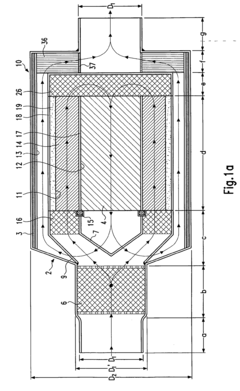
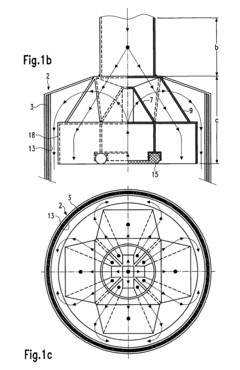
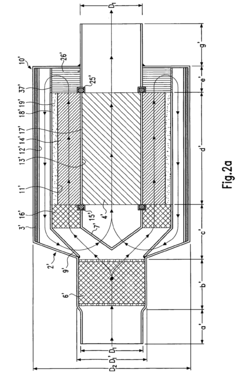
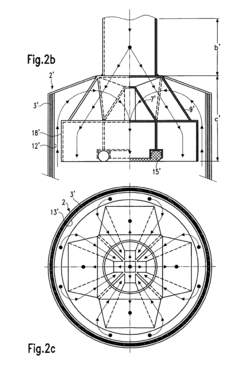
- A compact particle filter arrangement with a 'folded' exhaust gas flow path featuring multiple sections that maximize residence time and temperature, including catalytic converters to enhance heat dissipation and filtration efficiency, ensuring the filter reaches high temperatures quickly to prevent clogging.
Environmental Regulations Impact on DPF Development
Environmental regulations have been the primary driving force behind the development and evolution of Diesel Particulate Filter (DPF) technology. Since the early 2000s, increasingly stringent emission standards worldwide have necessitated advanced particulate matter (PM) control systems for diesel engines. The European Union's Euro standards, the United States EPA's Tier regulations, and similar frameworks in Asia have progressively lowered permissible PM emission levels, directly influencing DPF design requirements.
The introduction of Euro 5 and EPA 2007 standards marked a pivotal moment, effectively mandating DPF systems for most diesel vehicles. These regulations reduced allowable PM emissions by over 90% compared to previous standards, creating an immediate market need for effective filtration solutions. Subsequent regulatory frameworks have further tightened these requirements, with Euro 6d and EPA Tier 3 standards pushing the technological boundaries of what DPF systems must achieve.
Regulatory compliance testing methodologies have significantly impacted DPF development trajectories. The shift from steady-state testing to real-world driving emissions (RDE) testing in Europe has exposed the limitations of early DPF designs, particularly regarding regeneration frequency and efficiency under variable operating conditions. This regulatory evolution has directly contributed to the development of more sophisticated DPF systems with improved regeneration strategies to prevent clogging issues.
Future regulatory trends indicate continued tightening of emission standards globally. China's rapidly evolving emission standards are approaching European levels of stringency, while India's Bharat Stage VI represents a significant leap forward in emission control requirements. These emerging markets are creating new challenges for DPF technology, as systems must be adapted to different fuel qualities, driving conditions, and maintenance practices prevalent in these regions.
The regulatory landscape has also expanded beyond tailpipe emissions to include lifecycle considerations. Several jurisdictions now incorporate durability requirements, mandating that emission control systems maintain effectiveness for specific mileage thresholds. This has directly influenced DPF design parameters related to ash accumulation capacity and long-term structural integrity, factors closely linked to clogging prevention strategies.
Regulatory non-compliance carries significant financial and reputational consequences for manufacturers, as evidenced by several high-profile diesel emissions scandals. This regulatory pressure has accelerated investment in advanced DPF technologies that can reliably prevent clogging while maintaining compliance across diverse operating conditions, driving innovation in materials science, sensor technology, and regeneration strategies.
The introduction of Euro 5 and EPA 2007 standards marked a pivotal moment, effectively mandating DPF systems for most diesel vehicles. These regulations reduced allowable PM emissions by over 90% compared to previous standards, creating an immediate market need for effective filtration solutions. Subsequent regulatory frameworks have further tightened these requirements, with Euro 6d and EPA Tier 3 standards pushing the technological boundaries of what DPF systems must achieve.
Regulatory compliance testing methodologies have significantly impacted DPF development trajectories. The shift from steady-state testing to real-world driving emissions (RDE) testing in Europe has exposed the limitations of early DPF designs, particularly regarding regeneration frequency and efficiency under variable operating conditions. This regulatory evolution has directly contributed to the development of more sophisticated DPF systems with improved regeneration strategies to prevent clogging issues.
Future regulatory trends indicate continued tightening of emission standards globally. China's rapidly evolving emission standards are approaching European levels of stringency, while India's Bharat Stage VI represents a significant leap forward in emission control requirements. These emerging markets are creating new challenges for DPF technology, as systems must be adapted to different fuel qualities, driving conditions, and maintenance practices prevalent in these regions.
The regulatory landscape has also expanded beyond tailpipe emissions to include lifecycle considerations. Several jurisdictions now incorporate durability requirements, mandating that emission control systems maintain effectiveness for specific mileage thresholds. This has directly influenced DPF design parameters related to ash accumulation capacity and long-term structural integrity, factors closely linked to clogging prevention strategies.
Regulatory non-compliance carries significant financial and reputational consequences for manufacturers, as evidenced by several high-profile diesel emissions scandals. This regulatory pressure has accelerated investment in advanced DPF technologies that can reliably prevent clogging while maintaining compliance across diverse operating conditions, driving innovation in materials science, sensor technology, and regeneration strategies.
Cost-Benefit Analysis of Advanced DPF Systems
When evaluating advanced Diesel Particulate Filter (DPF) systems, a comprehensive cost-benefit analysis reveals significant economic implications for fleet operators and individual vehicle owners. Initial investment costs for advanced DPF systems typically range from $1,500 to $5,000 per unit, depending on vehicle size and application requirements. This represents a substantial upfront expenditure compared to standard filtration systems.
However, the long-term operational benefits often justify this initial investment. Advanced DPF systems with improved regeneration capabilities demonstrate 30-40% longer service intervals between maintenance events. This translates to reduced downtime, with studies indicating savings of approximately 8-12 hours of vehicle availability per year.
Maintenance cost reductions constitute another significant benefit. Traditional DPF systems require cleaning or replacement every 80,000-100,000 miles, costing between $400-$800 per service event. Advanced systems with enhanced substrate materials and optimized flow dynamics extend this interval to 120,000-150,000 miles, representing a 25-30% reduction in lifetime maintenance expenditure.
Fuel economy improvements further enhance the value proposition. Next-generation DPF systems with reduced backpressure characteristics show fuel consumption improvements of 2-4% compared to conventional designs. For commercial vehicles traveling 100,000 miles annually, this equates to potential savings of $1,200-$2,400 per year at current diesel prices.
Environmental compliance benefits must also factor into the analysis. As emissions regulations continue to tighten globally, vehicles with advanced DPF systems maintain compliance longer, avoiding potential non-compliance penalties that can exceed $10,000 per violation in some jurisdictions. Additionally, many regions offer tax incentives or subsidies for vehicles equipped with superior emissions control technology, potentially offsetting 15-25% of the initial investment.
The return on investment timeline varies by application but typically ranges from 18-36 months for heavy-duty commercial applications. Fleet operators report particularly favorable economics when advanced DPF systems are deployed in high-utilization scenarios such as long-haul trucking or continuous industrial operations where downtime costs are most significant.
When factoring in the reduced risk of catastrophic filter failure and associated engine damage, which can cost upwards of $20,000 to repair, the preventative value of advanced systems becomes even more apparent. This risk mitigation aspect represents an often overlooked but significant component of the complete cost-benefit equation.
However, the long-term operational benefits often justify this initial investment. Advanced DPF systems with improved regeneration capabilities demonstrate 30-40% longer service intervals between maintenance events. This translates to reduced downtime, with studies indicating savings of approximately 8-12 hours of vehicle availability per year.
Maintenance cost reductions constitute another significant benefit. Traditional DPF systems require cleaning or replacement every 80,000-100,000 miles, costing between $400-$800 per service event. Advanced systems with enhanced substrate materials and optimized flow dynamics extend this interval to 120,000-150,000 miles, representing a 25-30% reduction in lifetime maintenance expenditure.
Fuel economy improvements further enhance the value proposition. Next-generation DPF systems with reduced backpressure characteristics show fuel consumption improvements of 2-4% compared to conventional designs. For commercial vehicles traveling 100,000 miles annually, this equates to potential savings of $1,200-$2,400 per year at current diesel prices.
Environmental compliance benefits must also factor into the analysis. As emissions regulations continue to tighten globally, vehicles with advanced DPF systems maintain compliance longer, avoiding potential non-compliance penalties that can exceed $10,000 per violation in some jurisdictions. Additionally, many regions offer tax incentives or subsidies for vehicles equipped with superior emissions control technology, potentially offsetting 15-25% of the initial investment.
The return on investment timeline varies by application but typically ranges from 18-36 months for heavy-duty commercial applications. Fleet operators report particularly favorable economics when advanced DPF systems are deployed in high-utilization scenarios such as long-haul trucking or continuous industrial operations where downtime costs are most significant.
When factoring in the reduced risk of catastrophic filter failure and associated engine damage, which can cost upwards of $20,000 to repair, the preventative value of advanced systems becomes even more apparent. This risk mitigation aspect represents an often overlooked but significant component of the complete cost-benefit equation.
Unlock deeper insights with Patsnap Eureka Quick Research — get a full tech report to explore trends and direct your research. Try now!
Generate Your Research Report Instantly with AI Agent
Supercharge your innovation with Patsnap Eureka AI Agent Platform!