Improving Diesel Particulate Filter Washcoat Adherence
SEP 18, 20259 MIN READ
Generate Your Research Report Instantly with AI Agent
Patsnap Eureka helps you evaluate technical feasibility & market potential.
DPF Washcoat Technology Background and Objectives
Diesel Particulate Filters (DPFs) have emerged as a critical component in modern diesel emission control systems since their introduction in the early 1990s. Initially developed to address growing concerns about particulate matter emissions from diesel engines, DPF technology has undergone significant evolution over the past three decades. The fundamental purpose of DPFs is to capture and remove soot particles from diesel exhaust gases, thereby reducing harmful emissions that contribute to air pollution and associated health risks.
The washcoat layer applied to DPF substrates plays a pivotal role in enhancing filtration efficiency and catalytic performance. This specialized coating typically consists of high surface area materials such as alumina, zeolites, or mixed metal oxides, often impregnated with precious metals like platinum, palladium, or rhodium. The historical progression of washcoat technology has moved from simple passive filtration systems to advanced catalytically active coatings that facilitate both particulate capture and oxidation.
Current technological trends in DPF washcoating focus on achieving multiple objectives simultaneously: improving adherence to ceramic substrates, enhancing catalytic efficiency, reducing backpressure, and extending service intervals. The industry has witnessed a shift from single-function filters to multifunctional systems that integrate particulate filtration with NOx reduction capabilities, requiring increasingly sophisticated washcoat formulations and application techniques.
The primary technical objective in improving washcoat adherence is to develop coating formulations and application methods that ensure strong bonding between the washcoat and the substrate under extreme thermal and mechanical conditions. This includes withstanding temperatures exceeding 600°C during regeneration cycles and resisting detachment due to vibration and thermal expansion differentials. Enhanced adherence directly correlates with extended filter lifespan and maintained emission control efficiency over time.
Secondary objectives include optimizing washcoat distribution throughout the filter channels to ensure uniform coverage while minimizing flow restriction. This balancing act between sufficient catalytic material loading and acceptable exhaust backpressure represents one of the central challenges in DPF design. Additionally, there is growing emphasis on reducing the precious metal content in washcoats to address cost and resource sustainability concerns without compromising performance.
The evolution of regulatory frameworks globally, particularly Euro 7, China 7, and US EPA standards, continues to drive innovation in DPF washcoat technology. These regulations progressively lower permissible emission limits and introduce more stringent durability requirements, necessitating advances in washcoat adherence and performance under real-world driving conditions. The technical trajectory points toward nano-engineered materials and precision application methods as key enablers for meeting these increasingly demanding standards.
The washcoat layer applied to DPF substrates plays a pivotal role in enhancing filtration efficiency and catalytic performance. This specialized coating typically consists of high surface area materials such as alumina, zeolites, or mixed metal oxides, often impregnated with precious metals like platinum, palladium, or rhodium. The historical progression of washcoat technology has moved from simple passive filtration systems to advanced catalytically active coatings that facilitate both particulate capture and oxidation.
Current technological trends in DPF washcoating focus on achieving multiple objectives simultaneously: improving adherence to ceramic substrates, enhancing catalytic efficiency, reducing backpressure, and extending service intervals. The industry has witnessed a shift from single-function filters to multifunctional systems that integrate particulate filtration with NOx reduction capabilities, requiring increasingly sophisticated washcoat formulations and application techniques.
The primary technical objective in improving washcoat adherence is to develop coating formulations and application methods that ensure strong bonding between the washcoat and the substrate under extreme thermal and mechanical conditions. This includes withstanding temperatures exceeding 600°C during regeneration cycles and resisting detachment due to vibration and thermal expansion differentials. Enhanced adherence directly correlates with extended filter lifespan and maintained emission control efficiency over time.
Secondary objectives include optimizing washcoat distribution throughout the filter channels to ensure uniform coverage while minimizing flow restriction. This balancing act between sufficient catalytic material loading and acceptable exhaust backpressure represents one of the central challenges in DPF design. Additionally, there is growing emphasis on reducing the precious metal content in washcoats to address cost and resource sustainability concerns without compromising performance.
The evolution of regulatory frameworks globally, particularly Euro 7, China 7, and US EPA standards, continues to drive innovation in DPF washcoat technology. These regulations progressively lower permissible emission limits and introduce more stringent durability requirements, necessitating advances in washcoat adherence and performance under real-world driving conditions. The technical trajectory points toward nano-engineered materials and precision application methods as key enablers for meeting these increasingly demanding standards.
Market Demand Analysis for Enhanced DPF Performance
The global market for enhanced Diesel Particulate Filter (DPF) performance shows robust growth driven by increasingly stringent emission regulations worldwide. The European Union's Euro 7 standards, set to be implemented by 2025, will require a 35% reduction in particulate matter emissions compared to Euro 6 standards, creating immediate demand for improved DPF technologies. Similarly, China's implementation of China VI standards and the U.S. EPA's ongoing tightening of diesel emission requirements are forcing manufacturers to seek more efficient filtration solutions.
Market research indicates that the global DPF market is projected to grow at a CAGR of 8.2% between 2023 and 2028, reaching a market value of $24.3 billion by 2028. The commercial vehicle segment represents the largest market share, accounting for approximately 62% of total demand, followed by passenger vehicles at 28% and off-road applications at 10%.
The demand for enhanced washcoat adherence specifically stems from fleet operators' growing concerns about DPF durability and maintenance costs. Current DPF systems require cleaning or replacement every 100,000-150,000 miles, with each service event costing between $600-$1,200. Improved washcoat adherence could extend service intervals by 40-50%, representing significant operational savings for commercial fleets.
A survey of fleet managers revealed that 78% consider DPF reliability a critical factor in vehicle purchasing decisions, with 65% reporting DPF-related downtime as a major operational challenge. This underscores the market's willingness to pay premium prices for solutions offering enhanced durability and reduced maintenance requirements.
The aftermarket segment for DPF replacement and servicing currently represents a $5.7 billion market globally, with projections showing 9.3% annual growth through 2027. This segment particularly benefits from improved washcoat technologies that extend filter lifespan and performance.
Regional analysis shows North America and Europe leading demand for premium DPF solutions, with Asia-Pacific markets expected to show the fastest growth rate due to rapid implementation of stricter emission standards in countries like India, South Korea, and China. The agricultural and construction equipment sectors are emerging as significant growth opportunities, with new regulations extending emission control requirements to previously exempt machinery categories.
Customer preference analysis indicates a growing demand for DPF systems that maintain filtration efficiency over longer periods while reducing backpressure penalties. This market trend aligns perfectly with the technical benefits that improved washcoat adherence technologies can deliver, positioning such innovations to capture significant market share.
Market research indicates that the global DPF market is projected to grow at a CAGR of 8.2% between 2023 and 2028, reaching a market value of $24.3 billion by 2028. The commercial vehicle segment represents the largest market share, accounting for approximately 62% of total demand, followed by passenger vehicles at 28% and off-road applications at 10%.
The demand for enhanced washcoat adherence specifically stems from fleet operators' growing concerns about DPF durability and maintenance costs. Current DPF systems require cleaning or replacement every 100,000-150,000 miles, with each service event costing between $600-$1,200. Improved washcoat adherence could extend service intervals by 40-50%, representing significant operational savings for commercial fleets.
A survey of fleet managers revealed that 78% consider DPF reliability a critical factor in vehicle purchasing decisions, with 65% reporting DPF-related downtime as a major operational challenge. This underscores the market's willingness to pay premium prices for solutions offering enhanced durability and reduced maintenance requirements.
The aftermarket segment for DPF replacement and servicing currently represents a $5.7 billion market globally, with projections showing 9.3% annual growth through 2027. This segment particularly benefits from improved washcoat technologies that extend filter lifespan and performance.
Regional analysis shows North America and Europe leading demand for premium DPF solutions, with Asia-Pacific markets expected to show the fastest growth rate due to rapid implementation of stricter emission standards in countries like India, South Korea, and China. The agricultural and construction equipment sectors are emerging as significant growth opportunities, with new regulations extending emission control requirements to previously exempt machinery categories.
Customer preference analysis indicates a growing demand for DPF systems that maintain filtration efficiency over longer periods while reducing backpressure penalties. This market trend aligns perfectly with the technical benefits that improved washcoat adherence technologies can deliver, positioning such innovations to capture significant market share.
Current Challenges in Washcoat Adherence Technology
Despite significant advancements in diesel particulate filter (DPF) technology, washcoat adherence remains a persistent challenge for manufacturers and researchers. The primary issue stems from the thermal expansion mismatch between the washcoat materials and the ceramic substrate. During high-temperature regeneration cycles, which can reach temperatures exceeding 600°C, differential expansion rates create mechanical stresses that lead to cracking, flaking, and eventual detachment of the catalytic coating.
Surface preparation techniques present another significant hurdle. Current methods often fail to create optimal surface roughness profiles that would maximize mechanical interlocking between the washcoat and substrate. Inadequate surface activation results in weak chemical bonding, particularly problematic with advanced cordierite and silicon carbide substrates that feature increasingly complex channel geometries designed for improved filtration efficiency.
The washcoat slurry formulation itself introduces multiple challenges. Achieving the ideal rheological properties remains difficult - slurries must be fluid enough to penetrate the filter channels uniformly but viscous enough to adhere during the coating process. Current binder systems often compromise between adhesion strength and catalytic performance, as higher binder concentrations improve adherence but can block active catalyst sites and reduce overall efficiency.
Drying and calcination processes represent another critical challenge area. Rapid moisture removal during drying creates capillary forces that can disrupt the washcoat layer before it fully adheres. Meanwhile, non-uniform temperature distribution during calcination leads to localized stresses and coating defects. The industry lacks standardized protocols that account for different substrate geometries and washcoat compositions.
Environmental factors further complicate adherence technology. Increasingly stringent emissions regulations require higher catalyst loadings, which in turn demand thicker washcoat layers that are inherently more prone to adhesion failures. Additionally, the push toward lower precious metal content necessitates higher surface area supports that often exhibit poorer mechanical stability.
Quality control and testing methodologies present ongoing challenges. Current adherence testing is largely destructive and provides limited quantitative data. Non-destructive evaluation techniques like ultrasonic testing and X-ray tomography show promise but remain difficult to implement in production environments. The lack of standardized adherence metrics makes it challenging to compare different coating technologies or establish clear performance benchmarks.
Cost considerations create additional constraints. Advanced adherence solutions often involve expensive pre-treatment processes or specialty binders that significantly increase production costs. Finding economically viable adherence technologies that can be implemented at industrial scale remains a significant barrier to widespread adoption of improved washcoat systems.
Surface preparation techniques present another significant hurdle. Current methods often fail to create optimal surface roughness profiles that would maximize mechanical interlocking between the washcoat and substrate. Inadequate surface activation results in weak chemical bonding, particularly problematic with advanced cordierite and silicon carbide substrates that feature increasingly complex channel geometries designed for improved filtration efficiency.
The washcoat slurry formulation itself introduces multiple challenges. Achieving the ideal rheological properties remains difficult - slurries must be fluid enough to penetrate the filter channels uniformly but viscous enough to adhere during the coating process. Current binder systems often compromise between adhesion strength and catalytic performance, as higher binder concentrations improve adherence but can block active catalyst sites and reduce overall efficiency.
Drying and calcination processes represent another critical challenge area. Rapid moisture removal during drying creates capillary forces that can disrupt the washcoat layer before it fully adheres. Meanwhile, non-uniform temperature distribution during calcination leads to localized stresses and coating defects. The industry lacks standardized protocols that account for different substrate geometries and washcoat compositions.
Environmental factors further complicate adherence technology. Increasingly stringent emissions regulations require higher catalyst loadings, which in turn demand thicker washcoat layers that are inherently more prone to adhesion failures. Additionally, the push toward lower precious metal content necessitates higher surface area supports that often exhibit poorer mechanical stability.
Quality control and testing methodologies present ongoing challenges. Current adherence testing is largely destructive and provides limited quantitative data. Non-destructive evaluation techniques like ultrasonic testing and X-ray tomography show promise but remain difficult to implement in production environments. The lack of standardized adherence metrics makes it challenging to compare different coating technologies or establish clear performance benchmarks.
Cost considerations create additional constraints. Advanced adherence solutions often involve expensive pre-treatment processes or specialty binders that significantly increase production costs. Finding economically viable adherence technologies that can be implemented at industrial scale remains a significant barrier to widespread adoption of improved washcoat systems.
Current Washcoat Formulation and Application Methods
01 Washcoat composition for improved adherence
Specific compositions of washcoats can significantly improve adherence to diesel particulate filters. These compositions typically include binders, adhesion promoters, and specialized materials that create strong bonds with the filter substrate. The formulations may incorporate alumina, silica, zirconia, or combinations thereof as base materials, along with specific additives that enhance surface interactions and mechanical interlocking with the filter walls.- Washcoat composition for improved adherence: Specific washcoat compositions can significantly improve adherence to diesel particulate filter substrates. These compositions typically include binders, adhesion promoters, and specialized ceramic materials that form strong bonds with the filter surface. The formulations are designed to withstand high temperatures and thermal cycling while maintaining structural integrity. Optimized particle size distribution and rheological properties of the washcoat slurry also contribute to better coating uniformity and adherence.
- Surface treatment methods for enhanced washcoat adhesion: Various surface treatment methods can be applied to diesel particulate filters to enhance washcoat adhesion. These include physical roughening, chemical etching, plasma treatment, and application of primer layers. Such treatments increase the surface area and create anchor points for the washcoat to adhere. Pre-coating procedures that clean and prepare the substrate surface are also critical for removing contaminants that might interfere with adhesion.
- Drying and calcination techniques for washcoat stability: Controlled drying and calcination processes are essential for developing strong bonds between the washcoat and filter substrate. Optimized temperature profiles, humidity control, and heating rates prevent cracking and delamination during the curing process. Multi-stage calcination techniques can be employed to gradually remove organic components while allowing inorganic materials to form stable crystalline structures. These processes significantly impact the final adherence quality and durability of the washcoat.
- Multilayer washcoat systems for improved durability: Multilayer washcoat architectures can enhance overall adherence and performance of diesel particulate filters. These systems typically include a base layer optimized for substrate adhesion and subsequent functional layers containing catalytic materials. The gradient structure helps manage thermal expansion differences between the substrate and active components. Interlayer compatibility and controlled porosity throughout the layers contribute to mechanical stability during operation and regeneration cycles.
- Testing and evaluation methods for washcoat adhesion: Specialized testing protocols have been developed to evaluate the adherence quality of washcoats on diesel particulate filters. These include ultrasonic vibration tests, thermal shock resistance evaluations, and accelerated aging procedures that simulate real-world conditions. Advanced analytical techniques such as scanning electron microscopy and adhesion strength measurements provide quantitative data on coating integrity. These methods help optimize formulations and application processes to achieve maximum durability in field applications.
02 Surface treatment methods for enhanced washcoat adhesion
Various surface treatment methods can be applied to diesel particulate filters before washcoating to improve adherence. These include physical treatments like sandblasting or plasma treatment, and chemical treatments such as acid etching or application of coupling agents. These pre-treatments modify the surface characteristics of the filter substrate, creating more anchoring points and increasing the surface area for better mechanical interlocking with the washcoat.Expand Specific Solutions03 Application techniques for uniform washcoat distribution
Specialized application techniques ensure uniform distribution and adherence of washcoats on diesel particulate filters. These include dip-coating with controlled withdrawal rates, spray coating with optimized pressure and nozzle configurations, and vacuum-assisted methods that ensure penetration into the porous structure. The application process often involves multiple steps with intermediate drying or curing phases to build up layers with strong interfacial bonding.Expand Specific Solutions04 Thermal treatment protocols for washcoat stabilization
Specific thermal treatment protocols are crucial for stabilizing washcoats on diesel particulate filters. These include carefully controlled drying, calcination, and sintering processes at optimized temperatures and heating rates. The thermal treatments remove solvents, promote chemical bonding between the washcoat and substrate, and create a mechanically stable coating that can withstand the harsh conditions of diesel exhaust systems, including high temperatures and thermal cycling.Expand Specific Solutions05 Testing and evaluation methods for washcoat adherence
Various testing and evaluation methods are employed to assess the adherence quality of washcoats on diesel particulate filters. These include adhesion tests like scratch testing, ultrasonic vibration tests, and thermal shock resistance evaluations. Advanced analytical techniques such as scanning electron microscopy, energy-dispersive X-ray spectroscopy, and 3D tomography are used to characterize the interface between the washcoat and filter substrate, providing insights into adhesion mechanisms and failure modes.Expand Specific Solutions
Key Industry Players in Emission Control Systems
The diesel particulate filter (DPF) washcoat adherence technology market is currently in a growth phase, with increasing regulatory pressure driving innovation. The global market size for emission control technologies is projected to reach $150 billion by 2025, with DPF technologies representing a significant segment. Leading players include Johnson Matthey, Corning, and Umicore, who have established mature technical solutions with proven durability. Automotive manufacturers like Nissan, Toyota, and Hyundai are actively collaborating with catalyst specialists to improve washcoat adherence. The technology landscape shows varying maturity levels, with companies like BASF, NGK Insulators, and IBIDEN focusing on advanced ceramic substrates and coating technologies, while newer entrants such as SINOTECH and Anhui Yisheng are developing cost-effective alternatives for emerging markets.
Johnson Matthey Plc
Technical Solution: Johnson Matthey has developed advanced washcoat formulations specifically designed to improve DPF adherence through their patented CRT® (Continuously Regenerating Trap) technology. Their approach involves a two-layer washcoat system: a base layer with high porosity alumina that creates strong mechanical interlocking with the filter substrate, and a catalytic top layer containing precisely dispersed platinum group metals. The company utilizes sol-gel chemistry to create nano-structured materials that form chemical bonds with the filter substrate during the calcination process. Their manufacturing process includes controlled drying protocols that minimize thermal stress during coating application, preventing cracking and delamination. Johnson Matthey has also pioneered the use of specific binder systems that enhance adhesion while maintaining optimal catalyst performance and backpressure characteristics.
Strengths: Industry-leading expertise in catalyst chemistry with over 40 years of experience in emissions control technology. Their washcoat formulations demonstrate excellent thermal stability up to 850°C and resistance to thermal cycling. Weaknesses: Their premium solutions often come at higher cost compared to competitors, and some formulations may require specialized application equipment.
Corning, Inc.
Technical Solution: Corning has developed an integrated approach to DPF washcoat adherence that begins with their proprietary DuraTrap® filter substrate design. Their technology focuses on optimizing the substrate microstructure to enhance washcoat adhesion through increased surface roughness and controlled porosity distribution. Corning's washcoat adherence solution incorporates a pre-treatment process that modifies the cordierite surface chemistry to create stronger bonds with catalyst materials. They've engineered specialized slurry formulations with rheological properties specifically tailored to their filter substrates, ensuring optimal penetration depth and uniform coating. Their manufacturing process includes precision-controlled dipping and vacuum-assisted coating techniques that achieve consistent washcoat distribution. Corning has also developed post-coating thermal treatments that promote chemical bonding between the washcoat and substrate while minimizing thermal stress.
Strengths: Vertical integration allowing optimization of both substrate and washcoat as a system, resulting in up to 30% better adherence than standard approaches. Their solutions maintain excellent filtration efficiency while improving catalyst durability. Weaknesses: Their integrated approach may limit flexibility when working with non-Corning substrates, and implementation requires significant process adjustments for manufacturers.
Critical Patents and Innovations in Washcoat Adherence
Diesel particulate filter
PatentInactiveEP1598104B1
Innovation
- A diesel particulate filter with a washcoat layer containing mixed oxide particles doped with Rh or Pt atoms, which are placed within and on the surface of the crystal lattice points of the mixed oxide, enhancing oxygen storage capacity and preventing sintering, allowing for efficient particulate matter burning at lower temperatures.


Diesel particulate filter cleaning apparatus and method
PatentInactiveUS7819978B2
Innovation
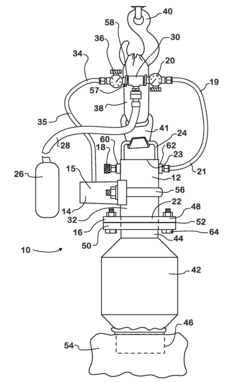
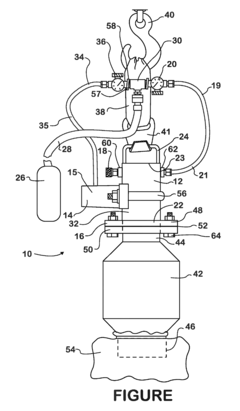
- An air chamber connected to the diesel particulate filter with a pressure relief valve and a vibrator is used to dislodge and remove particulate material using pressurized air and vibrations, allowing for quick and economical cleaning with readily available shop equipment.
Environmental Regulations Impact on DPF Technology
Environmental regulations have become increasingly stringent worldwide, significantly influencing the development and implementation of Diesel Particulate Filter (DPF) technologies. The European Union's Euro standards have progressively tightened particulate matter (PM) emission limits, with Euro 6 requiring a 97% reduction in PM emissions compared to Euro 1. Similarly, the United States EPA's Tier 4 Final regulations and California Air Resources Board (CARB) standards have established strict PM emission thresholds for diesel engines.
These regulatory frameworks have directly impacted DPF washcoat adherence requirements, as filters must maintain their efficiency throughout their operational lifetime to ensure compliance. The durability of washcoat adhesion has become a critical performance parameter, with many jurisdictions now requiring manufacturers to guarantee DPF effectiveness for up to 435,000 miles for heavy-duty applications.
Regulatory testing protocols have evolved to specifically evaluate washcoat adherence under various conditions. The EPA's accelerated aging procedures now include thermal cycling tests designed to stress the washcoat-substrate interface, while the European Commission has implemented in-service conformity testing to verify long-term performance retention of emission control systems including DPFs.
The global regulatory landscape continues to diverge in certain aspects while converging in others. China's implementation of China VI standards closely mirrors Euro 6 requirements, while India's Bharat Stage VI regulations have accelerated the adoption of advanced DPF technologies in emerging markets. Japan's post-new long-term regulations have established unique testing methodologies that specifically address washcoat durability under conditions typical to the Japanese driving cycle.
Regulatory bodies are increasingly focusing on real-world emissions performance rather than laboratory testing alone. The introduction of Real Driving Emissions (RDE) testing in Europe has placed additional emphasis on DPF washcoat durability under variable operating conditions, including cold starts, high-speed operation, and varying altitudes. This shift has prompted manufacturers to develop more robust washcoat formulations and application techniques.
Future regulatory trends indicate a continued tightening of particulate number (PN) limits alongside PM mass restrictions, which will further challenge DPF technology. The European Commission's proposed Euro 7 standards and the EPA's Cleaner Trucks Initiative suggest that next-generation DPFs will need to demonstrate exceptional washcoat adherence properties to maintain compliance throughout their service life, particularly under the expanded boundary conditions these new regulations are expected to include.
These regulatory frameworks have directly impacted DPF washcoat adherence requirements, as filters must maintain their efficiency throughout their operational lifetime to ensure compliance. The durability of washcoat adhesion has become a critical performance parameter, with many jurisdictions now requiring manufacturers to guarantee DPF effectiveness for up to 435,000 miles for heavy-duty applications.
Regulatory testing protocols have evolved to specifically evaluate washcoat adherence under various conditions. The EPA's accelerated aging procedures now include thermal cycling tests designed to stress the washcoat-substrate interface, while the European Commission has implemented in-service conformity testing to verify long-term performance retention of emission control systems including DPFs.
The global regulatory landscape continues to diverge in certain aspects while converging in others. China's implementation of China VI standards closely mirrors Euro 6 requirements, while India's Bharat Stage VI regulations have accelerated the adoption of advanced DPF technologies in emerging markets. Japan's post-new long-term regulations have established unique testing methodologies that specifically address washcoat durability under conditions typical to the Japanese driving cycle.
Regulatory bodies are increasingly focusing on real-world emissions performance rather than laboratory testing alone. The introduction of Real Driving Emissions (RDE) testing in Europe has placed additional emphasis on DPF washcoat durability under variable operating conditions, including cold starts, high-speed operation, and varying altitudes. This shift has prompted manufacturers to develop more robust washcoat formulations and application techniques.
Future regulatory trends indicate a continued tightening of particulate number (PN) limits alongside PM mass restrictions, which will further challenge DPF technology. The European Commission's proposed Euro 7 standards and the EPA's Cleaner Trucks Initiative suggest that next-generation DPFs will need to demonstrate exceptional washcoat adherence properties to maintain compliance throughout their service life, particularly under the expanded boundary conditions these new regulations are expected to include.
Material Science Advancements for Coating Stability
Recent advancements in material science have significantly contributed to improving diesel particulate filter (DPF) washcoat adherence. The development of nano-structured materials has revolutionized coating stability by providing enhanced surface area and mechanical interlocking mechanisms. These materials, including nano-alumina, nano-ceria, and nano-zirconia, demonstrate superior adhesion properties when compared to their conventional counterparts, primarily due to their unique surface chemistry and physical characteristics.
Polymer-ceramic hybrid materials represent another breakthrough in coating technology. These composites combine the flexibility and adhesion properties of polymers with the thermal stability and mechanical strength of ceramics. The resulting materials exhibit remarkable resistance to thermal cycling and mechanical vibration, two primary factors contributing to washcoat detachment in DPF applications.
Sol-gel processing techniques have evolved to enable precise control over coating microstructure and porosity. Advanced sol-gel formulations incorporate modified precursors with functional groups that form strong chemical bonds with filter substrates. This chemical bonding, combined with optimized rheological properties, ensures uniform coating distribution and exceptional adherence even under extreme operating conditions.
Surface modification technologies have also played a crucial role in enhancing coating stability. Plasma treatment, chemical etching, and silanization processes alter the surface energy and chemistry of filter substrates, creating favorable conditions for washcoat adhesion. These pre-treatment methods generate reactive sites on substrate surfaces that form strong chemical bonds with coating materials, significantly improving long-term durability.
High-temperature resistant binders have been developed specifically for DPF applications. These specialized materials maintain their adhesive properties at temperatures exceeding 800°C while resisting chemical degradation from exhaust components. Inorganic phosphates, modified silicates, and advanced ceramic binders have demonstrated exceptional performance in maintaining coating integrity throughout the DPF lifecycle.
Computational materials science has accelerated the discovery and optimization of coating formulations. Molecular dynamics simulations and density functional theory calculations provide insights into interfacial interactions between coatings and substrates at the atomic level. These computational approaches enable researchers to predict coating behavior under various conditions and design materials with optimized adherence properties.
Multi-layer coating architectures represent a systems approach to enhancing stability. By strategically combining materials with complementary properties in layered structures, engineers have developed coating systems that distribute thermal and mechanical stresses while maintaining excellent catalytic performance. These sophisticated coating architectures often incorporate gradient compositions that optimize both adherence and functional performance.
Polymer-ceramic hybrid materials represent another breakthrough in coating technology. These composites combine the flexibility and adhesion properties of polymers with the thermal stability and mechanical strength of ceramics. The resulting materials exhibit remarkable resistance to thermal cycling and mechanical vibration, two primary factors contributing to washcoat detachment in DPF applications.
Sol-gel processing techniques have evolved to enable precise control over coating microstructure and porosity. Advanced sol-gel formulations incorporate modified precursors with functional groups that form strong chemical bonds with filter substrates. This chemical bonding, combined with optimized rheological properties, ensures uniform coating distribution and exceptional adherence even under extreme operating conditions.
Surface modification technologies have also played a crucial role in enhancing coating stability. Plasma treatment, chemical etching, and silanization processes alter the surface energy and chemistry of filter substrates, creating favorable conditions for washcoat adhesion. These pre-treatment methods generate reactive sites on substrate surfaces that form strong chemical bonds with coating materials, significantly improving long-term durability.
High-temperature resistant binders have been developed specifically for DPF applications. These specialized materials maintain their adhesive properties at temperatures exceeding 800°C while resisting chemical degradation from exhaust components. Inorganic phosphates, modified silicates, and advanced ceramic binders have demonstrated exceptional performance in maintaining coating integrity throughout the DPF lifecycle.
Computational materials science has accelerated the discovery and optimization of coating formulations. Molecular dynamics simulations and density functional theory calculations provide insights into interfacial interactions between coatings and substrates at the atomic level. These computational approaches enable researchers to predict coating behavior under various conditions and design materials with optimized adherence properties.
Multi-layer coating architectures represent a systems approach to enhancing stability. By strategically combining materials with complementary properties in layered structures, engineers have developed coating systems that distribute thermal and mechanical stresses while maintaining excellent catalytic performance. These sophisticated coating architectures often incorporate gradient compositions that optimize both adherence and functional performance.
Unlock deeper insights with Patsnap Eureka Quick Research — get a full tech report to explore trends and direct your research. Try now!
Generate Your Research Report Instantly with AI Agent
Supercharge your innovation with Patsnap Eureka AI Agent Platform!