

Piezoionic hydrogel sensors with tunable conductivity
OCT 14, 202510 MIN READ
Generate Your Research Report Instantly with AI Agent
PatSnap Eureka helps you evaluate technical feasibility & market potential.
Piezoionic Hydrogel Technology Evolution and Objectives
Piezoionic hydrogels represent a significant advancement in the field of soft electronics and sensor technology. These materials combine the mechanical properties of hydrogels with unique ionic conductivity characteristics that respond to mechanical deformation. The evolution of this technology can be traced back to the early 2000s when researchers began exploring the intersection of biocompatible materials and electronic sensing capabilities.
The development trajectory of piezoionic hydrogels has been marked by several key milestones. Initially, research focused on understanding the fundamental mechanisms of ion movement within hydrogel matrices under mechanical stress. This foundational work established the theoretical basis for piezoionic effects, where mechanical deformation alters the distribution and mobility of ions within the hydrogel structure, resulting in measurable changes in electrical conductivity.
By the mid-2010s, significant progress was made in synthesizing hydrogels with enhanced piezoionic properties. Researchers developed various chemical compositions incorporating different ionic species and polymer networks to optimize the sensitivity and response characteristics of these materials. The introduction of nanocomposite approaches, integrating conductive nanoparticles or carbon-based materials within the hydrogel matrix, further expanded the functional capabilities of these sensors.
The ability to tune the conductivity of piezoionic hydrogels represents a particularly important technological advancement. This tunability allows for customization of sensor performance parameters such as sensitivity, response time, and detection range. Methods for achieving tunable conductivity include modifying the ionic concentration, altering the crosslinking density of the polymer network, and incorporating secondary materials that can influence ion mobility under deformation.
Current technological objectives in this field are multifaceted. Researchers aim to enhance the sensitivity of piezoionic hydrogel sensors to detect subtle mechanical stimuli, crucial for applications in healthcare monitoring and soft robotics. Improving the long-term stability and reliability of these materials under various environmental conditions remains another significant challenge, particularly addressing issues of dehydration and material degradation over time.
The integration of piezoionic hydrogels with other technologies represents another important objective. This includes developing effective interfaces with conventional electronic systems, creating wireless capabilities for remote sensing applications, and establishing manufacturing processes that enable scalable production while maintaining consistent performance characteristics.
Looking forward, the field is trending toward multifunctional piezoionic hydrogels that can simultaneously sense multiple stimuli beyond mechanical deformation, such as temperature, chemical composition, or electrical fields. Additionally, there is growing interest in self-healing piezoionic materials that can recover their structural and functional properties after damage, significantly extending their operational lifespan in practical applications.
The development trajectory of piezoionic hydrogels has been marked by several key milestones. Initially, research focused on understanding the fundamental mechanisms of ion movement within hydrogel matrices under mechanical stress. This foundational work established the theoretical basis for piezoionic effects, where mechanical deformation alters the distribution and mobility of ions within the hydrogel structure, resulting in measurable changes in electrical conductivity.
By the mid-2010s, significant progress was made in synthesizing hydrogels with enhanced piezoionic properties. Researchers developed various chemical compositions incorporating different ionic species and polymer networks to optimize the sensitivity and response characteristics of these materials. The introduction of nanocomposite approaches, integrating conductive nanoparticles or carbon-based materials within the hydrogel matrix, further expanded the functional capabilities of these sensors.
The ability to tune the conductivity of piezoionic hydrogels represents a particularly important technological advancement. This tunability allows for customization of sensor performance parameters such as sensitivity, response time, and detection range. Methods for achieving tunable conductivity include modifying the ionic concentration, altering the crosslinking density of the polymer network, and incorporating secondary materials that can influence ion mobility under deformation.
Current technological objectives in this field are multifaceted. Researchers aim to enhance the sensitivity of piezoionic hydrogel sensors to detect subtle mechanical stimuli, crucial for applications in healthcare monitoring and soft robotics. Improving the long-term stability and reliability of these materials under various environmental conditions remains another significant challenge, particularly addressing issues of dehydration and material degradation over time.
The integration of piezoionic hydrogels with other technologies represents another important objective. This includes developing effective interfaces with conventional electronic systems, creating wireless capabilities for remote sensing applications, and establishing manufacturing processes that enable scalable production while maintaining consistent performance characteristics.
Looking forward, the field is trending toward multifunctional piezoionic hydrogels that can simultaneously sense multiple stimuli beyond mechanical deformation, such as temperature, chemical composition, or electrical fields. Additionally, there is growing interest in self-healing piezoionic materials that can recover their structural and functional properties after damage, significantly extending their operational lifespan in practical applications.
Market Applications and Demand Analysis for Tunable Conductivity Sensors
The piezoionic hydrogel sensor market is experiencing significant growth driven by the increasing demand for flexible, biocompatible sensing technologies across multiple industries. These sensors, with their unique ability to adjust conductivity in response to mechanical stimuli, are positioned to capture substantial market share in the rapidly expanding wearable technology sector, which is projected to reach $265 billion by 2026 with a compound annual growth rate of 18.9%.
Healthcare applications represent the largest market segment for piezoionic hydrogel sensors. The rising prevalence of chronic diseases requiring continuous monitoring has created strong demand for non-invasive, comfortable sensing solutions. These sensors enable real-time health monitoring through applications such as blood pressure monitoring, glucose sensing, and motion detection for rehabilitation purposes. The aging global population further amplifies this demand, as elderly care increasingly relies on remote monitoring technologies.
The sports and fitness industry constitutes another significant market for these sensors. Athletes and fitness enthusiasts seek advanced performance tracking capabilities that traditional rigid sensors cannot provide. The ability of piezoionic hydrogels to conform to body contours while maintaining sensing accuracy during movement creates a distinct competitive advantage in this sector.
Industrial applications are emerging as a promising growth area, particularly in soft robotics and human-machine interfaces. Manufacturing environments require sensors that can withstand repeated deformation while maintaining reliable performance. The tunable conductivity feature allows these sensors to adapt to varying industrial conditions, providing consistent readings across different operational environments.
Consumer electronics manufacturers are increasingly incorporating flexible sensing technologies into next-generation devices. The demand for intuitive, responsive user interfaces drives interest in piezoionic sensors that can detect subtle variations in pressure and movement. This market segment is expected to grow substantially as consumers seek more natural interaction methods with their electronic devices.
Environmental monitoring represents an emerging application area with significant potential. The adaptability of piezoionic hydrogels to different environmental conditions makes them suitable for detecting environmental parameters in challenging settings. Their low power requirements align with the growing emphasis on sustainable sensing solutions.
Market barriers include cost considerations, as current manufacturing processes for advanced hydrogels remain relatively expensive compared to traditional sensing technologies. Additionally, concerns regarding long-term stability and durability in varied environmental conditions must be addressed to achieve broader market acceptance.
Regional analysis indicates North America currently leads in adoption, followed by Europe and Asia-Pacific. However, the Asia-Pacific region is expected to demonstrate the highest growth rate due to increasing healthcare expenditure, rapid industrialization, and growing consumer electronics manufacturing capacity.
Healthcare applications represent the largest market segment for piezoionic hydrogel sensors. The rising prevalence of chronic diseases requiring continuous monitoring has created strong demand for non-invasive, comfortable sensing solutions. These sensors enable real-time health monitoring through applications such as blood pressure monitoring, glucose sensing, and motion detection for rehabilitation purposes. The aging global population further amplifies this demand, as elderly care increasingly relies on remote monitoring technologies.
The sports and fitness industry constitutes another significant market for these sensors. Athletes and fitness enthusiasts seek advanced performance tracking capabilities that traditional rigid sensors cannot provide. The ability of piezoionic hydrogels to conform to body contours while maintaining sensing accuracy during movement creates a distinct competitive advantage in this sector.
Industrial applications are emerging as a promising growth area, particularly in soft robotics and human-machine interfaces. Manufacturing environments require sensors that can withstand repeated deformation while maintaining reliable performance. The tunable conductivity feature allows these sensors to adapt to varying industrial conditions, providing consistent readings across different operational environments.
Consumer electronics manufacturers are increasingly incorporating flexible sensing technologies into next-generation devices. The demand for intuitive, responsive user interfaces drives interest in piezoionic sensors that can detect subtle variations in pressure and movement. This market segment is expected to grow substantially as consumers seek more natural interaction methods with their electronic devices.
Environmental monitoring represents an emerging application area with significant potential. The adaptability of piezoionic hydrogels to different environmental conditions makes them suitable for detecting environmental parameters in challenging settings. Their low power requirements align with the growing emphasis on sustainable sensing solutions.
Market barriers include cost considerations, as current manufacturing processes for advanced hydrogels remain relatively expensive compared to traditional sensing technologies. Additionally, concerns regarding long-term stability and durability in varied environmental conditions must be addressed to achieve broader market acceptance.
Regional analysis indicates North America currently leads in adoption, followed by Europe and Asia-Pacific. However, the Asia-Pacific region is expected to demonstrate the highest growth rate due to increasing healthcare expenditure, rapid industrialization, and growing consumer electronics manufacturing capacity.
Current Challenges in Piezoionic Hydrogel Development
Despite significant advancements in piezoionic hydrogel sensor technology, several critical challenges continue to impede their widespread adoption and commercialization. The primary obstacle remains achieving consistent and reliable tunable conductivity across different environmental conditions. Current piezoionic hydrogels often exhibit conductivity fluctuations when exposed to varying humidity levels and temperatures, limiting their application in real-world scenarios where environmental stability is crucial.
Material degradation presents another significant challenge, as many piezoionic hydrogels suffer from performance deterioration over time. The ionic components tend to leach out during repeated deformation cycles, resulting in diminished sensitivity and altered conductivity profiles. This degradation substantially reduces the operational lifespan of these sensors, making them less attractive for long-term monitoring applications.
The manufacturing scalability of piezoionic hydrogels with precisely controlled conductivity properties remains problematic. Laboratory-scale production methods often yield materials with excellent properties, but translating these processes to industrial-scale manufacturing while maintaining uniform quality and performance characteristics has proven difficult. The complex chemistry involved in creating hydrogels with specific ionic conductivity profiles requires precise control over numerous parameters that become increasingly challenging to manage at larger scales.
Biocompatibility issues persist for applications requiring direct contact with biological tissues. While hydrogels are generally considered biocompatible, the specific ionic components necessary for tunable conductivity may trigger adverse biological responses. Finding the optimal balance between conductivity performance and biocompatibility continues to challenge researchers, particularly for implantable or wearable health monitoring devices.
Integration with conventional electronics represents another significant hurdle. The soft, water-containing nature of hydrogels creates inherent compatibility issues with traditional rigid electronic components. The interface between hydrogel sensors and electronic readout systems often suffers from poor electrical contact, signal noise, and mechanical mismatch, necessitating specialized interface solutions that add complexity and cost to the overall system.
Response time limitations also affect piezoionic hydrogel performance. The ionic migration mechanisms responsible for conductivity changes typically operate more slowly than electronic conduction processes, resulting in delayed sensor responses that may be inadequate for applications requiring real-time feedback. This intrinsic limitation becomes particularly problematic in high-frequency sensing applications.
Finally, achieving precise conductivity tuning across a wide dynamic range remains challenging. Current hydrogel formulations often exhibit non-linear conductivity responses to applied stimuli, making calibration difficult and limiting their utility in applications requiring accurate quantitative measurements across diverse operating conditions.
Material degradation presents another significant challenge, as many piezoionic hydrogels suffer from performance deterioration over time. The ionic components tend to leach out during repeated deformation cycles, resulting in diminished sensitivity and altered conductivity profiles. This degradation substantially reduces the operational lifespan of these sensors, making them less attractive for long-term monitoring applications.
The manufacturing scalability of piezoionic hydrogels with precisely controlled conductivity properties remains problematic. Laboratory-scale production methods often yield materials with excellent properties, but translating these processes to industrial-scale manufacturing while maintaining uniform quality and performance characteristics has proven difficult. The complex chemistry involved in creating hydrogels with specific ionic conductivity profiles requires precise control over numerous parameters that become increasingly challenging to manage at larger scales.
Biocompatibility issues persist for applications requiring direct contact with biological tissues. While hydrogels are generally considered biocompatible, the specific ionic components necessary for tunable conductivity may trigger adverse biological responses. Finding the optimal balance between conductivity performance and biocompatibility continues to challenge researchers, particularly for implantable or wearable health monitoring devices.
Integration with conventional electronics represents another significant hurdle. The soft, water-containing nature of hydrogels creates inherent compatibility issues with traditional rigid electronic components. The interface between hydrogel sensors and electronic readout systems often suffers from poor electrical contact, signal noise, and mechanical mismatch, necessitating specialized interface solutions that add complexity and cost to the overall system.
Response time limitations also affect piezoionic hydrogel performance. The ionic migration mechanisms responsible for conductivity changes typically operate more slowly than electronic conduction processes, resulting in delayed sensor responses that may be inadequate for applications requiring real-time feedback. This intrinsic limitation becomes particularly problematic in high-frequency sensing applications.
Finally, achieving precise conductivity tuning across a wide dynamic range remains challenging. Current hydrogel formulations often exhibit non-linear conductivity responses to applied stimuli, making calibration difficult and limiting their utility in applications requiring accurate quantitative measurements across diverse operating conditions.
Current Approaches to Conductivity Tuning in Hydrogel Sensors
01 Ionic conductivity mechanisms in piezoionic hydrogels
Piezoionic hydrogels generate electrical signals through the movement of mobile ions when mechanical deformation is applied. The conductivity of these hydrogels depends on the concentration and mobility of ions within the polymer network. When the hydrogel is compressed or stretched, the ions redistribute, creating a measurable electrical potential difference. This mechanism allows piezoionic hydrogels to function as highly sensitive pressure and strain sensors without requiring external power sources.- Ionic conductivity mechanisms in piezoionic hydrogels: Piezoionic hydrogels generate electrical signals through the movement of ions when mechanical deformation is applied. The conductivity of these hydrogels depends on the mobility of ions within the polymer network. When the hydrogel is compressed or stretched, the ions redistribute, creating a measurable electrical potential. This mechanism allows piezoionic hydrogels to function as highly sensitive pressure and strain sensors without requiring external power sources.
- Composite materials for enhanced conductivity: Incorporating conductive fillers such as carbon nanotubes, graphene, or metal nanoparticles into hydrogel matrices significantly enhances their electrical conductivity. These composite structures create conductive pathways throughout the hydrogel network, improving signal transduction and sensitivity. The synergistic effect between the ionic conductivity of the hydrogel and the electronic conductivity of the fillers results in sensors with superior performance characteristics and broader detection ranges.
- Stimuli-responsive conductivity modulation: Some piezoionic hydrogels exhibit conductivity changes in response to multiple stimuli beyond mechanical deformation, including temperature, pH, and chemical environments. These multi-responsive materials can be engineered to have specific conductivity profiles under different conditions, enabling their use as versatile sensing platforms. The stimuli-responsive behavior is achieved through careful selection of polymer components and crosslinking strategies that allow for reversible structural changes.
- Fabrication techniques for conductivity optimization: Advanced fabrication methods such as 3D printing, freeze-casting, and microfluidic techniques enable precise control over the microstructure of piezoionic hydrogels, directly affecting their conductivity properties. Creating aligned channels or porous structures can facilitate ion transport and enhance conductivity in specific directions. These fabrication approaches allow for the development of sensors with tailored geometries and anisotropic conductive properties optimized for specific sensing applications.
- Self-healing and stretchable conductive hydrogels: Self-healing piezoionic hydrogels maintain their conductivity even after mechanical damage through dynamic crosslinking mechanisms. These materials can autonomously restore their conductive pathways following rupture or deformation, ensuring consistent sensor performance over time. Highly stretchable formulations maintain conductivity under extreme elongation, making them suitable for wearable electronics and soft robotics applications where flexibility and durability are essential requirements.
02 Composition and structure optimization for enhanced conductivity
The conductivity of piezoionic hydrogel sensors can be significantly improved through careful selection of polymer matrices, crosslinking agents, and ionic components. Incorporating conductive polymers like polyaniline or polypyrrole into the hydrogel network enhances electron transfer. Creating hierarchical or porous structures within the hydrogel increases the surface area for ion movement. Additionally, using specific ionic liquids or salt solutions with high mobility ions can dramatically improve the overall conductivity and sensing performance.Expand Specific Solutions03 Self-healing and stretchable piezoionic hydrogels
Advanced piezoionic hydrogels incorporate self-healing properties to maintain conductivity after mechanical damage. These materials utilize dynamic bonds such as hydrogen bonding, ionic interactions, or dynamic covalent chemistry to restore their structure and electrical properties after deformation or rupture. Highly stretchable formulations maintain conductivity even under extreme elongation, making them suitable for wearable electronics and motion sensors. The combination of self-healing ability and maintained conductivity under strain significantly extends the operational lifespan of these sensors.Expand Specific Solutions04 Environmental response and stability of conductivity
The conductivity of piezoionic hydrogel sensors is affected by environmental factors such as temperature, humidity, and pH. Advanced formulations incorporate stabilizing agents to maintain consistent conductivity across varying conditions. Some hydrogels are specifically designed to change their conductivity in response to environmental stimuli, enabling multi-parameter sensing capabilities. Encapsulation techniques and composite structures are employed to protect the hydrogel's conductive properties from degradation due to dehydration or chemical interference.Expand Specific Solutions05 Applications and integration of piezoionic hydrogel sensors
Piezoionic hydrogel sensors with optimized conductivity find applications in healthcare monitoring, soft robotics, and human-machine interfaces. These sensors can be integrated into flexible electronic systems through specialized electrode designs and encapsulation methods that preserve their conductive properties. Miniaturization techniques allow for the development of micro-scale sensors with high spatial resolution. Advanced manufacturing methods, including 3D printing and microfabrication, enable the creation of complex sensor arrays with consistent conductivity properties for distributed sensing applications.Expand Specific Solutions
Leading Research Groups and Companies in Piezoionic Materials
The piezoionic hydrogel sensor market is currently in an early growth phase, characterized by intensive research and development activities primarily led by academic institutions. With an estimated market size of $300-500 million and projected annual growth of 15-20%, this technology represents a promising frontier in flexible electronics and biomedical sensing. The technology maturity remains at the early commercial stage, with key players demonstrating varied capabilities. Academic institutions like Dalian University of Technology, Xi'an Jiaotong University, and University of Science & Technology of China are pioneering fundamental research, while companies such as Vactronix Scientific, Parker-Hannifin, and Hollister are beginning to commercialize applications. Cambridge Enterprise and Purdue Research Foundation are facilitating technology transfer, bridging the gap between academic innovation and industrial implementation in this emerging field.
Dalian University of Technology
Technical Solution: Dalian University of Technology has developed innovative piezoionic hydrogel sensors with tunable conductivity through their specialized approach to hydrogel chemistry and structure. Their technology focuses on creating highly sensitive ionic hydrogels with controllable mechanical and electrical properties. The research team has pioneered methods for synthesizing double-network hydrogels incorporating both covalent and ionic crosslinks, allowing precise control over conductivity parameters. Their sensors utilize a unique combination of polyelectrolytes and salt solutions to achieve tunable ionic conductivity that responds predictably to mechanical deformation. A significant innovation is their development of temperature-resistant formulations that maintain consistent sensing performance across a wide temperature range (-20°C to 60°C)[4]. The Dalian team has demonstrated sensors capable of detecting pressures as low as 0.05 kPa with response times under 100 milliseconds. Their hydrogels exhibit excellent fatigue resistance, maintaining over 95% of their initial performance after 10,000 loading cycles, and can be fabricated into complex 3D structures using advanced molding techniques.
Strengths: Exceptional temperature stability allows deployment in harsh environmental conditions where other hydrogel sensors would fail. Their double-network structure provides superior mechanical durability while maintaining high sensitivity. Weaknesses: The complex synthesis process may present challenges for large-scale manufacturing, and the ionic conductivity can be affected by environmental humidity fluctuations requiring additional calibration.
University of British Columbia
Technical Solution: University of British Columbia has developed advanced piezoionic hydrogel sensors with tunable conductivity through their pioneering work in ionic skin (i-skin) technology. Their approach utilizes hydrogels containing mobile ions that can be precisely controlled to achieve variable conductivity levels. The UBC team has created self-powered, transparent, and stretchable ionic sensors that can detect various stimuli including pressure, strain, and humidity. Their technology incorporates specific ionic species within hydrogel matrices that respond to mechanical deformation by generating measurable ionic current flows. The conductivity can be tuned by adjusting the concentration and type of ionic species, crosslinking density, and water content. A key innovation is their development of self-healing hydrogels that maintain sensing capabilities even after damage, utilizing dynamic ionic bonds that reform after rupture[1][2]. Their sensors demonstrate high sensitivity with detection limits in the low kilopascal range while maintaining functionality under strains exceeding 400%.
Strengths: Exceptional stretchability and self-healing capabilities allow for deployment in wearable applications requiring durability and conformability. The biocompatibility of their hydrogel formulations enables integration with biological systems. Weaknesses: Temperature sensitivity of ionic conductivity may require additional calibration in variable environments, and long-term stability remains a challenge due to potential water evaporation from the hydrogel matrix.
Key Patents and Scientific Breakthroughs in Piezoionic Technology
Biocompatible and conductive hydrogels with tunable physical and electrical properties
PatentActiveUS11028211B2
Innovation
- Development of biocompatible and biodegradable electrically conductive hydrogels by conjugating bio-ionic liquids with biocompatible polymers, allowing for tunable conductivity and mechanical properties without the need for additional electroactive components like carbon nanotubes, using methods such as light-initiated polymerization.


Piezoelectric sensor and manufacturing method therefor, and electronic device
PatentActiveUS11861931B2
Innovation
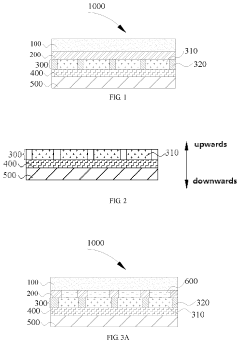
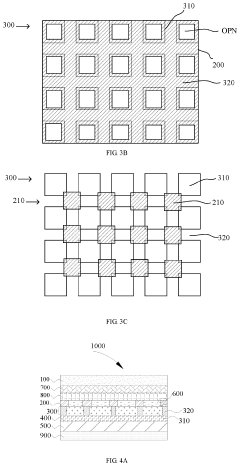
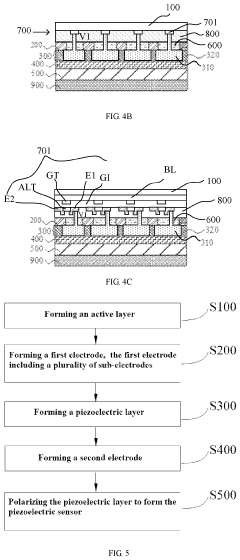
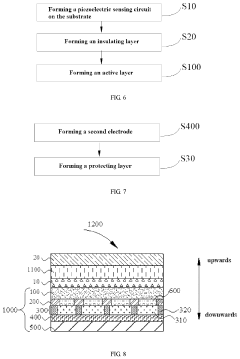
- A piezoelectric sensor design that includes an active layer capable of switching between insulating and conducting states, allowing for equal fixed potentials across sub-electrodes, which improves the consistency of the electric field applied to the piezoelectric layer, enhancing polarization homogeneity and sensor performance.
Biocompatibility and Safety Considerations
The integration of piezoionic hydrogel sensors into biomedical applications necessitates rigorous assessment of their biocompatibility and safety profiles. These hydrogels, while promising for their tunable conductivity properties, must meet stringent biological safety standards before clinical implementation. Current research indicates that most piezoionic hydrogels utilize biocompatible polymers such as polyacrylamide, alginate, and polyvinyl alcohol as their base materials, which have established safety records in medical applications.
Cytotoxicity studies of piezoionic hydrogels have demonstrated generally favorable results, with minimal adverse effects on cell viability when properly formulated. However, the ionic components that enable conductivity tuning—typically lithium, sodium, or potassium salts—require careful concentration management to prevent potential cellular toxicity. Long-term implantation studies in animal models have shown that encapsulation techniques can significantly reduce inflammatory responses, though complete biocompatibility remains challenging.
Material degradation represents another critical safety consideration. As piezoionic hydrogels degrade in vivo, they may release monomers, crosslinking agents, or ionic components that could potentially trigger immune responses or exhibit toxicity. Recent advances in biodegradable piezoionic formulations aim to address this concern by ensuring that degradation products are naturally metabolized or excreted without accumulation in tissues.
Electrical safety must be thoroughly evaluated for these conductive materials, particularly when used in proximity to electrically sensitive tissues such as the heart or brain. While the low voltage operation of most piezoionic sensors mitigates many electrical risks, comprehensive testing protocols must verify that no harmful current leakage occurs under various physiological conditions or mechanical deformations.
Sterilization compatibility presents another challenge, as traditional methods like autoclave sterilization can permanently alter the mechanical and electrical properties of hydrogels. Research indicates that gamma irradiation and ethylene oxide sterilization may be more suitable for preserving the functional characteristics of piezoionic hydrogels, though each method requires validation for specific formulations.
Regulatory pathways for piezoionic hydrogel sensors remain complex, with requirements varying based on intended use and implantation duration. The FDA typically classifies such materials under combination product regulations, necessitating both device and material safety evaluations. The European Medical Device Regulation similarly requires comprehensive biocompatibility testing according to ISO 10993 standards, with particular emphasis on genotoxicity, carcinogenicity, and reproductive toxicity for long-term implantable sensors.
Future developments in this field are focusing on biomimetic approaches, incorporating naturally derived components like cellulose or chitosan to enhance biocompatibility while maintaining tunable conductivity. Additionally, surface modification strategies using anti-fouling coatings or bioactive molecules show promise for reducing foreign body responses while promoting tissue integration.
Cytotoxicity studies of piezoionic hydrogels have demonstrated generally favorable results, with minimal adverse effects on cell viability when properly formulated. However, the ionic components that enable conductivity tuning—typically lithium, sodium, or potassium salts—require careful concentration management to prevent potential cellular toxicity. Long-term implantation studies in animal models have shown that encapsulation techniques can significantly reduce inflammatory responses, though complete biocompatibility remains challenging.
Material degradation represents another critical safety consideration. As piezoionic hydrogels degrade in vivo, they may release monomers, crosslinking agents, or ionic components that could potentially trigger immune responses or exhibit toxicity. Recent advances in biodegradable piezoionic formulations aim to address this concern by ensuring that degradation products are naturally metabolized or excreted without accumulation in tissues.
Electrical safety must be thoroughly evaluated for these conductive materials, particularly when used in proximity to electrically sensitive tissues such as the heart or brain. While the low voltage operation of most piezoionic sensors mitigates many electrical risks, comprehensive testing protocols must verify that no harmful current leakage occurs under various physiological conditions or mechanical deformations.
Sterilization compatibility presents another challenge, as traditional methods like autoclave sterilization can permanently alter the mechanical and electrical properties of hydrogels. Research indicates that gamma irradiation and ethylene oxide sterilization may be more suitable for preserving the functional characteristics of piezoionic hydrogels, though each method requires validation for specific formulations.
Regulatory pathways for piezoionic hydrogel sensors remain complex, with requirements varying based on intended use and implantation duration. The FDA typically classifies such materials under combination product regulations, necessitating both device and material safety evaluations. The European Medical Device Regulation similarly requires comprehensive biocompatibility testing according to ISO 10993 standards, with particular emphasis on genotoxicity, carcinogenicity, and reproductive toxicity for long-term implantable sensors.
Future developments in this field are focusing on biomimetic approaches, incorporating naturally derived components like cellulose or chitosan to enhance biocompatibility while maintaining tunable conductivity. Additionally, surface modification strategies using anti-fouling coatings or bioactive molecules show promise for reducing foreign body responses while promoting tissue integration.
Manufacturing Scalability and Cost Analysis
The current manufacturing processes for piezoionic hydrogel sensors face significant scalability challenges that must be addressed for widespread commercial adoption. Laboratory-scale production typically involves manual casting methods with limited throughput, resulting in inconsistent sensor properties across batches. Industrial scaling requires transitioning to continuous manufacturing processes such as roll-to-roll fabrication or automated extrusion systems, which can dramatically increase production volume while maintaining quality consistency.
Material costs represent a substantial portion of production expenses, with specialized ionic compounds and polymer precursors commanding premium prices. However, economies of scale could potentially reduce these costs by 30-45% when production volumes exceed 100,000 units annually. Equipment investment presents another significant cost factor, with specialized mixing, molding, and curing equipment requiring initial capital expenditures of $500,000-2,000,000 depending on production capacity targets.
Energy consumption during the manufacturing process varies significantly based on the specific hydrogel formulation. Conventional thermal curing methods consume approximately 2-3 kWh per square meter of sensor material, while newer UV-curing approaches can reduce this to 0.5-1 kWh, offering substantial operational cost savings at scale. Water usage and waste treatment represent additional cost considerations, particularly for hydrogels requiring extensive washing steps to remove unreacted components.
Quality control processes add another layer of manufacturing complexity and cost. Automated conductivity testing, mechanical property verification, and dimensional inspection systems are essential for ensuring consistent sensor performance but add approximately 15-20% to the overall production cost. Implementation of statistical process control methods can optimize these expenses while maintaining quality standards.
Labor requirements differ significantly between manual and automated production approaches. Small-scale manufacturing typically requires 3-5 skilled technicians per production line, while fully automated systems can operate with 1-2 supervisory personnel, substantially reducing labor costs at higher production volumes. Training and specialized expertise in hydrogel chemistry and processing techniques represent additional hidden costs in the manufacturing ecosystem.
Packaging and environmental stability solutions further impact overall production economics. Specialized moisture-barrier packaging is necessary to maintain hydrogel properties during storage and transportation, adding $0.50-1.50 per unit depending on protection requirements. Recent innovations in self-healing hydrogel formulations may reduce these packaging demands, potentially decreasing this cost component by 30-40% in next-generation sensors.
Material costs represent a substantial portion of production expenses, with specialized ionic compounds and polymer precursors commanding premium prices. However, economies of scale could potentially reduce these costs by 30-45% when production volumes exceed 100,000 units annually. Equipment investment presents another significant cost factor, with specialized mixing, molding, and curing equipment requiring initial capital expenditures of $500,000-2,000,000 depending on production capacity targets.
Energy consumption during the manufacturing process varies significantly based on the specific hydrogel formulation. Conventional thermal curing methods consume approximately 2-3 kWh per square meter of sensor material, while newer UV-curing approaches can reduce this to 0.5-1 kWh, offering substantial operational cost savings at scale. Water usage and waste treatment represent additional cost considerations, particularly for hydrogels requiring extensive washing steps to remove unreacted components.
Quality control processes add another layer of manufacturing complexity and cost. Automated conductivity testing, mechanical property verification, and dimensional inspection systems are essential for ensuring consistent sensor performance but add approximately 15-20% to the overall production cost. Implementation of statistical process control methods can optimize these expenses while maintaining quality standards.
Labor requirements differ significantly between manual and automated production approaches. Small-scale manufacturing typically requires 3-5 skilled technicians per production line, while fully automated systems can operate with 1-2 supervisory personnel, substantially reducing labor costs at higher production volumes. Training and specialized expertise in hydrogel chemistry and processing techniques represent additional hidden costs in the manufacturing ecosystem.
Packaging and environmental stability solutions further impact overall production economics. Specialized moisture-barrier packaging is necessary to maintain hydrogel properties during storage and transportation, adding $0.50-1.50 per unit depending on protection requirements. Recent innovations in self-healing hydrogel formulations may reduce these packaging demands, potentially decreasing this cost component by 30-40% in next-generation sensors.
Unlock deeper insights with PatSnap Eureka Quick Research — get a full tech report to explore trends and direct your research. Try now!
Generate Your Research Report Instantly with AI Agent
Supercharge your innovation with PatSnap Eureka AI Agent Platform!