Predictions for the next decade in V16 engine technological developments
AUG 15, 20259 MIN READ
Generate Your Research Report Instantly with AI Agent
PatSnap Eureka helps you evaluate technical feasibility & market potential.
V16 Engine Evolution and Future Goals
The V16 engine, a marvel of automotive engineering, has undergone significant evolution since its inception in the early 20th century. Initially developed for luxury and high-performance applications, these engines have been synonymous with power, prestige, and technological prowess. As we look towards the next decade, the trajectory of V16 engine development is poised for remarkable advancements, driven by the dual imperatives of performance enhancement and environmental sustainability.
Historically, V16 engines have been the pinnacle of internal combustion engine design, offering unparalleled smoothness and power output. However, their complexity and fuel consumption have limited their widespread adoption. The coming decade presents an opportunity to address these challenges while pushing the boundaries of what's possible in engine technology.
One of the primary goals for V16 engine development in the next ten years will be the integration of advanced materials and manufacturing techniques. Lightweight alloys, carbon fiber components, and 3D-printed parts are expected to play a crucial role in reducing engine weight while maintaining structural integrity. This weight reduction will contribute to improved fuel efficiency and overall vehicle performance.
Electrification is another key area that will shape the future of V16 engines. Hybrid V16 powertrains are likely to emerge, combining the traditional combustion engine with electric motors. This hybridization will not only boost power output but also significantly improve fuel economy and reduce emissions, aligning with increasingly stringent environmental regulations.
Advanced combustion technologies will be at the forefront of V16 engine evolution. Variable compression ratios, intelligent valve timing, and cylinder deactivation systems will be refined to optimize performance across a wide range of operating conditions. These innovations will enable V16 engines to deliver exceptional power when needed while operating efficiently during normal driving conditions.
The integration of artificial intelligence and machine learning algorithms into engine management systems represents another exciting frontier. These technologies will allow for real-time optimization of engine parameters, predictive maintenance, and adaptive performance tuning based on driving conditions and driver preferences.
As we progress through the next decade, the focus on sustainable fuels will intensify. V16 engines will likely be designed to accommodate alternative fuels such as hydrogen or synthetic fuels, offering a pathway to carbon-neutral operation without sacrificing the unique characteristics that make V16 engines desirable.
In conclusion, the next decade promises to be an exciting period of innovation for V16 engine technology. The goals are clear: to preserve the legacy of power and prestige associated with these engines while embracing the future of sustainable and intelligent propulsion systems. This evolution will ensure that V16 engines remain relevant and continue to push the boundaries of automotive engineering in the years to come.
Historically, V16 engines have been the pinnacle of internal combustion engine design, offering unparalleled smoothness and power output. However, their complexity and fuel consumption have limited their widespread adoption. The coming decade presents an opportunity to address these challenges while pushing the boundaries of what's possible in engine technology.
One of the primary goals for V16 engine development in the next ten years will be the integration of advanced materials and manufacturing techniques. Lightweight alloys, carbon fiber components, and 3D-printed parts are expected to play a crucial role in reducing engine weight while maintaining structural integrity. This weight reduction will contribute to improved fuel efficiency and overall vehicle performance.
Electrification is another key area that will shape the future of V16 engines. Hybrid V16 powertrains are likely to emerge, combining the traditional combustion engine with electric motors. This hybridization will not only boost power output but also significantly improve fuel economy and reduce emissions, aligning with increasingly stringent environmental regulations.
Advanced combustion technologies will be at the forefront of V16 engine evolution. Variable compression ratios, intelligent valve timing, and cylinder deactivation systems will be refined to optimize performance across a wide range of operating conditions. These innovations will enable V16 engines to deliver exceptional power when needed while operating efficiently during normal driving conditions.
The integration of artificial intelligence and machine learning algorithms into engine management systems represents another exciting frontier. These technologies will allow for real-time optimization of engine parameters, predictive maintenance, and adaptive performance tuning based on driving conditions and driver preferences.
As we progress through the next decade, the focus on sustainable fuels will intensify. V16 engines will likely be designed to accommodate alternative fuels such as hydrogen or synthetic fuels, offering a pathway to carbon-neutral operation without sacrificing the unique characteristics that make V16 engines desirable.
In conclusion, the next decade promises to be an exciting period of innovation for V16 engine technology. The goals are clear: to preserve the legacy of power and prestige associated with these engines while embracing the future of sustainable and intelligent propulsion systems. This evolution will ensure that V16 engines remain relevant and continue to push the boundaries of automotive engineering in the years to come.
Market Demand Analysis for V16 Engines
The market demand for V16 engines has been steadily declining over the past decades, primarily due to shifting consumer preferences, stringent environmental regulations, and advancements in smaller, more efficient engine technologies. However, there remains a niche market for these powerful engines, particularly in luxury and high-performance vehicles.
In the luxury automotive sector, V16 engines continue to symbolize prestige and exclusivity. Manufacturers like Cadillac and Bugatti have historically used V16 engines in their flagship models to showcase engineering prowess and cater to ultra-high-net-worth individuals seeking the pinnacle of automotive excellence. This segment, while small, demonstrates a consistent demand for V16-powered vehicles as status symbols and collectors' items.
The high-performance and motorsport industries also maintain interest in V16 engines, albeit limited. These engines' ability to produce immense power and torque makes them attractive for specialized applications such as land speed record attempts or custom-built racing vehicles. However, the practical limitations of size, weight, and fuel consumption restrict their widespread adoption in mainstream motorsports.
Marine applications represent another potential market for V16 engines. Large yachts and commercial vessels sometimes employ V16 configurations for their high power output and reliability. As the luxury yacht market continues to grow, there may be sustained demand for V16 engines in this sector.
Looking ahead, the market for V16 engines is expected to face significant challenges. Increasing global focus on reducing carbon emissions and improving fuel efficiency is likely to further constrain the market. Many countries are implementing stricter emissions standards and planning to phase out internal combustion engines entirely in favor of electric powertrains.
Despite these challenges, there may be opportunities for V16 engines to evolve and find new niches. Potential areas of growth include the development of hybrid V16 systems that combine traditional internal combustion with electric motors, offering improved efficiency while maintaining the prestige and power associated with V16 configurations. Additionally, the use of advanced materials and manufacturing techniques could lead to lighter, more compact V16 engines that better meet modern performance and efficiency demands.
In conclusion, while the overall market demand for V16 engines is expected to remain limited and potentially decrease further, there will likely continue to be a small but dedicated market segment that values these engines for their unique characteristics, historical significance, and engineering excellence. The key to sustaining and potentially growing this market lies in innovation and adaptation to changing regulatory and consumer landscapes.
In the luxury automotive sector, V16 engines continue to symbolize prestige and exclusivity. Manufacturers like Cadillac and Bugatti have historically used V16 engines in their flagship models to showcase engineering prowess and cater to ultra-high-net-worth individuals seeking the pinnacle of automotive excellence. This segment, while small, demonstrates a consistent demand for V16-powered vehicles as status symbols and collectors' items.
The high-performance and motorsport industries also maintain interest in V16 engines, albeit limited. These engines' ability to produce immense power and torque makes them attractive for specialized applications such as land speed record attempts or custom-built racing vehicles. However, the practical limitations of size, weight, and fuel consumption restrict their widespread adoption in mainstream motorsports.
Marine applications represent another potential market for V16 engines. Large yachts and commercial vessels sometimes employ V16 configurations for their high power output and reliability. As the luxury yacht market continues to grow, there may be sustained demand for V16 engines in this sector.
Looking ahead, the market for V16 engines is expected to face significant challenges. Increasing global focus on reducing carbon emissions and improving fuel efficiency is likely to further constrain the market. Many countries are implementing stricter emissions standards and planning to phase out internal combustion engines entirely in favor of electric powertrains.
Despite these challenges, there may be opportunities for V16 engines to evolve and find new niches. Potential areas of growth include the development of hybrid V16 systems that combine traditional internal combustion with electric motors, offering improved efficiency while maintaining the prestige and power associated with V16 configurations. Additionally, the use of advanced materials and manufacturing techniques could lead to lighter, more compact V16 engines that better meet modern performance and efficiency demands.
In conclusion, while the overall market demand for V16 engines is expected to remain limited and potentially decrease further, there will likely continue to be a small but dedicated market segment that values these engines for their unique characteristics, historical significance, and engineering excellence. The key to sustaining and potentially growing this market lies in innovation and adaptation to changing regulatory and consumer landscapes.
Current V16 Technology and Challenges
V16 engines, while rare in modern automotive applications, continue to hold a niche position in specialized sectors such as marine propulsion and stationary power generation. The current state of V16 technology represents a pinnacle of internal combustion engine design, offering unparalleled power output and smooth operation.
One of the primary challenges facing V16 engines is their inherent complexity and size. With 16 cylinders arranged in a V-configuration, these engines require sophisticated engineering to manage thermal dynamics, balance, and fuel distribution. The sheer number of moving parts also presents maintenance challenges and potential reliability issues.
Emissions regulations pose another significant hurdle for V16 engines. As global environmental standards become increasingly stringent, manufacturers must innovate to reduce harmful exhaust emissions while maintaining performance. This often involves advanced fuel injection systems, exhaust gas recirculation, and catalytic converters specifically designed for high-output engines.
Fuel efficiency remains a constant challenge for V16 engines due to their large displacement and high fuel consumption. Engineers are exploring various technologies to improve efficiency, including variable valve timing, cylinder deactivation, and advanced engine management systems. However, balancing efficiency with the power output expected from a V16 engine presents a unique engineering challenge.
The limited market for V16 engines also creates economic challenges for manufacturers. The high development and production costs associated with these specialized engines must be offset by a relatively small customer base, primarily in luxury and high-performance applications.
In terms of materials and manufacturing, V16 engines push the boundaries of current technology. Advanced alloys and composites are necessary to withstand the extreme temperatures and pressures generated by these powerplants. Precision manufacturing techniques, such as 3D printing for complex components, are being explored to enhance performance and reduce weight.
The integration of hybrid and electric technologies with V16 engines represents both a challenge and an opportunity. While electrification could potentially address some efficiency and emissions concerns, it also introduces new complexities in terms of packaging, weight distribution, and power management.
Looking ahead, the future of V16 engines will likely be shaped by advancements in materials science, combustion efficiency, and emissions control technologies. The challenge lies in preserving the unique characteristics of V16 engines while adapting to a rapidly changing automotive landscape focused on sustainability and efficiency.
One of the primary challenges facing V16 engines is their inherent complexity and size. With 16 cylinders arranged in a V-configuration, these engines require sophisticated engineering to manage thermal dynamics, balance, and fuel distribution. The sheer number of moving parts also presents maintenance challenges and potential reliability issues.
Emissions regulations pose another significant hurdle for V16 engines. As global environmental standards become increasingly stringent, manufacturers must innovate to reduce harmful exhaust emissions while maintaining performance. This often involves advanced fuel injection systems, exhaust gas recirculation, and catalytic converters specifically designed for high-output engines.
Fuel efficiency remains a constant challenge for V16 engines due to their large displacement and high fuel consumption. Engineers are exploring various technologies to improve efficiency, including variable valve timing, cylinder deactivation, and advanced engine management systems. However, balancing efficiency with the power output expected from a V16 engine presents a unique engineering challenge.
The limited market for V16 engines also creates economic challenges for manufacturers. The high development and production costs associated with these specialized engines must be offset by a relatively small customer base, primarily in luxury and high-performance applications.
In terms of materials and manufacturing, V16 engines push the boundaries of current technology. Advanced alloys and composites are necessary to withstand the extreme temperatures and pressures generated by these powerplants. Precision manufacturing techniques, such as 3D printing for complex components, are being explored to enhance performance and reduce weight.
The integration of hybrid and electric technologies with V16 engines represents both a challenge and an opportunity. While electrification could potentially address some efficiency and emissions concerns, it also introduces new complexities in terms of packaging, weight distribution, and power management.
Looking ahead, the future of V16 engines will likely be shaped by advancements in materials science, combustion efficiency, and emissions control technologies. The challenge lies in preserving the unique characteristics of V16 engines while adapting to a rapidly changing automotive landscape focused on sustainability and efficiency.
Current V16 Engine Solutions
01 V16 engine design and configuration
V16 engines are characterized by their unique configuration of 16 cylinders arranged in a V-shape. This design allows for high power output while maintaining a relatively compact size. The V-configuration helps in balancing the engine and reducing vibrations, making it suitable for high-performance applications.- V16 engine design and configuration: V16 engines are characterized by their unique configuration of 16 cylinders arranged in a V-shape. This design allows for high power output while maintaining a relatively compact size. The V16 layout is often used in high-performance vehicles and marine applications due to its ability to produce significant horsepower and torque.
- V16 engine applications in vehicles: V16 engines are utilized in various vehicle types, including luxury cars, racing cars, and heavy-duty trucks. These engines provide exceptional power and performance, making them suitable for high-end automotive applications where maximum output is required. The implementation of V16 engines in vehicles often involves specialized design considerations to accommodate their size and power characteristics.
- V16 engine cooling systems: Efficient cooling systems are crucial for V16 engines due to their high power output and heat generation. These systems may include advanced radiator designs, multiple cooling circuits, and specialized coolant formulations to maintain optimal operating temperatures. Proper thermal management is essential for ensuring the longevity and performance of V16 engines.
- V16 engine control and management systems: Advanced electronic control systems are employed in V16 engines to optimize performance, fuel efficiency, and emissions. These systems may include sophisticated engine management units, fuel injection systems, and variable valve timing mechanisms. The integration of modern control technologies allows for precise tuning and monitoring of V16 engine operations.
- V16 engine sound and vibration management: Managing sound and vibration is a critical aspect of V16 engine design. Engineers employ various techniques to reduce noise and vibration, including advanced mounting systems, sound-dampening materials, and exhaust system designs. These measures aim to enhance the overall refinement and comfort of vehicles equipped with V16 engines while maintaining their distinctive sound characteristics.
02 V16 engine applications in vehicles
V16 engines are often used in luxury and high-performance vehicles, including cars, boats, and aircraft. Their powerful output makes them ideal for large vehicles that require significant torque and horsepower. These engines are also found in some military and industrial applications where high power is necessary.Expand Specific Solutions03 V16 engine components and accessories
Various components and accessories are specifically designed for V16 engines, including specialized intake and exhaust systems, cooling systems, and lubrication systems. These components are engineered to handle the high power output and unique configuration of V16 engines, ensuring optimal performance and reliability.Expand Specific Solutions04 V16 engine control systems
Advanced control systems are employed in V16 engines to manage fuel injection, ignition timing, and other critical parameters. These systems often incorporate sophisticated electronic controls and sensors to optimize engine performance, fuel efficiency, and emissions control across various operating conditions.Expand Specific Solutions05 V16 engine manufacturing and assembly
The manufacturing and assembly of V16 engines require specialized processes and equipment due to their complex design and high-precision components. This includes advanced machining techniques, precise alignment procedures, and rigorous quality control measures to ensure the engine's performance and durability meet the required standards.Expand Specific Solutions
Key Players in V16 Engine Industry
The V16 engine technology landscape is currently in a mature phase, with limited market growth potential due to environmental regulations and the shift towards electrification. However, niche applications in high-performance and luxury sectors persist. Key players like Honda Motor Co., Toyota Motor Corp., and General Electric Company continue to invest in research and development, focusing on improving efficiency, reducing emissions, and exploring hybrid technologies. Smaller specialized firms such as BRP-Rotax GmbH & Co. KG and Jacobs Vehicle Systems, Inc. are also contributing to advancements in specific areas of V16 engine technology. The market size remains relatively small, with most developments aimed at enhancing existing designs rather than revolutionary breakthroughs.
Toyota Motor Corp.
Technical Solution: Toyota is exploring the potential of V16 engines for high-performance and luxury vehicle applications. Their research focuses on combining V16 architecture with hybrid electric systems to create powerful yet fuel-efficient powertrains[4]. The company is developing advanced cylinder deactivation technologies that could allow V16 engines to operate as V8 or even inline-6 configurations under light loads, significantly improving fuel economy[5]. Toyota is also investigating the use of hydrogen as a fuel for V16 engines, potentially offering a zero-emission option for large displacement engines[6].
Strengths: Strong hybrid technology expertise, extensive resources for R&D. Weaknesses: Limited current presence in V16 market, potential conflict with broader electrification strategy.
Cummins, Inc.
Technical Solution: Cummins is focusing on advanced combustion technologies for V16 engines, including high-pressure fuel injection systems and variable valve actuation. They are developing a new generation of V16 engines with improved power density, targeting up to 4000 hp output while reducing emissions[1]. The company is also investing in electrification and hydrogen fuel technologies, potentially integrating these into hybrid V16 powertrains for marine and power generation applications[2]. Cummins' research includes advanced materials for lighter engine components and improved thermal management systems to enhance efficiency and durability[3].
Strengths: Extensive experience in large engine development, strong R&D capabilities. Weaknesses: High development costs, potential market shift away from large combustion engines.
Core V16 Engine Innovations
High-power V16 diesel engine
PatentActiveCN108194198A
Innovation
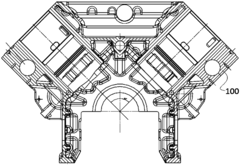
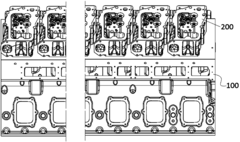
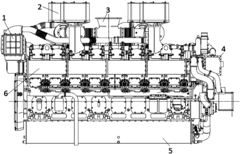
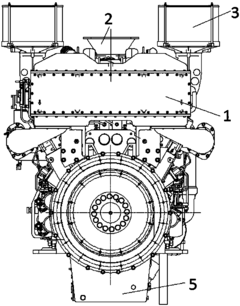
- A high-power V-shaped 16-cylinder diesel engine is designed, which uses a V-shaped cylinder block, 16 single cylinder heads, four turbochargers and an intercooler, combined with a cooling system of high and low temperature water circulation loops, to achieve turbocharging through Technology and classified cooling systems increase air density and lower temperatures to meet the needs of high power and torque.
Variable valve actuation system having a crank-based actuation transmission
PatentInactiveUS20080141960A1
Innovation
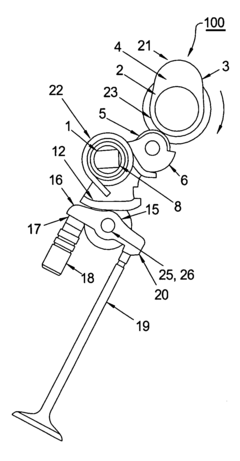
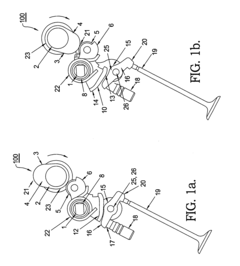
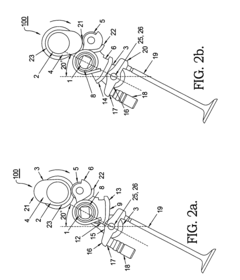
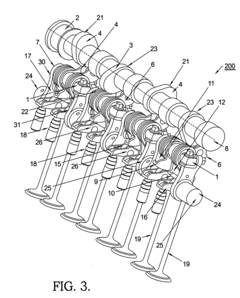
- A simplified mechanical VVA system using a single electrical rotary actuator and a secondary crank mechanism with an eccentric transmission to vary valve lift, duration, and phasing, eliminating the need for multiple frame structures and parasitic loads, and reducing the number of mechanical parts for easier assembly and reduced power consumption.
Environmental Impact of V16 Engines
The environmental impact of V16 engines has been a significant concern in recent years, and this trend is expected to continue over the next decade. As emissions regulations become increasingly stringent worldwide, manufacturers of V16 engines will face mounting pressure to reduce their environmental footprint. One of the primary areas of focus will be on improving fuel efficiency and reducing greenhouse gas emissions.
Advancements in materials science and engineering are likely to play a crucial role in enhancing the environmental performance of V16 engines. Lightweight materials, such as advanced alloys and composites, may be incorporated into engine designs to reduce overall weight and improve fuel economy. Additionally, innovations in thermal management and friction reduction could lead to more efficient combustion processes, further minimizing fuel consumption and emissions.
The integration of hybrid and electric technologies into V16 engine systems is another potential avenue for reducing environmental impact. Mild hybrid systems, which incorporate electric motors to assist the combustion engine, could become more prevalent in high-performance vehicles utilizing V16 engines. This approach would allow for improved fuel efficiency during low-load conditions while maintaining the power output that V16 engines are known for.
Advanced exhaust aftertreatment systems are expected to evolve significantly in the coming decade. Catalytic converters, particulate filters, and selective catalytic reduction (SCR) systems will likely become more sophisticated, capable of capturing and neutralizing a higher percentage of harmful emissions. These improvements will be crucial in meeting increasingly strict emissions standards, particularly in urban areas where air quality concerns are paramount.
The use of alternative fuels and advanced lubricants may also contribute to reducing the environmental impact of V16 engines. Synthetic fuels, biofuels, and hydrogen-enriched fuels could potentially offer lower carbon emissions while maintaining high performance. Similarly, next-generation lubricants may help reduce friction and wear within the engine, leading to improved efficiency and longevity.
As the automotive industry shifts towards electrification, the role of V16 engines may evolve. While they may become less common in mainstream vehicles, V16 engines could find a niche in specialized applications where their unique characteristics are valued. In such cases, the focus will be on maximizing efficiency and minimizing environmental impact through cutting-edge technologies and innovative design approaches.
Overall, the environmental impact of V16 engines in the next decade will be shaped by a combination of regulatory pressures, technological advancements, and changing market demands. Manufacturers will need to balance the desire for high performance with the imperative of environmental responsibility, leading to a new generation of V16 engines that are both powerful and more sustainable.
Advancements in materials science and engineering are likely to play a crucial role in enhancing the environmental performance of V16 engines. Lightweight materials, such as advanced alloys and composites, may be incorporated into engine designs to reduce overall weight and improve fuel economy. Additionally, innovations in thermal management and friction reduction could lead to more efficient combustion processes, further minimizing fuel consumption and emissions.
The integration of hybrid and electric technologies into V16 engine systems is another potential avenue for reducing environmental impact. Mild hybrid systems, which incorporate electric motors to assist the combustion engine, could become more prevalent in high-performance vehicles utilizing V16 engines. This approach would allow for improved fuel efficiency during low-load conditions while maintaining the power output that V16 engines are known for.
Advanced exhaust aftertreatment systems are expected to evolve significantly in the coming decade. Catalytic converters, particulate filters, and selective catalytic reduction (SCR) systems will likely become more sophisticated, capable of capturing and neutralizing a higher percentage of harmful emissions. These improvements will be crucial in meeting increasingly strict emissions standards, particularly in urban areas where air quality concerns are paramount.
The use of alternative fuels and advanced lubricants may also contribute to reducing the environmental impact of V16 engines. Synthetic fuels, biofuels, and hydrogen-enriched fuels could potentially offer lower carbon emissions while maintaining high performance. Similarly, next-generation lubricants may help reduce friction and wear within the engine, leading to improved efficiency and longevity.
As the automotive industry shifts towards electrification, the role of V16 engines may evolve. While they may become less common in mainstream vehicles, V16 engines could find a niche in specialized applications where their unique characteristics are valued. In such cases, the focus will be on maximizing efficiency and minimizing environmental impact through cutting-edge technologies and innovative design approaches.
Overall, the environmental impact of V16 engines in the next decade will be shaped by a combination of regulatory pressures, technological advancements, and changing market demands. Manufacturers will need to balance the desire for high performance with the imperative of environmental responsibility, leading to a new generation of V16 engines that are both powerful and more sustainable.
V16 Engine Efficiency Improvements
Over the next decade, V16 engine efficiency improvements are expected to focus on several key areas. Advanced materials and manufacturing techniques will play a crucial role in enhancing engine performance. Lightweight alloys and composite materials will be increasingly utilized to reduce overall engine weight while maintaining structural integrity. This weight reduction will contribute to improved fuel efficiency and power-to-weight ratios.
Thermal management will see significant advancements, with the implementation of more sophisticated cooling systems. These may include precision-controlled coolant flow, targeted cooling for specific engine components, and the integration of phase-change materials to absorb and dissipate heat more effectively. Such improvements will allow V16 engines to operate at higher temperatures, increasing thermal efficiency without compromising reliability.
Combustion optimization will remain a primary focus, with the development of more precise fuel injection systems and advanced ignition technologies. Multi-stage injection systems, capable of delivering multiple precisely timed fuel pulses per combustion cycle, will become more prevalent. This will result in more complete fuel combustion, reduced emissions, and improved power output.
Turbocharging and supercharging technologies will continue to evolve, with the potential introduction of electric-assisted forced induction systems. These hybrid boosting solutions will offer faster response times and improved low-end torque, addressing traditional turbo lag issues while enhancing overall engine efficiency.
Variable valve timing and lift systems will become more sophisticated, potentially incorporating camless technology. Electrohydraulic or electromagnetic valve actuation systems may replace traditional camshafts, allowing for infinitely variable valve control. This will enable engines to optimize performance across a wider range of operating conditions, improving both power output and fuel economy.
Integration of mild hybrid systems is likely to become more common in V16 engines. The addition of integrated starter-generators and small battery packs will allow for energy recuperation during deceleration and provide power assist during acceleration. This hybridization will contribute to improved fuel efficiency and reduced emissions, particularly in urban driving scenarios.
Lastly, advancements in engine control units (ECUs) and software will play a crucial role in optimizing V16 engine performance. Machine learning algorithms and real-time adaptive control strategies will enable engines to continuously optimize their operation based on driving conditions, environmental factors, and user preferences. This will result in improved efficiency, reduced emissions, and enhanced overall performance across various driving scenarios.
Thermal management will see significant advancements, with the implementation of more sophisticated cooling systems. These may include precision-controlled coolant flow, targeted cooling for specific engine components, and the integration of phase-change materials to absorb and dissipate heat more effectively. Such improvements will allow V16 engines to operate at higher temperatures, increasing thermal efficiency without compromising reliability.
Combustion optimization will remain a primary focus, with the development of more precise fuel injection systems and advanced ignition technologies. Multi-stage injection systems, capable of delivering multiple precisely timed fuel pulses per combustion cycle, will become more prevalent. This will result in more complete fuel combustion, reduced emissions, and improved power output.
Turbocharging and supercharging technologies will continue to evolve, with the potential introduction of electric-assisted forced induction systems. These hybrid boosting solutions will offer faster response times and improved low-end torque, addressing traditional turbo lag issues while enhancing overall engine efficiency.
Variable valve timing and lift systems will become more sophisticated, potentially incorporating camless technology. Electrohydraulic or electromagnetic valve actuation systems may replace traditional camshafts, allowing for infinitely variable valve control. This will enable engines to optimize performance across a wider range of operating conditions, improving both power output and fuel economy.
Integration of mild hybrid systems is likely to become more common in V16 engines. The addition of integrated starter-generators and small battery packs will allow for energy recuperation during deceleration and provide power assist during acceleration. This hybridization will contribute to improved fuel efficiency and reduced emissions, particularly in urban driving scenarios.
Lastly, advancements in engine control units (ECUs) and software will play a crucial role in optimizing V16 engine performance. Machine learning algorithms and real-time adaptive control strategies will enable engines to continuously optimize their operation based on driving conditions, environmental factors, and user preferences. This will result in improved efficiency, reduced emissions, and enhanced overall performance across various driving scenarios.
Unlock deeper insights with PatSnap Eureka Quick Research — get a full tech report to explore trends and direct your research. Try now!
Generate Your Research Report Instantly with AI Agent
Supercharge your innovation with PatSnap Eureka AI Agent Platform!