

Check GC-MS Column Selection: Mixture Separation Outcomes
SEP 22, 20259 MIN READ
Generate Your Research Report Instantly with AI Agent
PatSnap Eureka helps you evaluate technical feasibility & market potential.
GC-MS Column Technology Background and Objectives
Gas Chromatography-Mass Spectrometry (GC-MS) has evolved significantly since its inception in the mid-20th century, becoming an indispensable analytical technique in various fields including environmental analysis, food safety, forensic science, and pharmaceutical research. The column technology, as the heart of GC separation, has undergone continuous refinement to meet increasingly demanding analytical challenges. From packed columns to capillary columns, and from conventional stationary phases to specialized materials, the evolution reflects the persistent pursuit of higher separation efficiency, selectivity, and thermal stability.
The current technological landscape of GC-MS columns is characterized by a diverse array of stationary phases, column dimensions, and manufacturing techniques. Polysiloxane-based stationary phases with various functional groups dominate the market, offering different selectivity profiles for specific applications. The trend toward miniaturization has led to the development of narrow-bore columns that provide enhanced efficiency while reducing analysis time and solvent consumption.
Recent advancements in column technology have focused on improving thermal stability, reducing column bleed, and enhancing separation performance for complex mixtures. The introduction of ionic liquid stationary phases represents a significant innovation, offering unique selectivity for challenging separations. Additionally, the development of multidimensional GC systems has expanded the separation capabilities for highly complex samples.
The primary objective of this research is to establish a systematic framework for GC-MS column selection that optimizes separation outcomes for complex mixtures. This involves understanding the fundamental relationships between column properties (stationary phase chemistry, film thickness, column dimensions) and separation performance for different classes of compounds. By developing predictive models and decision-making tools, we aim to streamline the column selection process and reduce the empirical trial-and-error approach currently prevalent in method development.
Furthermore, this research seeks to explore emerging column technologies and evaluate their potential to address current analytical challenges. This includes investigating novel stationary phases, column configurations, and hybrid approaches that combine different separation mechanisms. The ultimate goal is to enhance the resolution, sensitivity, and throughput of GC-MS analyses, particularly for complex environmental samples, metabolomic studies, and trace contaminant detection.
The technological trajectory suggests a future convergence of advanced materials science, computational modeling, and separation science to develop "intelligent" column systems that can be tailored to specific analytical challenges. This research aims to contribute to this evolution by providing fundamental insights into column-analyte interactions and developing practical guidelines for optimizing separation outcomes.
The current technological landscape of GC-MS columns is characterized by a diverse array of stationary phases, column dimensions, and manufacturing techniques. Polysiloxane-based stationary phases with various functional groups dominate the market, offering different selectivity profiles for specific applications. The trend toward miniaturization has led to the development of narrow-bore columns that provide enhanced efficiency while reducing analysis time and solvent consumption.
Recent advancements in column technology have focused on improving thermal stability, reducing column bleed, and enhancing separation performance for complex mixtures. The introduction of ionic liquid stationary phases represents a significant innovation, offering unique selectivity for challenging separations. Additionally, the development of multidimensional GC systems has expanded the separation capabilities for highly complex samples.
The primary objective of this research is to establish a systematic framework for GC-MS column selection that optimizes separation outcomes for complex mixtures. This involves understanding the fundamental relationships between column properties (stationary phase chemistry, film thickness, column dimensions) and separation performance for different classes of compounds. By developing predictive models and decision-making tools, we aim to streamline the column selection process and reduce the empirical trial-and-error approach currently prevalent in method development.
Furthermore, this research seeks to explore emerging column technologies and evaluate their potential to address current analytical challenges. This includes investigating novel stationary phases, column configurations, and hybrid approaches that combine different separation mechanisms. The ultimate goal is to enhance the resolution, sensitivity, and throughput of GC-MS analyses, particularly for complex environmental samples, metabolomic studies, and trace contaminant detection.
The technological trajectory suggests a future convergence of advanced materials science, computational modeling, and separation science to develop "intelligent" column systems that can be tailored to specific analytical challenges. This research aims to contribute to this evolution by providing fundamental insights into column-analyte interactions and developing practical guidelines for optimizing separation outcomes.
Market Analysis of GC-MS Column Applications
The global GC-MS column market demonstrates robust growth, currently valued at approximately 320 million USD with projections to reach 450 million USD by 2027, representing a compound annual growth rate of 5.8%. This growth is primarily driven by expanding applications across pharmaceutical research, environmental monitoring, food safety testing, and forensic analysis sectors.
The pharmaceutical and biotechnology segment dominates market demand, accounting for nearly 40% of total consumption, as these industries increasingly rely on GC-MS technology for drug development, quality control, and metabolomics research. Environmental testing represents the second-largest market segment at 25%, with growing regulatory requirements for pollutant monitoring worldwide creating sustained demand for specialized columns.
Regional analysis reveals North America as the leading market with 38% share, followed by Europe (30%) and Asia-Pacific (22%). The Asia-Pacific region, particularly China and India, exhibits the fastest growth trajectory due to expanding industrial bases, increasing environmental concerns, and growing investment in analytical infrastructure.
Market segmentation by column type shows capillary columns commanding approximately 70% of market share, with packed columns and other specialized formats comprising the remainder. Within capillary columns, non-polar columns (particularly DB-5MS and HP-5MS equivalents) represent the largest segment due to their versatility across multiple applications.
Key market trends include increasing demand for columns with enhanced selectivity for complex mixture separation, growing preference for columns with higher temperature stability, and rising adoption of specialized columns for targeted applications such as chiral separations, pesticide analysis, and volatile organic compound detection.
The competitive landscape features both established analytical instrument manufacturers offering integrated solutions and specialized column manufacturers. Major players include Agilent Technologies, Thermo Fisher Scientific, Restek Corporation, Shimadzu Corporation, and PerkinElmer, collectively controlling approximately 65% of the global market.
Customer purchasing decisions increasingly prioritize column performance characteristics such as separation efficiency, selectivity, thermal stability, and inertness over initial acquisition costs, reflecting the critical importance of reliable analytical results in regulated industries.
Emerging opportunities include columns specifically designed for high-throughput analysis, miniaturized systems, and specialized applications in metabolomics, food authentication, and cannabis testing. The market also shows growing interest in columns optimized for challenging separations involving isomers, structurally similar compounds, and complex biological matrices.
The pharmaceutical and biotechnology segment dominates market demand, accounting for nearly 40% of total consumption, as these industries increasingly rely on GC-MS technology for drug development, quality control, and metabolomics research. Environmental testing represents the second-largest market segment at 25%, with growing regulatory requirements for pollutant monitoring worldwide creating sustained demand for specialized columns.
Regional analysis reveals North America as the leading market with 38% share, followed by Europe (30%) and Asia-Pacific (22%). The Asia-Pacific region, particularly China and India, exhibits the fastest growth trajectory due to expanding industrial bases, increasing environmental concerns, and growing investment in analytical infrastructure.
Market segmentation by column type shows capillary columns commanding approximately 70% of market share, with packed columns and other specialized formats comprising the remainder. Within capillary columns, non-polar columns (particularly DB-5MS and HP-5MS equivalents) represent the largest segment due to their versatility across multiple applications.
Key market trends include increasing demand for columns with enhanced selectivity for complex mixture separation, growing preference for columns with higher temperature stability, and rising adoption of specialized columns for targeted applications such as chiral separations, pesticide analysis, and volatile organic compound detection.
The competitive landscape features both established analytical instrument manufacturers offering integrated solutions and specialized column manufacturers. Major players include Agilent Technologies, Thermo Fisher Scientific, Restek Corporation, Shimadzu Corporation, and PerkinElmer, collectively controlling approximately 65% of the global market.
Customer purchasing decisions increasingly prioritize column performance characteristics such as separation efficiency, selectivity, thermal stability, and inertness over initial acquisition costs, reflecting the critical importance of reliable analytical results in regulated industries.
Emerging opportunities include columns specifically designed for high-throughput analysis, miniaturized systems, and specialized applications in metabolomics, food authentication, and cannabis testing. The market also shows growing interest in columns optimized for challenging separations involving isomers, structurally similar compounds, and complex biological matrices.
Current Challenges in GC-MS Column Technology
Despite significant advancements in GC-MS technology, several critical challenges persist in column technology that impact separation outcomes for complex mixtures. The primary challenge remains achieving optimal selectivity across diverse compound classes simultaneously. Current stationary phases often excel at separating certain chemical groups while performing poorly with others, creating a fundamental trade-off that limits comprehensive analysis of heterogeneous samples.
Column bleed presents another significant challenge, particularly at elevated temperatures necessary for high-boiling point compounds. This phenomenon introduces background noise and potential interference peaks that can mask analytes of interest or lead to false positives, especially problematic when analyzing trace components in complex matrices. Modern columns have improved thermal stability, but complete elimination of bleed remains elusive.
Inertness issues continue to plague GC-MS column technology, particularly when analyzing reactive, polar, or labile compounds. Active sites within columns can cause peak tailing, irreversible adsorption, or even decomposition of sensitive analytes. While deactivation technologies have advanced, achieving uniform inertness across the entire column length and throughout its lifetime remains challenging.
Column-to-column reproducibility represents a persistent obstacle for method transfer and validation. Manufacturing variations, even within the same product line, can lead to retention time shifts and separation pattern changes that complicate method standardization across laboratories. This variability necessitates recalibration and revalidation when columns are replaced, increasing analytical costs and complexity.
The limited temperature range of most columns constrains separation capabilities. Low-temperature limits affect the analysis of volatile compounds, while upper temperature restrictions prevent elution of high-molecular-weight components. Although high-temperature columns exist, they often sacrifice other performance characteristics like efficiency or lifetime.
Column aging and degradation over time present ongoing challenges. Exposure to oxygen, water, or reactive sample components gradually deteriorates column performance through stationary phase oxidation or bleeding. This degradation manifests as shifting retention times, reduced resolution, and increased background noise, complicating long-term method stability.
Emerging challenges include the need for columns compatible with fast and ultra-fast GC methods, which demand thinner films and narrower internal diameters while maintaining separation efficiency. Additionally, there is growing demand for columns capable of handling direct injection of complex matrices without rapid fouling, particularly important for high-throughput environmental and biological sample analysis.
Column bleed presents another significant challenge, particularly at elevated temperatures necessary for high-boiling point compounds. This phenomenon introduces background noise and potential interference peaks that can mask analytes of interest or lead to false positives, especially problematic when analyzing trace components in complex matrices. Modern columns have improved thermal stability, but complete elimination of bleed remains elusive.
Inertness issues continue to plague GC-MS column technology, particularly when analyzing reactive, polar, or labile compounds. Active sites within columns can cause peak tailing, irreversible adsorption, or even decomposition of sensitive analytes. While deactivation technologies have advanced, achieving uniform inertness across the entire column length and throughout its lifetime remains challenging.
Column-to-column reproducibility represents a persistent obstacle for method transfer and validation. Manufacturing variations, even within the same product line, can lead to retention time shifts and separation pattern changes that complicate method standardization across laboratories. This variability necessitates recalibration and revalidation when columns are replaced, increasing analytical costs and complexity.
The limited temperature range of most columns constrains separation capabilities. Low-temperature limits affect the analysis of volatile compounds, while upper temperature restrictions prevent elution of high-molecular-weight components. Although high-temperature columns exist, they often sacrifice other performance characteristics like efficiency or lifetime.
Column aging and degradation over time present ongoing challenges. Exposure to oxygen, water, or reactive sample components gradually deteriorates column performance through stationary phase oxidation or bleeding. This degradation manifests as shifting retention times, reduced resolution, and increased background noise, complicating long-term method stability.
Emerging challenges include the need for columns compatible with fast and ultra-fast GC methods, which demand thinner films and narrower internal diameters while maintaining separation efficiency. Additionally, there is growing demand for columns capable of handling direct injection of complex matrices without rapid fouling, particularly important for high-throughput environmental and biological sample analysis.
Current Column Selection Strategies for Complex Mixtures
01 Column selection and optimization for GC-MS analysis
The selection and optimization of columns in GC-MS significantly impacts separation outcomes. Different stationary phases, column dimensions (length, diameter, film thickness), and temperature programming can be tailored to specific analytical needs. Optimized columns enhance resolution, sensitivity, and selectivity for target compounds, reducing co-elution issues and improving peak shapes. Column selection should be based on the chemical properties of analytes and the complexity of the sample matrix.- Column selection and optimization for GC-MS analysis: The selection and optimization of GC-MS columns significantly impacts separation outcomes. Different stationary phases, column dimensions (length, diameter, film thickness), and temperature programming can be tailored to specific analytical needs. Optimized columns enhance resolution, sensitivity, and selectivity for target compounds, reducing co-elution issues and improving peak shapes for more accurate identification and quantification.
- Novel stationary phase materials for enhanced separation: Innovative stationary phase materials improve GC-MS separation outcomes by offering unique selectivity for specific compound classes. These materials include modified polysiloxanes, ionic liquids, metal-organic frameworks, and specialized polymeric phases that provide enhanced thermal stability, reduced column bleed, and improved separation of isomers and structurally similar compounds. Such advancements allow for more efficient analysis of complex mixtures.
- Multi-dimensional GC-MS separation techniques: Multi-dimensional GC-MS techniques employ multiple columns with different selectivity to resolve complex mixtures. These approaches include heart-cutting GC-GC, comprehensive two-dimensional gas chromatography (GC×GC), and column switching technologies. By utilizing orthogonal separation mechanisms, these techniques significantly improve peak capacity, resolution of co-eluting compounds, and detection of trace components in complex matrices.
- Column conditioning and maintenance for optimal performance: Proper column conditioning and maintenance protocols are essential for achieving consistent and reliable GC-MS separation outcomes. This includes initial conditioning procedures, regular baking out, trimming of the inlet end, and protection from contamination. Effective maintenance extends column lifetime, maintains separation efficiency, reduces baseline noise, and ensures reproducible retention times across multiple analyses.
- Application-specific column configurations: Specialized column configurations are designed for specific analytical applications in GC-MS. These include columns optimized for environmental pollutants, petroleum fractions, food contaminants, forensic samples, and biological matrices. Application-specific columns incorporate tailored selectivity, optimized dimensions, and specialized coatings to enhance separation of target analytes while minimizing interference from matrix components.
02 Novel stationary phase materials for enhanced separation
Innovative stationary phase materials have been developed to improve GC-MS separation outcomes. These include specialized polymers, ionic liquids, metal-organic frameworks, and functionalized silica materials that offer unique selectivity for specific compound classes. These novel materials can provide improved thermal stability, reduced column bleed, better inertness, and enhanced separation of isomers and structurally similar compounds that are difficult to resolve with conventional columns.Expand Specific Solutions03 Multi-dimensional GC-MS techniques for complex sample analysis
Multi-dimensional GC-MS techniques, such as GC×GC-MS, employ multiple columns with different selectivities to achieve superior separation of complex mixtures. These techniques utilize heart-cutting, thermal modulation, or flow modulation to transfer analytes between columns. The orthogonal separation mechanisms significantly increase peak capacity, allowing for the resolution of co-eluting compounds and providing more comprehensive chemical information from complex samples like environmental extracts, petroleum products, and biological matrices.Expand Specific Solutions04 Column technology for targeted compound analysis
Specialized column technologies have been developed for the targeted analysis of specific compound classes. These columns feature customized selectivity for particular applications such as pesticide residue analysis, environmental pollutants, pharmaceutical impurities, and metabolomics. The stationary phases are designed to provide optimal separation of target analytes from matrix interferences, improving detection limits and quantification accuracy while reducing analysis time through optimized selectivity.Expand Specific Solutions05 Data processing and interpretation methods for GC-MS separation
Advanced data processing and interpretation methods enhance the value of GC-MS separation outcomes. These include deconvolution algorithms for resolving overlapping peaks, retention indices for compound identification, chemometric approaches for pattern recognition, and machine learning techniques for automated data analysis. These computational methods complement the physical separation achieved by the column, allowing for the extraction of meaningful information from complex chromatograms and improving the reliability of compound identification and quantification.Expand Specific Solutions
Major Manufacturers and Suppliers in GC-MS Column Industry
The GC-MS column selection market for mixture separation is in a mature growth phase, with an estimated global value exceeding $1.5 billion. Leading players include Agilent Technologies and Shimadzu Corp., who dominate with comprehensive product portfolios and advanced technological capabilities. The technology has reached high maturity levels, with recent innovations focusing on specialized applications and enhanced separation efficiency. Companies like Thermo Finnigan, LECO Corp., and Waters (through Micromass UK) are driving innovation in column technology for complex mixture analysis. Academic institutions such as KAIST and Kyushu University collaborate with industry leaders to develop next-generation separation technologies, while smaller specialized firms like Spectra Analysis Instruments focus on niche applications, creating a competitive yet collaborative ecosystem.
Agilent Technologies, Inc.
Technical Solution: Agilent Technologies has developed comprehensive GC-MS column selection technologies centered around their J&W column series, which includes specialized columns like DB-5MS, HP-5MS, and VF-5MS for different separation requirements. Their approach incorporates advanced stationary phase chemistry with precise control of film thickness (typically 0.25-1.0 μm) and column dimensions (15-60m length, 0.18-0.32mm ID) to optimize separation outcomes. Agilent's Retention Time Locking (RTL) technology allows analysts to precisely match retention times across different instruments and laboratories, ensuring consistent separation profiles for complex mixtures. Their column selection methodology employs a systematic approach based on analyte polarity, volatility range, and matrix complexity, supported by their Column Selection Tool software that recommends optimal columns based on specific separation challenges. Agilent has also pioneered low-bleed MS-certified columns specifically designed to minimize background interference in mass spectrometry detection.
Strengths: Industry-leading column manufacturing precision with exceptional reproducibility between batches; comprehensive application-specific column portfolio covering virtually all separation needs; robust technical support and method development resources. Weaknesses: Premium pricing compared to generic alternatives; some proprietary technologies create potential vendor lock-in; requires significant expertise to fully leverage their advanced column selection tools.
Shimadzu Corp.
Technical Solution: Shimadzu has developed a multi-dimensional approach to GC-MS column selection through their Advanced LabSolutions software platform, which incorporates retention indices databases and predictive modeling to optimize column selection for specific separation challenges. Their technology focuses on specialized stationary phases like their Shim-pack series that offers unique selectivity for complex environmental and food safety applications. Shimadzu's column selection methodology emphasizes compatibility with their high-sensitivity mass spectrometry systems, particularly for trace analysis applications requiring ultra-low bleed characteristics. Their research has produced columns with optimized phase ratios (β values between 100-400) that maximize separation efficiency while maintaining reasonable analysis times. Shimadzu has also pioneered the development of specialized columns for emerging contaminants analysis, incorporating novel deactivation techniques that minimize active sites and reduce analyte adsorption, particularly important for polar compounds in complex matrices.
Strengths: Excellent integration between column technology and their MS detection systems; strong focus on application-specific column development for emerging contaminants; comprehensive method packages that include optimized column recommendations. Weaknesses: Somewhat smaller column portfolio compared to market leaders; regional variations in technical support quality; software tools for column selection less intuitive than some competitors.
Key Innovations in Stationary Phase Chemistry
Portable mems GC-MS system
PatentActiveUS11360059B2
Innovation
- The integration of a MEMS GC column with an integrated heater inside the MS vacuum system minimizes thermal losses by leveraging the vacuum's high thermal isolation properties, reducing heating power consumption and simplifying the interface with the mass spectrometer, while using non-active cooling methods like a periodically activated cold finger for efficient sample analysis.


Carrier gas ion scavenger to reduce peak tailing and reactions
PatentPendingUS20250123250A1
Innovation
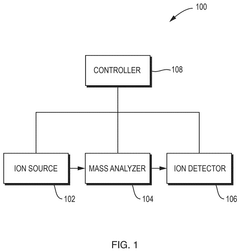
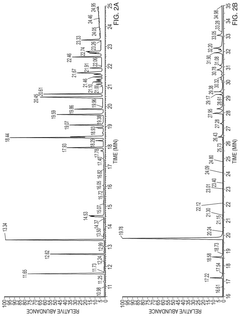
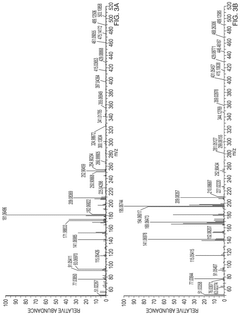
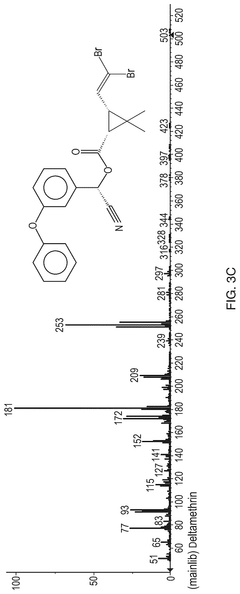
- A system and method for GC-MS using a carrier gas other than helium, which includes a scavenger gas with a lower ionization energy than the carrier gas, such as methane or a mixture of methane and ammonia, to reduce peak tailing and reactions by undergoing charge exchange with carrier gas ions in the ionization chamber.
Method Validation and Reproducibility Considerations
Method validation is a critical component in GC-MS analysis that ensures the reliability and reproducibility of separation outcomes when selecting columns for mixture analysis. Validation protocols must include assessments of linearity, precision, accuracy, limits of detection (LOD), limits of quantification (LOQ), and robustness parameters specific to the column characteristics being employed. For complex mixtures, these validation metrics become even more crucial as they directly impact the resolution of closely eluting compounds and the overall separation efficiency.
Reproducibility considerations must address both intra-laboratory and inter-laboratory variations. Column-to-column reproducibility represents a significant challenge in GC-MS analysis, with manufacturing variations potentially leading to altered selectivity and retention characteristics even within the same product line. Stationary phase consistency, particularly for specialized columns with unique selectivity properties, requires thorough evaluation through repeated injections of standard mixtures across multiple column lots.
Temperature programming reproducibility directly affects separation outcomes and must be validated across different instruments and laboratory conditions. The thermal stability of the selected column stationary phase determines the upper temperature limits and influences long-term column performance. Validation protocols should include accelerated aging tests to predict column longevity under routine operational conditions.
System suitability tests (SSTs) provide essential metrics for ongoing method validation when implementing specific column selections. These tests should incorporate resolution standards tailored to the target analyte classes and should be performed regularly to monitor column performance degradation over time. For complex mixture analysis, SSTs should specifically challenge the column's ability to resolve critical pairs of compounds that represent the separation challenges in the actual samples.
Method transfer considerations become particularly important when standardizing column selection across multiple laboratories or instruments. Robustness testing should deliberately vary critical parameters such as carrier gas flow rates, temperature ramps, and injection techniques to establish acceptable operational ranges for the selected column configuration. This approach helps identify potential failure points in the method that might compromise separation outcomes.
Documentation of column history, including injection counts, maximum temperatures reached, and exposure to potentially harmful matrices, supports long-term reproducibility assessment. Modern analytical laboratories increasingly implement column tracking systems that monitor performance metrics over time, allowing for data-driven decisions regarding column replacement schedules and method revalidation requirements.
Reproducibility considerations must address both intra-laboratory and inter-laboratory variations. Column-to-column reproducibility represents a significant challenge in GC-MS analysis, with manufacturing variations potentially leading to altered selectivity and retention characteristics even within the same product line. Stationary phase consistency, particularly for specialized columns with unique selectivity properties, requires thorough evaluation through repeated injections of standard mixtures across multiple column lots.
Temperature programming reproducibility directly affects separation outcomes and must be validated across different instruments and laboratory conditions. The thermal stability of the selected column stationary phase determines the upper temperature limits and influences long-term column performance. Validation protocols should include accelerated aging tests to predict column longevity under routine operational conditions.
System suitability tests (SSTs) provide essential metrics for ongoing method validation when implementing specific column selections. These tests should incorporate resolution standards tailored to the target analyte classes and should be performed regularly to monitor column performance degradation over time. For complex mixture analysis, SSTs should specifically challenge the column's ability to resolve critical pairs of compounds that represent the separation challenges in the actual samples.
Method transfer considerations become particularly important when standardizing column selection across multiple laboratories or instruments. Robustness testing should deliberately vary critical parameters such as carrier gas flow rates, temperature ramps, and injection techniques to establish acceptable operational ranges for the selected column configuration. This approach helps identify potential failure points in the method that might compromise separation outcomes.
Documentation of column history, including injection counts, maximum temperatures reached, and exposure to potentially harmful matrices, supports long-term reproducibility assessment. Modern analytical laboratories increasingly implement column tracking systems that monitor performance metrics over time, allowing for data-driven decisions regarding column replacement schedules and method revalidation requirements.
Environmental and Sustainability Aspects of Column Materials
The environmental impact of GC-MS column materials has become increasingly significant as analytical laboratories worldwide adopt more sustainable practices. Traditional column manufacturing processes often involve hazardous chemicals and generate substantial waste. Silica-based columns, while effective for separation, require energy-intensive production methods and utilize potentially harmful silane coupling agents during the stationary phase bonding process. The disposal of these columns presents additional environmental challenges due to their composite nature and potential contamination with analytes.
Recent advancements have focused on developing eco-friendly alternatives that maintain analytical performance while reducing environmental footprint. Green chemistry principles are being applied to column manufacturing, with manufacturers exploring biodegradable polymers and renewable materials as potential stationary phases. These sustainable columns often demonstrate comparable separation efficiency while requiring less toxic solvents during production and use.
The lifecycle assessment of GC-MS columns reveals significant opportunities for sustainability improvements. Modern columns designed with environmental considerations typically feature reduced solvent requirements during conditioning and operation, translating to decreased laboratory waste generation. Some innovative manufacturers have implemented take-back programs, allowing for proper recycling or repurposing of used columns rather than disposal in landfills.
Energy consumption during column operation represents another environmental consideration. Columns designed for optimal performance at lower temperatures can significantly reduce the energy demands of GC-MS systems. This efficiency not only decreases operational costs but also minimizes the carbon footprint associated with analytical procedures. Manufacturers are increasingly providing thermal efficiency data alongside traditional performance metrics to assist laboratories in making environmentally conscious selections.
Water usage in column manufacturing has also come under scrutiny, with newer production techniques implementing closed-loop systems that recycle process water. This approach substantially reduces both water consumption and the potential for contamination of water systems with manufacturing chemicals. Additionally, some manufacturers have transitioned to water-based rather than organic solvent-based processes for certain production steps.
Regulatory frameworks increasingly influence column selection decisions, with many jurisdictions implementing stricter guidelines regarding laboratory waste disposal and chemical usage. Forward-thinking laboratories are proactively selecting columns with improved environmental profiles to ensure compliance with current and anticipated regulations, while simultaneously advancing their sustainability initiatives and corporate social responsibility goals.
Recent advancements have focused on developing eco-friendly alternatives that maintain analytical performance while reducing environmental footprint. Green chemistry principles are being applied to column manufacturing, with manufacturers exploring biodegradable polymers and renewable materials as potential stationary phases. These sustainable columns often demonstrate comparable separation efficiency while requiring less toxic solvents during production and use.
The lifecycle assessment of GC-MS columns reveals significant opportunities for sustainability improvements. Modern columns designed with environmental considerations typically feature reduced solvent requirements during conditioning and operation, translating to decreased laboratory waste generation. Some innovative manufacturers have implemented take-back programs, allowing for proper recycling or repurposing of used columns rather than disposal in landfills.
Energy consumption during column operation represents another environmental consideration. Columns designed for optimal performance at lower temperatures can significantly reduce the energy demands of GC-MS systems. This efficiency not only decreases operational costs but also minimizes the carbon footprint associated with analytical procedures. Manufacturers are increasingly providing thermal efficiency data alongside traditional performance metrics to assist laboratories in making environmentally conscious selections.
Water usage in column manufacturing has also come under scrutiny, with newer production techniques implementing closed-loop systems that recycle process water. This approach substantially reduces both water consumption and the potential for contamination of water systems with manufacturing chemicals. Additionally, some manufacturers have transitioned to water-based rather than organic solvent-based processes for certain production steps.
Regulatory frameworks increasingly influence column selection decisions, with many jurisdictions implementing stricter guidelines regarding laboratory waste disposal and chemical usage. Forward-thinking laboratories are proactively selecting columns with improved environmental profiles to ensure compliance with current and anticipated regulations, while simultaneously advancing their sustainability initiatives and corporate social responsibility goals.
Unlock deeper insights with PatSnap Eureka Quick Research — get a full tech report to explore trends and direct your research. Try now!
Generate Your Research Report Instantly with AI Agent
Supercharge your innovation with PatSnap Eureka AI Agent Platform!