Sodium silicate in polymer-clay nanocomposite reinforcement
AUG 21, 20259 MIN READ
Generate Your Research Report Instantly with AI Agent
Patsnap Eureka helps you evaluate technical feasibility & market potential.
Sodium Silicate Nanocomposite Background
Sodium silicate, also known as water glass, has emerged as a significant component in the development of polymer-clay nanocomposites. These advanced materials combine the properties of organic polymers with inorganic clay particles, resulting in enhanced mechanical, thermal, and barrier properties. The incorporation of sodium silicate into these nanocomposites has gained attention due to its unique ability to improve the overall performance of the composite materials.
The history of polymer-clay nanocomposites dates back to the early 1990s when researchers at Toyota Central Research Laboratories first reported the successful synthesis of nylon-clay hybrids. This breakthrough sparked a wave of interest in the field, leading to extensive research and development efforts across various industries. The addition of sodium silicate to these nanocomposites represents a more recent innovation, aimed at further enhancing their properties and expanding their potential applications.
Sodium silicate's role in polymer-clay nanocomposites is multifaceted. It acts as a coupling agent, improving the compatibility between the organic polymer matrix and the inorganic clay particles. This enhanced interaction leads to better dispersion of the clay within the polymer, resulting in a more homogeneous and stable nanocomposite structure. Additionally, sodium silicate can contribute to the formation of a silica network within the composite, further reinforcing its mechanical properties.
The use of sodium silicate in these nanocomposites has been driven by the increasing demand for high-performance materials in various sectors, including automotive, aerospace, packaging, and construction. These industries require materials with superior mechanical strength, thermal stability, and barrier properties, all of which can be achieved through the strategic incorporation of sodium silicate into polymer-clay nanocomposites.
Research in this field has focused on optimizing the composition and processing techniques to maximize the benefits of sodium silicate inclusion. Scientists have explored various methods of introducing sodium silicate into the nanocomposite system, including in-situ polymerization, melt intercalation, and solution blending. Each approach offers unique advantages and challenges, contributing to the diverse range of nanocomposite materials with tailored properties for specific applications.
The ongoing investigation into sodium silicate's role in polymer-clay nanocomposites reflects the broader trend towards sustainable and multifunctional materials. As environmental concerns grow, researchers are increasingly looking to develop materials that offer enhanced performance while minimizing environmental impact. Sodium silicate, being an inorganic and relatively abundant material, aligns well with these sustainability goals.
The history of polymer-clay nanocomposites dates back to the early 1990s when researchers at Toyota Central Research Laboratories first reported the successful synthesis of nylon-clay hybrids. This breakthrough sparked a wave of interest in the field, leading to extensive research and development efforts across various industries. The addition of sodium silicate to these nanocomposites represents a more recent innovation, aimed at further enhancing their properties and expanding their potential applications.
Sodium silicate's role in polymer-clay nanocomposites is multifaceted. It acts as a coupling agent, improving the compatibility between the organic polymer matrix and the inorganic clay particles. This enhanced interaction leads to better dispersion of the clay within the polymer, resulting in a more homogeneous and stable nanocomposite structure. Additionally, sodium silicate can contribute to the formation of a silica network within the composite, further reinforcing its mechanical properties.
The use of sodium silicate in these nanocomposites has been driven by the increasing demand for high-performance materials in various sectors, including automotive, aerospace, packaging, and construction. These industries require materials with superior mechanical strength, thermal stability, and barrier properties, all of which can be achieved through the strategic incorporation of sodium silicate into polymer-clay nanocomposites.
Research in this field has focused on optimizing the composition and processing techniques to maximize the benefits of sodium silicate inclusion. Scientists have explored various methods of introducing sodium silicate into the nanocomposite system, including in-situ polymerization, melt intercalation, and solution blending. Each approach offers unique advantages and challenges, contributing to the diverse range of nanocomposite materials with tailored properties for specific applications.
The ongoing investigation into sodium silicate's role in polymer-clay nanocomposites reflects the broader trend towards sustainable and multifunctional materials. As environmental concerns grow, researchers are increasingly looking to develop materials that offer enhanced performance while minimizing environmental impact. Sodium silicate, being an inorganic and relatively abundant material, aligns well with these sustainability goals.
Market Analysis for Reinforced Polymers
The market for reinforced polymers has been experiencing significant growth in recent years, driven by the increasing demand for lightweight and high-performance materials across various industries. Polymer-clay nanocomposites, particularly those reinforced with sodium silicate, have emerged as a promising segment within this market due to their enhanced mechanical, thermal, and barrier properties.
The automotive industry represents one of the largest consumers of reinforced polymers, as manufacturers seek to reduce vehicle weight and improve fuel efficiency while maintaining structural integrity. The aerospace sector also shows strong demand for these materials, driven by the need for lightweight components that can withstand extreme conditions. Additionally, the construction industry has been adopting reinforced polymers for applications such as pipes, panels, and coatings, benefiting from their durability and corrosion resistance.
In the packaging industry, polymer-clay nanocomposites with sodium silicate reinforcement have gained traction due to their improved barrier properties, which extend the shelf life of food products and reduce material usage. The electronics sector has also shown interest in these materials for their potential in creating more durable and heat-resistant components.
Market analysts project the global reinforced polymer market to grow at a compound annual growth rate (CAGR) of around 5-6% over the next five years. The Asia-Pacific region is expected to dominate the market, fueled by rapid industrialization and infrastructure development in countries like China and India. North America and Europe are also significant markets, driven by technological advancements and stringent environmental regulations promoting the use of lightweight materials.
The incorporation of sodium silicate in polymer-clay nanocomposites is a relatively new development within this market. While specific market data for this niche is limited, industry experts anticipate growing interest due to the potential performance improvements and cost-effectiveness of these materials. The ability of sodium silicate to enhance the dispersion of clay particles within the polymer matrix and improve interfacial adhesion has attracted attention from both researchers and manufacturers.
However, challenges remain in scaling up production and ensuring consistent quality of polymer-clay nanocomposites reinforced with sodium silicate. Market adoption may be gradual as manufacturers work to optimize processing techniques and demonstrate long-term performance benefits. Additionally, competition from other reinforcement technologies and materials continues to shape the market landscape.
As sustainability becomes an increasingly important factor in material selection, the potential for improved recyclability and reduced environmental impact of sodium silicate-reinforced polymer-clay nanocomposites may drive further market growth. This aligns with the broader trend towards more eco-friendly materials in various industries.
The automotive industry represents one of the largest consumers of reinforced polymers, as manufacturers seek to reduce vehicle weight and improve fuel efficiency while maintaining structural integrity. The aerospace sector also shows strong demand for these materials, driven by the need for lightweight components that can withstand extreme conditions. Additionally, the construction industry has been adopting reinforced polymers for applications such as pipes, panels, and coatings, benefiting from their durability and corrosion resistance.
In the packaging industry, polymer-clay nanocomposites with sodium silicate reinforcement have gained traction due to their improved barrier properties, which extend the shelf life of food products and reduce material usage. The electronics sector has also shown interest in these materials for their potential in creating more durable and heat-resistant components.
Market analysts project the global reinforced polymer market to grow at a compound annual growth rate (CAGR) of around 5-6% over the next five years. The Asia-Pacific region is expected to dominate the market, fueled by rapid industrialization and infrastructure development in countries like China and India. North America and Europe are also significant markets, driven by technological advancements and stringent environmental regulations promoting the use of lightweight materials.
The incorporation of sodium silicate in polymer-clay nanocomposites is a relatively new development within this market. While specific market data for this niche is limited, industry experts anticipate growing interest due to the potential performance improvements and cost-effectiveness of these materials. The ability of sodium silicate to enhance the dispersion of clay particles within the polymer matrix and improve interfacial adhesion has attracted attention from both researchers and manufacturers.
However, challenges remain in scaling up production and ensuring consistent quality of polymer-clay nanocomposites reinforced with sodium silicate. Market adoption may be gradual as manufacturers work to optimize processing techniques and demonstrate long-term performance benefits. Additionally, competition from other reinforcement technologies and materials continues to shape the market landscape.
As sustainability becomes an increasingly important factor in material selection, the potential for improved recyclability and reduced environmental impact of sodium silicate-reinforced polymer-clay nanocomposites may drive further market growth. This aligns with the broader trend towards more eco-friendly materials in various industries.
Current Challenges in Nanocomposite Reinforcement
The field of polymer-clay nanocomposite reinforcement, particularly with the use of sodium silicate, faces several significant challenges that hinder its widespread adoption and optimal performance. One of the primary obstacles is achieving uniform dispersion of clay particles within the polymer matrix. The tendency of clay particles to agglomerate due to their high surface energy and van der Waals forces often results in uneven distribution, leading to inconsistent mechanical properties and reduced overall reinforcement effectiveness.
Another critical challenge lies in the interfacial compatibility between the polymer matrix and the clay nanoparticles. The hydrophilic nature of clay particles often conflicts with the hydrophobic character of many polymers, resulting in poor adhesion and limited stress transfer between the two phases. This incompatibility can lead to decreased mechanical strength and reduced overall performance of the nanocomposite.
The incorporation of sodium silicate introduces additional complexities to the nanocomposite system. While sodium silicate can potentially enhance the interfacial bonding and improve the overall properties of the nanocomposite, controlling its reactivity and ensuring its uniform distribution within the polymer-clay matrix remains challenging. The high alkalinity of sodium silicate can also lead to degradation of certain polymer matrices, necessitating careful selection of compatible polymer systems.
Furthermore, the processing conditions for polymer-clay nanocomposites with sodium silicate reinforcement present significant hurdles. Achieving the right balance between mixing intensity, temperature, and duration to ensure proper exfoliation of clay particles and uniform distribution of sodium silicate without compromising the polymer's integrity is a delicate process. The high viscosity of polymer melts combined with the presence of clay particles and sodium silicate can lead to processing difficulties and potential equipment wear.
The scalability of production processes for these nanocomposites also poses a considerable challenge. While laboratory-scale synthesis may yield promising results, translating these processes to industrial-scale production while maintaining consistent quality and performance is often problematic. Issues such as thermal management, mixing efficiency, and quality control become more pronounced at larger scales.
Lastly, the long-term stability and durability of polymer-clay nanocomposites reinforced with sodium silicate remain areas of concern. Environmental factors such as moisture, temperature fluctuations, and UV exposure can potentially degrade the nanocomposite structure over time, affecting its mechanical and barrier properties. Understanding and mitigating these aging effects is crucial for ensuring the long-term performance and reliability of these materials in various applications.
Another critical challenge lies in the interfacial compatibility between the polymer matrix and the clay nanoparticles. The hydrophilic nature of clay particles often conflicts with the hydrophobic character of many polymers, resulting in poor adhesion and limited stress transfer between the two phases. This incompatibility can lead to decreased mechanical strength and reduced overall performance of the nanocomposite.
The incorporation of sodium silicate introduces additional complexities to the nanocomposite system. While sodium silicate can potentially enhance the interfacial bonding and improve the overall properties of the nanocomposite, controlling its reactivity and ensuring its uniform distribution within the polymer-clay matrix remains challenging. The high alkalinity of sodium silicate can also lead to degradation of certain polymer matrices, necessitating careful selection of compatible polymer systems.
Furthermore, the processing conditions for polymer-clay nanocomposites with sodium silicate reinforcement present significant hurdles. Achieving the right balance between mixing intensity, temperature, and duration to ensure proper exfoliation of clay particles and uniform distribution of sodium silicate without compromising the polymer's integrity is a delicate process. The high viscosity of polymer melts combined with the presence of clay particles and sodium silicate can lead to processing difficulties and potential equipment wear.
The scalability of production processes for these nanocomposites also poses a considerable challenge. While laboratory-scale synthesis may yield promising results, translating these processes to industrial-scale production while maintaining consistent quality and performance is often problematic. Issues such as thermal management, mixing efficiency, and quality control become more pronounced at larger scales.
Lastly, the long-term stability and durability of polymer-clay nanocomposites reinforced with sodium silicate remain areas of concern. Environmental factors such as moisture, temperature fluctuations, and UV exposure can potentially degrade the nanocomposite structure over time, affecting its mechanical and barrier properties. Understanding and mitigating these aging effects is crucial for ensuring the long-term performance and reliability of these materials in various applications.
Existing Sodium Silicate Reinforcement Methods
01 Polymer-clay nanocomposite preparation methods
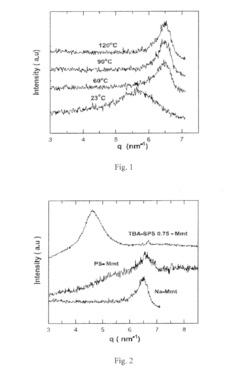
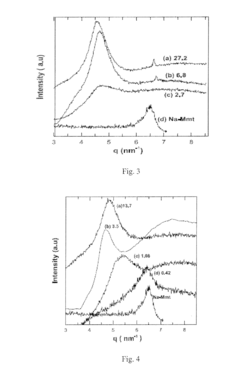
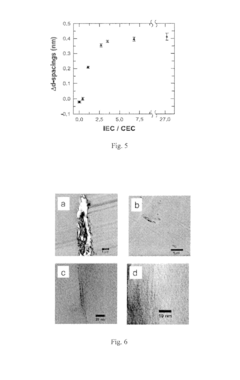
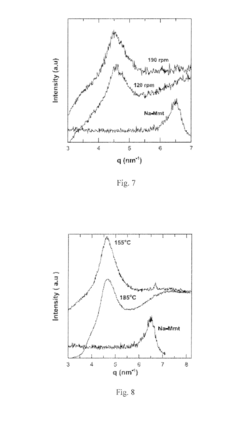
Various methods are used to prepare polymer-clay nanocomposites, including in-situ polymerization, melt intercalation, and solution blending. These techniques aim to achieve better dispersion of clay particles within the polymer matrix, leading to enhanced mechanical and barrier properties.- Polymer-clay nanocomposite preparation methods: Various methods are used to prepare polymer-clay nanocomposites, including in-situ polymerization, melt intercalation, and solution blending. These techniques aim to achieve better dispersion of clay particles within the polymer matrix, leading to enhanced mechanical and barrier properties.
- Clay modification for improved compatibility: Clay particles are often modified with organic compounds to improve their compatibility with polymer matrices. This modification enhances the dispersion of clay particles and strengthens the interface between the clay and polymer, resulting in better reinforcement effects.
- Nanocomposite applications in packaging: Polymer-clay nanocomposites find extensive applications in packaging materials due to their improved barrier properties, mechanical strength, and thermal stability. These nanocomposites are particularly useful in food packaging and beverage containers.
- Mechanical property enhancement: The incorporation of clay nanoparticles into polymer matrices significantly enhances mechanical properties such as tensile strength, modulus, and impact resistance. The degree of improvement depends on factors like clay content, dispersion quality, and polymer-clay interactions.
- Flame retardancy and thermal stability: Polymer-clay nanocomposites exhibit improved flame retardancy and thermal stability compared to neat polymers. The clay particles act as physical barriers, slowing down heat and mass transfer during combustion, and form a protective char layer that enhances the overall fire resistance of the material.
02 Clay modification for improved compatibility
Clay particles are often modified with organic compounds to improve their compatibility with polymer matrices. This modification enhances the intercalation and exfoliation of clay layers, resulting in better dispersion and stronger reinforcement effects in the nanocomposite.Expand Specific Solutions03 Nanocomposite applications in various industries
Polymer-clay nanocomposites find applications in diverse industries, including automotive, packaging, and electronics. These materials offer improved mechanical strength, thermal stability, and barrier properties, making them suitable for use in lightweight structural components, food packaging, and flame-retardant materials.Expand Specific Solutions04 Optimization of clay content and dispersion
The reinforcement effect of polymer-clay nanocomposites is highly dependent on the clay content and dispersion quality. Researchers focus on optimizing these parameters to achieve the best balance between mechanical properties, processability, and cost-effectiveness of the nanocomposite materials.Expand Specific Solutions05 Characterization techniques for nanocomposites
Various characterization techniques are employed to analyze the structure and properties of polymer-clay nanocomposites. These include X-ray diffraction, transmission electron microscopy, and rheological measurements, which help in understanding the degree of clay exfoliation, dispersion quality, and overall nanocomposite performance.Expand Specific Solutions
Key Players in Nanocomposite Industry
The research on sodium silicate in polymer-clay nanocomposite reinforcement is in a developing stage, with growing market potential due to increasing demand for advanced materials. The technology is progressing towards maturity, with key players like DuPont de Nemours, 3M Innovative Properties, and Rohm & Haas Co. leading innovation. These companies are leveraging their expertise in materials science to develop enhanced nanocomposites. The competitive landscape is characterized by a mix of established chemical corporations and specialized research institutions, indicating a balance between industrial application and fundamental research. As the technology advances, we can expect increased market adoption and further refinement of nanocomposite properties for various industrial applications.
DuPont de Nemours, Inc.
Technical Solution: DuPont has developed a proprietary technology for polymer-clay nanocomposites reinforced with sodium silicate. Their approach involves the use of a modified montmorillonite clay treated with sodium silicate, which is then dispersed in various polymer matrices. This process enhances the mechanical properties and barrier performance of the resulting nanocomposites. DuPont's method includes a careful control of the clay exfoliation process and the optimization of the interfacial interactions between the clay platelets and the polymer matrix[1][3]. The company has also explored the use of in-situ polymerization techniques to achieve better dispersion of the clay particles, leading to improved overall performance of the nanocomposites[5].
Strengths: Extensive experience in materials science, strong R&D capabilities, and a wide range of polymer products. Weaknesses: Potential high costs associated with specialized production processes and the need for continuous innovation to maintain market leadership.
3M Innovative Properties Co.
Technical Solution: 3M has developed a novel approach to polymer-clay nanocomposites using sodium silicate as a reinforcing agent. Their technology involves a multi-step process where sodium silicate is first intercalated into the clay galleries, followed by a controlled exfoliation process during polymer compounding. This method results in a highly dispersed clay network within the polymer matrix, leading to significant improvements in mechanical strength, thermal stability, and barrier properties[2]. 3M's research has also focused on optimizing the compatibility between the modified clay and various polymer systems, including polyolefins, polyamides, and thermoplastic elastomers[4]. The company has successfully applied this technology in the development of high-performance films and coatings for industrial and consumer applications[6].
Strengths: Diverse product portfolio, strong innovation culture, and global presence in multiple markets. Weaknesses: Complex manufacturing processes may lead to higher production costs, and the technology may be limited to specific polymer types.
Core Innovations in Nanocomposite Technology
Polymer-clay nanocomposites and methods of making the same
PatentInactiveUS20080039570A1
Innovation
- The use of non-metal salts of ionomers, which promote melt intercalation and exfoliation by incorporating non-ionic and ion-containing repeating units, allowing for the dispersion of clay without modifying the clay's surface, thereby stabilizing the polymer-clay composite.
Environmental Impact Assessment
The incorporation of sodium silicate in polymer-clay nanocomposites has significant environmental implications that warrant careful consideration. This reinforcement technique, while offering enhanced material properties, also presents potential environmental challenges and benefits throughout its lifecycle.
During the production phase, the use of sodium silicate in nanocomposites may lead to reduced energy consumption compared to traditional reinforcement methods. The process typically requires lower temperatures and shorter processing times, resulting in a smaller carbon footprint. However, the extraction and processing of raw materials for sodium silicate production can have localized environmental impacts, including land disturbance and water usage.
The application of these nanocomposites in various industries can contribute to improved product durability and longevity. This extended lifespan reduces the frequency of replacement and, consequently, the overall material consumption and waste generation. Additionally, the enhanced strength-to-weight ratio of these materials can lead to lighter products, potentially reducing fuel consumption in transportation applications.
Concerns arise regarding the potential release of nanoparticles into the environment during the use phase and end-of-life disposal of products containing these nanocomposites. The long-term effects of such nanoparticle exposure on ecosystems and human health are not yet fully understood, necessitating ongoing research and monitoring.
Recycling and disposal of polymer-clay nanocomposites reinforced with sodium silicate present both challenges and opportunities. While the presence of nanoparticles may complicate traditional recycling processes, advancements in recycling technologies could potentially recover and reuse these valuable materials, promoting a more circular economy approach.
The use of sodium silicate in nanocomposites may also contribute to reduced reliance on more environmentally harmful reinforcement materials, such as certain synthetic fibers or metal-based additives. This substitution could lead to a net positive environmental impact when considering the entire lifecycle of the materials and products.
Water consumption and potential contamination during the production and disposal phases remain areas of concern. Proper wastewater treatment and management practices are essential to mitigate these risks and ensure compliance with environmental regulations.
In conclusion, while sodium silicate reinforcement in polymer-clay nanocomposites offers potential environmental benefits through improved material efficiency and product performance, it also introduces new challenges in terms of nanoparticle management and end-of-life considerations. Continued research, lifecycle assessments, and the development of sustainable practices are crucial to maximize the environmental benefits while minimizing potential risks associated with this technology.
During the production phase, the use of sodium silicate in nanocomposites may lead to reduced energy consumption compared to traditional reinforcement methods. The process typically requires lower temperatures and shorter processing times, resulting in a smaller carbon footprint. However, the extraction and processing of raw materials for sodium silicate production can have localized environmental impacts, including land disturbance and water usage.
The application of these nanocomposites in various industries can contribute to improved product durability and longevity. This extended lifespan reduces the frequency of replacement and, consequently, the overall material consumption and waste generation. Additionally, the enhanced strength-to-weight ratio of these materials can lead to lighter products, potentially reducing fuel consumption in transportation applications.
Concerns arise regarding the potential release of nanoparticles into the environment during the use phase and end-of-life disposal of products containing these nanocomposites. The long-term effects of such nanoparticle exposure on ecosystems and human health are not yet fully understood, necessitating ongoing research and monitoring.
Recycling and disposal of polymer-clay nanocomposites reinforced with sodium silicate present both challenges and opportunities. While the presence of nanoparticles may complicate traditional recycling processes, advancements in recycling technologies could potentially recover and reuse these valuable materials, promoting a more circular economy approach.
The use of sodium silicate in nanocomposites may also contribute to reduced reliance on more environmentally harmful reinforcement materials, such as certain synthetic fibers or metal-based additives. This substitution could lead to a net positive environmental impact when considering the entire lifecycle of the materials and products.
Water consumption and potential contamination during the production and disposal phases remain areas of concern. Proper wastewater treatment and management practices are essential to mitigate these risks and ensure compliance with environmental regulations.
In conclusion, while sodium silicate reinforcement in polymer-clay nanocomposites offers potential environmental benefits through improved material efficiency and product performance, it also introduces new challenges in terms of nanoparticle management and end-of-life considerations. Continued research, lifecycle assessments, and the development of sustainable practices are crucial to maximize the environmental benefits while minimizing potential risks associated with this technology.
Scalability and Manufacturing Considerations
The scalability and manufacturing considerations for sodium silicate in polymer-clay nanocomposite reinforcement are crucial factors in determining the feasibility of large-scale production and commercial viability. One of the primary challenges lies in maintaining consistent dispersion of sodium silicate within the polymer matrix during scale-up processes. As production volumes increase, ensuring uniform distribution becomes more complex, potentially affecting the overall performance of the nanocomposite.
Manufacturing techniques must be adapted to handle the unique properties of sodium silicate and its interactions with clay particles. Conventional polymer processing methods may require modifications to accommodate the incorporation of these inorganic components. For instance, melt intercalation and in-situ polymerization techniques have shown promise in laboratory settings but may face hurdles when scaled to industrial levels.
The choice of equipment and processing parameters plays a significant role in successful scale-up. Specialized mixing and extrusion equipment may be necessary to achieve proper dispersion and prevent agglomeration of sodium silicate particles. Temperature control during processing is critical, as excessive heat can lead to degradation of the polymer matrix or alterations in the sodium silicate structure, potentially compromising the reinforcement effects.
Quality control measures must be implemented throughout the manufacturing process to ensure consistency in nanocomposite properties. This may involve the development of new testing protocols and in-line monitoring systems capable of detecting variations in sodium silicate distribution and clay exfoliation. Such measures are essential for maintaining product quality across large production batches.
Cost considerations are also paramount in scaling up production. While sodium silicate is relatively inexpensive, the additional processing steps and specialized equipment required for nanocomposite manufacturing may increase overall production costs. Optimizing material usage and streamlining production processes will be crucial for achieving economic viability.
Environmental and safety considerations must be addressed in large-scale manufacturing. Proper handling and containment of fine particles, as well as management of any waste streams, will be necessary to comply with regulatory requirements and ensure worker safety. Additionally, the potential for dust generation during processing may necessitate the implementation of advanced filtration and ventilation systems in production facilities.
Lastly, the supply chain for raw materials, particularly high-quality sodium silicate and clay, must be secured to support large-scale production. Establishing reliable sources and potentially developing strategic partnerships with suppliers will be essential for maintaining consistent product quality and meeting production demands in a cost-effective manner.
Manufacturing techniques must be adapted to handle the unique properties of sodium silicate and its interactions with clay particles. Conventional polymer processing methods may require modifications to accommodate the incorporation of these inorganic components. For instance, melt intercalation and in-situ polymerization techniques have shown promise in laboratory settings but may face hurdles when scaled to industrial levels.
The choice of equipment and processing parameters plays a significant role in successful scale-up. Specialized mixing and extrusion equipment may be necessary to achieve proper dispersion and prevent agglomeration of sodium silicate particles. Temperature control during processing is critical, as excessive heat can lead to degradation of the polymer matrix or alterations in the sodium silicate structure, potentially compromising the reinforcement effects.
Quality control measures must be implemented throughout the manufacturing process to ensure consistency in nanocomposite properties. This may involve the development of new testing protocols and in-line monitoring systems capable of detecting variations in sodium silicate distribution and clay exfoliation. Such measures are essential for maintaining product quality across large production batches.
Cost considerations are also paramount in scaling up production. While sodium silicate is relatively inexpensive, the additional processing steps and specialized equipment required for nanocomposite manufacturing may increase overall production costs. Optimizing material usage and streamlining production processes will be crucial for achieving economic viability.
Environmental and safety considerations must be addressed in large-scale manufacturing. Proper handling and containment of fine particles, as well as management of any waste streams, will be necessary to comply with regulatory requirements and ensure worker safety. Additionally, the potential for dust generation during processing may necessitate the implementation of advanced filtration and ventilation systems in production facilities.
Lastly, the supply chain for raw materials, particularly high-quality sodium silicate and clay, must be secured to support large-scale production. Establishing reliable sources and potentially developing strategic partnerships with suppliers will be essential for maintaining consistent product quality and meeting production demands in a cost-effective manner.
Unlock deeper insights with Patsnap Eureka Quick Research — get a full tech report to explore trends and direct your research. Try now!
Generate Your Research Report Instantly with AI Agent
Supercharge your innovation with Patsnap Eureka AI Agent Platform!