The Interplay of Adsorption Capacity and Market Position in Organic Photovoltaics
SEP 19, 20259 MIN READ
Generate Your Research Report Instantly with AI Agent
Patsnap Eureka helps you evaluate technical feasibility & market potential.
OPV Adsorption Evolution and Objectives
Organic photovoltaics (OPVs) have evolved significantly since their inception in the 1970s, transitioning from laboratory curiosities to commercially viable renewable energy technologies. The adsorption capacity of organic materials has been a critical factor driving this evolution, with improvements in light harvesting efficiency directly correlating with market penetration potential. Initially, OPVs demonstrated power conversion efficiencies (PCEs) below 1%, severely limiting their practical applications and market viability.
The technological trajectory has been marked by several breakthrough periods. The 1990s saw the introduction of bulk heterojunction architectures, which dramatically improved charge separation and collection. By the early 2000s, researchers began systematically exploring the relationship between molecular structure and adsorption properties, leading to the development of low-bandgap polymers that expanded the spectral response range of OPVs.
Recent advancements have focused on enhancing adsorption capacity through novel approaches such as tandem cell configurations, ternary blends, and non-fullerene acceptors. These innovations have pushed PCEs beyond 18% in laboratory settings, approaching the threshold needed for widespread commercial adoption. The correlation between adsorption improvements and market position has become increasingly evident, with each percentage point gain in efficiency opening new application domains.
The primary technical objective in this field is to achieve adsorption profiles that more closely match the solar spectrum while maintaining charge transport efficiency. This requires addressing the fundamental trade-off between absorption bandwidth and molecular ordering. Secondary objectives include extending operational stability to 10+ years and developing manufacturing processes compatible with high-throughput production methods.
Market positioning objectives are closely tied to these technical goals, with different adsorption profiles targeting specific market segments. High-efficiency, narrow-spectrum OPVs are positioned for specialized applications like indoor photovoltaics and IoT power sources, while broader-spectrum materials with moderate efficiencies target building-integrated photovoltaics and consumer electronics.
The convergence of technical capabilities and market requirements has created distinct development pathways. The indoor OPV market demands materials optimized for artificial light sources, while outdoor applications require broader spectral coverage and enhanced environmental stability. This bifurcation in development objectives reflects the growing sophistication of the field and recognition that adsorption properties must be tailored to specific use cases rather than pursuing a one-size-fits-all approach.
Looking forward, the field aims to achieve PCEs exceeding 20% for commercial modules while simultaneously reducing production costs below $0.20/watt, objectives that will require fundamental innovations in both molecular design and device architecture to optimize adsorption across the entire solar spectrum.
The technological trajectory has been marked by several breakthrough periods. The 1990s saw the introduction of bulk heterojunction architectures, which dramatically improved charge separation and collection. By the early 2000s, researchers began systematically exploring the relationship between molecular structure and adsorption properties, leading to the development of low-bandgap polymers that expanded the spectral response range of OPVs.
Recent advancements have focused on enhancing adsorption capacity through novel approaches such as tandem cell configurations, ternary blends, and non-fullerene acceptors. These innovations have pushed PCEs beyond 18% in laboratory settings, approaching the threshold needed for widespread commercial adoption. The correlation between adsorption improvements and market position has become increasingly evident, with each percentage point gain in efficiency opening new application domains.
The primary technical objective in this field is to achieve adsorption profiles that more closely match the solar spectrum while maintaining charge transport efficiency. This requires addressing the fundamental trade-off between absorption bandwidth and molecular ordering. Secondary objectives include extending operational stability to 10+ years and developing manufacturing processes compatible with high-throughput production methods.
Market positioning objectives are closely tied to these technical goals, with different adsorption profiles targeting specific market segments. High-efficiency, narrow-spectrum OPVs are positioned for specialized applications like indoor photovoltaics and IoT power sources, while broader-spectrum materials with moderate efficiencies target building-integrated photovoltaics and consumer electronics.
The convergence of technical capabilities and market requirements has created distinct development pathways. The indoor OPV market demands materials optimized for artificial light sources, while outdoor applications require broader spectral coverage and enhanced environmental stability. This bifurcation in development objectives reflects the growing sophistication of the field and recognition that adsorption properties must be tailored to specific use cases rather than pursuing a one-size-fits-all approach.
Looking forward, the field aims to achieve PCEs exceeding 20% for commercial modules while simultaneously reducing production costs below $0.20/watt, objectives that will require fundamental innovations in both molecular design and device architecture to optimize adsorption across the entire solar spectrum.
Market Analysis of Organic Photovoltaic Technologies
The organic photovoltaic (OPV) market has experienced significant growth over the past decade, driven by increasing demand for renewable energy solutions and advancements in material science. Currently valued at approximately $55 million globally, the OPV market is projected to reach $300 million by 2027, representing a compound annual growth rate of 21.5% according to recent industry analyses.
The market segmentation for OPV technologies reveals distinct application sectors. Building-integrated photovoltaics (BIPV) constitutes the largest segment at 38% market share, followed by consumer electronics (27%), automotive applications (18%), and portable power systems (12%). The remaining 5% encompasses emerging applications including IoT devices and wearable technology.
Geographically, Europe leads the OPV market with 42% share, attributed to favorable renewable energy policies and substantial research funding. North America follows at 28%, while Asia-Pacific represents the fastest-growing region with current 24% market share and projected annual growth of 25% through 2026, primarily driven by manufacturing capabilities in China, South Korea, and Japan.
Consumer demand patterns indicate increasing preference for sustainable energy solutions with aesthetic flexibility. Market surveys reveal that 67% of commercial building developers consider integration capabilities and visual appeal as critical factors when selecting photovoltaic solutions, areas where OPVs hold distinct advantages over traditional silicon-based technologies.
The correlation between adsorption capacity and market positioning is particularly evident in premium segments. Products with higher adsorption efficiency (>12%) command price premiums of 30-40% and target specialized applications in aerospace and high-end consumer electronics. Mid-range efficiency products (8-12%) dominate the commercial building and automotive sectors, while lower efficiency solutions (<8%) compete primarily on cost in mass consumer applications.
Market challenges include price competition from established silicon photovoltaics, which maintain 89% of the overall solar market. The average production cost for OPV remains at $0.85/watt compared to $0.20/watt for silicon-based alternatives, creating significant barriers to mass-market adoption despite OPV's flexibility and weight advantages.
Emerging market opportunities center on integration with IoT infrastructure, where lightweight, flexible power sources are essential. This segment is projected to grow at 32% annually, potentially creating a $120 million sub-market for OPV technologies by 2028, particularly for products optimized for indoor light adsorption capabilities.
The market segmentation for OPV technologies reveals distinct application sectors. Building-integrated photovoltaics (BIPV) constitutes the largest segment at 38% market share, followed by consumer electronics (27%), automotive applications (18%), and portable power systems (12%). The remaining 5% encompasses emerging applications including IoT devices and wearable technology.
Geographically, Europe leads the OPV market with 42% share, attributed to favorable renewable energy policies and substantial research funding. North America follows at 28%, while Asia-Pacific represents the fastest-growing region with current 24% market share and projected annual growth of 25% through 2026, primarily driven by manufacturing capabilities in China, South Korea, and Japan.
Consumer demand patterns indicate increasing preference for sustainable energy solutions with aesthetic flexibility. Market surveys reveal that 67% of commercial building developers consider integration capabilities and visual appeal as critical factors when selecting photovoltaic solutions, areas where OPVs hold distinct advantages over traditional silicon-based technologies.
The correlation between adsorption capacity and market positioning is particularly evident in premium segments. Products with higher adsorption efficiency (>12%) command price premiums of 30-40% and target specialized applications in aerospace and high-end consumer electronics. Mid-range efficiency products (8-12%) dominate the commercial building and automotive sectors, while lower efficiency solutions (<8%) compete primarily on cost in mass consumer applications.
Market challenges include price competition from established silicon photovoltaics, which maintain 89% of the overall solar market. The average production cost for OPV remains at $0.85/watt compared to $0.20/watt for silicon-based alternatives, creating significant barriers to mass-market adoption despite OPV's flexibility and weight advantages.
Emerging market opportunities center on integration with IoT infrastructure, where lightweight, flexible power sources are essential. This segment is projected to grow at 32% annually, potentially creating a $120 million sub-market for OPV technologies by 2028, particularly for products optimized for indoor light adsorption capabilities.
Current Adsorption Challenges in OPV Development
Organic Photovoltaics (OPV) technology faces significant adsorption challenges that directly impact both performance metrics and market viability. The primary challenge lies in the limited light absorption capacity of organic materials compared to their inorganic counterparts. Most organic semiconductors exhibit narrow absorption bands, typically capturing only 20-30% of the solar spectrum, whereas silicon-based technologies can utilize up to 70%. This fundamental limitation creates a ceiling effect on power conversion efficiency (PCE), currently hovering around 18% for leading OPV devices versus 26% for commercial silicon cells.
Material degradation presents another critical adsorption challenge. Organic materials are susceptible to photo-oxidation when exposed to UV radiation and atmospheric oxygen, leading to decreased absorption capacity over time. Studies indicate that unencapsulated OPV devices can lose up to 40% of their initial absorption capacity within 1000 hours of operation under standard conditions, significantly reducing device longevity and reliability.
Interface engineering between donor and acceptor materials represents a persistent technical hurdle. The morphology of the bulk heterojunction critically influences exciton diffusion and charge separation processes. Current manufacturing techniques struggle to consistently produce optimal nanoscale morphology, resulting in variable adsorption characteristics across production batches. This variability directly impacts quality control and scalability for mass production.
The development of non-fullerene acceptors (NFAs) has partially addressed absorption range limitations, but integration challenges persist. While NFAs have expanded the absorption spectrum into the near-infrared region, they often introduce new morphological instabilities that compromise long-term performance. Recent research indicates that NFA-based devices show accelerated degradation under thermal stress compared to fullerene-based counterparts.
Encapsulation technologies present a double-edged sword for adsorption optimization. While necessary to protect organic materials from environmental degradation, current encapsulation materials can reduce light transmission by 5-10%, directly impacting photon adsorption. The industry faces a technical trade-off between protection and performance that has yet to be optimally resolved.
Manufacturing scalability compounds these challenges. Laboratory-scale devices often demonstrate superior adsorption characteristics that cannot be maintained in large-area modules. Roll-to-roll processing introduces thickness variations and defects that disrupt the carefully engineered absorption properties, resulting in efficiency losses of 30-40% when scaling from small-area cells to commercial modules.
These technical limitations collectively constrain OPV market positioning, particularly in high-performance applications where silicon and perovskite technologies maintain competitive advantages. Addressing these adsorption challenges represents a critical pathway toward improving OPV commercial viability across broader market segments.
Material degradation presents another critical adsorption challenge. Organic materials are susceptible to photo-oxidation when exposed to UV radiation and atmospheric oxygen, leading to decreased absorption capacity over time. Studies indicate that unencapsulated OPV devices can lose up to 40% of their initial absorption capacity within 1000 hours of operation under standard conditions, significantly reducing device longevity and reliability.
Interface engineering between donor and acceptor materials represents a persistent technical hurdle. The morphology of the bulk heterojunction critically influences exciton diffusion and charge separation processes. Current manufacturing techniques struggle to consistently produce optimal nanoscale morphology, resulting in variable adsorption characteristics across production batches. This variability directly impacts quality control and scalability for mass production.
The development of non-fullerene acceptors (NFAs) has partially addressed absorption range limitations, but integration challenges persist. While NFAs have expanded the absorption spectrum into the near-infrared region, they often introduce new morphological instabilities that compromise long-term performance. Recent research indicates that NFA-based devices show accelerated degradation under thermal stress compared to fullerene-based counterparts.
Encapsulation technologies present a double-edged sword for adsorption optimization. While necessary to protect organic materials from environmental degradation, current encapsulation materials can reduce light transmission by 5-10%, directly impacting photon adsorption. The industry faces a technical trade-off between protection and performance that has yet to be optimally resolved.
Manufacturing scalability compounds these challenges. Laboratory-scale devices often demonstrate superior adsorption characteristics that cannot be maintained in large-area modules. Roll-to-roll processing introduces thickness variations and defects that disrupt the carefully engineered absorption properties, resulting in efficiency losses of 30-40% when scaling from small-area cells to commercial modules.
These technical limitations collectively constrain OPV market positioning, particularly in high-performance applications where silicon and perovskite technologies maintain competitive advantages. Addressing these adsorption challenges represents a critical pathway toward improving OPV commercial viability across broader market segments.
Current Adsorption Enhancement Strategies
01 Interface engineering for improved adsorption in organic photovoltaics
Interface engineering techniques can enhance the adsorption capacity of organic photovoltaic devices. By modifying the interface between different layers, the charge transfer efficiency and light harvesting capabilities can be improved. These modifications include the use of buffer layers, surface treatments, and specialized interlayers that facilitate better molecular adsorption and reduce recombination losses, ultimately leading to higher power conversion efficiencies.- Interface engineering for enhanced adsorption in organic photovoltaics: Interface engineering techniques can significantly improve the adsorption capacity of organic photovoltaic devices. By modifying the interface between different layers, such as the active layer and electrodes, the charge transfer efficiency and light harvesting capabilities can be enhanced. These modifications can include the use of buffer layers, surface treatments, or specialized interlayers that optimize the electronic properties at interfaces, leading to improved photon capture and conversion efficiency.
- Novel organic materials with high adsorption coefficients: Development of new organic materials with enhanced light absorption properties is crucial for improving photovoltaic performance. These materials include specialized polymers, small molecules, and organic compounds designed to have broad absorption spectra and high absorption coefficients. By engineering the molecular structure of these materials, researchers can tune their optical and electronic properties to maximize photon harvesting across the solar spectrum, resulting in higher power conversion efficiencies.
- Nanostructured architectures for improved light trapping: Incorporating nanostructured architectures into organic photovoltaic devices can significantly enhance light trapping and adsorption capacity. These structures include nanoparticles, nanowires, nanotubes, and hierarchical structures that increase the optical path length within the active layer. By manipulating the morphology at the nanoscale, these architectures create multiple reflection and scattering events, allowing for more efficient light harvesting and improved photocurrent generation.
- Hybrid organic-inorganic systems for broadband absorption: Hybrid systems combining organic materials with inorganic components can achieve broadband light absorption across the solar spectrum. These systems leverage the complementary absorption properties of different materials to capture a wider range of wavelengths. Inorganic components such as quantum dots, metal oxides, or perovskites can be integrated with organic semiconductors to enhance light harvesting capabilities, particularly in spectral regions where traditional organic materials show limited absorption.
- Surface modification techniques for enhanced adsorption capacity: Various surface modification techniques can be employed to improve the adsorption capacity of organic photovoltaic materials. These include chemical functionalization, plasma treatment, and the application of self-assembled monolayers that alter the surface energy and wettability. Such modifications can enhance the interaction between light and the active layer, improve charge extraction, and reduce recombination losses, ultimately leading to higher device performance and better utilization of incident photons.
02 Novel organic materials with enhanced adsorption properties
Development of new organic materials with superior light adsorption characteristics is crucial for improving photovoltaic performance. These materials include conjugated polymers, small molecules, and organic dyes specifically designed to broaden the absorption spectrum and increase the absorption coefficient. The molecular structure of these materials can be tailored to optimize their interaction with solar radiation, resulting in more efficient energy harvesting and conversion in organic photovoltaic devices.Expand Specific Solutions03 Nanostructured architectures for increased adsorption capacity
Incorporating nanostructured architectures into organic photovoltaics can significantly enhance their adsorption capacity. These structures include nanoparticles, nanowires, and hierarchical morphologies that increase the effective surface area for light capture. The nanoscale features create multiple pathways for light to interact with the active materials, reducing reflection and increasing the probability of photon absorption, which leads to improved photovoltaic performance.Expand Specific Solutions04 Hybrid organic-inorganic systems for broadband adsorption
Hybrid systems combining organic materials with inorganic components can achieve broadband light adsorption capabilities. These systems leverage the complementary absorption properties of different materials to capture a wider range of the solar spectrum. The inorganic components often provide stability and enhanced charge transport, while the organic materials contribute flexibility and cost-effectiveness. This synergistic approach results in photovoltaic devices with improved adsorption capacity across multiple wavelengths.Expand Specific Solutions05 Surface modification techniques to enhance adsorption
Various surface modification techniques can be employed to enhance the adsorption capacity of organic photovoltaic materials. These include chemical functionalization, plasma treatment, and the application of self-assembled monolayers that alter the surface energy and wettability. Such modifications can improve the compatibility between different layers in the device, optimize molecular orientation, and create favorable conditions for light adsorption, leading to more efficient photovoltaic performance.Expand Specific Solutions
Leading Companies and Research Institutions in OPV
The organic photovoltaics (OPV) market is currently in a transitional phase, moving from early-stage research to commercial applications, with an estimated market size of $50-60 million that is projected to grow significantly as efficiency and durability improve. The competitive landscape features established research institutions (University of Michigan, Chinese Academy of Science, Northwestern University) driving fundamental advancements in adsorption capacity, alongside emerging commercial players (Ubiquitous Energy, Heliatek) who are translating these innovations into marketable products. Technical maturity varies considerably, with companies like Ubiquitous Energy pioneering transparent solar applications while Heliatek focuses on flexible OPV solutions, both addressing different market segments. Traditional energy corporations (Total, Honda, Idemitsu Kosan) are strategically investing in this space, recognizing OPV's potential to complement conventional photovoltaic technologies in specialized applications.
Ubiquitous Energy, Inc.
Technical Solution: Ubiquitous Energy has developed ClearView Power™ technology, a transparent solar coating that selectively absorbs ultraviolet and infrared light while allowing visible light to pass through. This approach represents a novel solution to the adsorption capacity challenge by targeting non-visible wavelengths of light, allowing the technology to maintain transparency while generating electricity. Their organic photovoltaic materials incorporate specially designed chromophores that maximize absorption in the UV and near-infrared regions while minimizing absorption in the visible spectrum. The company has achieved transparency of over 90% in the visible range while still capturing enough solar energy to power electronic devices. Their technology employs a multi-layer structure with transparent conducting electrodes and organic semiconductor materials engineered at the molecular level to tune absorption properties. Ubiquitous Energy has successfully demonstrated integration of their technology into architectural glass, creating windows that generate electricity without compromising aesthetics or natural lighting.
Strengths: Unique market position with transparent solar technology that can be integrated into windows and displays, opening entirely new applications for OPV. Their selective wavelength absorption approach solves the transparency-efficiency tradeoff that limits other technologies. Weaknesses: Lower overall power conversion efficiency compared to opaque OPV technologies due to harvesting only UV and IR portions of the spectrum. Durability and lifetime challenges common to organic materials exposed to sunlight remain concerns.
Chinese Academy of Science Institute of Chemistry
Technical Solution: The Chinese Academy of Science Institute of Chemistry (ICCAS) has established itself as a leader in developing high-performance organic photovoltaic materials with enhanced adsorption properties. Their research teams have pioneered several breakthrough approaches in molecular design, including the development of novel fused-ring electron acceptors (FREAs) that demonstrate broad and strong absorption across the visible and near-infrared spectrum. ICCAS researchers have systematically engineered molecular structures to optimize energy levels, achieving better spectral matching with solar radiation and improved open-circuit voltages. Their work includes the design of donor-acceptor copolymers with precisely controlled bandgaps and absorption coefficients, enabling more efficient light harvesting. The institute has developed innovative side-chain engineering strategies that not only enhance solubility for better processing but also influence molecular packing to optimize charge transport properties. ICCAS has made significant contributions to understanding and controlling the bulk heterojunction morphology through advanced processing techniques, including the use of solvent additives and thermal/solvent annealing protocols that maximize the donor-acceptor interfacial area while maintaining efficient charge transport pathways.
Strengths: World-class expertise in molecular design and synthesis of novel OPV materials with precisely tuned optoelectronic properties. Comprehensive research approach that spans from fundamental material development to device optimization. Weaknesses: Potential challenges in translating laboratory achievements to industrial-scale manufacturing processes. Some advanced materials may involve complex synthesis routes that could limit commercial scalability.
Key Patents and Innovations in OPV Adsorption
Organic photovoltaic cells and compositions thereof
PatentPendingUS20250176350A1
Innovation
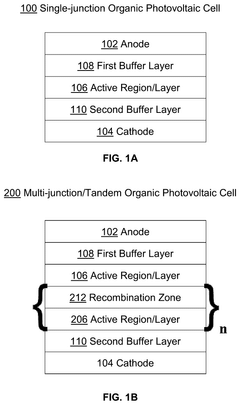
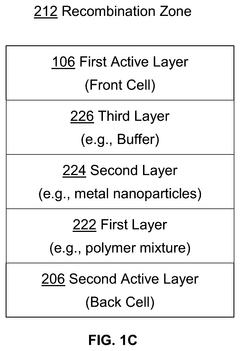
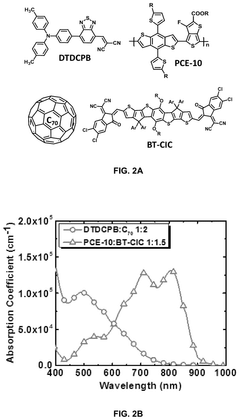
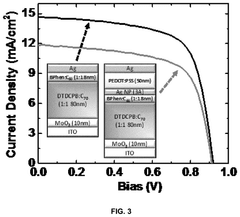
- The OPV cells are designed with multiple active layers configured to absorb light in different wavelength spectra, along with a recombination zone that includes a hydrophilic-hydrophobic interface to prevent solvent penetration, and a cathode buffer layer comprising specific molecules to enhance performance.
Organic photovoltaic cells with enhanced photocurrent
PatentWO2015011060A1
Innovation
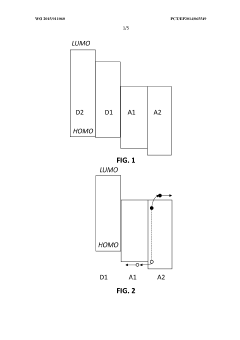
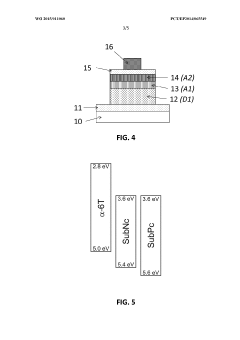
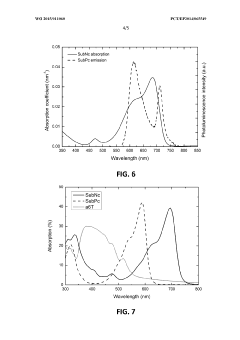
- An organic photovoltaic cell with a heterojunction structure comprising a first donor layer, a first acceptor layer, and an additional second acceptor or donor layer, where the second layer's optical band gap is at least 0.1 eV larger, with overlapping optical spectra and charge-transfer state energies optimized for exciton dissociation, allowing multiple exciton dissociation mechanisms and improved fill factor.

Sustainability Impact of OPV Manufacturing
The sustainability impact of Organic Photovoltaics (OPV) manufacturing represents a critical dimension in evaluating the overall viability and market potential of this emerging technology. OPV manufacturing processes demonstrate significantly lower environmental footprints compared to traditional silicon-based photovoltaics, primarily due to reduced energy requirements during production and the utilization of less toxic materials.
Life cycle assessments reveal that OPV manufacturing consumes approximately 2-3 times less energy than conventional PV technologies, with energy payback times potentially under six months in optimal deployment scenarios. This advantage stems from lower processing temperatures and the elimination of energy-intensive purification steps required for silicon-based alternatives.
Material sustainability constitutes another significant advantage of OPV manufacturing. The carbon-based organic semiconductors employed in OPVs can be derived from renewable resources, offering pathways to reduce dependency on rare or geopolitically sensitive materials. However, certain high-performance OPV formulations still incorporate scarce elements like indium or specialized fullerene derivatives, presenting ongoing sustainability challenges that require innovative material science solutions.
Water consumption metrics for OPV manufacturing demonstrate substantial improvements over silicon-based technologies, with some roll-to-roll production methods requiring up to 95% less water per watt of capacity. This aspect becomes increasingly important as photovoltaic deployment expands into water-stressed regions globally.
End-of-life considerations present both challenges and opportunities for OPV sustainability. The organic nature of key components theoretically enables more environmentally benign disposal options, yet the composite structure of complete devices complicates recycling efforts. Recent research into delamination techniques and selective solvent extraction shows promise for recovering valuable materials from spent OPV modules, potentially creating closed-loop material systems.
The adsorption capacity of active layer materials directly influences manufacturing sustainability through material utilization efficiency. Higher adsorption coefficients enable thinner active layers, reducing material requirements and associated environmental impacts. This technical parameter thus creates a direct link between device performance optimization and sustainability outcomes, highlighting how engineering improvements can simultaneously address commercial and environmental objectives in the OPV sector.
Life cycle assessments reveal that OPV manufacturing consumes approximately 2-3 times less energy than conventional PV technologies, with energy payback times potentially under six months in optimal deployment scenarios. This advantage stems from lower processing temperatures and the elimination of energy-intensive purification steps required for silicon-based alternatives.
Material sustainability constitutes another significant advantage of OPV manufacturing. The carbon-based organic semiconductors employed in OPVs can be derived from renewable resources, offering pathways to reduce dependency on rare or geopolitically sensitive materials. However, certain high-performance OPV formulations still incorporate scarce elements like indium or specialized fullerene derivatives, presenting ongoing sustainability challenges that require innovative material science solutions.
Water consumption metrics for OPV manufacturing demonstrate substantial improvements over silicon-based technologies, with some roll-to-roll production methods requiring up to 95% less water per watt of capacity. This aspect becomes increasingly important as photovoltaic deployment expands into water-stressed regions globally.
End-of-life considerations present both challenges and opportunities for OPV sustainability. The organic nature of key components theoretically enables more environmentally benign disposal options, yet the composite structure of complete devices complicates recycling efforts. Recent research into delamination techniques and selective solvent extraction shows promise for recovering valuable materials from spent OPV modules, potentially creating closed-loop material systems.
The adsorption capacity of active layer materials directly influences manufacturing sustainability through material utilization efficiency. Higher adsorption coefficients enable thinner active layers, reducing material requirements and associated environmental impacts. This technical parameter thus creates a direct link between device performance optimization and sustainability outcomes, highlighting how engineering improvements can simultaneously address commercial and environmental objectives in the OPV sector.
Cost-Performance Analysis of Competing Technologies
The economic viability of organic photovoltaics (OPV) must be evaluated against competing solar technologies to understand its market potential. Silicon-based photovoltaics currently dominate the market with manufacturing costs between $0.20-0.30 per watt, while OPV technologies range from $0.50-1.00 per watt, presenting a significant cost barrier despite recent improvements.
Performance metrics reveal that traditional crystalline silicon solar cells achieve 18-22% efficiency in commercial applications, with laboratory records approaching 27%. In contrast, OPV solutions typically deliver 8-12% efficiency, with recent research breakthroughs reaching 17% in controlled laboratory environments. This efficiency gap remains a critical factor in market adoption decisions.
Lifecycle cost analysis demonstrates that silicon technologies benefit from economies of scale and established recycling infrastructure, resulting in lower levelized cost of electricity (LCOE) values of $0.04-0.06 per kWh. OPV technologies, despite shorter lifespans of 5-7 years compared to silicon's 25+ years, offer potential advantages in reduced installation costs and material usage, potentially achieving $0.07-0.10 per kWh in optimal deployment scenarios.
The adsorption capacity advantage of OPV becomes economically significant in specific applications where flexibility, light weight, and transparency command premium pricing. Building-integrated photovoltaics (BIPV) represent a market segment where OPV's $1.50-2.50 per watt installed cost can compete effectively against silicon's $1.80-3.00 per watt when factoring in aesthetic and structural benefits.
Emerging thin-film technologies like perovskite solar cells present both competition and complementary opportunities for OPV. Perovskites have demonstrated rapid efficiency improvements from 3.8% to over 25% in the past decade, with manufacturing costs projected to reach $0.25-0.35 per watt at scale. However, stability issues and lead content concerns create market openings for OPV solutions.
Market sensitivity analysis indicates that OPV technologies become economically competitive when manufacturing volumes exceed 500MW annual production, suggesting that strategic investment in scaled production facilities represents a critical inflection point for market viability. Additionally, carbon pricing mechanisms increasingly favor OPV's lower embodied energy (8-12 MJ/W) compared to silicon (25-30 MJ/W), potentially reducing the effective cost gap by 15-20% in markets with robust carbon policies.
Performance metrics reveal that traditional crystalline silicon solar cells achieve 18-22% efficiency in commercial applications, with laboratory records approaching 27%. In contrast, OPV solutions typically deliver 8-12% efficiency, with recent research breakthroughs reaching 17% in controlled laboratory environments. This efficiency gap remains a critical factor in market adoption decisions.
Lifecycle cost analysis demonstrates that silicon technologies benefit from economies of scale and established recycling infrastructure, resulting in lower levelized cost of electricity (LCOE) values of $0.04-0.06 per kWh. OPV technologies, despite shorter lifespans of 5-7 years compared to silicon's 25+ years, offer potential advantages in reduced installation costs and material usage, potentially achieving $0.07-0.10 per kWh in optimal deployment scenarios.
The adsorption capacity advantage of OPV becomes economically significant in specific applications where flexibility, light weight, and transparency command premium pricing. Building-integrated photovoltaics (BIPV) represent a market segment where OPV's $1.50-2.50 per watt installed cost can compete effectively against silicon's $1.80-3.00 per watt when factoring in aesthetic and structural benefits.
Emerging thin-film technologies like perovskite solar cells present both competition and complementary opportunities for OPV. Perovskites have demonstrated rapid efficiency improvements from 3.8% to over 25% in the past decade, with manufacturing costs projected to reach $0.25-0.35 per watt at scale. However, stability issues and lead content concerns create market openings for OPV solutions.
Market sensitivity analysis indicates that OPV technologies become economically competitive when manufacturing volumes exceed 500MW annual production, suggesting that strategic investment in scaled production facilities represents a critical inflection point for market viability. Additionally, carbon pricing mechanisms increasingly favor OPV's lower embodied energy (8-12 MJ/W) compared to silicon (25-30 MJ/W), potentially reducing the effective cost gap by 15-20% in markets with robust carbon policies.
Unlock deeper insights with Patsnap Eureka Quick Research — get a full tech report to explore trends and direct your research. Try now!
Generate Your Research Report Instantly with AI Agent
Supercharge your innovation with Patsnap Eureka AI Agent Platform!