
Detection time and position controllable laser induced breakdown spectroscopy detection device
A technology of laser-induced breakdown and detection time, which is used in measurement devices, material excitation analysis, material analysis by optical means, etc., can solve problems such as poor signal-to-background ratio and measurement sensitivity that does not meet the requirements of trace detection.
Patent Information
- Authority / Receiving Office
- CN · China
- Current Assignee / Owner
- Publication Date
- 2011-07-20
Smart Images
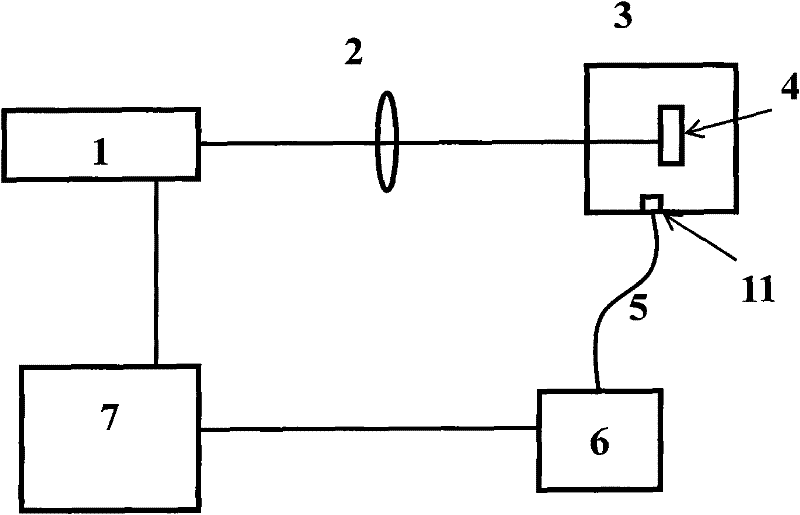
Figure 1 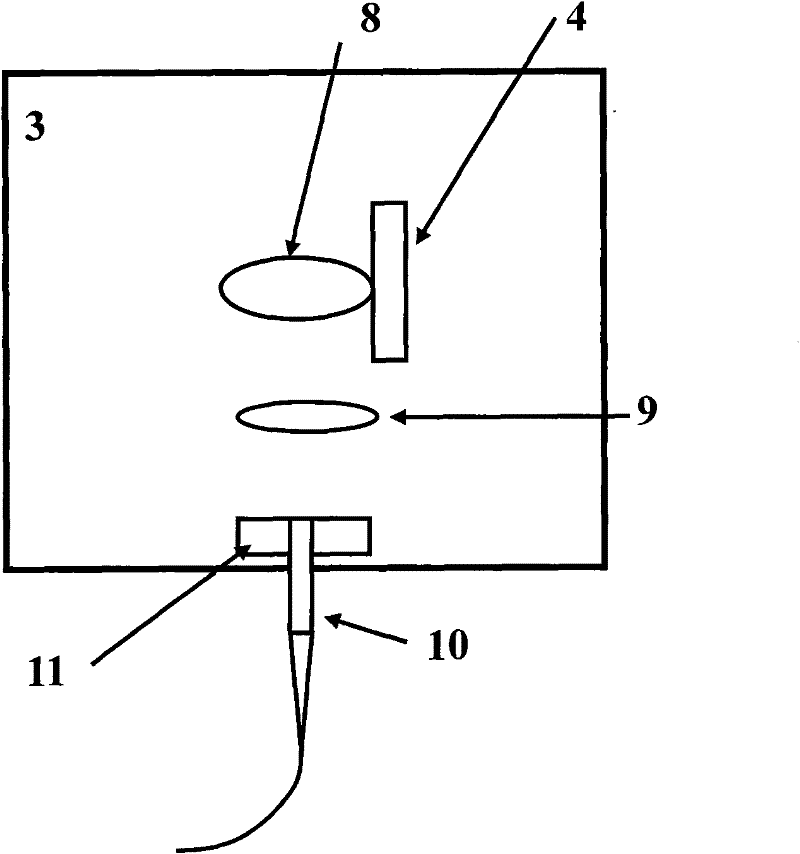
Figure 2 
Figure 3
Abstract
Description
technical field
[0001] The invention is an element detection technology device based on laser-induced breakdown spectroscopy. The equipment and device belong to the field of optoelectronic technology, and can be applied to the detection of metal elements in samples with complex components, such as the detection of heavy metal pollution elements in soil. Background technique
[0002] Laser Induced Breakdown Spectroscopy (LIBS, Laser Induced Breakdown Spectroscopy) detection technology is an element detection method based on atomic emission spectroscopy. The basic principle is to focus the high-energy short-pulse laser on the surface of the sample. The local high temperature makes the atoms break away from the bondage of the surface to form atomic vapor. Other atoms collide, speeding up the ionization process and eventually forming a plasma. As the temperature of the plasma cools, electrons and ions recombine to release photons. Since the atoms of each element have a specifi...
Examples
Embodiment
[0044] An example of implementation is as follows:
[0045] A laser-induced breakdown spectroscopy detection system for soil heavy metal pollution element detection, including laser, sample stage, spectrometer, light collection device, data acquisition and spectral analysis software.
[0046] The laser is generated by Nb:YAG passive Q-switched solid-state laser, the light wavelength is 1.06μm, the single pulse energy is adjustable from 30-100mJ, and the pulse width is less than 10ns;
[0047] The output laser is focused by a lens to form a spot with a diameter of 0.1mm-0.2mm at the focal point.
[0048] The sample is fixed on the sample holder of the sample stage, and the sample stage can be precisely adjusted back and forth so that the sample surface is just on the focal plane of the focusing lens, and the focused strong laser generates plasma sparks locally on the sample surface.
[0049] The optical fiber head fixture is fixed on a common one-dimensional translation stage ...