
Resistance spot welding method
A technology of resistance spot welding and electrode pairs, which is applied in the direction of resistance welding equipment, welding equipment, welding medium, etc., and can solve the problems of large influence of shunt, adaptive control not working, etc.
Patent Information
- Authority / Receiving Office
- CN · China
- Current Assignee / Owner
- Publication Date
- 2016-11-16
Smart Images
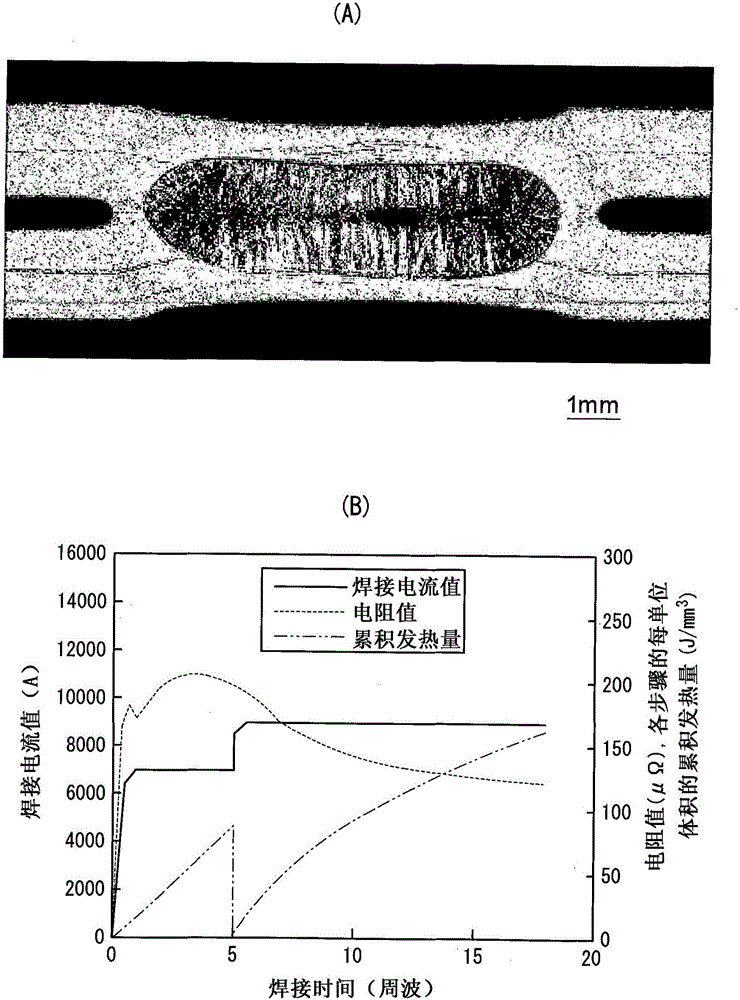
Figure 1 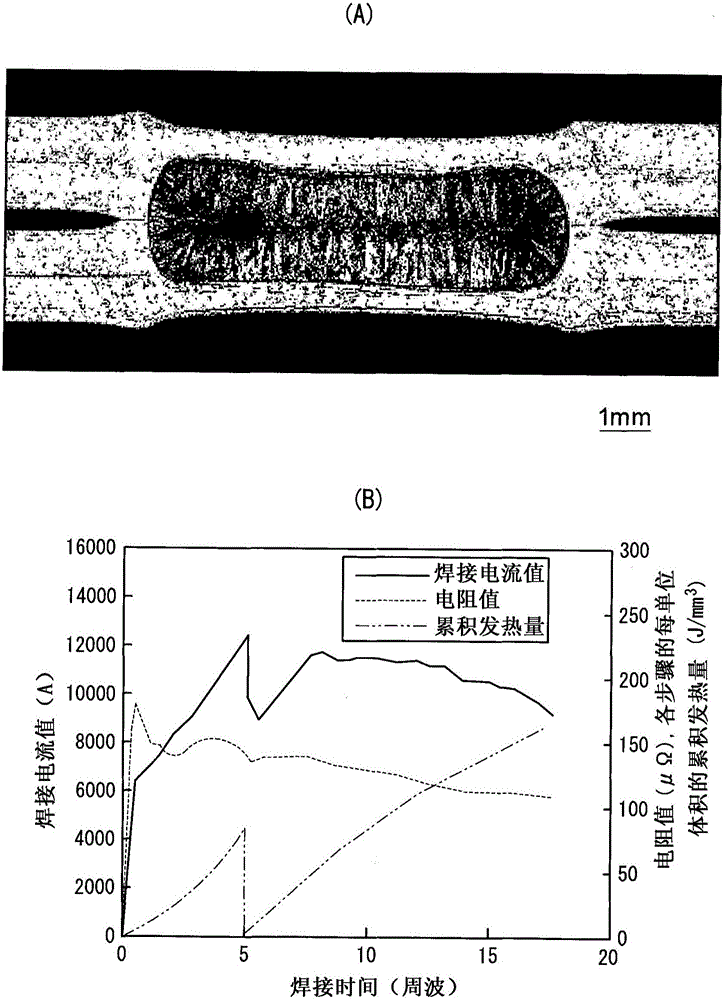
Figure 2 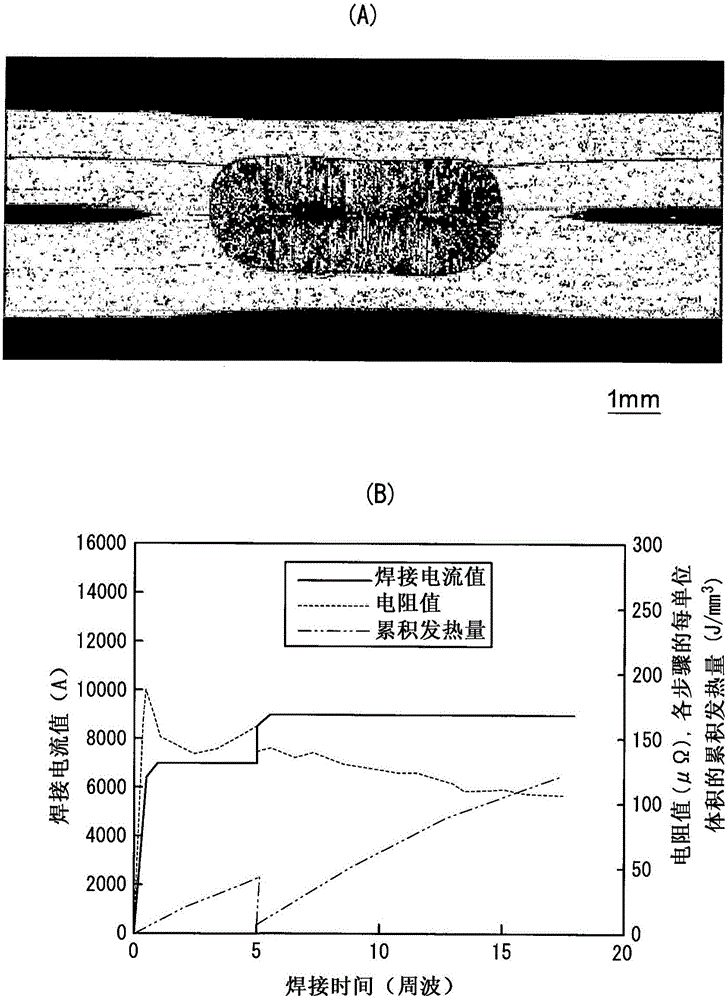
Figure 3
Abstract
Description
technical field
[0001] The present invention relates to resistance spot welding methods, and more particularly to methods capable of forming a proper nugget using adaptive control welding. Background technique
[0002] Generally, a resistance spot welding method, which is a type of overlap resistance welding method, is used to join overlapping steel plates. This welding method is a method in which two or more superimposed steel plates are sandwiched by a pair of electrodes from top to bottom, pressurized, and a high welding current is passed between the upper and lower electrodes for a short time to join them. A dot-shaped welded part can be obtained by utilizing resistance heating generated by passing a high welding current. This point-shaped welded portion is called a nugget, and when current flows to the superimposed steel sheets, both steel sheets are melted at the contact portion of the steel sheets to form a solidified portion, whereby the steel sheets are joined to e...
Examples
Embodiment 1
[0087] A steel material (270 MPa) having a thickness of 1.6 mm was prepared as a workpiece to be welded. Furthermore, both the test welding and the actual welding are performed by dividing the energization mode into two stages.
[0088] In the above-mentioned method, two workpieces to be welded are overlapped, and preliminary welding is carried out by constant current control in a state where there is no gap and no flow to the welded point, and the welding conditions for obtaining an appropriate nugget diameter are obtained. The welding machine uses an inverter DC resistance spot welder, and the electrode uses a chrome-copper electrode with a DR-shaped front-end diameter of 6mm. As a result, the welding conditions of the test welding set the first stage as applied force: 3.5kN, welding current: 7.0kA, energization time: 5cyc, set the second stage as applied force: 3.5kN, welding current: 9.0kA, Power-on time: 13cyc. It should be noted that, in this specification, the energiz...
experiment example
[0103] Next, the plate group in which the two thin steel plates were superposed as shown in Table 1 was subjected to resistance spot welding under welding conditions to manufacture welded joints. It should be noted that test welding was performed under the conditions shown in Table 1 without welded spots. The actual welding was carried out under the conditions shown in Table 1. It should be noted that the "two-stage adaptive control" in the "control method of formal welding" in Table 1 is the method of formal welding described in the above-mentioned embodiment 1, the "constant current control" is the method described in the above-mentioned comparative example 1, and " "Level 1 Adaptive Control" is the actual welding method described in Comparative Example 2 above.
[0104] With regard to the obtained welded joint, the welded portion was cut, and the cross-section was etched, followed by observation with an optical microscope to measure the nugget diameter. will get (t: thi...