

Traceless directing groups in radical cascades: from oligoalkynes to fused helicenes without tethered initators
a radical cascade and direct group technology, applied in the field of preparing a polycyclic aromatic compound, can solve the problems of difficult to achieve chemoselectivity, unsatisfactory solution, and often unavoidable use of such groups
Patent Information
- Authority / Receiving Office
- US · United States
- Patent Type
- Patents(United States)
- Current Assignee / Owner
- Publication Date
- 2017-06-13
Smart Images
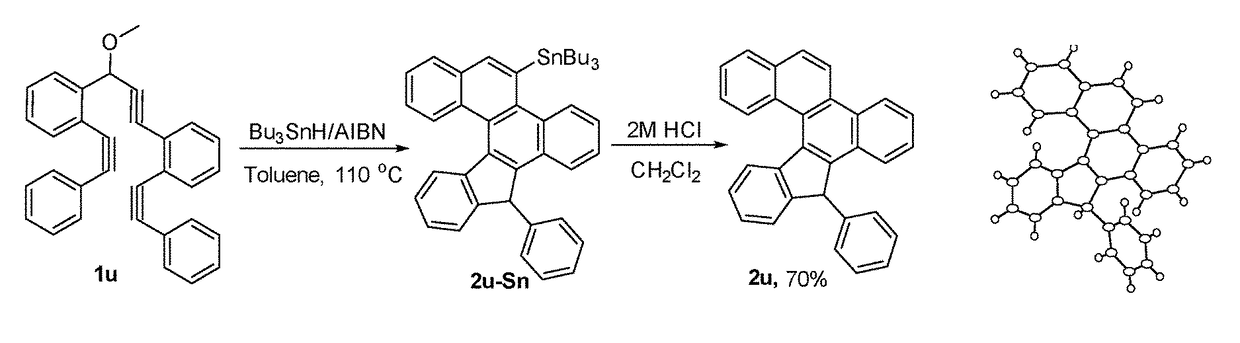
Figure 1 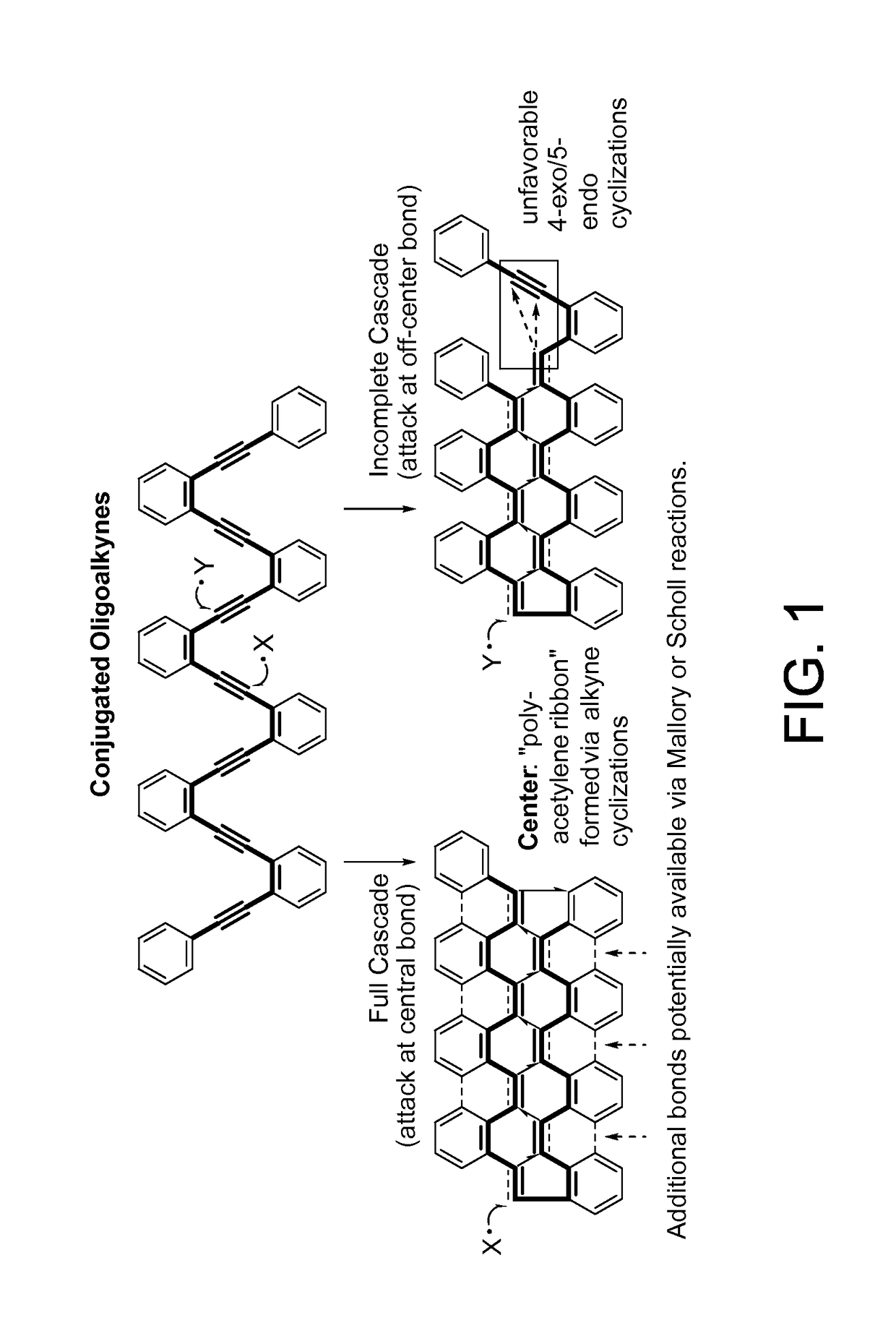
Figure 2 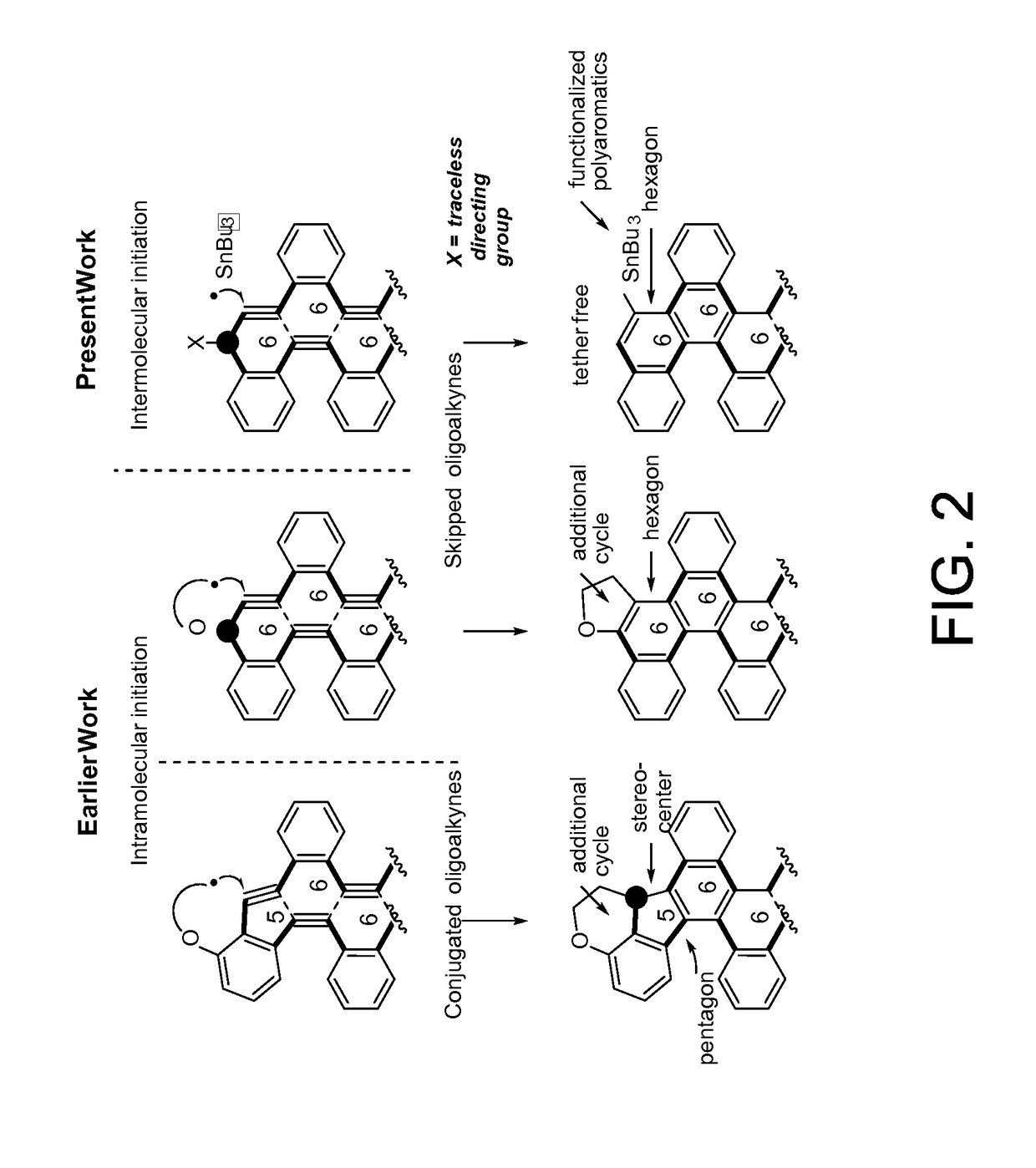
Figure 3
Abstract
Description
CROSS REFERENCE TO RELATED APPLICATION(S)
[0001] This application claims the benefit of U.S. Provisional Application Ser. No. 62 / 083,520, filed Nov. 24, 2014 and titled TRACELESS DIRECTING GROUPS IN RADICAL CASCADES: FROM OLIGOALKYNES TO FUSED HELICENES WITHOUT TETHERED INITIATORS. The priority provisional application is incorporated by reference herein as if set forth in its entirety.STATEMENT REGARDING FEDERALLY SPONSORED RESEARCH OR DEVELOPMENT
[0002] This invention was made with Government support under Grants CHE-1152491 and CHE-1213578 awarded by the National Science Foundation. The Government has certain rights in the invention.FIELD OF THE INVENTION
[0003] The present invention relates to a method of preparing a polycyclic aromatic compound, such as a substituted benzo[a]fluorene, substituted heteroaromatic analogues, and larger polycyclic aromatic structures.BACKGROUND OF THE INVENTION
[0004] Chemists have a love / hate relationship with protecting and directing groups. See Young, I....
Examples
examples
[0236]The following non-limiting examples are provided to further illustrate the present invention.
[0237]Unless otherwise noted, all reactions were carried out under nitrogen atmosphere in oven-dried glassware using standard syringe, cannula, and septa apparatus. Benzene, diethyl ether, toluene, tetrahydrofuran, and hexane were dried with a dry solvent system before use. Dichloromethane was dried over CaH2 before use. Reagents were purchased from commercial sources and used without purification, unless otherwise stated. Reactions were magnetically stirred and monitored by thin layer chromatography carried out on 0.25 mm silica gel plates (60f-254) using UV light as visualizing agents and ethanolic solution of phosphomolybdic acid and heat as developing agents. Column chromatography was performed using Kieselgel 60 (70-230 mesh) or Kieselgel 60 (230-400 mesh). Preparative thin-layer chromatography (PTLC) separations were carried out on 0.25 or 0.55 mm silica gel plates (60F-254).
Synt...