
Rotary type multichannel fluorescence excitation method based on input-output optical fiber
A technology for outputting optical fibers and exciting fluorescence, applied in the field of photoelectric detection in biomedicine, to achieve high detection accuracy, overcoming the problem of poor positioning and repeated positioning accuracy, and high speed.
Patent Information
- Authority / Receiving Office
- CN · China
- Patent Type
- Patents(China)
- Current Assignee / Owner
- Publication Date
- 2010-06-09
- Estimated Expiration
- Not applicable · inactive patent
Smart Images
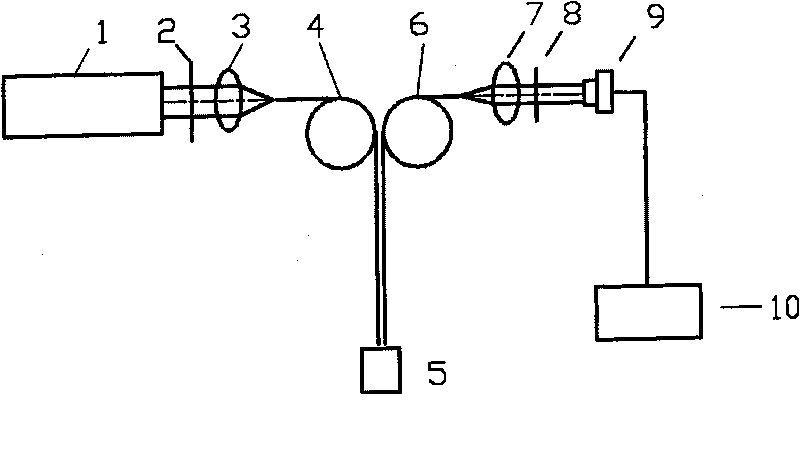
Figure 1 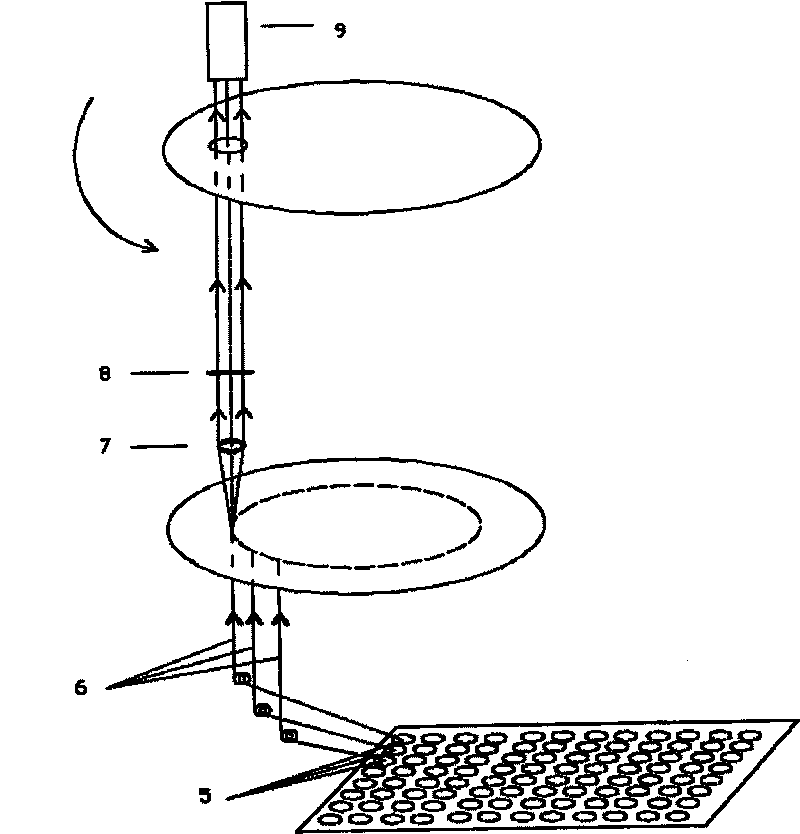
Figure 2 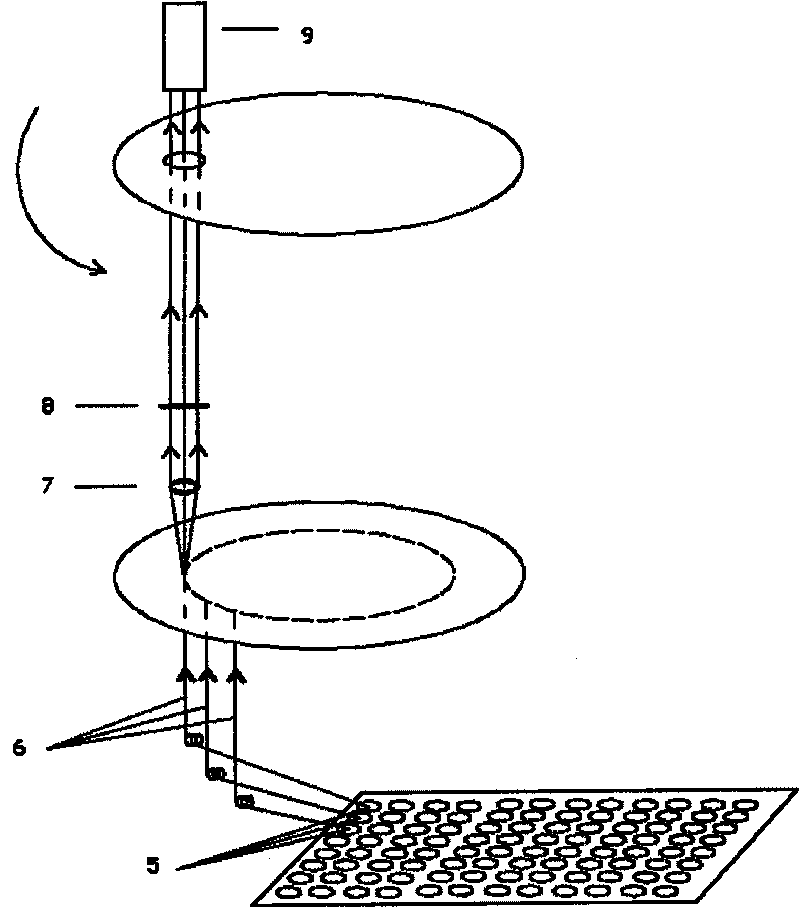
Figure 3
Abstract
Description
technical field
[0001] The invention relates to a rotary multi-channel excitation fluorescence device and method based on input and output optical fibers, and belongs to the technical field of photoelectric detection in biomedicine. Background technique
[0002] Because the external light source stimulates the object to be detected to induce fluorescence detection, it has very little impact on organisms, animals and human bodies. More importantly, the dynamic range and sensitivity of fluorescence detection are getting higher and higher, approaching or catching up with radioactive detection, so fluorescence detection It is widely used in life sciences, medical research and practical applications, especially in the field of real-time detection of living organisms, animals and human bodies.
[0003] In the classic multi-channel excitation-induced fluorescence device and method, one input optical fiber and another output optical fiber are used to transmit light, that is, one inp...
Examples
Embodiment
[0018] For such as figure 1 In the single-channel detection device shown, the light emitted by the light source 1 becomes monochromatic light through the excitation light filter 2, and then converges through the incident coupling lens 3, and then couples into an optical fiber in a group of multi-channel input optical fibers 4. After the colored light comes out from the input optical fiber 4, it irradiates the sample 5 in the reaction cell, and the sample 5 is excited to emit fluorescence; the excited fluorescence is directly coupled into an optical fiber in a group of multiple output optical fibers 6, and the fluorescent light from the output optical fiber 6 passes through The output coupling lens 7 becomes parallel light, and all the narrow-band fluorescence filtered by the release filter 8 is projected onto a rotatable disk, and the drive motor drives the disk to rotate; a hole is opened at the place where the fluorescence is projected to the disk, and the projected fluoresce...