
Composition for repairing surfaces of metallic rubbing pairs and preparation thereof
A composition and friction pair technology, which is applied in the direction of lubricating composition, petroleum industry, additives, etc., can solve the problems of limited repair film thickness and inability to effectively control the gap between metal friction pairs, so as to reduce maintenance labor intensity and reduce repair technical difficulty , the effect of low friction coefficient
Patent Information
- Authority / Receiving Office
- CN · China
- Patent Type
- Patents(China)
- Current Assignee / Owner
- Publication Date
- 2012-07-04
- Estimated Expiration
- Not applicable · inactive patent
Smart Images

Figure 1 
Figure 2 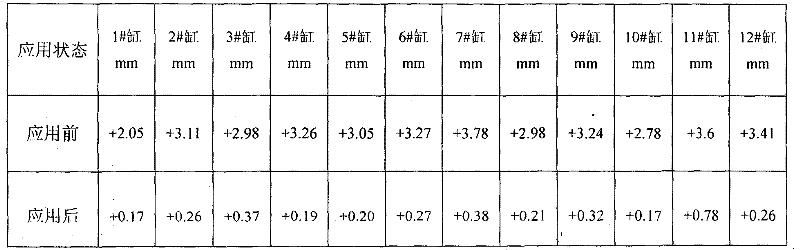
Figure 3
Abstract
Description
Technical field
[0001] The invention relates to a composition for repairing the surface of a metal friction pair and a preparation method thereof. Background technique
[0002] The surface wear of the metal friction pair inevitably occurs during operation. When the wear reaches a certain level, the metal friction pair will fail due to surface wear and must be replaced or repaired to make the equipment work normally. At present, spray welding, spraying, electroplating, and brushing are used to repair the surface of the metal friction pair, and the thickness of the repair layer can reach 0.5mm or more; surface strengthening modification technologies such as vapor deposition, surface quenching, chemical heat treatment, and ion implantation can strengthen the modification Some metal surfaces can also be deposited to form a film on the metal surface, but the repair thickness is very limited, usually less than 1 micron, which will not significantly increase the geometric size of the fr...
Examples
specific Embodiment approach 1
[0016] Specific embodiment 1: The composition for repairing the surface of the metal friction pair described in this embodiment is composed of 5-10 parts of nickel chloride powder (NiCl 2 ·6H 2 O), 5-10 parts of aluminum powder (Al), 20-30 parts of nickel powder (Ni), 15-20 parts of iron oxide powder (Fe 2 O 3 ), 5~10 parts of silica powder (SiO 2 ), 2 to 5 parts of powder suspension, 0.5 to 1 part of surface modifier and 14.5 to 47 parts of mineral lubricating oil; the nickel chloride powder (NiCl 2 ·6H 2 O) has a particle size of 0.5-2 microns, the aluminum powder (Al) has a particle size of 20-100 nanometers, the nickel powder (Ni) has a particle size of 100-200 nanometers, and the iron trioxide powder (Fe 2 O 3 ) Has a particle size of 50 to 200 nanometers, and the silica powder (SiO 2 ) Has a particle size of 100 microns to 200 nanometers.
specific Embodiment approach 2
[0017] Specific embodiment 2: The composition for repairing the surface of the metal friction pair according to the present embodiment is composed of 5.5 to 9.5 parts of nickel chloride powder, 5.5 to 9.5 parts of aluminum powder, 21 to 29 parts of nickel powder, and 16 to 9.5 parts by weight. It is composed of 19 parts of ferric oxide powder, 5.5 to 9.5 parts of silica powder, 2.5 to 4.5 parts of powder suspension agent, 0.55 to 0.95 parts of surface modifier and 16 to 45 parts of mineral lubricating oil. The other steps are the same as in the first embodiment. The composition of this embodiment is suitable for metal friction pairs in mechanical equipment, and the composition can determine the thickness of the repair modified layer according to the gap between the metal friction pairs.
specific Embodiment approach 3
[0018] Specific embodiment three: the particle size of the nickel chloride powder in this embodiment is 0.6-1.9 microns, the particle size of the aluminum powder is 30-90 nanometers, the particle size of the nickel powder is 110-190 nanometers, and the three The particle size of the iron oxide powder is 60 to 190 nanometers, and the particle size of the silica powder is 300 nanometers to 90 microns. The other steps are the same as in the first embodiment. The composition of this embodiment is suitable for metal friction pairs in mechanical equipment, and the composition can determine the thickness of the repair modified layer according to the gap between the metal friction pairs.