
Three-step distributed wireless cooperative multicast/broadcast method
A distributed and collaborative group technology, applied in the direction of broadcast service distribution, error prevention/detection using return channels, advanced technology, etc., to achieve the effects of ensuring fairness, improving throughput, and high throughput
Patent Information
- Authority / Receiving Office
- CN · China
- Patent Type
- Patents(China)
- Current Assignee / Owner
- Publication Date
- 2012-11-14
- Estimated Expiration
- Not applicable · inactive patent
Smart Images
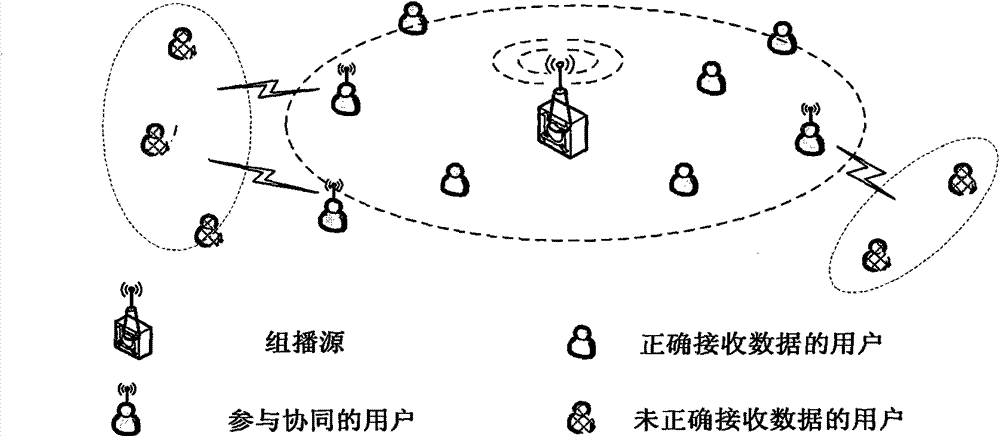
Figure 1 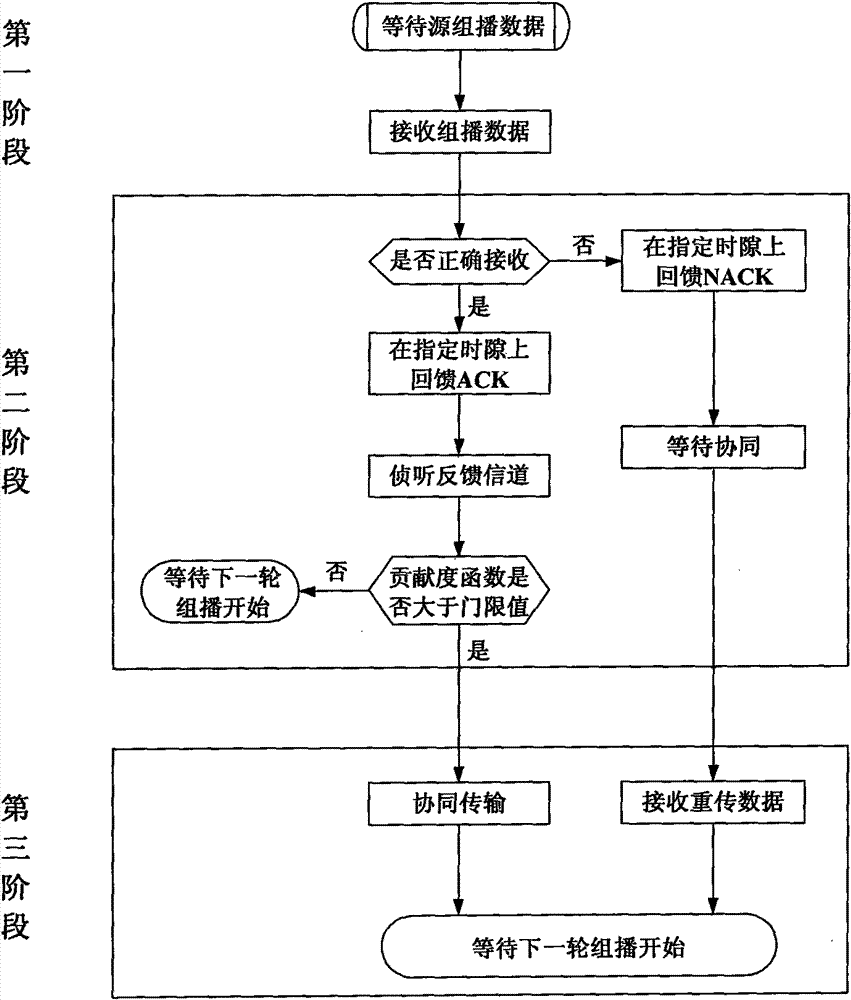
Figure 2 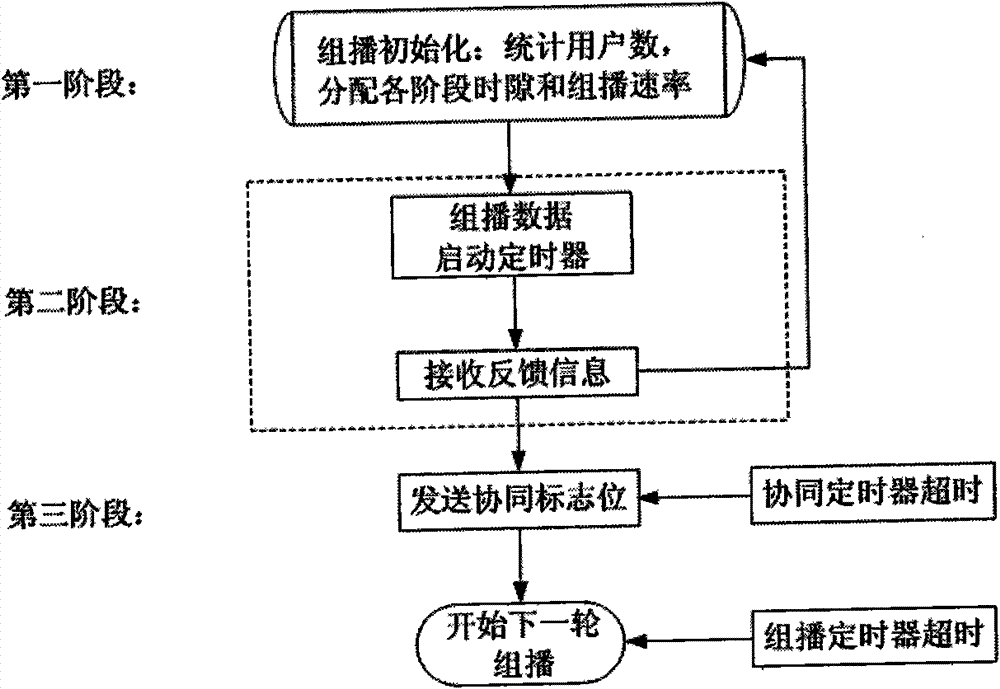
Figure 3
Abstract
Description
technical field
[0001] The invention relates to a transmission for multicast services, provides a distributed cooperative multicast / broadcast scheduling method based on cooperative communication, space diversity and power control technologies, and belongs to the technical field of wireless multicast / broadcast. Background technique
[0002] Wireless multicast / broadcast technology is an efficient mechanism for one-to-many data transmission in a wireless environment. It provides a broad wireless platform for TV, radio, film and other application suppliers, and has attracted widespread attention. The multicast / broadcast mode is a point-to-multipoint data service, and a single data stream is received by multiple users, which is especially suitable for live broadcast services such as TV programs and live event broadcasts. At present, the mobile TV service in which users watch TV programs on mobile terminals is gradually becoming popular on a large scale. The multimedia multicast / ...
Examples
Embodiment 1
[0057] Embodiment 1 (application under IEEE802.11 network architecture)
[0058] The present invention utilizes simultaneous cooperation of multiple users to obtain space diversity gain. Users can judge whether to participate in collaborative transmission by listening to the feedback information and calculating their respective collaborative contribution degrees. Multicast is implemented in three stages. The first stage is the multicast source multicast / broadcast data stage, the second stage is the user feedback stage, and the third stage is the user distributed collaborative transmission stage.
[0059] For the IEEE802.11 network architecture, there are 50 users in the system, and each round of multicast needs to broadcast data packets with a size of 1000 bytes at the basic rate R=2Mbps.
[0060] Specific steps are as follows:
[0061] Phase 1: Source Multicast / Broadcast Data Phase
[0062] Step 1: Initialize
[0063] a. Count the total number of multicast users, record i...
Embodiment 2
[0086] Embodiment 2 (application under IEEE802.16 network architecture)
[0087] The present invention utilizes simultaneous cooperation of multiple users to obtain space diversity gain. Users can judge whether to participate in cooperative transmission by listening to the feedback information and calculating their respective collaborative contribution degrees. Multicast is implemented in three phases. The first stage is the source multicast / broadcast data stage, the second stage is the user feedback stage, and the third stage is the user distributed cooperative transmission stage.
[0088] IEEE802.16 network architecture, a data frame is composed of downlink data subframe, uplink data subframe and guard band, it can be considered to divide the uplink subframe into a part of time slots for the second stage of feedback, and the feedback time is set according to user needs; The downlink subframe is divided into two parts for the transmission of multicast data. The former part ...