
A kind of zinc ion sensor molecule and its preparation and application
A zinc ion and sensor technology, applied in the field of cation detection, can solve problems such as complex electrical instruments, tedious sample preparation process, etc.
Patent Information
- Authority / Receiving Office
- CN · China
- Patent Type
- Patents(China)
- Current Assignee / Owner
- Publication Date
- 2017-12-29
- Estimated Expiration
- Not applicable · inactive patent
Smart Images
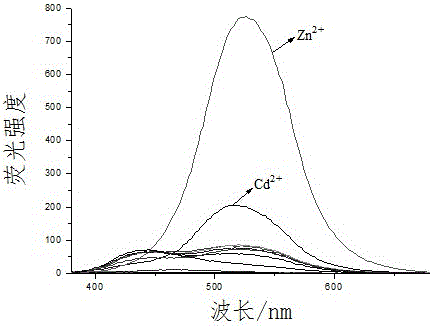
Figure 1 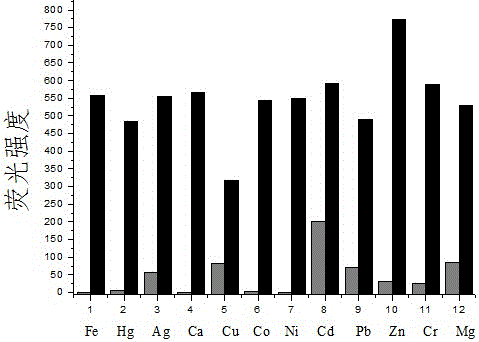
Figure 2 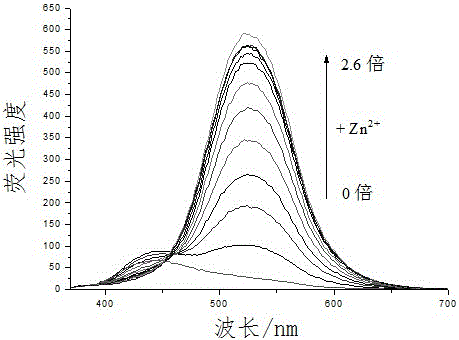
Figure 3
Abstract
Description
technical field
[0001] The invention belongs to the field of cation detection, and relates to the preparation of a zinc ion sensor molecule; the invention also relates to the application of the sensor molecule in highly selective fluorescent recognition of zinc ions. Background technique
[0002] Zinc ions play a very important role in catalysis and structure, can contain biological enzymes and bind DNA proteins. However, an imbalance in the level of zinc ions in the body may lead to some serious neurological diseases, such as Alzheimer's disease, cerebral ischemia and epilepsy, developmental defects or disabilities. Therefore, people pay more and more attention and are committed to the development and research of efficient and highly selective detection of Zn 2+ methods, such as inductively coupled plasma atomic emission spectrometry, atomic absorption spectrometry, electrochemical methods, etc. However, most of these methods require complex electrical instruments and ted...
Examples
Embodiment Construction
[0040] The structure and synthesis of the sensor molecule of the present invention, the fluorescence recognition method for zinc ions, the preparation and application of the detection test paper will be described in detail below through specific examples.
[0041] 1. Synthesis and characterization of sensor molecules
[0042] In a 250mL round-bottomed flask, add 0.7500g (5mmol) of hydroxyisophthalaldehyde, 0.5995g (5.5mmol) of 2-hydrazinopyridine, 5mL (0.05mmol) of glacial acetic acid for catalyst, 30mL of ethanol solvent, and stir at reflux at 80°C After 6 hours, a brown-yellow precipitate precipitated out, and the crude product was recrystallized from ethanol to obtain a dark-yellow product, which is the sensor molecule Y, with a yield of 86.2% (m.p. > 300°C). Its structure is characterized as follows:
[0043] 1 H NMR (DMSO– d 6 , 400 MHz) δ: 11.01(s, 1H, O-H); δ: 10.80 (s, 1H, N–H);δ: 10.72 (s, 1H, N–H); δ: 8.31 (s, 1H, CH =N). IR (KBr) ν: 1622 cm -1 (-HC=N-),3422 c...