

A miniaturized millimeter wave transceiver component
A technology of transmitting and receiving components and millimeter waves, applied in electrical components, transmission systems, etc., can solve the problems of narrow communication frequency band, large amount of debugging, and low reliability, so as to broaden the communication frequency band, reduce secondary damage, and reduce link loss Effect
Patent Information
- Authority / Receiving Office
- CN · China
- Patent Type
- Patents(China)
- Current Assignee / Owner
- Publication Date
- 2018-05-18
Smart Images

Figure 1 
Figure 2 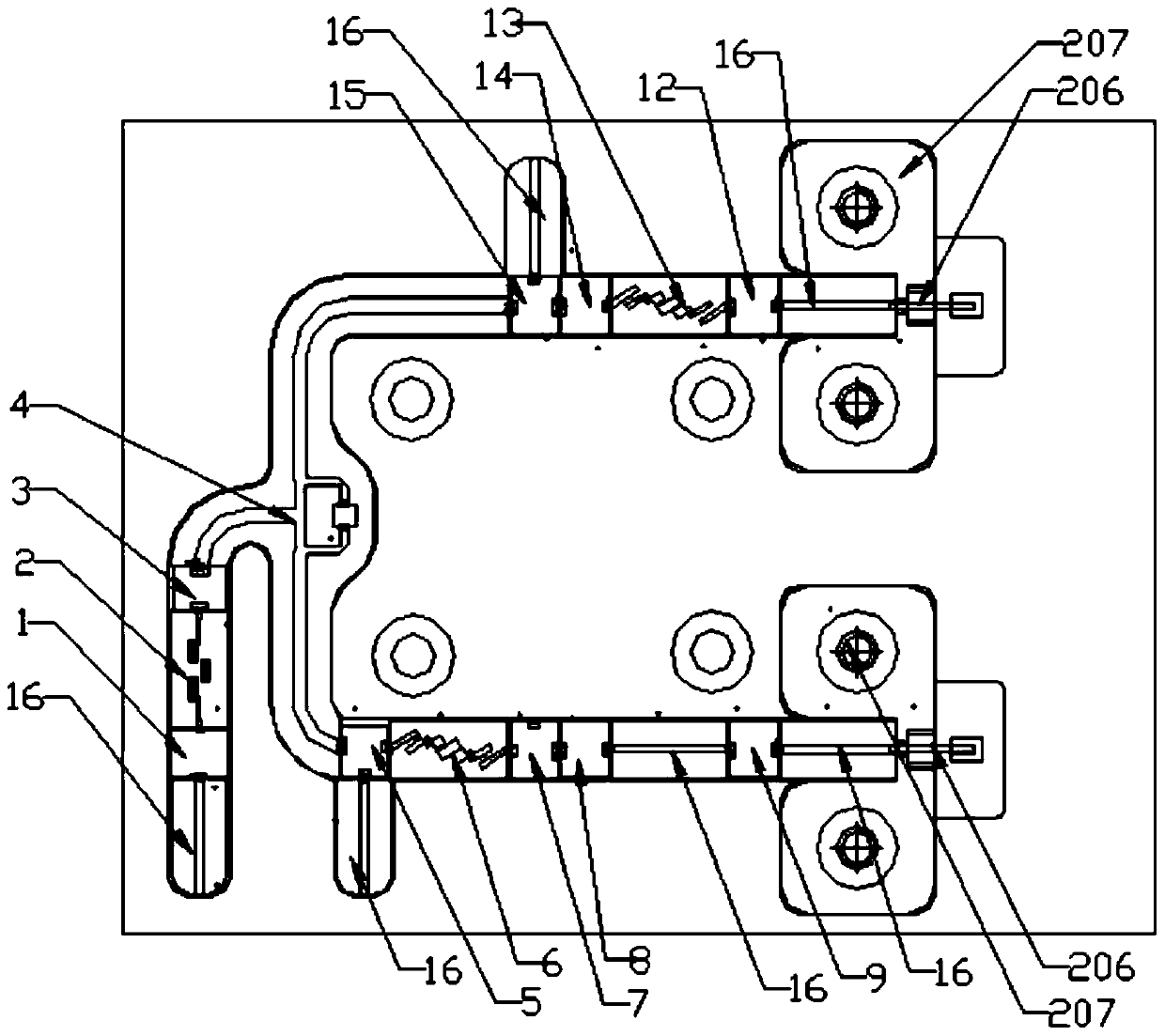
Figure 3
Abstract
Description
technical field
[0001] The invention belongs to the technical field of millimeter wave communication, and in particular relates to a miniaturized millimeter wave transceiver component. Background technique
[0002] The millimeter-wave wireless transceiver system mainly relies on the millimeter-wave transceiver component to convert high-frequency signals and intermediate-frequency signals, which is an important part of the millimeter-wave communication system. The existing millimeter-wave transceiver components all use conductive silver paste to paste the PCB printed board and MMIC chip on the aluminum shielding box. The MMIC chips are connected by the microstrip line on the PCB printed board, resulting in complex structure and bulky Huge, large amount of debugging, low reliability. At the same time, the waveguide coaxial conversion adopts the microstrip line transition, which is limited by the precision of the processing technology, resulting in a narrow communication frequ...
Examples
Embodiment Construction
[0025] Below in conjunction with accompanying drawing and embodiment, content of the invention will be further described:
[0026] In the existing technology, this product uses more MMIC chips, and the MMIC chips are all made of 99.6% aluminum oxide substrate material. The expansion coefficient of the substrate material is 7.5. The shielding box selected by the existing millimeter wave transceiver components is basically For copper or aluminum alloy, the expansion coefficient of the profile is about 20, which is quite different from the expansion coefficient of the substrate material, so it is difficult to carry out high-temperature seamless sintering. At the same time, the MMICs of the existing millimeter-wave transceiver components are connected by a microstrip printed board. The microstrip printed board and the MMIC chip are pasted on the shielding box body through conductive silver paste. The conductive silver paste is unevenly coated, and the thickness of the MMIC chip ( ...