
A treatment system for removing anionic surfactants in domestic wastewater
A surfactant and domestic wastewater technology, applied in biological water/sewage treatment, water/sewage treatment, neutralized water/sewage treatment, etc., can solve the problems of high cost, unstable treatment effect, complicated technology, etc. Processing ability, conducive to wide-scale promotion and application, good processing effect
Patent Information
- Authority / Receiving Office
- CN · China
- Patent Type
- Patents(China)
- Current Assignee / Owner
- Publication Date
- 2017-12-08
Smart Images
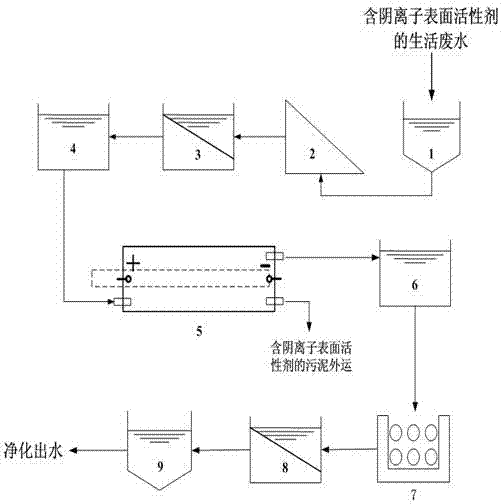
Figure 1 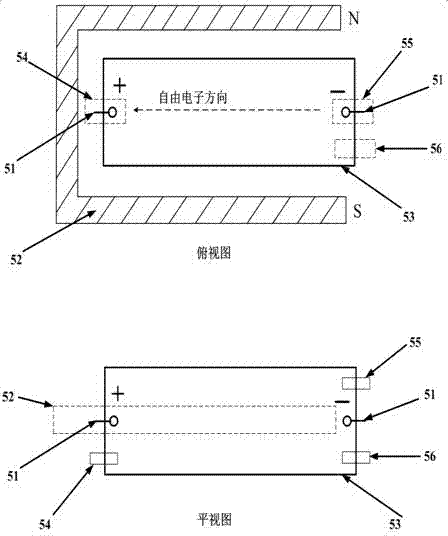
Figure 2
Abstract
Description
technical field
[0001] The invention relates to a treatment system for removing anionic surfactants in domestic wastewater, which belongs to the field of wastewater treatment in environmental protection. Background technique
[0002] Surfactant refers to a class of substances with certain properties, structure and interfacial adsorption performance, which can significantly reduce the surface tension of solvents or the interfacial tension of liquid-liquid and liquid-solid. Its English name surfactant is a compound word of surface active agent, which means "surfactant is a substance that can enhance surface (or interface) activity". That is, when the surfactant is dissolved in water, it can be divided into ionic surfactant and non-ionic surfactant according to whether it generates ions and its electrical properties. According to the dissociation properties of polar groups, surfactants include ionic surfactants, nonionic surfactants, and special surfactants.
[0003] In recen...
Examples
Embodiment Construction
[0020] like figure 1 The shown treatment system for removing anionic surfactants in domestic wastewater includes a water collection well 1, a coarse grid 2, a primary sedimentation tank 3, a pH value adjustment tank 4, anion-Hall effect separation tank 5, aeration and nitrification pond 6, biological denitrification pond 7, secondary sedimentation pond 8, water purification pond 9, etc.; among them, the domestic wastewater containing anionic surfactants enters the collection well 1 through the waste water pipeline, where centralized collection and preliminary stable adjustment are carried out. The outlet of the well 1 is connected to the coarse grid 2 through the wastewater pipeline, where large-diameter solid matter in the domestic wastewater is removed, and the outlet of the coarse grid 2 is connected to the primary sedimentation tank 3 through the wastewater pipeline, where the insoluble matter in the wastewater is further removed, The outlet of the primary sedimentation ta...