
Method for reducing pollutant discharge in phenol-acetone production
A technology for pollutant discharge and phenol acetone, which is applied in the fields of water pollutants, sustainable biological treatment, chemical instruments and methods, etc., can solve the problems of many waste water discharge nodes, high treatment costs, and difficult water treatment, and achieve significant resource recovery. and pollutant emission reduction effect, reducing difficulty, improving raw material utilization rate and product yield effect
Patent Information
- Authority / Receiving Office
- CN · China
- Patent Type
- Applications(China)
- Current Assignee / Owner
- Publication Date
- 2016-08-03
Smart Images
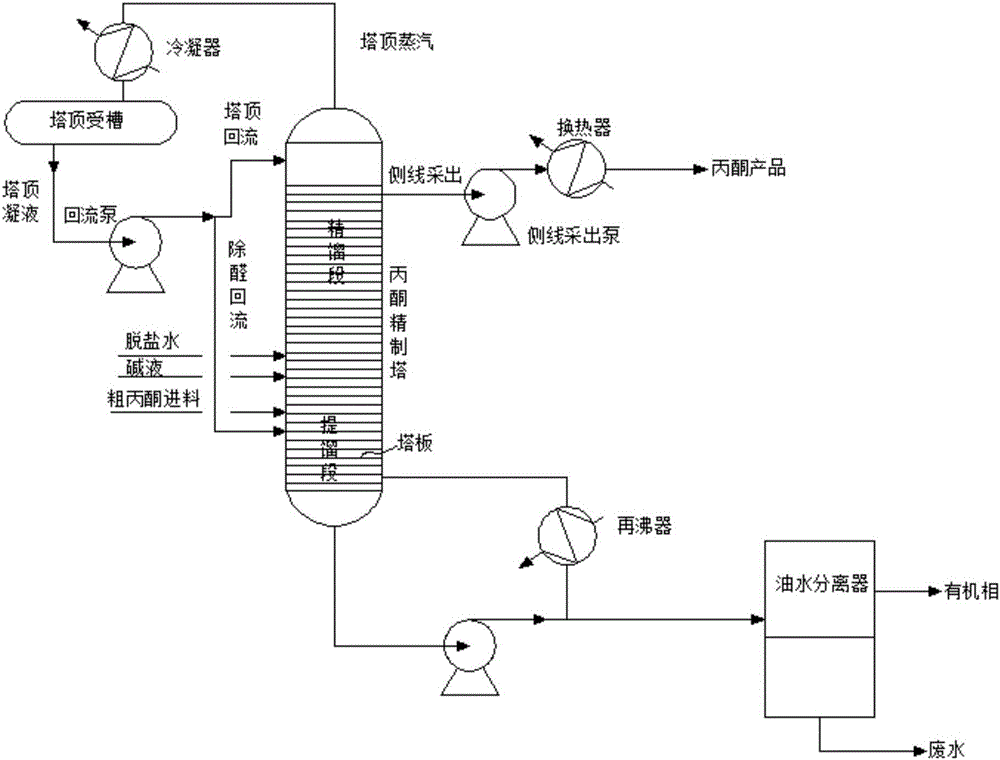
Figure 1 
Figure 2 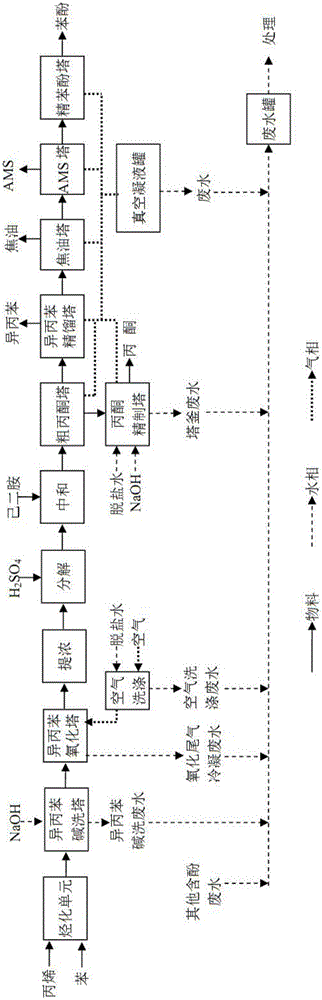
Figure 3
Abstract
Description
technical field
[0001] The present application relates to a reduction and control method for waste water pollutant recycling process of a phenol acetone production plant, which is also a method for reducing pollutant discharge in the production of phenol acetone. Background technique
[0002] Phenol and acetone are important basic chemical raw materials. The cumene method is currently the mainstream process for the production of phenol acetone. The process uses propylene and benzene as the main raw materials to produce cumene, which is then oxidized to produce cumene hydroperoxide, which decomposes under acidic heating conditions to produce phenol and acetone, and then undergoes rectification Refined to generate phenol and acetone products.
[0003] The phenol-acetone production plant has a long process flow and many wastewater discharge nodes. The existing wastewater treatment technologies for the phenol-acetone production plant mostly focus on the terminal treatment of t...
Examples
Embodiment 1
[0048] Adopt traditional cumene method to prepare phenol acetone (see figure 1 ), and its total drainage COD reaches 4000-8000mg / L.
[0049] The method of the present application carries out at least one of following transformations to traditional cumene method and device:
[0050] (1) An independent vacuum system is established in the acetone refining tower, and the pressure at the top of the tower is reduced by 15kPa, and a thin-layer structured packing is installed in the thickness of the liquid layer of the tray below the lye feed inlet (see image 3 , Figure 5 ), the reflux rate at the top of the tower and the reflux rate for removing aldehydes are reduced by 25%. Under the condition of ensuring the product quality of the side line, the steam consumption of the acetone refining tower tower is reduced by 20%, and the acetone content in the tower reactor is reduced from 2200mg / L to 520mg / L L.
[0051] (2) After the phenolic waste water is collected by the phenolic waste...
Embodiment 2
[0056] The method of the application carries out following transformation to traditional cumene method and device:
[0057] (1)~(4) item transformation is the same as embodiment 1.
[0058] (5) The total drainage of the device is treated with oil separation. After the treatment, the COD of the wastewater is 1800mg / L, and then it is treated with an aerobic biological fluidized bed, and the COD is removed by 87%. Use PAC and PAM as coagulants and coagulants for coagulation and sedimentation treatment, and then use H 2 o 2 Enhanced degradation treatment for oxidant, the dosage is 250mg / L, ferrous ion is used as the catalyst, the dosage is 50mg / L, the COD of the treated effluent is below 50mg / L, and phenol and acetone are not detected.