
Rubber composition for tires, and pneumatic tire
A technology for a rubber composition and a tire, which is applied to the rubber composition for tires and the field of pneumatic tires, can solve the problems of high cohesion, low affinity between silica and rubber components, and cannot reduce rolling resistance wet performance, etc. Excellent low rolling resistance and excellent handling stability
Patent Information
- Authority / Receiving Office
- CN · China
- Patent Type
- Applications(China)
- Current Assignee / Owner
- Publication Date
- 2017-05-31
Smart Images
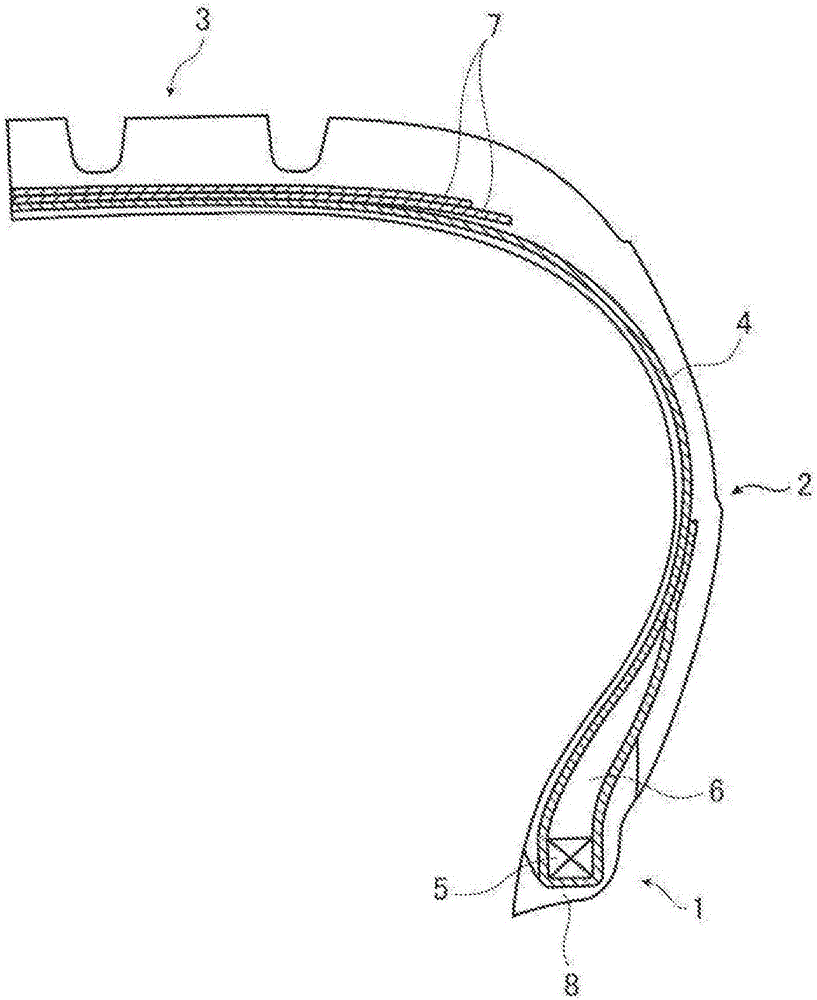
Figure 1 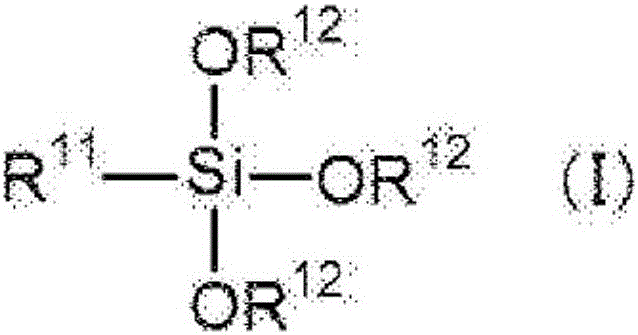
Figure 2 
Figure 3
Abstract
Description
technical field
[0001] The present invention relates to a rubber composition for tires and a pneumatic tire. Background technique
[0002] In recent years, reduction in rolling resistance of tires has been demanded from the standpoint of low fuel consumption during vehicle running. In addition, improvement in wet performance (braking performance on a wet road surface) is required from the viewpoint of safety. In contrast, there is known a method of blending silica into a rubber component constituting a tread portion of a tire to achieve both low rolling resistance and wet performance.
[0003] However, there are following problems: the affinity between silica and rubber components is low, and in addition, the cohesiveness of silica is high, so even if only silica is blended in rubber components, silica is not dispersed and cannot The effect of reducing rolling resistance and the effect of improving wet performance can be sufficiently obtained.
[0004] In contrast, Patent...
Examples
Embodiment
[0192] Hereinafter, the present invention will be described in further detail through examples, but the present invention is not limited thereto.
[0193] [Preparation of modified conjugated diene rubber]
[0194]
[0195] Cyclohexane (35 g) and tetramethylethylenediamine (1.4 mmol) were added to a 100 mL ampoule purged with nitrogen, and n-butyllithium (4.3 mmol) was further added thereto. Next, isoprene (21.6 g) and styrene (3.1 g) were slowly added and reacted in an ampoule at 50° C. for 120 minutes to obtain a polymer block A having an active terminal. Regarding this polymer block A, the weight average molecular weight, molecular weight distribution, aromatic vinyl compound unit content, isoprene unit content, and 1,4-bonding content were measured. These measurement results are shown in Table 1.
[0196] Next, in an autoclave with a stirrer, under a nitrogen atmosphere, cyclohexane (4000 g), 1,3-butadiene (474.0 g) and styrene (126.0 g) were charged, and then the entir...