
Preparation method of 5-chlorovaleryl chloride
A technology of chlorovaleryl chloride and valerolactone is applied in the preparation of acyl halide, organic chemistry and other directions, which can solve the problems of troublesome processing and large pollution, and achieve the effects of simplified operation, high synthesis efficiency and pollution reduction.
Patent Information
- Authority / Receiving Office
- CN · China
- Current Assignee / Owner
- Publication Date
- 2018-01-26
Smart Images
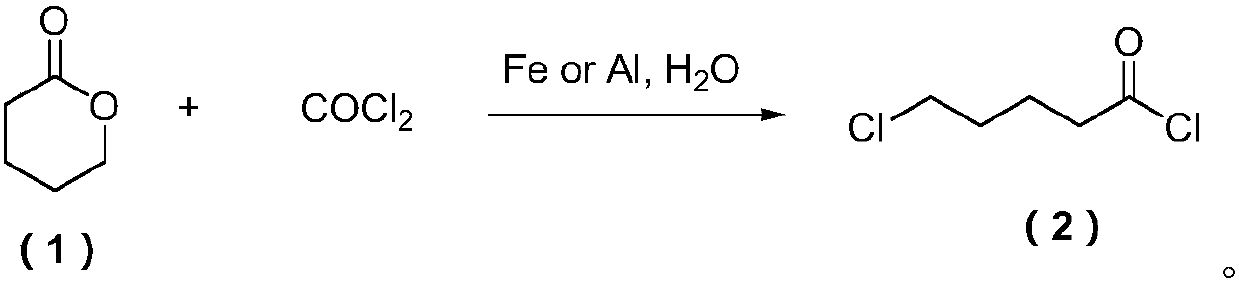
Figure 1 
Figure 2 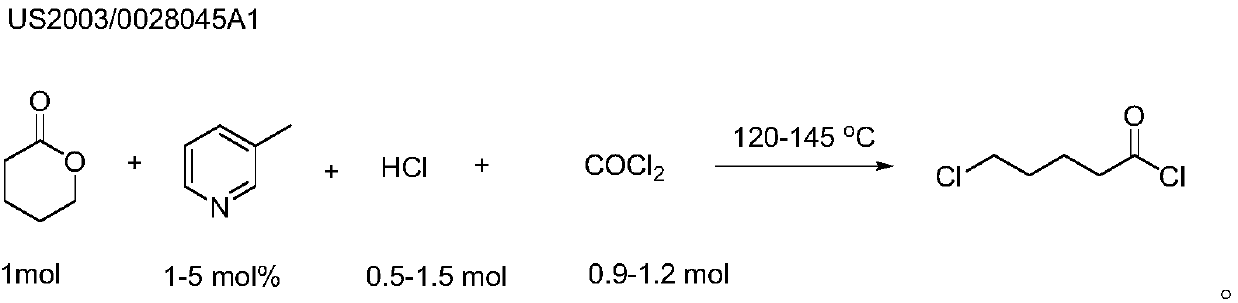
Figure 3
Abstract
Description
technical field
[0001] The invention belongs to the field of organic synthesis, and in particular relates to a method for preparing a pesticide synthesis intermediate-5-chlorovaleryl chloride. Background technique
[0002] 5-chlorovaleryl chloride is an important synthetic intermediate of pyrazole herbicides. 5-chloropentanoyl chloride is used as the raw material of 1,1,7-trichloro-1-hepten-3-one, and then the third generation pyrazole herbicides can be synthesized. Pyrazole herbicides have the characteristics of ultra-efficient herbicidal activity, high selectivity, extremely low mammalian toxicity and good environmental characteristics, and have become a hot spot in the research and development of herbicides in the world in recent years. With the continuous expansion of the demand for high-efficiency herbicides, the demand for 5-chlorovaleryl chloride as an intermediate is also gradually increasing. At present, the method for synthesizing 5-chloropentanoyl chloride mainl...
Examples
Embodiment 1
[0029] In a two-necked round-bottomed flask (one is connected to the condenser and the other is used as passing through phosgene), add δ-valerolactone (100g, 1mol) successively, catalyst Fe powder (0.5g, 0.5wt%) and water ( 2g, 2wt%), heated the mixed solution to 100°C and started to feed phosgene (107g, 1.1mol). The time for feeding phosgene was about 4 hours, during which the temperature was maintained at about 100°C. After adding phosgene, continue to react at about 80°C for 1 hour, then cool down the reaction solution to room temperature, and replace excess phosgene with nitrogen. The reaction solution was distilled under reduced pressure and the fraction at 120°C (1.0kPa) was collected to obtain 5-chlorovaleryl chloride (142g, yield 93%).
[0030] Replacement example:
[0031] The preparation method is the same as in Example 1, the difference is that the amount of Fe catalyst, water, phosgene, and reaction temperature are adjusted, and the impact on the reaction yield is...
Embodiment 2
[0035] In a two-necked round-bottomed flask (one is connected to the condenser tube and the other is used as passing through phosgene), add δ-valerolactone (100g, 1mol) successively, and the catalyst Fe 2 o 3 (1g, 1wt%) and water (2g, 2wt%), begin to pass into phosgene (107g, 1.1mol) after the mixed solution is heated up to 100 ℃, the time of passing into phosgene is about 4 hours, and temperature maintains during At around 100°C. After adding phosgene, continue to react at about 80°C for 1 hour, then cool down the reaction solution to room temperature, and replace excess phosgene with nitrogen. The reaction solution was distilled under reduced pressure and the fraction at 120°C (1.0kPa) was collected to obtain 5-chlorovaleryl chloride (122g, yield 80%).
Embodiment 3
[0037] In a two-necked round-bottomed flask (one is connected to the condenser tube, the other is used for passing through phosgene), successively add δ-valerolactone (100g, 1mol), catalyst FeCl 3 (1.0g, 1wt%) and water (2g, 2wt%), begin to pass into phosgene (107g, 1.1mol) after the mixed solution is heated up to 100 ℃, the time of passing into phosgene is about 4 hours, during the temperature Maintained at around 100°C. After adding phosgene, continue to react at about 80°C for 1 hour, then cool down the reaction solution to room temperature, and replace excess phosgene with nitrogen. The reaction solution was distilled under reduced pressure and the fraction at 120°C (1.0kPa) was collected to obtain 5-chlorovaleryl chloride (132g, yield 86%).