
Method for breeding ricefield eels
A rice field eel and feed technology, which is applied in fish farming, animal feed, animal feed, etc., can solve the problems of high cost and easy increase of harmful germ invasion, etc., and achieve the effect of lubricating taste, reducing harmful germ invasion, and high nutritional value of protein
Patent Information
- Authority / Receiving Office
- CN · China
- Patent Type
- Applications(China)
- Current Assignee / Owner
- Publication Date
- 2018-11-06
- Estimated Expiration
- Not applicable · inactive patent
Smart Images
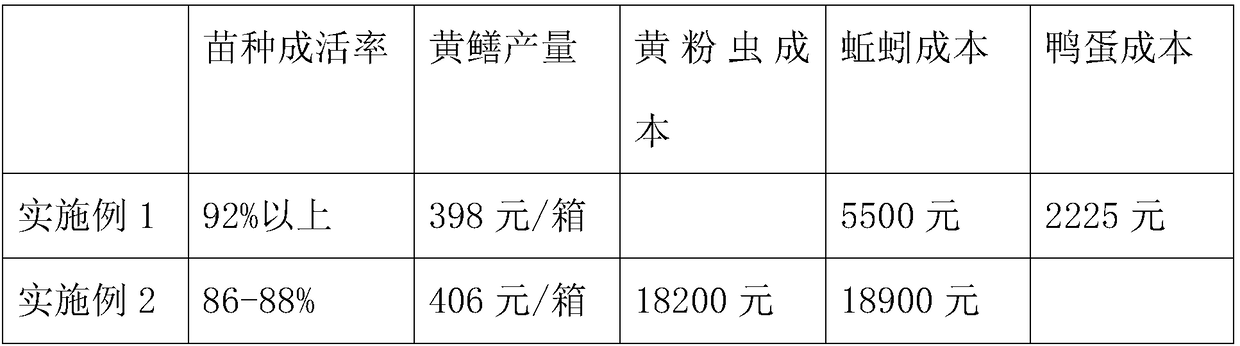
Figure 1
Abstract
Description
technical field
[0001] The invention relates to the field of aquaculture, in particular to a method for raising rice field eels. Background technique
[0002] Rice field eel, commonly known as squid, is a temperate aquatic fish. It is rich in nutrients, tender in meat, rich in protein, DHA, lecithin, vitamin A, and various trace elements. It has good medicinal and edible value, and can be made into a variety of delicacies, which is deeply loved by people. In the traditional breeding method, earthworms and Tenebrio molitor are often used as auxiliary materials on the basis of feed, which is not only costly, but also easily increases the invasion of harmful bacteria. Contents of the invention
[0003] The object of the present invention is to provide a method for raising rice field eels, using duck eggs to eliminate Tenebrio molitor and reduce earthworms, with high nutritional value, less disease, high survival rate and low cost.
[0004] To achieve the above object, the p...
Examples
Embodiment 1
[0015] With 10 acres of breeding land and 500 cages as the implementation unit; time: 2017, the breeding period is 110 days;
[0016] Set up net cages in the pond, choose polyvinyl chloride net cages, and the size of a single net cage is 1-2m 2 , Mesh 60 mesh, after placing the net cage, plant the aquatic plants in the net cage after insecticide and disinfection, and the coverage rate of aquatic plants reaches 80-90% of the water area in the net cage;
[0017] Throw in seedlings, and the eel breeding period is divided into three cycles: training period, feeding period and feeding period;
[0018] a. The training period is 3 days, feeding once a day from 2:00 to 5:00 in the afternoon, feeding a total of 7.5kg of duck eggs, 30kg of earthworms, and 0.5kg of Victoria;
[0019] b. The feeding period is 7 days, feeding once a day from 4:50 to 6:00 in the afternoon, feeding a total of 15kg of duck eggs, 15kg of earthworms, and 0.3kg of Victoria;
[0020] c. The feeding period is 90...
Embodiment 2
[0024] With 10 mu of breeding land and 500 net cages as the implementation unit; time: 2016, the breeding period is 110 days;
[0025] In the present embodiment, other steps are all the same, and the difference is that Tenebrio molitor is replaced with duck eggs to increase the usage of earthworms;
[0026] Present embodiment Tenebrio molitor consumption 3500kg, earthworm 2700kg;
[0027] The breeding effect of embodiment 1 and embodiment 2 is compared, see the following table:
[0028]
[0029] As can be seen from the table, under the similar situation of breeding, adopting the method of the present invention can effectively reduce the cost of Tenebrio molitor and earthworm.