
An antibacterial food freshness indicator material capable of detecting carbon dioxide and its preparation method
A carbon dioxide and freshness technology, which is applied in the direction of material analysis by observing the influence of chemical indicators, material analysis, material analysis by optical means, etc. It is applied in the field of food packaging, which is difficult to promote, etc., to achieve the effect of extending its shelf life, inhibiting the growth of harmful bacteria, and having good antibacterial effect.
Patent Information
- Authority / Receiving Office
- CN · China
- Patent Type
- Patents(China)
- Current Assignee / Owner
- Publication Date
- 2021-06-18
Smart Images

Figure 1 
Figure 2 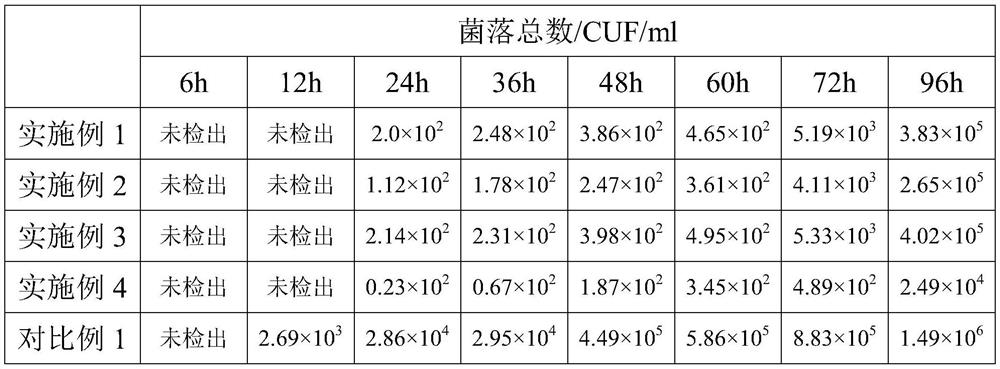
Figure 3
Abstract
Description
technical field
[0001] The invention relates to an antibacterial food freshness indicator material capable of detecting carbon dioxide and a preparation method thereof, belonging to the field of food packaging. Background technique
[0002] Ensure food safety and build a powerful economy. Every year around the world, countless wastes are caused by food spoilage. The growth and reproduction of microorganisms is not only an important reason for the decline in food freshness, but also some microorganisms can cause great harm to the human body. The freshness of food is affected by various factors such as irregular packaging and storage of food, and it often occurs that food deteriorates during the shelf life. In the initial stage of food freshness decline, it is difficult for people to judge the freshness of food through sensory analysis. In addition, many packaged foods are not eaten once after opening, and are often stored in refrigeration. In this case, the freshness of th...
Examples
preparation example Construction
[0053] The present invention also provides a method for preparing an antibacterial food freshness indicating material capable of detecting carbon dioxide, comprising the following steps:
[0054] Step 1. According to parts by weight, 2-6 parts of starch, 0.1-0.5 parts of titanium dioxide dispersion, 1-5 parts of calcium hydroxide, 1-4 parts of glycerol, 1-3 parts of urea, and 0.05 parts of xanthan gum -0.2 parts, 80-90 parts of water, after mixing, stirring and ultrasonic treatment, heating at 70-90°C to obtain film solution A;
[0055] Step 2. According to parts by weight, mix 3-8 parts of polyvinyl alcohol and 85-95 parts of water, stir after mixing, and heat at 80-100°C to obtain film solution B;
[0056] Step 3, according to parts by weight, 1-3 parts of methyl red solution with a concentration of 0.05%-0.25%, 2-6 parts of bromothymol blue solution with a concentration of 0.1%-0.25%, the two are according to the ratio of parts After mixing 1:2~2.5, carry out stirring and ...
Embodiment 1
[0064] In this embodiment, the antibacterial food freshness indicating material capable of detecting carbon dioxide is composed of the following raw materials:
[0065] Membrane solution A: 2 parts of starch, 0.1 part of titanium dioxide dispersion, 1 part of calcium hydroxide, 1 part of glycerol, 1 part of urea, 0.05 parts of xanthan gum, 80 parts of water; Membrane solution B: 3 parts of polyvinyl alcohol solution ; Membrane solution C: 1 part of methyl red solution with a concentration of 0.05%, and 2 parts of bromothymol blue solution with a concentration of 0.1%.
[0066] The preparation method includes as follows:
[0067] Step 1. According to parts by weight, mix 2 parts of starch, 0.1 part of titanium dioxide dispersion, 1 part of calcium hydroxide, 1 part of glycerol, 1 part of urea, 0.05 part of xanthan gum, and 80 parts of water, mix and stir and ultrasonic treatment, heated at 70°C to obtain membrane solution A;
[0068] Step 2. According to parts by weight, mix ...
Embodiment 2
[0072] In this embodiment, the antibacterial food freshness indicating material capable of detecting carbon dioxide is composed of the following raw materials:
[0073] Membrane solution A: 4 parts of starch, 0.3 parts of titanium dioxide dispersion, 3 parts of calcium hydroxide, 2 parts of glycerin, 2 parts of urea, 0.12 parts of xanthan gum, 85 parts of water; Membrane solution B: 6 parts of polyvinyl alcohol solution Membrane solution C: 2 parts of methyl red solution with a concentration of 0.09%, and 4.6 parts of bromothymol blue solution with a concentration of 0.18%.
[0074] The preparation method is as follows:
[0075] Step 1. According to parts by weight, mix 4 parts of starch, 0.3 parts of titanium dioxide dispersion, 3 parts of calcium hydroxide, 2 parts of glycerol, 2 parts of urea, 0.12 parts of xanthan gum, and 85 parts of water, mix and stir and ultrasonic treatment, heated at 80°C to obtain membrane solution A;
[0076] Step 2. According to parts by weight,...