
A bidirectional self-locking unlocking device suitable for medium and low speed maglev trains
A two-way self-locking, maglev train technology, applied in electric vehicles, vehicle parts, transportation and packaging, etc., can solve problems such as complex structural relationships, difficult assembly relationships, complex working principles, etc., to simplify the lower structure, facilitate layout, Conducive to lightweight effect
Patent Information
- Authority / Receiving Office
- CN · China
- Patent Type
- Patents(China)
- Current Assignee / Owner
- Publication Date
- 2020-10-02
Smart Images
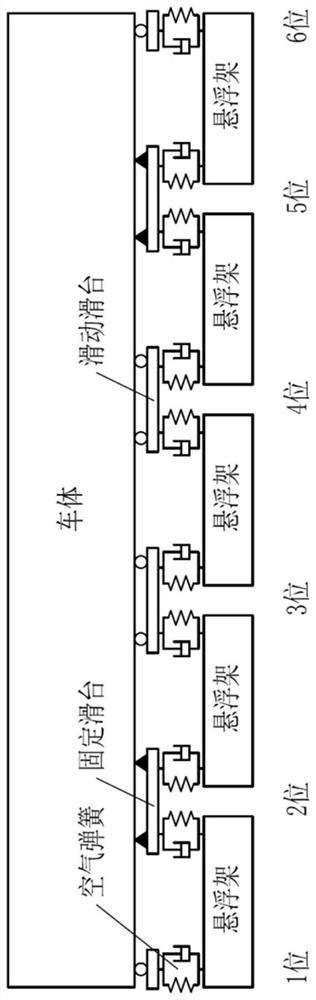
Figure 1 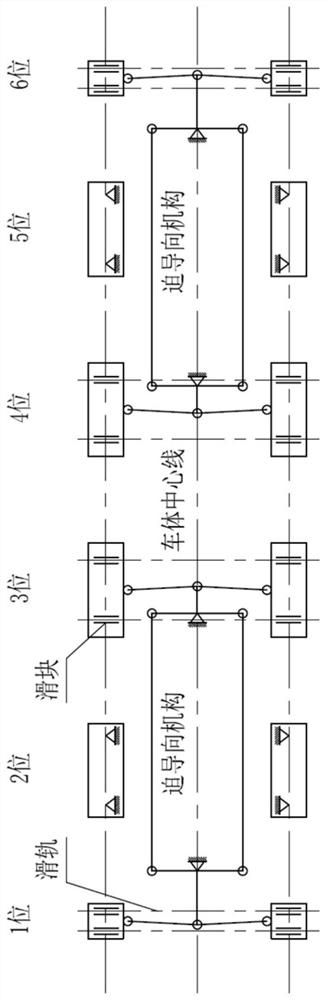
Figure 2 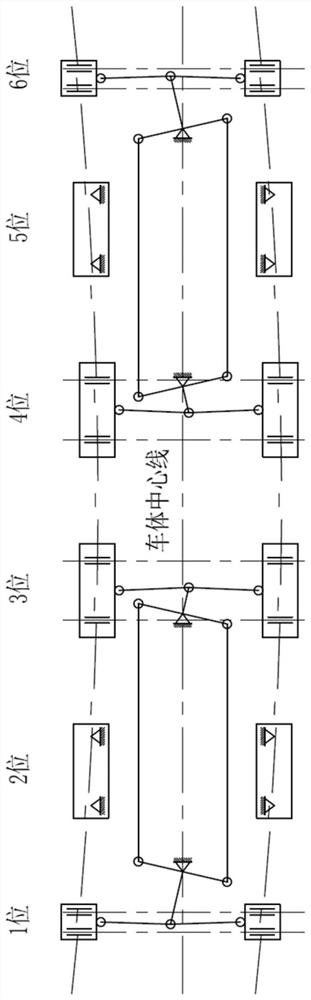
Figure 3
Abstract
Description
technical field
[0001] The invention relates to the technical field of conventional electromagnetic levitation transportation systems, in particular to a two-way self-locking and unlocking device suitable for medium and low-speed maglev trains. Background technique
[0002] Medium and low-speed maglev transportation technology relies on electromagnetic force to levitate the train, and uses a linear motor to drive the train, and the running speed is generally 100-160 kilometers per hour. Medium and low-speed maglev trains have the characteristics of low operating noise, good environmental performance, comfortable ride, strong climbing ability, small turning radius, high safety and reliability, low operation and maintenance costs, and strong adaptability to terrain environments. It is suitable for transportation connections between large and medium-sized cities, short-distance cities and tourist attractions.
[0003] There are obvious differences between the medium and low sp...
Examples
Embodiment 1
[0039] Aiming at the problems and deficiencies of the forced guide mechanism in the background technology, the present invention discloses a device with two-way self-locking and unlocking function, which cancels the forced guide mechanism configured on the existing medium and low-speed maglev vehicles, so that the vehicle structure can operate without the forced guide mechanism. Under normal circumstances, the lateral force received by the car body structure can also be evenly transmitted to each sliding table, and at the same time, the movements of each sliding table are independent of each other. When the vehicle passes a curve, its position can be freely adjusted according to the shape of the track without mutual interference. Interference creates additional impact.
[0040] Such as Figure 4As shown, the two-way self-locking unlocking device is installed at the position of the original linear guide rail between the car body underframe and the slide table of the maglev vehi...
Embodiment 2
[0046] The two-way self-locking and unlocking device of the present invention is applied to low-speed maglev vehicles with five modules.
[0047] Such as Figure 7 As shown, the forced guiding mechanism has been canceled, and the 2-position and 5-position sliding tables are fixed sliding tables, and the 1, 3, 4, and 6-position sliding tables are equipped with the two-way self-locking unlocking device of the present invention.
[0048] Figure 8 Shown is another kind of installation mode of the present invention. Likewise, the 2-position and 5-position slides are still fixed slides. 1. Replace the device of the present invention at the position of the linear guide rail on one side of the 6-position slide table, and keep the linear guide rail on the other side. 3. The linear guide rails of the 4-position slide table are retained, and the two-way self-locking unlocking device of the present invention is installed in the middle of the two linear guide rails.
Embodiment 3
[0050] The bidirectional self-locking and unlocking linear guide rail of the present invention is applied to three-module medium and low-speed maglev vehicles.
[0051] Such as Figure 9 Shown, 2 and 3 sliding tables are fixed sliding tables, and 1 and 4 sliding tables are equipped with the two-way self-locking unlocking device of the present invention.