
Antistatic coating and preparation method thereof, and application of antistatic coating
An anti-static and coating technology, applied in conductive coatings, coatings and other directions, can solve the problems of poor mechanical properties of ordinary anti-static PVC materials, poor graphene dispersion, environmental pollution, etc., to improve mechanical properties and thin coating thickness. , the effect of reducing the dosage
Patent Information
- Authority / Receiving Office
- CN · China
- Patent Type
- Applications(China)
- Current Assignee / Owner
- Publication Date
- 2020-03-31
- Estimated Expiration
- Not applicable · inactive patent
Smart Images
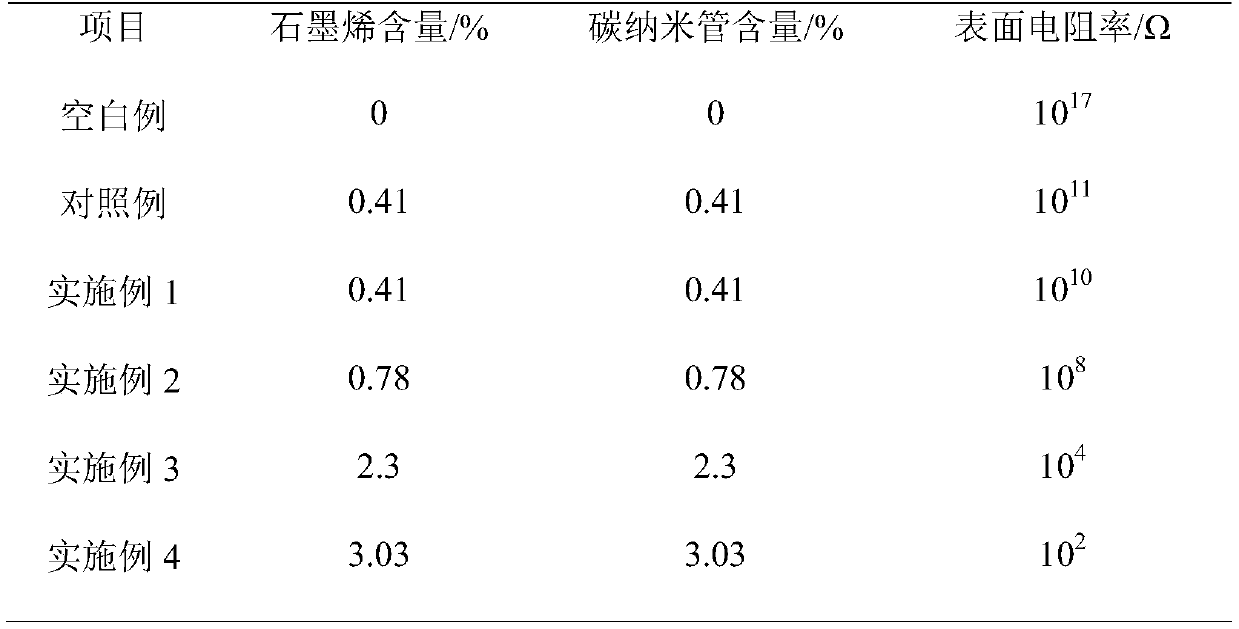
Figure 1
Abstract
Description
technical field
[0001] The invention relates to an antistatic coating suitable for PVC substrates, in particular to an antistatic coating and a preparation method and application thereof, belonging to the technical field of graphene / polymer composite materials. Background technique
[0002] PVC has long been one of the most important polymer products in people's production and life. It is loved by people because of its good flame retardancy, excellent wear resistance, strong chemical corrosion resistance, and low gas and water leakage. , It has also become the second largest plastic consumer product in the world whose consumption is second only to that of polyethylene. However, with the development of society, people have higher and higher requirements on the performance of PVC. Substituting plastic for steel will become the mainstream trend of plastic development in the future. Although PVC has mechanical properties, corrosion resistance, water and gas leakage resistance O...
Examples
Embodiment 1
[0037] (1) Take the following graphene slurry components by weight: 1 part by weight graphene, 1 part by weight carbon nanotube, 100 parts by weight DOP, 0.5 part by weight polyvinylpyrrolidone;
[0038] (2) adding the material taken in step (1) into a sand mill, and grinding for 2 hours to obtain a graphene slurry;
[0039] (3) Take the following graphene PVC paste resin antistatic coating components by weight: 100 parts by weight PVC paste resin, 80 parts by weight of graphene slurry of step (2) gained, 2 parts by weight stabilizer, 2 parts by weight Calcium carbonate, 1 part by weight of stearic acid;
[0040] (4) adding the material taken by step (3) into a high-speed disperser and mixing for 1 hour, obtaining graphene PVC paste resin antistatic coating;
[0041] (5) Weighing the graphene PVC paste resin antistatic coating obtained in step (4) and coating it on a PVC plate, baking at 150° C. for 3 minutes and performing a performance test.
Embodiment 2
[0043] (1) Take the following graphene slurry components by weight: 2 parts by weight of graphene, 2 parts by weight of carbon nanotubes, 100 parts by weight of DOP, 1 part by weight of polyvinylpyrrolidone;
[0044] (2) adding the material taken in step (1) into a sand mill, and grinding for 2 hours to obtain a graphene slurry;
[0045](3) take by weight the following graphene PVC paste resin antistatic coating components: 100 parts by weight of PVC paste resin, 20 parts by weight of vinyl chloride paste resin, 100 parts by weight of the graphene slurry of step (2) gained, 3 Parts by weight stabilizer, 5 parts by weight calcium carbonate, 2 parts by weight stearic acid;
[0046] (4) adding the material taken by step (3) into a high-speed disperser and mixing for 1 hour, obtaining graphene PVC paste resin antistatic coating;
[0047] (5) Weighing the graphene PVC paste resin antistatic coating obtained in step (4) and coating it on a PVC plate, baking at 150° C. for 3 minutes...
Embodiment 3
[0049] (1) Take the following graphene slurry components by weight: 5 parts by weight of graphene, 5 parts by weight of carbon nanotubes, 100 parts by weight of DOP, 3 parts by weight of polyvinylpyrrolidone;
[0050] (2) adding the material taken in step (1) into a sand mill, and grinding for 2 hours to obtain a graphene slurry;
[0051] (3) take by weight the following graphene PVC paste resin antistatic coating components: 100 parts by weight of PVC paste resin, 30 parts by weight of vinyl chloride paste resin, the graphene slurry of 200 parts by weight of step (2) gained, 5 parts by weight Parts by weight stabilizer, 8 parts by weight calcium carbonate, 3 parts by weight stearic acid;
[0052] (4) adding the material taken by step (3) into a high-speed disperser and mixing for 1 hour, obtaining graphene PVC paste resin antistatic coating;
[0053] (5) Weighing the graphene PVC paste resin antistatic coating obtained in step (4) and coating it on a PVC plate, baking at 150...