
Method for synthesizing MOF derivative semiconductor heterojunction material by solvothermal method
A solvothermal method and MOF technology are applied in the preparation of MOF derivative semiconductor heterojunction materials and the preparation of new catalytic materials. Harsh and other problems, to achieve broad scientific research and practical value, suitable for large-scale mass production, the effect of simple instruments
Patent Information
- Authority / Receiving Office
- CN · China
- Patent Type
- Applications(China)
- Current Assignee / Owner
- Publication Date
- 2020-06-09
Smart Images
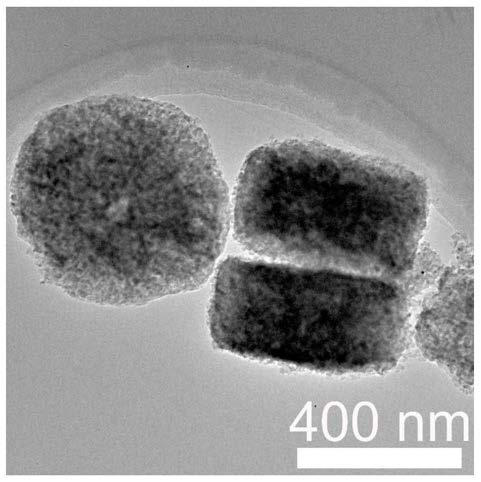
Figure 1
Abstract
Description
[0001] Technical field
[0002] The invention belongs to the field of catalyst materials, and relates to a method for preparing a novel catalyst material, in particular to a method for preparing a MOF derivative semiconductor heterojunction material synthesized by a solvothermal method. Background technique
[0003] Metal-organic frameworks (MOFs), also known as porous coordination polymers (PCPs), are synthesized from secondary building blocks (SBUs), metal cation salts or clusters, and multidentate organic ligands with coordination-type linkages. 2D or 3D porous crystalline materials. Due to its metal center, highly ordered porous structure, uniform pore size and environment, extremely high specific surface area and functional organic linking groups, tailorability, and ultra-high specific surface area, MOFs are excellent catalyst templates. . In recent years, MOFs derivatives have shown potential application prospects in many research fields, especially the in-depth resear...
Examples
Embodiment 1
[0034] At 25°C, weigh 2.49g of terephthalic acid (PTA) (15mmol) and 2.56mL of tetra-n-butyl titanate (7.5mmol) in 45mL of N,N-dimethylformaldehyde containing 0.87mL of acetic acid (15mmol). Amide (DMF) and 5mL of anhydrous methanol, placed in an ultrasonic machine, mixed and stirred until completely dissolved, transferred to a crystallization kettle, crystallized at 180°C for 16h, after the crystallization was completed, centrifuged and dried for 24h to obtain MIL-125 material; then calcined in a muffle furnace: first, the heating rate is 0.5-1°C / min, raised to 250-300°C, and kept for 0.5-1.5h; then, the heating rate is 0.5-2°C / min, raised to 450 -480°C, keep warm for 0.5-1.5h, and soak the product (1mmol) in a solution containing Sr(OH) 2 8H2O (1mmol) in 10mL deionized water, 10mL ethylene glycol, 2mL 1,2-propanediol and 2g tetrabutylammonium hydroxide solution (TBAH, 25wt), transferred to a crystallization kettle, crystallized at 160°C for 4h, crystallized After the chemica...
Embodiment 2
[0036] At 25°C, weigh 2.49g of terephthalic acid (PTA) (15mmol) and 2.56mL of tetra-n-butyl titanate (7.5mmol) in 45mL of N,N-dimethylformaldehyde containing 0.87mL of acetic acid (15mmol). Amide (DMF) and 5mL of anhydrous methanol, placed in an ultrasonic machine, mixed and stirred until completely dissolved, transferred to a crystallization kettle, crystallized at 180°C for 16h, after the crystallization was completed, centrifuged and dried for 24h to obtain MIL-125 material; then calcined in a muffle furnace: first, the heating rate is 0.5-1°C / min, raised to 250-300°C, and kept for 0.5-1.5h; then, the heating rate is 0.5-2°C / min, raised to 450 -480°C, keep warm for 0.5-1.5h, soak the product (1mmol) in a solution containing Fe(OH) 2 (1mmol) in 10mL deionized water, 10mL ethylene glycol, 2mL 1,2-propanediol and 2g tetrabutylammonium hydroxide solution (TBAH, 25wt), transferred to a crystallization kettle, crystallized at 160°C for 4h, and the crystallization was completed F...
Embodiment 3
[0038] At 25°C, weigh 2.49g of terephthalic acid (PTA) (15mmol) and 2.56mL of tetra-n-butyl titanate (7.5mmol) in 45mL of N,N-dimethylformaldehyde containing 0.87mL of acetic acid (15mmol). Amide (DMF) and 5mL of anhydrous methanol, placed in an ultrasonic machine, mixed and stirred until completely dissolved, transferred to a crystallization kettle, crystallized at 180°C for 16h, after the crystallization was completed, centrifuged and dried for 24h to obtain MIL-125 material; then calcined in a muffle furnace: first, the heating rate is 0.5-1°C / min, raised to 250-300°C, and kept for 0.5-1.5h; then, the heating rate is 0.5-2°C / min, raised to 450 -480°C, keep warm for 0.5-1.5h, and soak the product (1mmol) in a solution containing Ba(OH) 2 (1mmol) in 10mL deionized water, 10mL ethylene glycol, 2mL 1,2-propanediol and 2g tetrabutylammonium hydroxide solution (TBAH, 25wt), transferred to a crystallization kettle, crystallized at 160°C for 4h, and the crystallization was complete...