
GNSS receiver-oriented interference source positioning method for 5G system, storage medium and equipment
A positioning method and interference source technology, applied in the field of positioning and navigation, to achieve the effect of improving positioning accuracy, improving response speed, and eliminating influence
Patent Information
- Authority / Receiving Office
- CN · China
- Patent Type
- Applications(China)
- Current Assignee / Owner
- Publication Date
- 2020-12-29
Smart Images
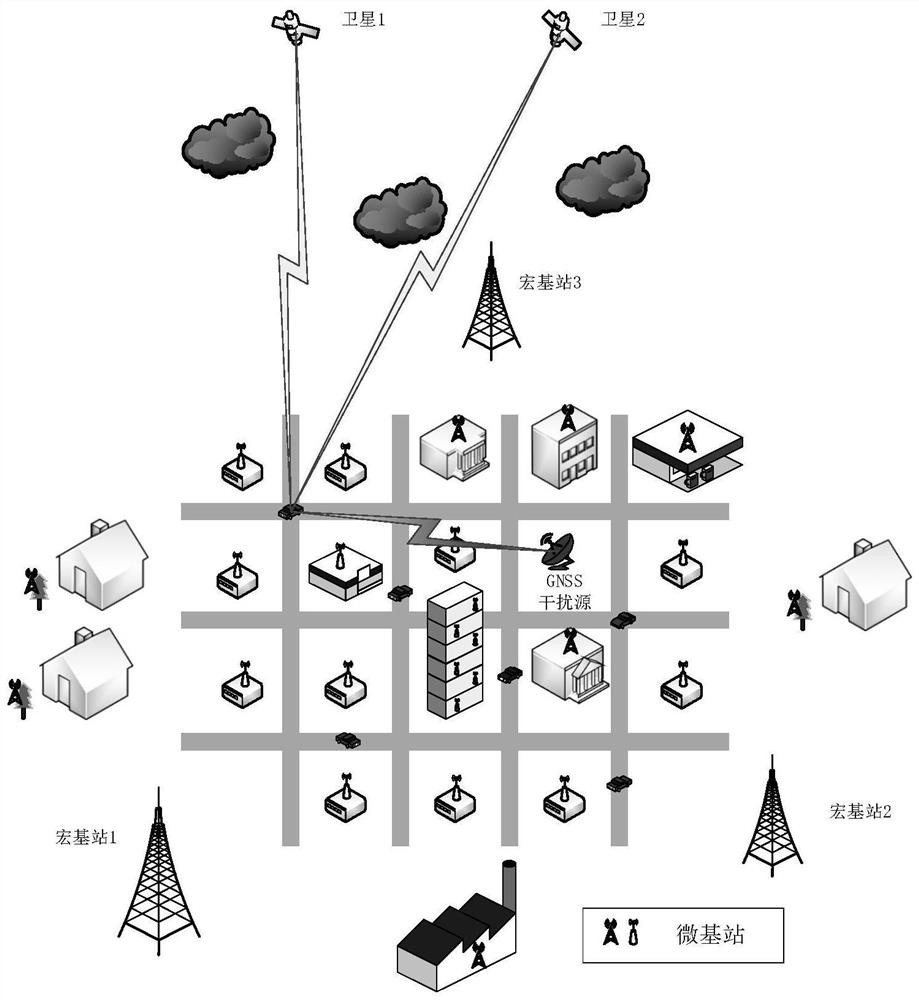
Figure 1 
Figure 2 
Figure 3
Abstract
Description
technical field
[0001] The invention belongs to the technical field of positioning and navigation, and in particular relates to an interference source positioning method, storage medium and equipment for GNSS receivers in a 5G system. Background technique
[0002] Global Navigation Satellite System (GNSS) is a general term for satellite navigation systems that provide continuous positioning, navigation and timing services (Position, Velocity and Time, PVT) for ground users through space satellite constellations. It was born for military applications, which led to the development of jamming technology against it from the very beginning. However, with the rapid development of economy and technology, the demand for GNSS in the civilian field is also increasing. In recent years, the number of mobile smart devices is increasing, and the demand for positioning, navigation and timing services is also increasing. , the ability of GNSS to work properly and provide reliable services ...
Examples
Embodiment
[0105]Consider an ultra-dense networking area with a large number of communication devices and base stations. In this area, there is an interference source that attacks the GNSS receiver. The above-mentioned scheme is used to locate the interference source. The detailed simulation parameters are shown in Table 1.
[0106] Table 1 Simulation parameter table
[0107]
[0108] Comparison scheme
comparative approach 1
[0109] Comparison scheme 1: use the MUSIC algorithm to estimate the angle of arrival of the interference signal.
comparative approach 2
[0110] Comparison scheme 2: Use the chan algorithm for positioning calculation.
[0111] see Figure 4 , is a schematic diagram of the estimation accuracy of the angle estimation method changing with the SNR. From the figure, it can be seen that the estimation error of this method is quite large at low SNR, but when the SNR is higher than -6dB, the pitch angle and The estimation errors of azimuth angles are all less than 5°, which shows that this method is feasible when the signal-to-noise ratio is constant. And when the signal-to-noise ratio further reaches -2dB and above, the estimation accuracy has reached within 1°, which can provide quite high accuracy for the final positioning result. Considering that in the second step of micro base station positioning, the distance between the micro base station and the interference source is quite close, so it has a high signal-to-noise ratio, so this method can be used to estimate AOA parameters and improve the positioning speed.
...