
Soaping agent for cotton fabric dyed with reactive dyes and its preparation method and application
A technology of soaping agent and surfactant, which is applied in the field of soaping agent and its preparation for dyed cotton fabrics with reactive dyes, can solve the problems of pollution and achieve the effect of reducing the use of water resources
Patent Information
- Authority / Receiving Office
- CN · China
- Patent Type
- Patents(China)
- Current Assignee / Owner
- Publication Date
- 2021-11-09
Smart Images
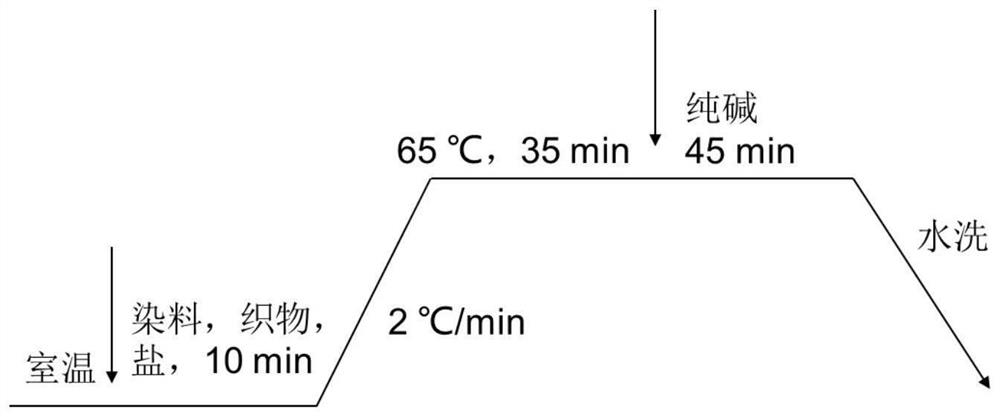
Figure 1 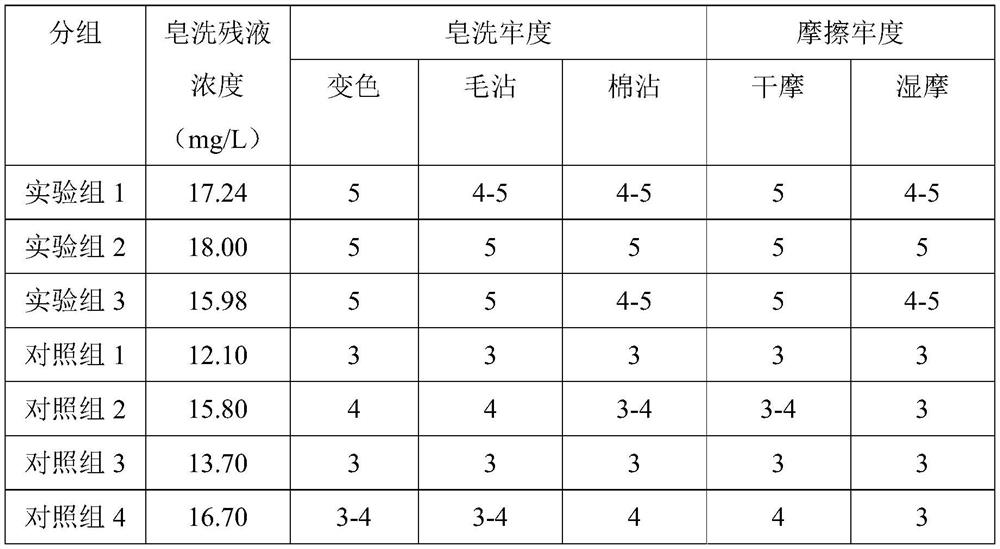
Figure 2 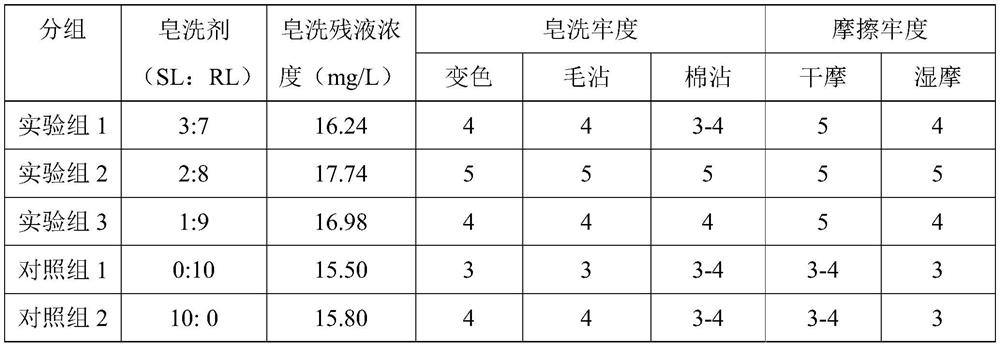
Figure 3
Abstract
Description
technical field
[0001] The invention relates to the technical field of textiles, in particular to a soaping agent for cotton fabric dyed with reactive dyes, a preparation method and application thereof. Background technique
[0002] Reactive dyes are widely used because of their bright color, complete color spectrum and low price. However, it is easy to form floating color when reactive dyes are used to dye cellulose fibers. The reasons may be as follows: ① When reactive dyes are used to dye cellulose fibers, some dyes are dyed on the fabric and combined with it by van der Waals force, and the other part of the dyes are in the alkali Under mild conditions, hydrolysis occurs to form hydrolyzed dyes; ②If the dye is used too much, it will accumulate on the surface of the fabric in the form of multi-layer associations, so that only the bottom dye molecules can react with the cellulose fiber to dye; ③ When the carbon atoms and active chlorine atoms in the dye molecules undergo d...
Examples
experiment example 1
[0046] Experimental example 1: The effect of time on the soaping effect of sophorolipids
[0047] A soaping process, the soaping process comprises hot water washing, cold water washing, soaping agent soaping, and then through the steps of cold water washing.
[0048] Wherein, the soaping agent is a sophorolipid with a mass concentration of 2 g / L.
[0049] Wherein, in the soaping step of the soaping agent: the ratio of soap to bath is 1:30, and the soaping temperature is 80°C.
[0050] Wherein, in the hot water washing step, the temperature is 55° C., the time is 5 minutes, and the bath ratio is 1:50.
[0051] Wherein, in the cold water washing step, the temperature is 25° C., the time is 5 minutes, and the bath ratio is 1:50.
[0052] According to the above soaping method, the cotton fabrics dyed with reactive dyes were soaped, and grouped according to different soaping times, wherein: the corresponding soaping times of experimental groups 1, 2, and 3 were: 15min, 20min, and...
experiment example 2
[0058] Experimental example 2: Effect of temperature on soaping effect of sophorolipids
[0059] A soaping process, the soaping process comprises hot water washing, cold water washing, soaping agent soaping, and then through the steps of cold water washing.
[0060] Wherein, the soaping agent is a sophorolipid with a mass concentration of 2.0 g / L.
[0061] Wherein, in the soaping step of the soaping agent: the ratio of soap to bath is 1:30, and the soaping time is 20 minutes.
[0062] Wherein, in the hot water washing step, the temperature is 55° C., the time is 5 minutes, and the bath ratio is 1:50.
[0063] Wherein, in the cold water washing step, the temperature is 25° C., the time is 5 minutes, and the bath ratio is 1:50.
[0064] According to the above soaping method, the cotton fabrics dyed with reactive dyes were soaped, and grouped according to different soaping temperatures, wherein: the corresponding soaping temperatures of experimental groups 1, 2, and 3 were: 60°...
experiment example 3
[0070] Experimental Example 3: Effect of Sophorolipid (SL) / Sodium Dodecylbenzene Sulfonate (SDBS) Compound System on Soaping Effect
[0071] A soaping process, the soaping process comprises hot water washing, cold water washing, soaping agent soaping, and then through the steps of cold water washing.
[0072] Wherein, the total concentration of the soaping agent system of the experimental group and the control group is 2.0 g / L.
[0073] Wherein, in the soaping step of the soaping agent: the ratio of soap to bath is 1:30, the soaping time is 20 minutes, and the soaping temperature is 80°C.
[0074] Wherein, in the hot water washing step, the temperature is 55° C., the time is 5 minutes, and the bath ratio is 1:50.
[0075] Wherein, in the cold water washing step, the temperature is 25° C., the time is 5 minutes, and the bath ratio is 1:50.
[0076] According to the above-mentioned soaping method, reactive dye dyed cotton fabric is soaped, and grouped according to different so...