
Ladder climbing mechanism
A technology for climbing ladders and load-bearing shafts is applied in the field of ladder-climbing mechanisms, which can solve the problems of low efficiency, neglect of efficient driving, and complex equipment structure, and achieve the effects of high load capacity, simple structure and high efficiency.
Patent Information
- Authority / Receiving Office
- CN · China
- Patent Type
- Applications(China)
- Current Assignee / Owner
- Publication Date
- 2022-02-08
Smart Images
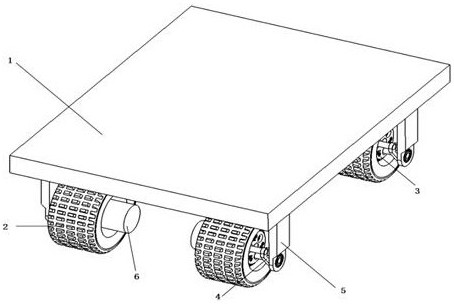
Figure 1 
Figure 2 
Figure 3
Abstract
Description
technical field
[0001] The invention specifically relates to a climbing ladder mechanism, which belongs to the technical field of mechanical mechanisms. Background technique
[0002] The information disclosed in this background section is only intended to increase some understanding of the general background of the present invention, and is not necessarily to be regarded as an acknowledgment or any form of suggestion that the information constitutes the prior art already known to those skilled in the art.
[0003] Most stair climbing machines in the prior art mainly use crawler tracks, multi-legs and multi-wheels, but the structure of most of the equipment is complicated, and there is a singleness and low efficiency in the application and switching of both flat ground and stairs. Problems of performance and low load capacity.
[0004] For the problem of switching between flat ground and stair road conditions, most institutions only consider the function of the mechanism on ...
Examples
Embodiment Construction
[0039] It should be noted that the following detailed description is exemplary and intended to provide further explanation of the present invention. Unless defined otherwise, all technical and scientific terms used herein have the same meaning as commonly understood by one of ordinary skill in the art to which this invention belongs.
[0040] In a typical embodiment of the present invention, propose a kind of four-wheel type campus climbing ladder mechanism, as figure 1 As shown, it includes a vehicle body device 1, four wheel devices 2, a connection limiting device, a motor and a motor seat 6.
[0041] The vehicle body device 1 in this embodiment includes but not limited to structures such as a body body, a body armrest, and a body operation panel, wherein the body operation panel is provided with a controller, and the controller is electrically connected to the motor to adjust the power of the motor , the above structures or components and their connection relationships all...