
Synthesis method of 6-methyl nicotine
A technology of methyl nicotine and synthesis method, which is applied in the direction of organic chemistry, can solve the problems of difficult separation of 6-methyl nicotine, unfixed methyl substitution position, harsh reaction conditions, etc., so as to avoid difficult separation, poor selectivity, conditionally controlled effects
Patent Information
- Authority / Receiving Office
- CN · China
- Current Assignee / Owner
- Publication Date
- 2022-05-06
Smart Images
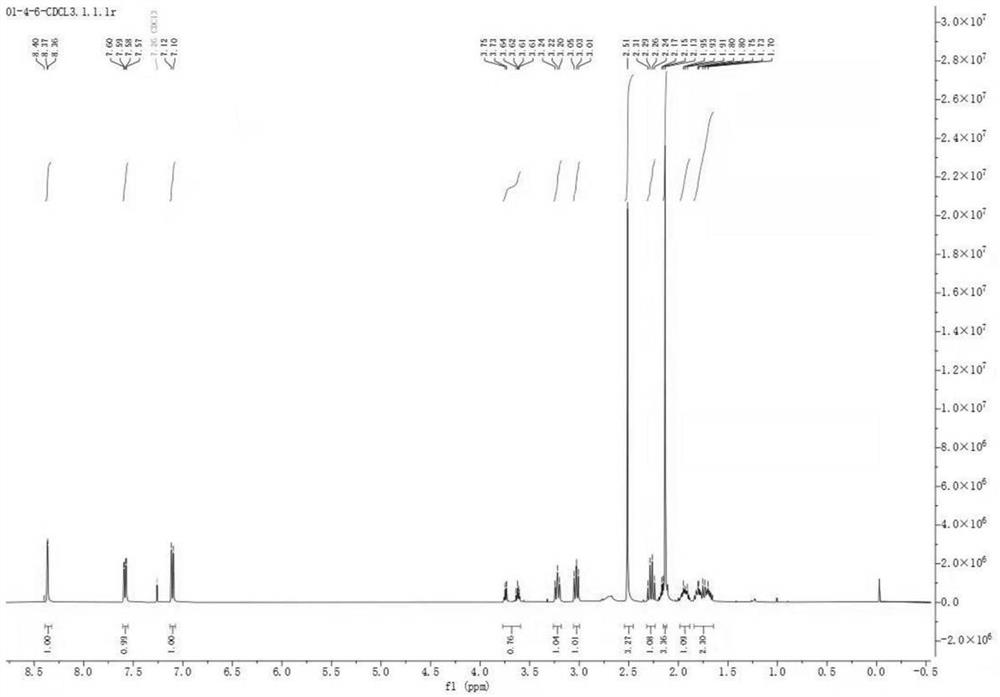
Figure 1 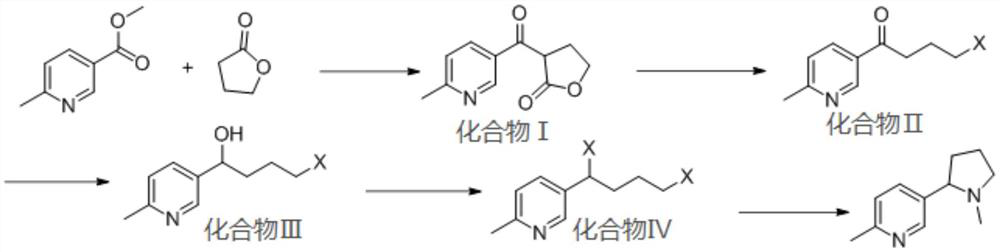
Figure 2 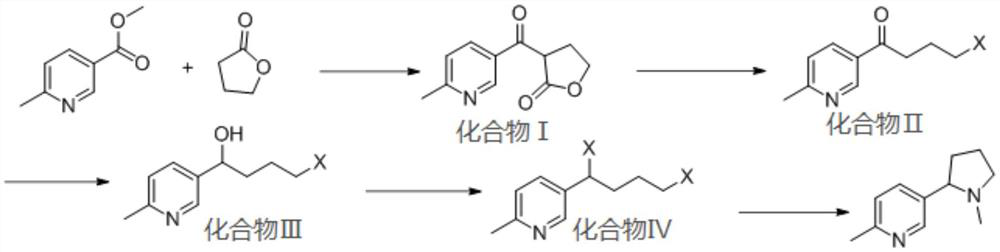
Figure 3
Abstract
Description
technical field
[0001] The invention relates to the technical field of organic chemical synthesis, in particular to a method for synthesizing 6-methylnicotine. Background technique
[0002] Neurodegenerative diseases are one of the major threats to human health. With the deepening of research on such diseases, some scholars believe that the nicotinic acetylcholine receptor (nAChR) in neurons is an important target for drug therapy (Neuropharmacology 1995, 34, 563). Many studies have confirmed that the natural alkaloid nicotine has certain relief and therapeutic effects on Parkinson's disease, Alzheimer's disease and Tourette's disease, but it itself has toxic and side effects on the cardiovascular system and digestive system, which greatly limits its clinical application (Chem. Eng. News 2000, 78, 23-26). Existing literature (J.Med.Chem.1997, 40, 4169; J.Pharm.Exp.Ther.2000, 292, 461) has summarized the structure-activity relationship of nAChR ligands through systematic re...
Examples
Embodiment 1
[0051] The synthesis route of 6-methylnicotine of the present embodiment is as follows:
[0052] The specific operation steps are as follows:
[0053] S1. Weigh 800mg of γ-butyrolactone (9.3mmol) and dissolve it in 150ml of N,N-dimethylformamide (DMF), cool down to 0°C, stir for 10min, then add 240mg of NaH (9.9mmol) in batches, and react After 30 min, 1 g of methyl 6-methylnicotinate (6.6 mmol) was added, the refrigeration was turned off, and the reaction was carried out at room temperature for 5 h, and the end point was determined by TLC detection to obtain compound I;
[0054] S2. First add a small amount of 5w% dilute hydrochloric acid to compound I until no bubbles are generated, then add 20ml concentrated hydrochloric acid and 20ml 1,4-dioxane, heat to 95°C and react for 5h, after the complete reaction of compound I is determined by TLC detection, Cool down to room temperature, add 50% NaOH solution under ice bath conditions to adjust the pH to 9, combine the organic ph...
Embodiment 2
[0060] S1. Weigh 800mg of γ-butyrolactone (9.3mmol) and dissolve it in 150ml of tetrahydrofuran, cool down to 0°C, stir for 10min, then add 240mg of NaH (9.9mmol) in batches, react for 30min, then add 1g of 6-methylnicotinic acid Methyl ester (6.6mmol), turn off the refrigeration, react at room temperature for 5h, and determine the end point by TLC detection to obtain compound I;
[0061] S2. First add a small amount of 5w% dilute hydrochloric acid to compound I until no bubbles are generated, then add 20ml concentrated hydrochloric acid and 20ml 1,4-dioxane, heat to 95°C and react for 5h, after the complete reaction of compound I is determined by TLC detection, Cool down to room temperature, add 50% NaOH solution under ice bath conditions to adjust the pH to 9, combine the organic phases after extraction and concentrate and dry to obtain compound II;
[0062] S3. Compound II was dissolved in 20ml of methanol, 250mg of sodium borohydride was added, and reacted at -10°C for 2 h...
Embodiment 3
[0066] S1. Weigh 800mg of γ-butyrolactone (9.3mmol) and dissolve it in 150ml of tetrahydrofuran, cool down to 0°C, stir for 10min, then add 960mg of sodium tert-butoxide (9.9mmol) in batches, react for 30min, then add 1g of 6-methanol Nicotinic acid methyl ester (6.6 mmol), turn off the refrigeration, react at room temperature for 5h, and determine the end point by TLC detection to obtain compound Ⅰ;
[0067] S2. First add a small amount of 5w% dilute hydrochloric acid to compound I until no bubbles are generated, then add 20ml concentrated hydrochloric acid and 20ml 1,4-dioxane, heat to 95°C and react for 5h, after the complete reaction of compound I is determined by TLC detection, Cool down to room temperature, add 50% NaOH solution under ice bath conditions to adjust the pH to 9, combine the organic phases after extraction and concentrate and dry to obtain compound II;
[0068] S3. Compound II was dissolved in 20ml of methanol, 250mg of sodium borohydride was added, and rea...