
Preparation and use of an injectable hydrogel for repairing infected bone defects
By combining chitosan with 4-formylphenylboronic acid, rosemary acid and tobramycin, a composite hydrogel for repair of infectious bone defects was prepared, which solved the problem of the lack of immune regulation function of existing hydrogels, achieved the dual effects of antibacterial activity and M2 macrophage polarization, and significantly promoted the bone healing process.
Patent Information
- Application Number
- CN202410378730.9
- Authority / Receiving Office
- CN · China
- Patent Type
- Patents(China)
- Current Assignee / Owner
- Filing Date
- 2024-03-29
- Publication Date
- 2025-04-22
- Estimated Expiration
- 2044-03-29
AI Technical Summary
Existing injectable hydrogels for infectious bone defect repair lack the ideal immunomodulatory function, resulting in limited bone healing processes.
A composite hydrogel was prepared to form a hydrogel with antibacterial activity and sustained induction of M2 macrophage polarization by combining chitosan with 4-formylphenylboronic acid, rosmarinic acid and tobramycin.
This hydrogel not only showed excellent antibacterial properties and good biocompatibility in in vitro experiments, but also promoted the repair of infectious bone defects by inducing M2 macrophage polarization, significantly accelerated the bone healing process.
Smart Images
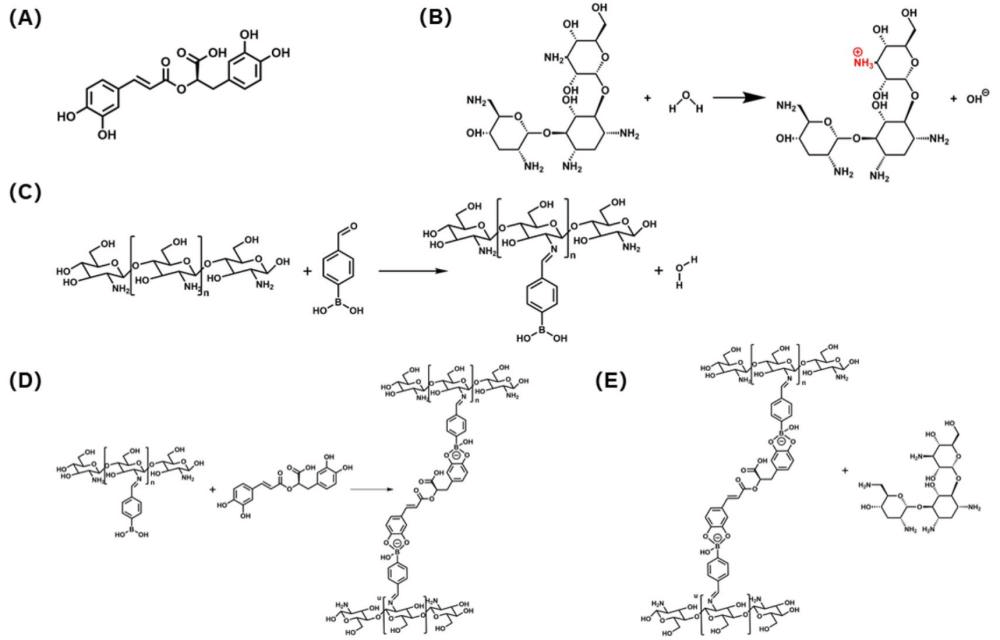
Figure CN118320178B_ABST
Abstract
Description
Technical Field
[0001] The invention relates to an injectable hydrogel, in particular to a preparation method and application of the injectable hydrogel for repairing infectious bone defects, belonging to the technical field of medicine. Background Art
[0002] In the field of orthopedics, the repair of infected bone defects (IBDs) has always been an extremely difficult clinical problem that has troubled surgeons. When bacteria invade and colonize the bone defect site, severe immune responses and the accumulation of a large amount of acidic metabolites can greatly reduce the activity of osteoblasts, damage nerve fibers and blood vessels, thereby limiting the in situ regeneration of bone and prolonging the bone healing period. Since bone remodeling usually proceeds from the defect surface to the center of the defect area, constructing an antibacterial / osteogenic interface microenvironment is considered to be a reasonable strategy for repairing IBDs. Injectable hydrogels (IHs) have shown great potential for bone repair in the past few decades due to their minimally invasive surgery, high spatial adaptability, structural similarity to the extracellular matrix (ECM), and local cell / biological factor / drug delivery capabilities. However, almost all IHs reported for the repair of IBDs are only endowed with antibacterial and bioinductive properties. In recent years, with the development of osteoimmunology, researchers have found that immunomodulation plays a central regulatory role in bacterial clearance and bone healing. Therefore, IHs with ideal immunomodulatory functions can, in principle, accelerate the repair of IBDs, a view that has attracted great attention.
[0003] Macrophages (M φ ) is a highly plastic cell that plays a key immunoregulatory role in resisting infection and inducing bone regeneration. Soon after bone injury, neutrophils trigger acute inflammation within hours, followed by the immediate migration of monocytes (Mono) from the peripheral blood to the defect. Mono then rapidly transforms into M0 macrophages, which accumulate at the defect interface and become the main cell type. Under external stimuli, M0 macrophages can be polarized to the classically activated M1 phenotype or alternatively activated to the M2 phenotype, and M1 macrophages can also be polarized to the M2 phenotype. The exosomes of M1 macrophages (such as CCL2, CXCL8, SDF-1, TNF - α , IL-6, IL-8, etc.) to limit fibrosis, recruit other immune cells (such as B cells and T cells) to clear bacteria and damaged tissues, recruit vascular progenitor cells (VPCs) and bone marrow mesenchymal stem cells (BMSCs) to initiate osteogenesis. β, ARG-1, BMP-2, VEGF) can reduce the inflammatory response to restore bone homeostasis and induce endothelial differentiation of vascular progenitor cells and osteogenic differentiation of bone marrow mesenchymal stem cells. In the normal bone healing process, M0 macrophages are temporarily polarized to M1 phenotype in the initial stage (first 3 days) and then converted to M2 phenotype. Without intervention, bacterial infection is difficult to eliminate. Once the bone defect site is infected with bacteria, macrophages will be over-polarized to M1 phenotype. However, prolonged polarization of M1 macrophages will aggravate the inflammatory response and thus limit osteogenesis. Therefore, the injectable hydrogel required for repairing infected bone defects should meet the following two requirements: antibacterial and able to induce sustained M2 macrophage polarization. Considering that bone infection is mainly caused by Staphylococcus aureus (SA) in clinical practice, followed by some Gram-negative bacilli and streptococci, injectable hydrogels for the treatment of infected bone defects should use broad-spectrum antimicrobial drugs sensitive to SA. Summary of the invention
[0004] In view of the above problems, the present invention prepares an injectable hydrogel for the repair of infected bone defects, which has good immunomodulatory properties and excellent antibacterial activity, and has good biocompatibility. The results of rheological and other physical and chemical performance tests illustrate the enhancement of the mechanical properties of the composite hydrogel; the excellent antibacterial properties of the composite hydrogel are successfully verified through cell and in vitro clinical animal experiments, and bone regeneration is successfully induced through immunomodulation. The present invention reports a new injectable hydrogel for the repair of infected bone defects, and applies it to the field of bone repair technology.
[0005] A method for preparing an injectable hydrogel for repairing infected bone defects comprises the following steps:
[0006] (1) Dissolve chitosan CS and 4-formylphenylboronic acid 4-FPBA in an alcohol-water mixed solution and stir evenly to obtain a 4-FPBA-CS mixed solution;
[0007] (2) dissolving rosmarinic acid RosA in the 4-FPBA-CS mixed solution and stirring evenly to obtain a 4-FPBA-CS / RosA mixed solution;
[0008] (3) The tobramycin solution and the 4-FPBA-CS / RosA mixed solution are mixed and allowed to stand to obtain an injectable hydrogel for repairing infected bone defects.
[0009] In the step (1), the weight ratio of CS to 4-FPBA is 1:0.01-0.05, preferably 1:0.03.
[0010] The alcohol-water mixed solution is a mixed solution formed by ethanol and water as known in the art, and the volume fraction of the ethanol can be 20-50%. The purpose of the alcohol-water mixed solution is to fully dissolve chitosan and 4-formylphenylboronic acid and achieve the purpose of mixing. Generally, conventional stirring operation is required during the mixing process.
[0011] In some cases, the obtained 4-FPBA-CS mixed solution can also be dialyzed to remove excess ethanol solvent and a small amount of unreacted 4-formylphenylboronic acid.
[0012] In some cases, the 4-FPBA-CS mixed solution obtained after dialysis is freeze-dried for subsequent experimental steps, and the obtained dry product only needs to be dissolved in water for reuse.
[0013] In the step (2), the molar ratio of RosA to CS-4-FPBA is 1:2-5, preferably 1:2.
[0014] In the step (3), the concentration of the tobramycin solution is 10-50 mg / ml.
[0015] In the step (3), during the mixing process of the tobramycin solution and the 4-FPBA-CS / RosA mixed solution, the tobramycin solution is mixed into the 4-FPBA-CS / RosA mixed solution by a point injection method, and the injectable hydrogel is obtained after standing. The single injection volume is about 0.05 ml, that is, about 10 injections are made for every 0.5 ml of injection solution. The single point injection volume is recommended to produce a sesame-sized gel. The volume ratio of the 4-FPBA-CS / RosA mixed solution to the tobramycin solution is 1:0.5-1, preferably 1:0.75.
[0016] By mixing tobramycin into the 4-FPBA-CS / RosA mixed solution through dot injection, not only can tobramycin be evenly distributed in the 4-FPBA-CS / RosA mixed solution, but also the overall pH value of the mixed solution can be made alkaline. Under alkaline conditions, the chitosan molecules are transformed into a crystalline state, and the boric acid ester bonds with pH response characteristics are transformed from a planar structure to a complex structure, forming a more stable cross-linked structure, which increases the mechanical strength of the composite hydrogel.
[0017] Another technical solution of the present invention is to use the injectable hydrogel for repairing infectious bone defects prepared by the preparation method in the preparation of bone defect repair materials.
[0018] In the present invention, rosmarinic acid (RosA) is a natural phenolic acid compound with two catechol structures, which has been shown to have broad-spectrum antibacterial activity and is particularly sensitive to SA (Figure 1 A). In addition, more and more researchers have found that RosA can induce polarization of M2 macrophages. Chitosan is a cationic polyelectrolyte with excellent biocompatibility and biodegradability. A high-concentration chitosan aqueous solution can be quickly converted into a high-strength crystalline hydrogel after being treated with alkaline solution. Tobramycin (Tob) is an aminoglycoside antibiotic with broad-spectrum antibacterial activity, especially effective against Gram-negative bacteria. In addition, tobramycin is water-soluble, and its aqueous solution is weakly alkaline due to the protonation of the side amino group ( Figure 1 B). The phenylboronic acid group can react with the catechol group to form a reversible boronate ester bond, thereby preventing the catechol group from being oxidized to a quinone.
[0019] The present invention uses rosmarinic acid, chitosan, tobramycin and 4-formylphenylboronic acid 4-FPBA to develop an injectable hydrogel with strong structural adaptability, strong antibacterial activity and sustained / stable immunomodulatory function of inducing M2 macrophage polarization. Briefly, first, chitosan molecules are modified by introducing 4-formylphenylboronic acid (called 4-FPBA-CS) on the chitosan chain through Schiff base reaction ( Figure 1 C). Then, the prepared 4-FPBA-CS and RosA rosmarinic acid formed a reversible boronate ester bond to form a 4-FPBA-CS / RosA injectable hydrogel ( Figure 1 D). Finally, the 4-FPBA-CS / RosA injectable hydrogel was injected into the bone defect, and then the tobramycin Tob solution was injected into the 4-FPBA-CS / ROSA matrix. As the pH value inside the 4-FPBA-CS / RosA injectable hydrogel increased, the chitosan molecules crystallized to form a 4-FPBA-CS / RosA / Tob hydrogel with enhanced mechanical properties, which could also adapt to the irregular bone defect interface ( Figure 1 E). As the 4-FPBA-CS / RosA / Tob hydrogel gradually degrades, RosA and Tob can be continuously released at the interface between the hydrogel and the bone defect to exert their effects. BRIEF DESCRIPTION OF THE DRAWINGS
[0020] Figure 1 Schematic diagram of the preparation of 4-FPBA-CS / RosA / Tob hydrogel in Example 1, wherein A is the structural formula of rosmarinic acid, B is the reaction formula that the tobramycin Tob aqueous solution is alkaline, C is the reaction formula for preparing 4-FPBA-CS, D is the reaction formula for preparing 4-FPBA-CS / RosA, and E is the reaction formula for preparing 4-FPBA-CS / RosA / Tob hydrogel.
[0021] Figure 2 This is a flow chart of the preparation of 4-FPBA-CS / RosA / Tob hydrogel in Example 1.
[0022] Figure 3 These are the actual pictures prepared in Example 1, wherein A is a actual picture of 4-FPBA-CS / RosA, B is a actual picture of tobramycin Tob, C is a actual picture of 4-FPBA-CS / RosA / Tob hydrogel, and D is a actual picture of 4-FPBA-CS / RosA / Tob hydrogel adapting to an irregular bone defect interface.
[0023] Figure 4 Rheological diagram, where A is a 4-FPBA-CS mixed solution, B is a 4-FPBA-CS / RosA mixed solution, and C is a 4-FPBA-CS / RosA / Tob composite hydrogel.
[0024] Figure 5 Micro-CT images of rat skulls at 4 and 8 weeks after material implantation.
[0025] Figure 6 These are immunohistochemical images of rat skulls 4 and 8 weeks after material implantation. DETAILED DESCRIPTION
[0026] An embodiment is provided below, wherein the experimental reagents and equipment in all embodiments are as follows:
[0027] Experimental reagents: Chitosan was purchased from Huantai County Jinhu Crust Products Co., Ltd., 4-formylphenylboronic acid was purchased from Energy-Chemical, rosmarinic acid was purchased from Macklin, and tobramycin Tob was purchased from Bidepharm.
[0028] Example 1
[0029] use Figure 1 , 2 The principle and process of the preparation are as follows:
[0030] Preparation of 4-FPBA-CS
[0031] (1) Weigh 5.0 g of chitosan and dissolve it in 200 ml of a mixed solution of ethanol and water (ethanol: water = 3:7). Place the mixture in a constant temperature heated magnetic stirrer and stir to dissolve. Then add 1.6 g of 4-formylphenylboronic acid and stir at 25 °C for 24 h.
[0032] (2) dialyzing the solution of (1) with deionized water for 3 days (molecular weight cutoff 3500Da) (to remove unreacted raw materials and solvent);
[0033] (3) The solution in (2) was frozen at -80°C overnight, and then transferred to a freeze dryer for freeze drying to obtain 4-FPBA-CS.
[0034] Preparation of 4-FPBA-CS / RosA mixed solution
[0035] Weigh 0.2 g of the final product 4-FPBA-CS obtained in step 1 and dissolve it in water. After it is completely dissolved, add 0.01 g of rosmarinic acid and continue stirring for 24 hours.
[0036] Preparation of 4-FPBA-CS / RosA / Tob composite hydrogel
[0037] (1) Weigh tobramycin Tob and dissolve it in water to adjust the concentration to 50 mg / ml;
[0038] (2) The tobramycin Tob solution in (1) was injected into 4-FPBA-CS / RosA in a dot-shaped manner (the single injection volume was approximately 0.05 ml, i.e., the injection volume was approximately 10 times for every 0.5 ml of injection solution, and the single-point injection volume was sufficient to produce a sesame-sized gel), and the mixture was allowed to stand to obtain a 4-FPBA-CS / RosA / Tob composite hydrogel.
[0039] Characterization of composite hydrogels
[0040] like Figure 3 As shown in A and C, the composite hydrogel is in a viscous flow state before adding tobramycin Tob; after adding tobramycin Tob, the viscous flow state changes into a gel state. Due to its special gelation mode, the hydrogel can gel in situ and can fit the complex shape of the bone defect. At the same time, rheological experiments were carried out on the composite hydrogel. Figure 4 As shown in Figure C, the storage modulus G′ of the hydrogel is greater than the corresponding loss modulus G″, further proving the nature of gelation.
[0041] Cytotoxicity experiment of composite hydrogel
[0042] Repair effect of composite hydrogel on infected skull defect in rats
[0043] A rat infected skull defect model was established, and the animals were then divided into a blank control group (Control, without any treatment), a 4-FPBA-CS gel implantation group (FC), a 4-FPBA-CS / Tob gel implantation group (FCT), and a 4-FPBA-CS / RosA / Tob gel implantation group (FCTR). At 4 and 8 weeks after implantation, three rats infected with Staphylococcus aureus were killed in each group, and the skulls were removed. The skulls were fixed in 4% paraformaldehyde solution for 48 hours, and then scanned and reconstructed using micro-CT ( Figure 5). The images were viewed using CTvox software, and the new bone volume fraction (BV / TV) was statistically analyzed. It can be seen from the micro-CT images that 4 weeks after implantation, there was obvious new bone formation in the defect area of the FCTR group, and the new bone area in the FCT group was relatively small. In contrast, the unrepaired bone defect area between the two ends of the host bone in the control group and the FC group was occupied by connective tissue. 8 weeks after implantation, a large amount of dense new bone tissue was formed in the FCTR group, and the defect area was basically closed. The new bone in the FCT group was less than that in the FCTR group, but significantly more than that in the control group and the FC group. Immunohistochemical staining of rat skull further detected the expression of Col-1 and BMP2, which are necessary for osteoblast differentiation, in the skull defect site 4 and 8 weeks after gel implantation. The results showed that the expression trends of the two were consistent with micro-CT ( Figure 6 ), which confirmed that 4-FPBA-CS / RosA / Tob composite hydrogel can promote the repair of infectious skull defects in rats.
Claims
1. A method for preparing an injectable hydrogel for repairing infected bone defects, characterized in that: The following steps are involved: (1) Dissolve chitosan CS and 4-formylphenylboronic acid 4-FPBA in an alcohol-water mixed solution and stir evenly to obtain a 4-FPBA-CS mixed solution; (2) dissolving rosmarinic acid RosA in the 4-FPBA-CS mixed solution and stirring evenly to obtain a 4-FPBA-CS / RosA mixed solution; (3) The tobramycin solution and the 4-FPBA-CS / RosA mixed solution are mixed and allowed to stand to obtain an injectable hydrogel for repairing infected bone defects.
2. The method for preparing an injectable hydrogel for repairing infectious bone defects according to claim 1, characterized in that: In the step (1), the weight ratio of CS to 4-FPBA is 1:0.01-0.
05.
3. The method for preparing an injectable hydrogel for repairing infectious bone defects according to claim 1, characterized in that: In the step (1), the weight ratio of CS to 4-FPBA is 1:0.
03.
4. The method for preparing an injectable hydrogel for repairing infectious bone defects according to claim 1, characterized in that: In the step (2), the molar ratio of RosA to CS-4-FPBA is 1:2-5.
5. The method for preparing an injectable hydrogel for repairing infectious bone defects according to claim 4, characterized in that: In the step (2), the molar ratio of RosA to CS-4-FPBA is 1:
2.
6. The method for preparing an injectable hydrogel for repairing infectious bone defects according to claim 1, characterized in that: In the step (3), the concentration of the tobramycin solution is 10-50 mg / ml.
7. The method for preparing an injectable hydrogel for repairing infectious bone defects according to claim 1, characterized in that: In the step (3), during the mixing process of the tobramycin solution and the 4-FPBA-CS / RosA mixed solution, the tobramycin solution is mixed into the 4-FPBA-CS / RosA mixed solution by a dot injection method, and the injectable hydrogel is obtained after standing.
8. The method for preparing an injectable hydrogel for repairing infectious bone defects according to claim 1, characterized in that: The volume ratio of the 4-FPBA-CS / RosA mixed solution to the tobramycin solution is 1:0.5-1.
9. The method for preparing an injectable hydrogel for repairing infectious bone defects according to claim 8, characterized in that: The volume ratio of the 4-FPBA-CS / RosA mixed solution to the tobramycin solution is 1:0.
75.
10. Use of the injectable hydrogel for repairing infectious bone defects prepared by the preparation method according to any one of claims 1 to 9 in the preparation of bone defect repair materials.
Citation Information
Patent Citations
Preparation method and application of rosmarinic acid hydrogel without cross-linking agent
CN118873733A