
Iodine adulterated photocatalytic multicrystal material possessing photocatalytic performance under visible light
A crystalline material, photocatalytic technology, applied in physical/chemical process catalysts, chemical instruments and methods, chemical/physical processes, etc., can solve the problems of low quantum yield, short life, low photocatalytic activity, etc. Catalytic activity, improve photon efficiency, achieve full-frequency absorption effect
Patent Information
- Authority / Receiving Office
- CN · China
- Patent Type
- Patents(China)
- Current Assignee / Owner
- Publication Date
- 2006-06-14
- Estimated Expiration
- Not applicable · inactive patent
Smart Images
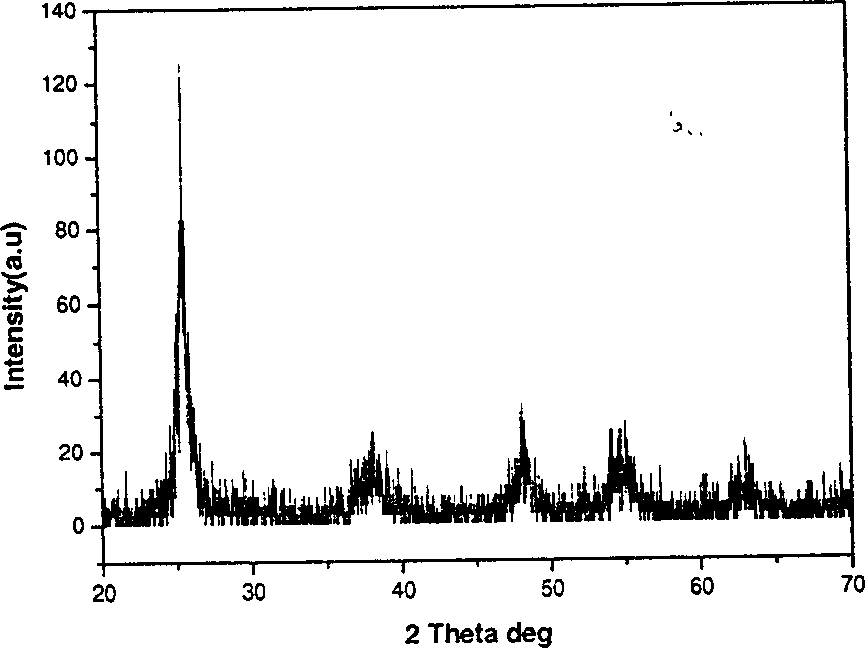
Figure 1 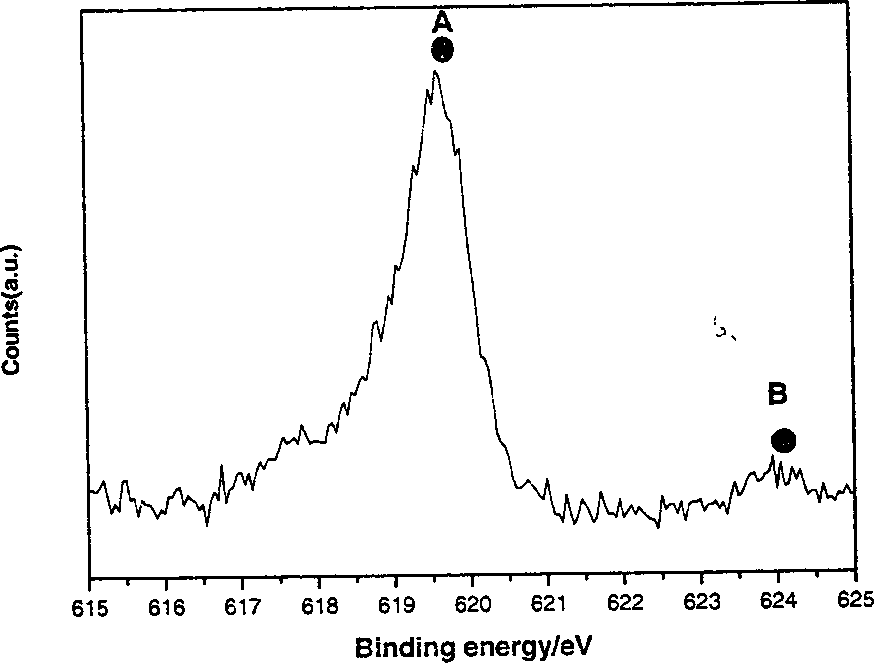
Figure 2 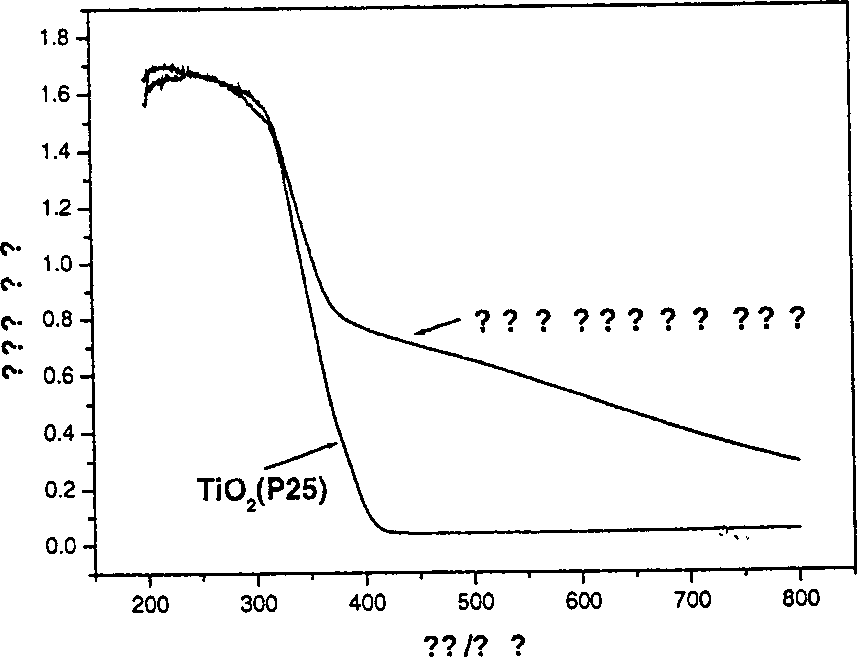
Figure 3
Abstract
Description
technical field
[0001] The invention relates to a crystal material, in particular to an iodine-doped photocatalytic polycrystalline material with photocatalytic activity under visible light conditions, and belongs to the field of inorganic nano photocatalytic materials. Background technique
[0002] Titanium dioxide has good photocatalytic activity and photoelectric performance, and has broad application prospects in many fields such as photocatalytic degradation of organic pollutants in water and air, photoelectrochemical solar cells, and photolysis of water to produce hydrogen. However, in practical applications, titanium dioxide as a photocatalyst still has some defects: on the one hand, TiO 2 The lifetimes of photogenerated electrons and photogenerated holes are extremely short, and the two are easy to recombine, resulting in TiO 2 The quantum yield is low and the photocatalytic activity is not high; on the other hand, TiO 2 The band gap is wide, and the excitation lig...
Examples
Embodiment 1
[0020] In the prepared iodine-doped photocatalytic polycrystalline material, the content of titanium accounts for 54.70%, the content of oxygen accounts for 35.30% and the content of iodine accounts for 10.00%.
[0021] 20ml of iodic acid solution (0.5M / L) was reacted with 20ml of tetrabutyl titanate (mass percentage>98.0%) until white precipitate was completely formed. The white precipitate was directly heated in an oven, treated at 120°C for 4 hours, evaporated to remove water and part of the alcohols produced in the reaction to obtain a solid dry product. Then grind the obtained dry solid to make the particles uniform and reduce soft agglomeration. Put it into a muffle furnace after grinding, and calcinate at 195° C. for 2 hours to obtain an iodine-doped photocatalytic polycrystalline material with high catalytic activity under visible light.
Embodiment 2
[0023] In the prepared iodine-doped photocatalytic polycrystalline material, the content of titanium accounts for 59.95%, the content of oxygen accounts for 39.95% and the content of iodine accounts for 0.10%.
[0024] 10ml of iodic acid solution (0.5M / L) was reacted with 20ml of tetrabutyl titanate (mass percentage>98.0%) until a white precipitate was completely formed. The white precipitate was directly heated in an oven, treated at 120°C for 4 hours, evaporated to remove water and part of the alcohols produced in the reaction to obtain a solid dry product. Then grind the obtained dry solid to make the particles uniform and reduce soft agglomeration. Put it into a muffle furnace after grinding, and calcinate at 500° C. for 2 hours to obtain an iodine-doped photocatalytic polycrystalline material with high catalytic activity under visible light.
Embodiment 3
[0026] In the prepared iodine-doped photocatalytic polycrystalline material, the content of titanium accounts for 60.61%, the content of oxygen accounts for 39.18% and the content of iodine accounts for 0.21%.
[0027] 15ml of iodic acid solution (0.5M / L) was reacted with 20ml of tetrabutyl titanate (mass percentage>98.0%) until a white precipitate was completely formed. The white precipitate was directly heated in an oven, treated at 120°C for 4 hours, evaporated to remove water and part of the alcohols produced in the reaction to obtain a solid dry product. Then grind the obtained dry solid to make the particles uniform and reduce soft agglomeration. Put it into a muffle furnace after grinding, and calcinate at 355° C. for 2 hours to obtain an iodine-doped photocatalytic polycrystalline material with high catalytic activity under visible light.
[0028] Such as figure 1 As shown, by X-ray diffraction detection, in Example 3, the crystal phase of the iodine-doped photocatal...