
Apparatus and method for optimizing the efficiency of germanium junctions in multi-junction solar cells
a solar cell and efficiency optimization technology, applied in the direction of photovoltaics, electrical apparatus, semiconductor devices, etc., can solve the problems of less than optimal performance, the requirement for solar cells to meet the needs of more sophisticated applications has not kept pace with demand, and the optimization of the germanium junction cannot be accomplished withou
Patent Information
- Authority / Receiving Office
- US · United States
- Current Assignee / Owner
- Publication Date
- 2002-04-11
- Estimated Expiration
- Not applicable · inactive patent
Smart Images
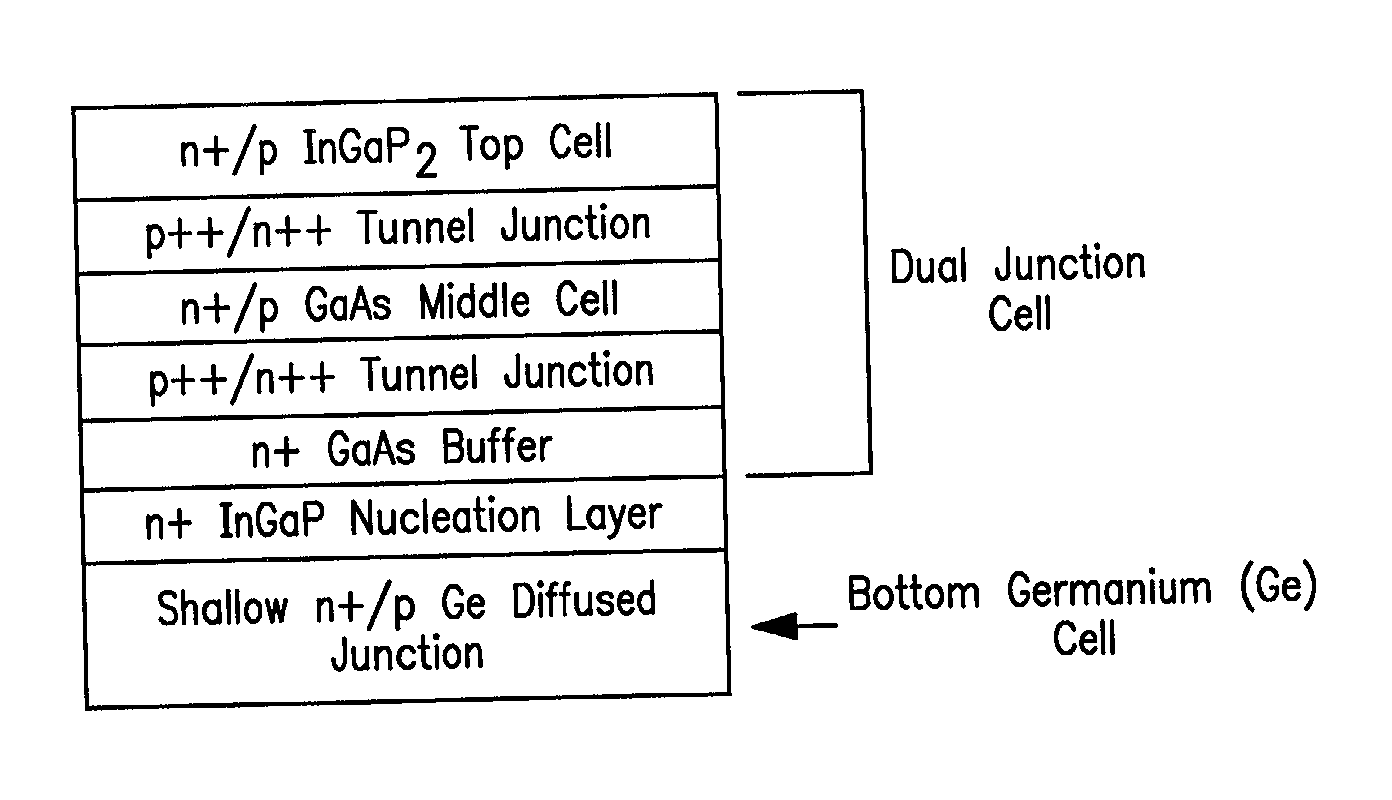
Figure 1 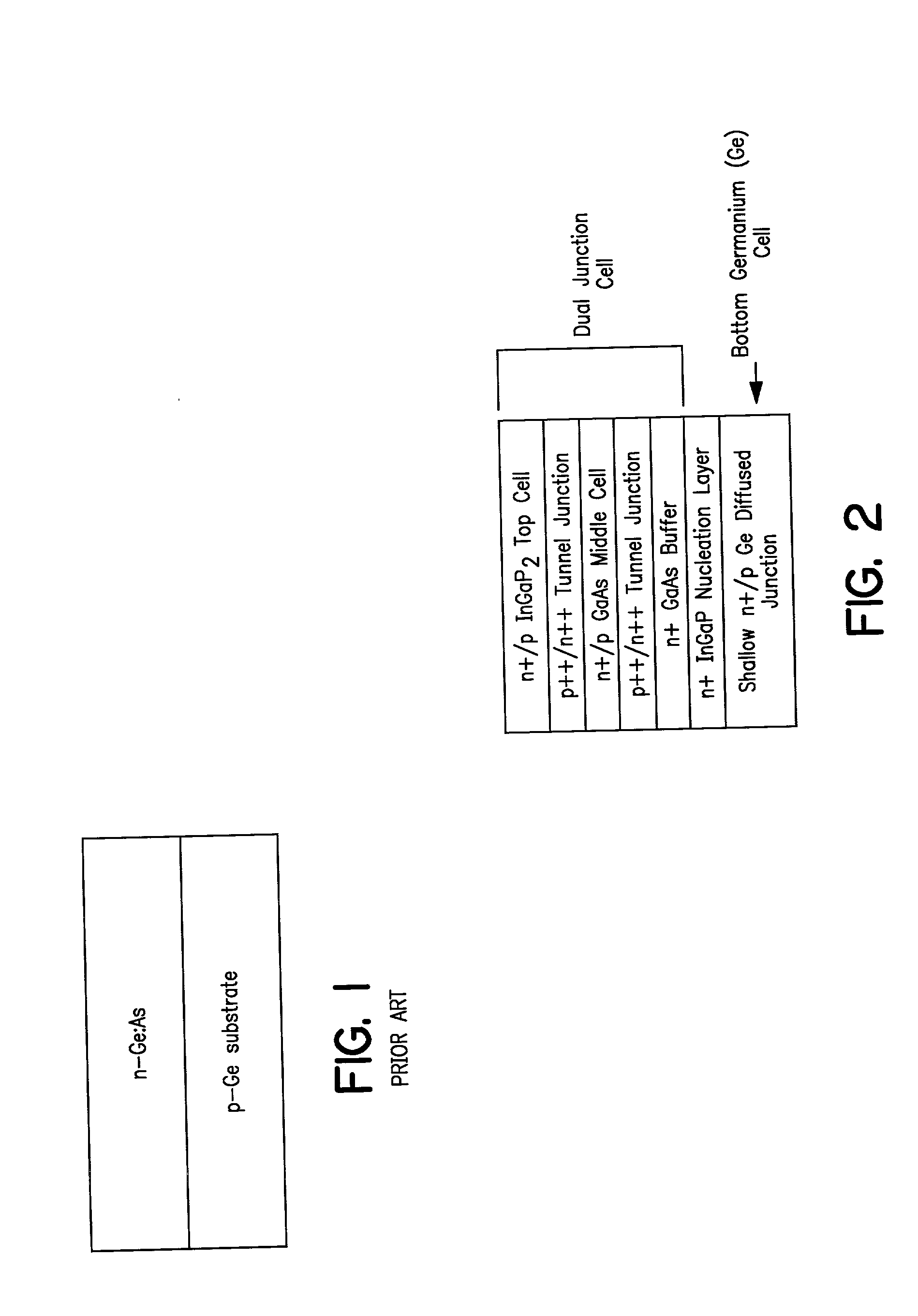
Figure 2 
Figure 3
Abstract
Description
PRIORITY
[0001] Pursuant to 35 U.S.C. .sctn. 119(e) and 37 C.F.R. .sctn. 1.78, the present application claims priority to the provisional application entitled "An Apparatus and Method for Optimizing the Efficiency of Germanium Junctions in Multi-Junction Solar Cells" by Mark A. Stan et al. (application Ser. No. 60 / 212,552; attorney docket number 1613370-0006) filed on Jun. 19, 2000.
[0002] The present invention relates to solar cells and methods for their fabrication, and more particularly to optimizing the efficiency of germanium (Ge) junctions of multi-junction solar cells having a stacked semiconductor layer structure to provide a high efficiency for the conversion of incident light into electrical energy.DESCRIPTION OF THE RELATED ART
[0003] Solar cells are one of the most important new energy sources that have become available in the past several years. Considerable effort has gone into solar cell development. Most of the work has involved using silicon-based semiconductor materia...
Examples
Embodiment Construction
[0018] The present invention now will be described more fully with reference to the accompanying drawings, in which the preferred embodiments of the invention are shown. The present invention may, however, be embodied in many different forms and should not be construed as being limited to the embodiments set forth herein; rather these embodiments are provided so that this disclosure will be thorough and complete and will fully convey the invention to those skilled in the art.
[0019] FIG. 2 is a block diagram that shows a schematic cross section of a triple junction solar cell in which an embodiment of the present invention has been implemented. In the present invention a phosphorus containing compound, InGaP, with a lattice parameter equal to that of the germanium substrate is inserted as a nucleation layer between the germanium substrate and the overlying dual junction epilayers as shown in FIG. 2. The indium gallium phosphide (InGaP) nucleation layer serves as a diffusion barrier t...