
Pressure swing reforming for fuel cell systems
a fuel cell and pressure swing technology, applied in the direction of combustible gas production, sustainable manufacturing/processing, separation processes, etc., can solve the problems of reducing the efficiency of steam reform furnaces, occupying a large space, and severely limit the utility of point-of-use fuel applications, so as to reduce the recovery demands of separators and compact separators.
Patent Information
- Authority / Receiving Office
- US · United States
- Patent Type
- Applications(United States)
- Current Assignee / Owner
- Publication Date
- 2004-09-09
Smart Images
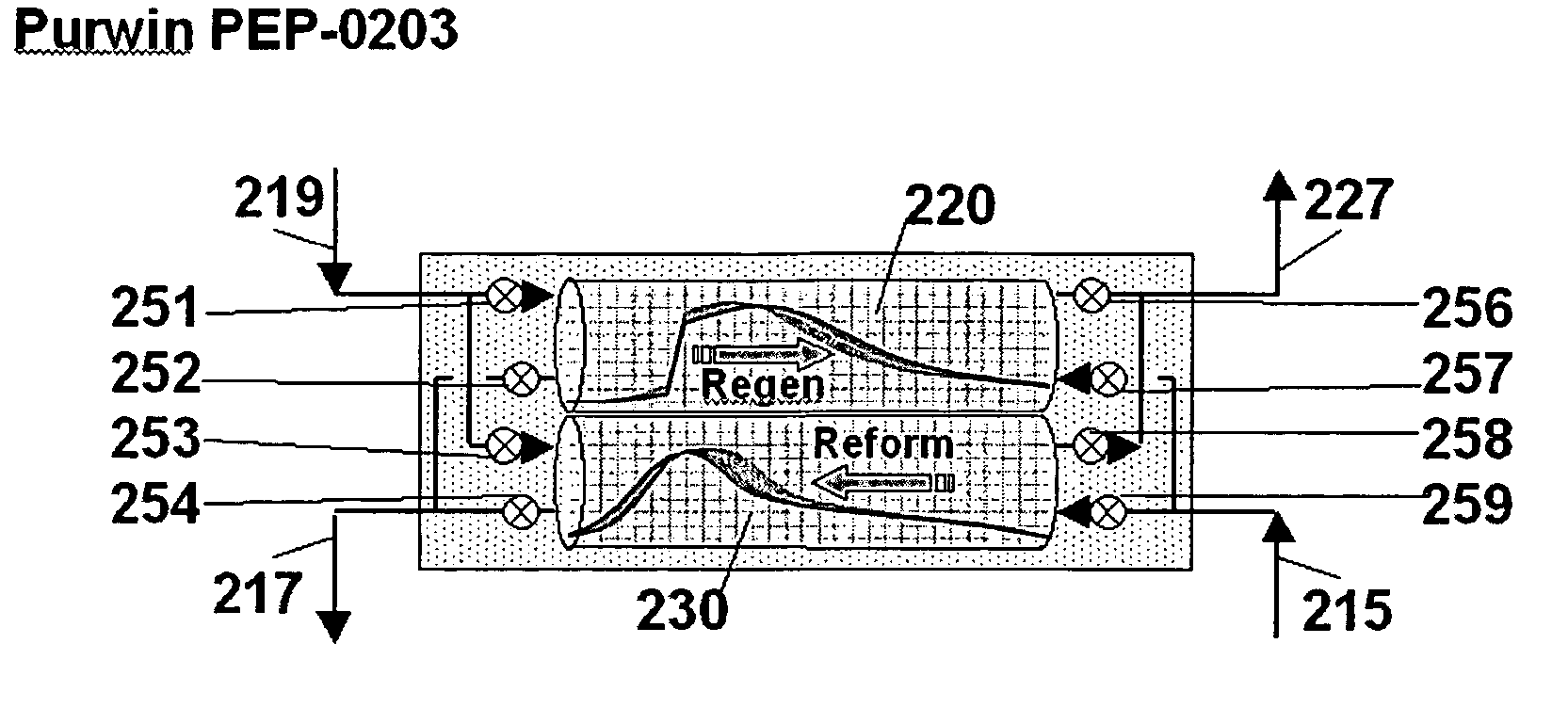
Figure 1 
Figure 2 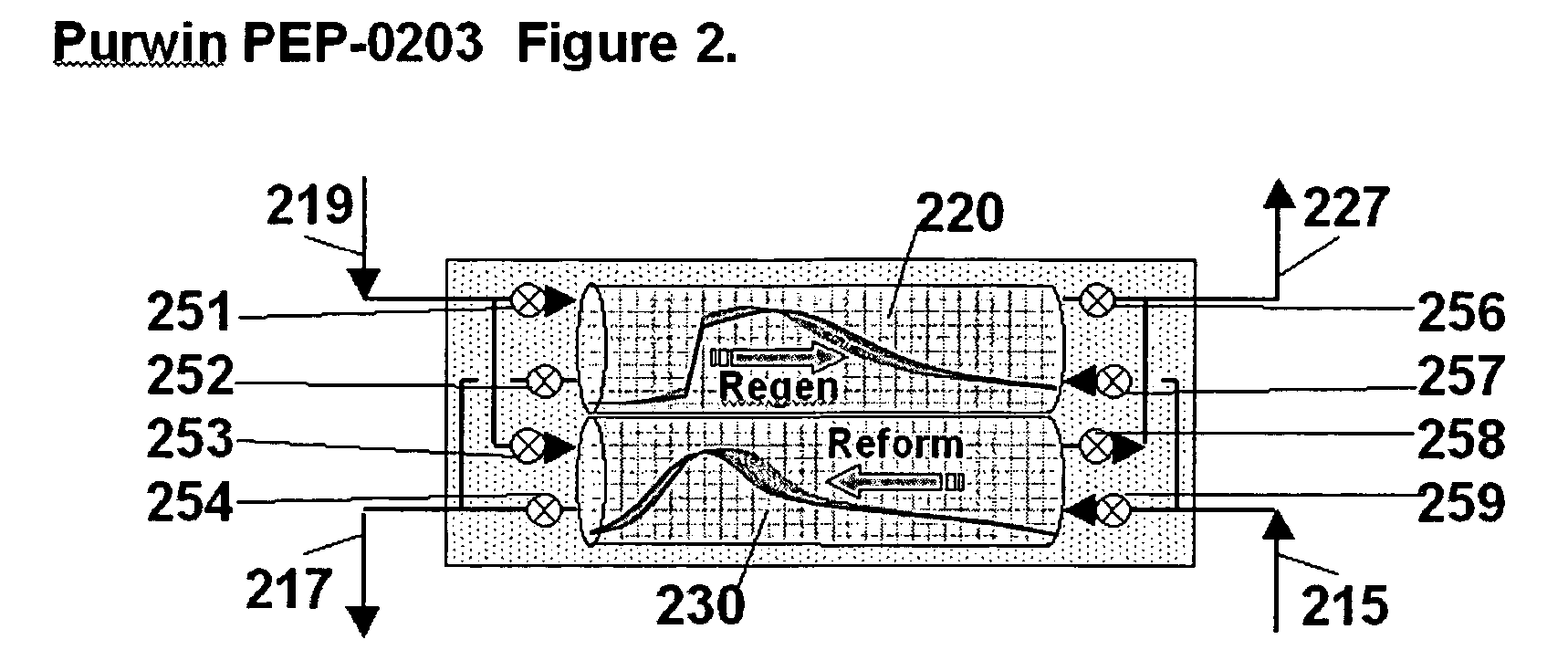
Figure 3
Abstract
Description
[0001] Non-Provisional Application based on Provisional Application No. 60 / 450,904 filed Feb. 28, 2003.
[0002] This application claims the benefit of U.S. Provisional Application No. 60 / 450,904 filed Feb. 28, 2003.
[0003] The present invention relates to process improvements in the production of hydrogen from hydrocarbons. More particularly, the invention relates to a process scheme wherein synthesis gas is produced in a cyclic reforming process in which the reforming step of the synthesis gas production is performed at pressures greater than or equal to the regeneration step. The hydrogen stream may be used as a source of hydrogen fuel in applications such as fuel cells. The present invention provides an efficient process for producing a hydrogen fuel from hydrocarbons, particularly useful for confined space applications such as "on board" vehicle applications (e.g. passenger vehicles, trucks, buses or the like) for fuel cell powered vehicles.
[0004] Conventional synthesis gas generat...
Examples
example 2
[0087] To illustrate another embodiment of the present invention, an amount of methane was processed using the pressure swing reforming process illustrated in FIG. 5, but without the steam boiler (502). The hydrogen separation means in this example is a polymer membrane, operating at a temperature of about 100.degree. C. Key system parameters are identified in Table 2 below:
2 TABLE 2 Stream Identity 501 + 503 507 509 511 530 527 Reform Shift H2 Recycle Depleted Flue Feed Outlet Product Purge Air Gas T, .degree. C. 400 500 100 100 400 530 P, Atm ga. 9 9 1 9 to 0.5 0.5 0 gmols / min CH4 12.37 0.37 0 0.37 H2O 20.25 3.39 0 3.39 18.3 21.89 H2 0 39.92 37.07 2.85 CO 0 8.21 0 8.21 CO2 0 3.77 0 3.77 12.35 N2 0 0.07 0 0.07 93.4 93.4 O2 0 0 0 0 6.26 .DELTA.Hc, kW 160 199 145 54
[0088] This example makes use of two PSR reactors, operated as described with respect to FIG. 2 to provide a substantially continuous stream of product. The cycle time is 6 seconds, with regeneration and reforming each ope...
example 3
[0089] To illustrate another embodiment of the present invention, an amount of methane was processed using the pressure swing reforming process illustrated in FIG. 3. In this example, the fuel cell is a proton conducting solid oxide fuel cell ("SOFC") operating at about 500.degree. C. SOFC anode and cathode effluents (streams 318 & 312) are used as PSR regeneration feed (streams 329 & 330). Waste heat from the SOFC and the regeneration effluent (327) are used to make steam and provide preheat (not shown) of PSR and SOFC feeds, as needed. Water for steam is condensed from a cooled regeneration effluent (stream 327; cooling and condensation not shown). Key system parameters are identified in Table 3 below:
3 TABLE 3 Stream Identity 301 + 303 305 H2 318 / 329 312 / 330 327 Reform Reform Consumed Anode Cathode Regen in out In SOFC Effluent Effluent Effluent Temp, C 500 511 500 500 459 Pres. Atm* 0.2 0.2 0.1 0.1 0 Gmols / min CH4 4.12 0.12 0.12 H2O 6.33 1.75 0.74 13.57 14.55 H2 12.56 13.57 CO 3...